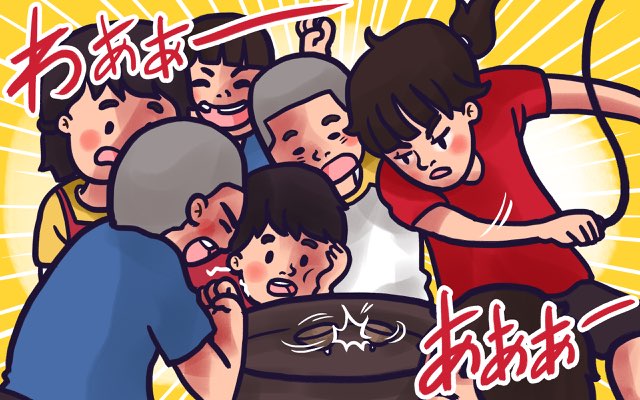
“Three, two, one, yoi shoot!” With a swing of our arms, the children and I launched our tops from our hands, careful to hold on to the thread. “Shippai!” or “I failed,” a student said her top toppled over. But not me. Not this time. “Dekita! I did it!” I shouted with satisfaction, my top spinning across the floor.
After a few days of practice and frustration, I finally did it. My technique wasn’t perfect, but I could now spin a Japanese top, my new favorite toy. And I wasn’t alone. For the time being none of my students were thinking of their toys at home.
Japan’s traditional games are something I knew almost nothing about when I arrived in the country. Seven years later, I am still learning of new ones. From kite flying (and battling) to hanetsuki (think badminton) to karuta (a card game relying on recognition speed) Japanese culture has a wide variety of old-fashioned games to offer. But they are under threat.
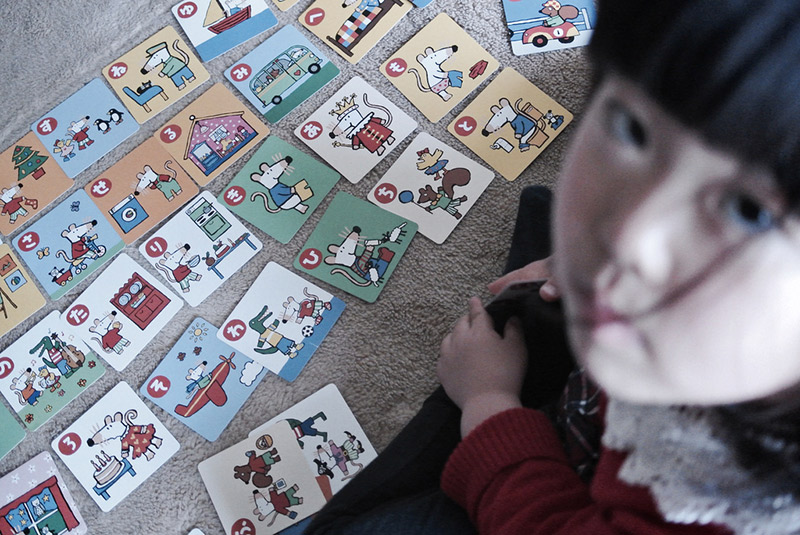
“Children these days just want to play with video games or expensive toys,” a coworker said.
“They aren’t interested in the games we used to play,” one grandparent lamented.
I can’t disagree. Just go to a mall or ride a train, just about anywhere kids can be found playing with portable games or flashy new toys. I’ve even come across kids at playgrounds, sitting on benches and mashing buttons, absorbed in their miniature screens.
Perhaps the best proof of portable gaming’s popularity is the success of the Nintendo DS which by 2013 had moved almost 33 million units in Japan alone. With a child population estimated at about 17 million, that’s nearly enough units for every child to own two! Of course that isn’t true, gaming is popular with all ages. But it shows just how popular portable gaming has become.
As a result, traditional gaming is fading in the face of new technologies. But the good news is, we can enjoy both. And thanks to Japanese school curriculum many students do.
Japanese kindergartens for example, make efforts to preserve Japan’s gaming traditions. Since toys and games from home are prohibited at school, children have no choice but to use what’s available. A simple piece of paper can be turned into hundreds of different things via another Japanese tradition- origami. Give a child access to cardboard, newspaper and tape and what they come up with is amazing. I’ve seen makeshift swords, helmets, Kamen Rider (a perennial Japanese hero series) belts and even haunted houses.
On special occasions the children are given more complicated materials to work with. At my schools we decorate kites and umbrellas. Before every New Years the children are given plain wooden tops. The children give them custom paint-jobs before working on technique. The schools hold a “Koma Taikai” or “Top Contest” to give the students extra motivation.
The activity stirred memories of my own. When I was a child I had a different type of top. By twirling the stem between the forefinger and thumb and releasing it, the top would spin. Since there was no challenge my interest in tops didn’t last long.
My kindergartens have those types of tops too. The younger children played with simple tops to develop their skills. But the older class used more sophisticated tops. These tops came with a string that is wrapped around the toy to give it spin.
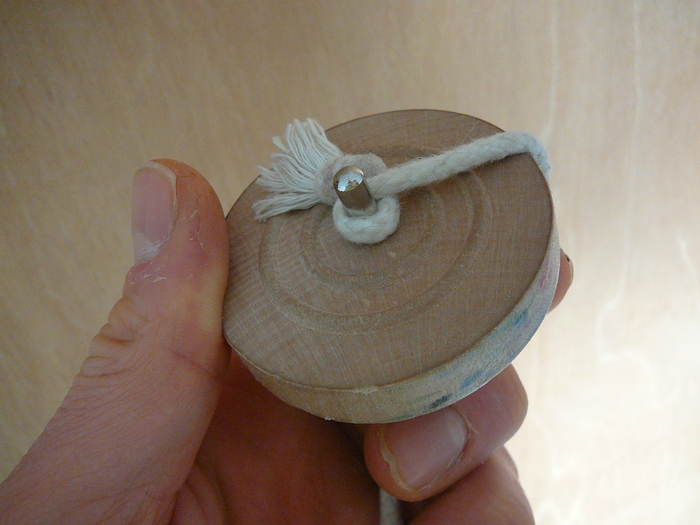
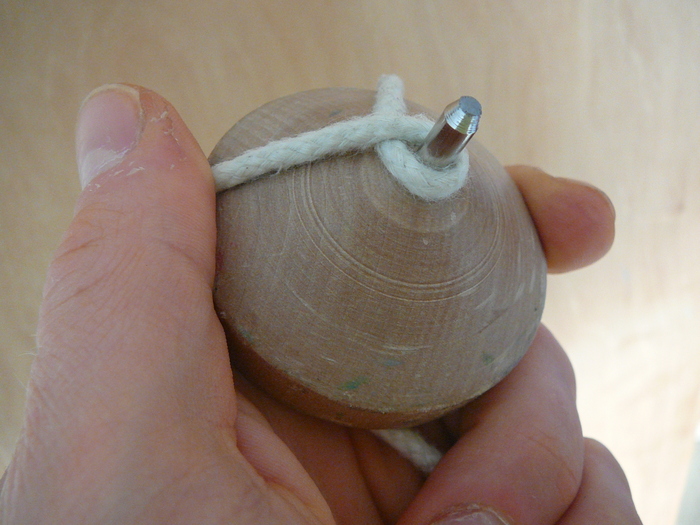
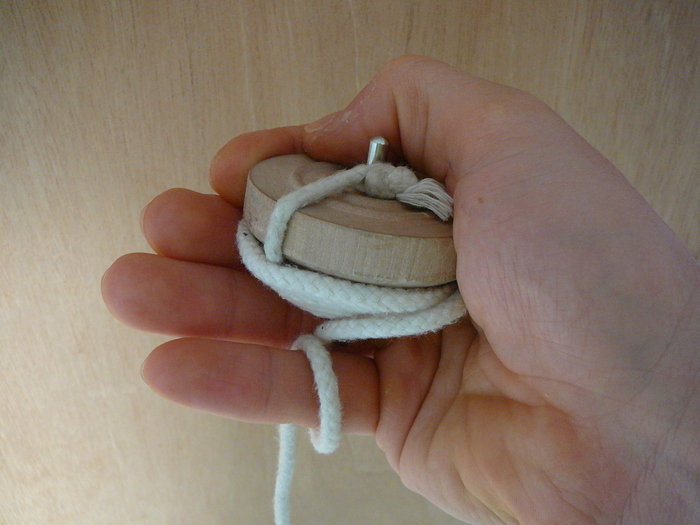
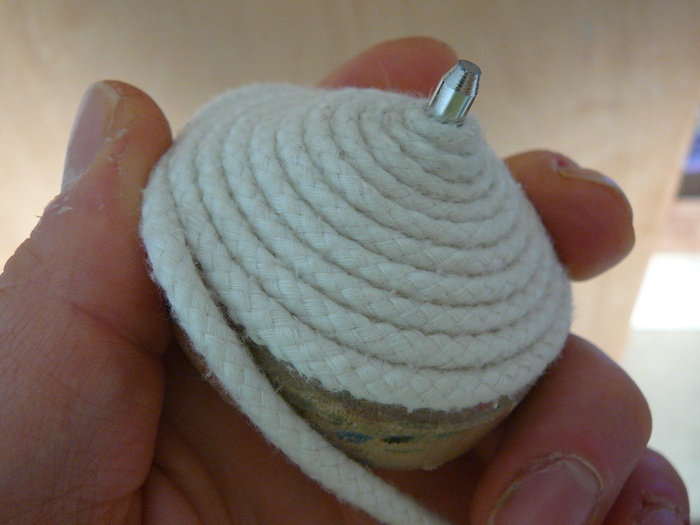
The wrapping process is complex and takes some practice. First, the knotted end of the string is wrapped around the upper stem once, using the tension created by the knot to hold it in place. Next, the remaining length of the string is pulled to the tip underneath and wrapped around it, careful to maintain the tension holding the knot in place at top. Finally the string is wrapped around itself in a spiral around the bottom of the top, usually until the entire bottom is covered by the string.
Now the top is ready for action. The remaining string is secured around a finger on the throwing hand, usually the pinky. With a sweeping forehand motion like in tennis or when skipping a stone across water, throw the top to the floor. The unraveling string makes the top spin.
On my first attempts even wrapping the string was a challenge. At that time a successful throw seemed like too much to hope for. But with my students encouragement and tutelage, I continued to try.
Finally able to make it spin, I took on all challengers- whose top would outlast the rest? I felt like a real Poke-master, my top substituting for the Pokemon. Time flew by. The experience was extremely satisfying – that is until we were introduced to another, more complicated top.
It happened at the Koma Taikai. A group of elderly gentlemen came to watch. After the contest ended, they brought out some toys of their own. First came a bucket. Next a piece of canvas which was draped over the bucket, creating a shallow bowl shape.
“Now everyone watch!” one of the men said. He held a small piece of metal in the air. “This is a bei-goma.” The other men had them too.
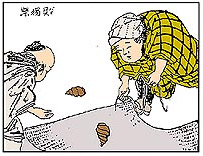
“They’re going to battle on that!” One student shouted pointing at the bucket. He was right. The men wrapped strings around the metal battle-tops and threw them spinning into the canvas bowl. It was Thunderdome without the dome. The tops knocked into one another, until only one remained.
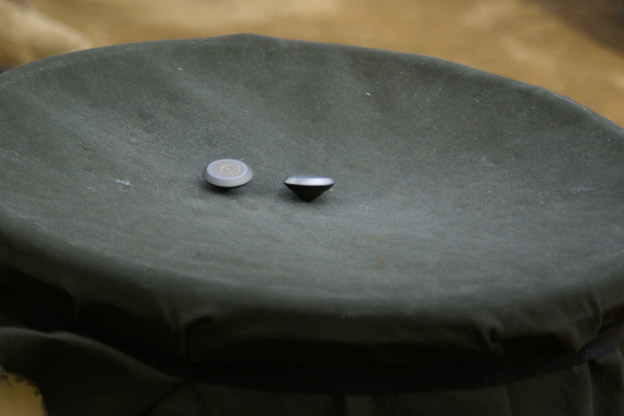
Afterwards, they taught us how to use the beigoma which are more difficult than the tops we had grown accustomed to. The beigoma had no stem at the top and almost no tip at the bottom. The top of the beigoma were engraved with images. Among the men’s collections there were planes, butterflies and various kanji.
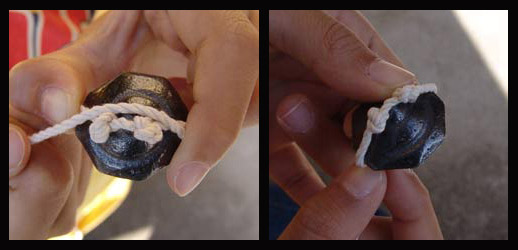
Since it lacks a stem, the beigoma has a unique wrapping technique. A beigmoa’s string has two knots. Instead of securing the string around the stem, the string is wrapped around the top and then secured around the two knots at the bottom. The string is coiled around these knots, creating the same swirling pattern as the wooden tops. The throwing motion is also different. A backhand motion is preferred with a quick flick instead of the long unwinding release characteristic of the wooden tops.
To battle one has to be precise, keeping the top in the canvas bowl. The top that remains spinning in the bowl the longest, often casting its opponents out, wins.
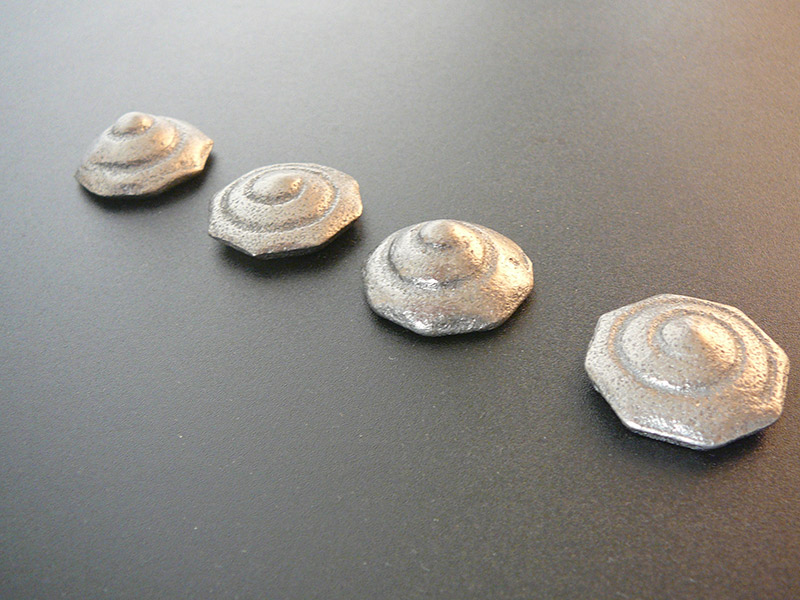
There are several types of beigoma with various widths, sizes and shapes. Some have deep swirls on the bottom while others have almost no markings at all. Some are a few centimeters tall while others clear only a centimeter. The size varies from as small as a 1 yen coin (a US penny) to the size of 500 yen (a US quarter). Aside from a round beigoma, the rest I saw were octagon in shape.
Beigoma have names that reflect their physical characteristics. Taka-ousama 高王様 is tall and heavy as it’s name, Tall King implies. ベousama 王様 is the smaller of the kings while Chuu-ousama 中王様 size lies somewhere between the other two. There’s Maru-roku 丸六 which, as maru implies is round.
Look carefully at the swirly design at the bottom of the pictured beigoma. Does the swirl remind you of anything? Beigoma were once called baigoma 貝独楽 or “shell toys.” That’s right, long ago real shells were used as tops. The swirls on the bottom of the metal beigoma are a reminder of their natural past.
The whole experience left me feeling like many teacher and grandparents. It would be a shame if traditional games are forgotten, particularly Japanese tops.
But there’s hope. As long as kindergartens and Japanese school’s put an emphasis on games and activities with cultural heritage they will not be forgotten. Toy stores and 100 yen shops continue to carry traditional toys, which are cheaper than video games or fancy new toys – I bought four beigoma for 500 yen (about 5 US dollars). Manga and anime also introduce the games to new generations. Just as “Hikaru no Go” introduced many Japanese children to the game of Go, the Beyblade series brought tops, albeit fancy ones with techniques launchers, back into the limelight for several seasons.
In the month before the contest, talk of tops ruled the day. Students brag about how they practice at home and how family members teach them special techniques. So maybe there’s no need to worry- tops are here to stay. And that’s great because although I was able to spin the beigoma on the floor, I failed to land it in the bowl. And that’s great because it gives me another challenge to look forward to next season, though I may just look like I’m playing with toys.