If you ever go to Japan, you'll come to realize that almost all men, especially salarymen, don't have mustaches (or facial hair for that matter). Although shaving your mustache can sometimes cause trouble, having a mustache can be problematic in Japan. If you decided to go to work with a mustache your boss might not just give you a simple slap on the wrist, he might actually fire you. Sad, but true.
But how can this be? In a modern country such as Japan, shouldn't it be a society in which one can look past another's facial hair without judging (or firing you?). I'd like to take you on a mustache-canoe journey through the river that is the history of how facial hair functions in Japan, past and present. I'd also like to educate you on mustaches in general in Japan, just in case you end up in a heated mustache-related argument. Nobody is going to be teased about falling flattop on your facial hair on my watch.
Japanese Mustache Vocabulary
Unlike English, Japanese has only one word for each type of facial hair, excluding the eyebrows: HIGE. Lucky you! You've just learned how to say mustache, beard, sideburns, and whiskers in Japanese, all at once. If you found it to be more confusing than "lucky", don't worry, we use a different kanji for each hige:
- mustache 髭
- cheek hair 鬚
- chin 髯
Furthermore, you can also say:
- mouth-hair kuchi hige 口髭
- cheek-hair hoohige 頬鬚
- chin-hair ago-hige 顎髯
Just as a note, to save some word-space in this article, from here on out I'll use "hige" to quickly refer to mustaches, beards, sideburns, (and whiskers). So, please don't get confused whenever you see the word "hige". Memorize the meaning right now!!!
Let's break down the words for each HIGE style: Mustache a.k.a. kuchi-hige is facial hair grown just above the upper lip and is the most common type of hige. For this popular mustache, there are three main styles. In Japanese, the "handlebar mustache" a.k.a. the "Kaiser mustache" is カイゼル 髭, toothbrush mustache is ちょび 髭, and the pencil-thin mustache is 泥鰌髭.
There are other types of hige out there besides these, of course. Let's take a look at some of the more interesting ones.
Ago-hige is the collection of facial hair grown on the chin, upper lip, lower cheeks, and neck. The most famous style of this is most likely to be the "goatee" and is translated into yagi-hige 山羊髯 (goat beard).
This can be taken a step further, too. Nothing says "I love Japan" more than trimming the hair on your chin into the shape of Mt. Fuji. Not surprisingly, this is called Fuji-hige 富士髯.
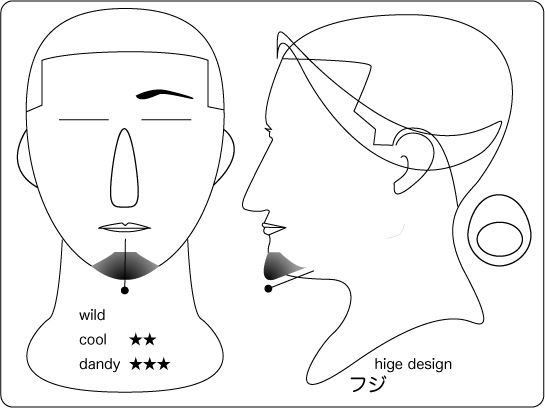
Hoo-hige is facial hair grown on the sides of the face and in front of the ears. It's not exactly the same thing as sideburns, however. In Japanese "sideburns" get separated into two different categories. (Remember, "hoo" means cheek so hoo-hige is the part of the sideburn that starts extending outward over your cheek.) The part of the sideburn that is directly beside your ear is called momiage もみあげ. It's difficult to distinguish exactly where momiage end and where hoo-hige begin, so some people just call them nagaimomiage 長いもみあげ, which means "long momiage."
Another very common hige style is the combination of the mustache and the goatee, which is called ラウンド 髭, 囲み, or カールおじさんの 髭.
And finally, if you have hige that isn't trimmed at all and just looks like messy stubble, it's called bushou-hige 無精髭 . Additionally, the "5 o'clock shadow" is called ao-hige 青髭. As you can see, for any variation or combination of mustaches, beards, and/or sideburns, we say "hige" and use " 髭."
Japanese Mustache History
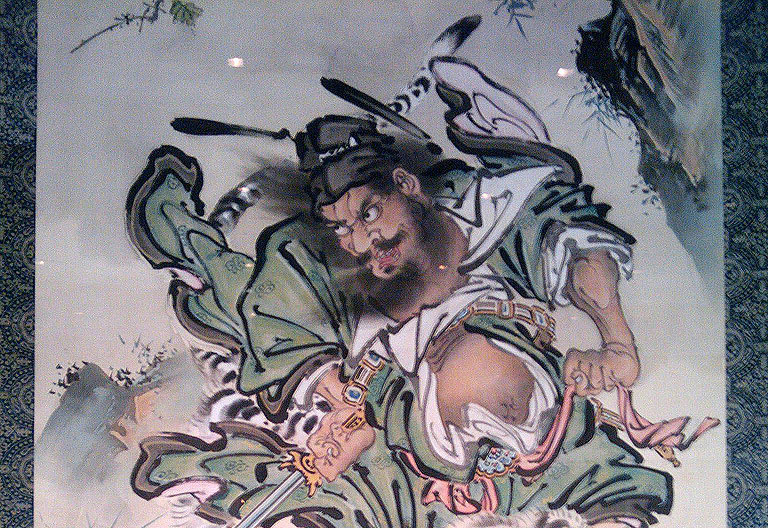
In Japan, from the medieval period to the beginning of Edo period, if you were a Samurai, you had to have hige. A Samurai without hige was made fun of. Thus, those who couldn't grow much hige or had thin ones, such as Hideyoshi Toyotomi, used fake hige.
When the Edo shogunate entered a calm stage and became a "civilian government" called bunchi-seiji 文治政治, showing a fighting spirit came to be regarded as having the intention of rebelling. Since hige represents the samurai's fighting spirit, feudal lords started shaving off their hige and left only their mage 髷 which is the long hair at the back of the head tied into a knot or bun. Another symbol of a samurai, the sakayaki 月代 which is the shaved part on the top of the head, remained during this period. This style was used until the middle of the 17th century. The government ended up banning people from having hige for the reason that hige could corrupt public morals, so all samurai had to shave off their hige, as well. They made one exception, however. People who had scars on their faces were granted permission to grow hige in order to hide their scars. Thus, Morihito Yamayoshi (a.k.a Shinpachirou Yamayoshi or Shinpachi) shaved his hige, though he doesn't have his hige in the moe-anime game called "ChuShingura46+1", since all Samurai characters are girls in the game.
In the second half of the 17th century, having a clean-shaven face became the standard among Japanese civilians. Meanwhile, in Hokkaido, Japan's indigenous group called Ainu still had hige but didn't have mage (the knot at the top of the head). Therefore, during the Edo-period, the homeland of the Ainu, Ezo-chi/Yezo 蝦夷地, was regarded as a land of savages, in large part due to them having hige. This "hige discrimination" is considered to be one of the initial reasons that people started to harbor contempt for the Ainu.
There is also an offensive and insulting term for foreigners, ketou 毛唐, which was created to spite foreigners with hige. ke 毛 means hair and tou 唐 means Tang Dynasty. The word ketou 毛唐 was originally intended for Chinese people though later it came to denote Westerners.
Speaking of Westerners, in and around the 18th century, hige became really popular in Victorian England and spread throughout Europe. That influence reached men of high status in Japan during the Meiji-era (that's after the anti-mustache Shogunate was overthrown, 1868-1912 AD) and so they started growing their hige again. Gaishi Nagaoka, an officer at Military Staff College in Tokyo, was one of them and he grew his mustache to an astounding 70cm (27.5inch) from end to end. His mustache was called the プロペラ 髭 and Nagaoka was very proud of it.
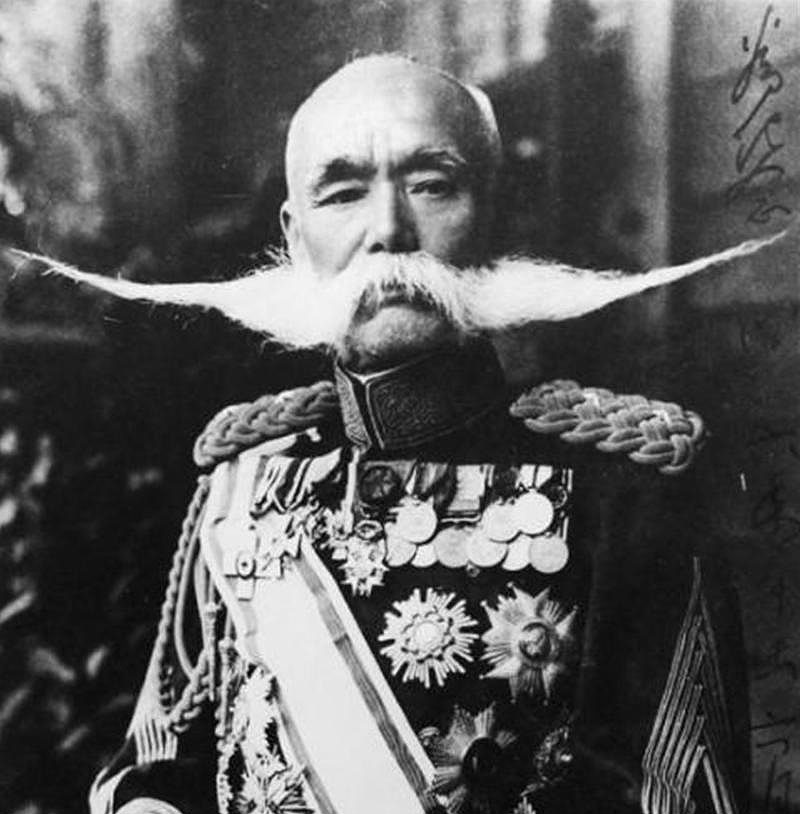
During the Taishou era (1912-1926 AD), some people still wore the toothbrush mustache or the Ronald-Coleman-like mustache called コールマン 髭. However, a new style without a mustache called MOBO (Modern Boy) became popular and the hige fever cooled down all the way until the militaristic Shouwa era (1926–1989) when the hige-boom came back (but didn't last that long). After the wars, safety razors spread around the country and shaving hige became the respectable, and respectful, style for salarymen all through the post-war reconstruction period.
Hige In The Contemporary Japan

Nowadays, though the trendiness of hige is gradually increasing, even to the point that there is now a popular Hige Dance, there are still far more clean-shaven Japanese men than those with hige. I guess it's because the old "Hige=Bad" mentality still lingers in many minds.
Across Japan, a general rule of employment stipulates that you must not have hige. This is particularly evident in the following industries: banking, investment, insurance, railway, airline, bus, taxi, retail, restaurant, and hotel. Companies make such rules because the firing, suspension of, demotion of a person, or reducing their salary for having hige is an infringement on personal rights. An employee must be given fair warning that having hige is against company policy.
In fact, some incidents have even gone all the way to the court system. For example, a postman named Noboru Nakamura had to hire a lawyer to fight for the right to keep his hige against Japan Post's 2004 grooming regulation. Nakamura wasn't the only postman who felt troubled by the regulation. Another postman named Hideki Shiba brought his case against Japan Post to court and won because the regulation was introduced after he had started working there. A taxi driver won his case that he took to court, as well. Those cases saiban 裁判 are called hige-saiban 髭裁判.
This means one very simple thing: it's very possible to get fired for having facial hair. Oh, and don't forget to lawyer up.
It all sounds far too serious for something as little (and natural) has hige, but as the saying たかが 髭、されど 髭 goes, "it's just hige, but it could be very important, as well". And indeed it can be. As I am a female, I don't understand how men feel about their hige. If I found a thick hige on my face, I'd remove it immediately. However, while writing this article I've learned about how difficult it was to have hige from a historical context. I've also learned how important hige can be for some men, and I'd like to learn more. I'd love to hear the passionate opinions of the "Hige-man". I guess we all want to, so keep an eye out for the next article in which I interview a Japanese salary man with a doozie of a mustache. What made him start growing his mustache? Did he need to fight his boss in order to keep it? It's him against society. You don't want to miss it!