
As Japanese food has made its way to other countries, it's clear what has led the way: if there's only one kind of Japanese cuisine you've eaten, it's sushi. (I'm assuming we can all agree on not counting instant ramen as "cuisine.") Sushi has become so mainstream in the US that you can buy it packaged in supermarket take-out sections and chefs invent variations using very non-Japanese ingredients like cream cheese. But even if you're trying to be a traditionalist, eating just the simple raw fish on rice, one familiar component of your sushi is almost always inauthentic: That little dab of green stuff with the unique heat probably isn't really wasabi.
Impostor Condiment
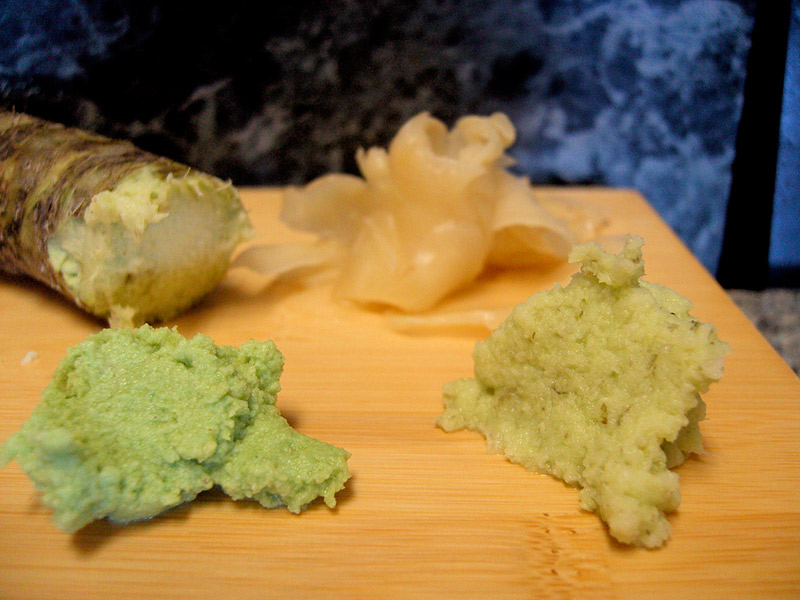
Freshly grated (right) and paste(left) wasabi by rdpeyton
A friend of mine who recently moved back to the States from Japan after ten years reported this on Twitter as her first experience of culture shock:
Shocked to find that there is no real wasabi in the US. only "wasabi" are tubes of horseradish mixed w/blue#1 & yellow#4.
It's not quite true that there is no real wasabi in the US – you can sometimes get it in high-end sushi restaurants, and although I've never seen it in a grocery here, there is such a thing as American-grown real wasabi paste in tubes. But unless you've made a special effort and are paying extra, you can be pretty sure that real wasabi is not what you're eating.
Of course wasabi is not the only Japanese ingredient that you can't easily get outside of Japan. I have to grow my own shishito peppers and make a special trip across town to pay like $3.50 – seriously, that is insane – for just two of those long negi onions. But the rarity of real wasabi is totally different. Mostly, people in the US are not eating the meals that those shishito peppers would be missing from. But we're all eating sushi.
So why did most the popular Japanese food abroad make its way around the world without this fundamental ingredient? The problem is that Japan chose a rather specialized plant to make such an important part of this dish. Wasabi requires unusual growing conditions that aren't easy to reproduce, and are quite unlike the typical garden or farm.
The Natural and Unnatural History of Wasabi
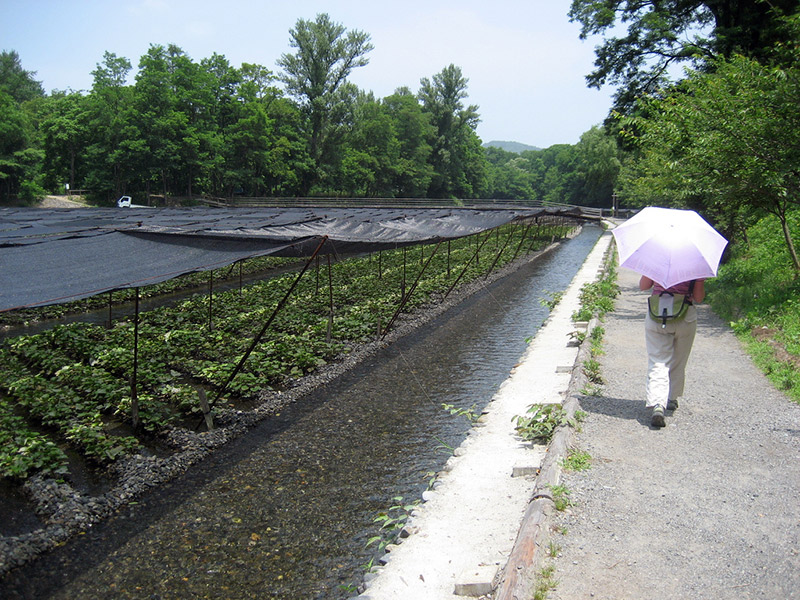
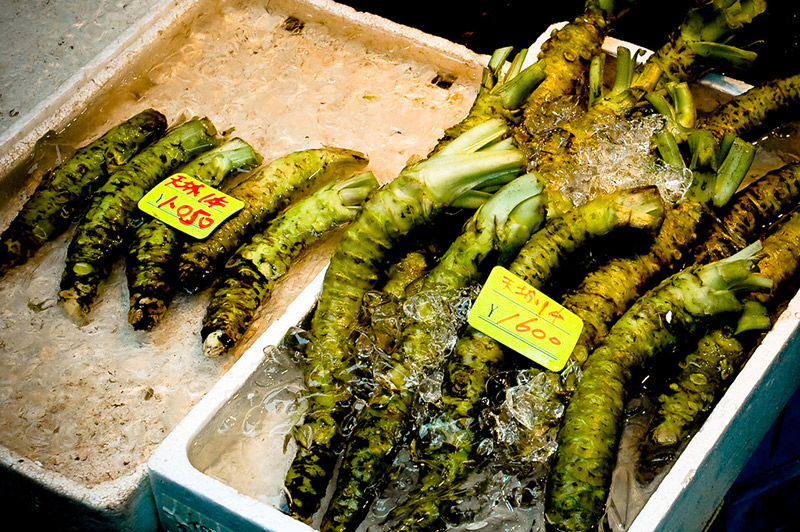
The wasabi plant is part of the mustard family and is related to horseradish and daikon radish, other foods that have that same spicy kick. And like those two, the part you're eating is the root, which in the case of wasabi is usually grated to a fine paste.
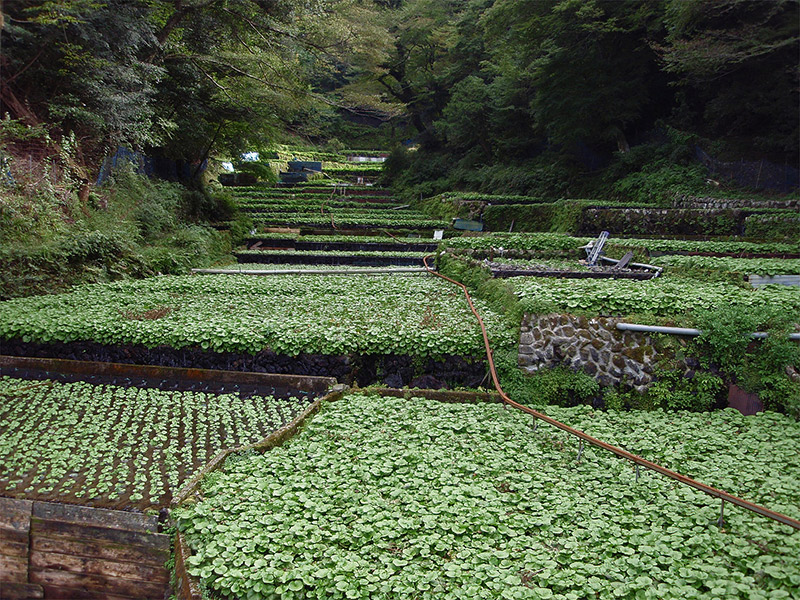
Wasabi is an aquatic plant, adapted to grow in cold, flowing mountain streams, and needs heavy shade – not at all the conditions of your average vegetable garden or farm field. So the best-quality cultivated wasabi grows in specially built beds with stream water flowing through them, shaded by a cloth covering or in some places, carefully spaced trees. And once you've got all that right, unlike your usual vegetable or herb, it takes two to four years for the root to grow to harvestable size.
Because of the difficulty of producing wasabi in this way that's close to its natural habit of growing, the industry eventually come up with a way of producing it in more normal farm fields in wet soil. It's cheaper this way, but everyone appears to think it's lower quality (unless they're a company that also produces the field-grown type and wants people to buy it.)
Of course, given that most of us can only buy the fake stuff in tubes, we can only envy people who have the luxury of arguing the relative merits of water- and field-grown wasabi. I'm in no position to be fussy, so if anyone wants to send me some fresh wasabi grown in soil, please go right ahead. I promise I will be absolutely thrilled.
History of Wasabi Growing
According to archaeologists, wild wasabi was eaten as along ago as the Jomon period (14,000 to 400 BC) for its medicinal properties (more on that later). Written records mentioning wasabi go back to the tenth century, noting its use in particular dishes starting in Buddhist temples.
But in those days wasabi was gathered from the wild. Where the history really gets interesting to me is when wasabi started to be deliberately grown. As an American, I live in a country where if something started a hundred years ago we think it's old. So I am always amazed by those Japanese businesses which are run by like the tenth generation in the same family.
If you feel the same way, prepare to have your mind blown: the oldest wasabi farm in Japan is currently run by the 17th generation owner, in the town where wasabi is believed to have first been cultivated 400 years ago.
Monzen wasabi farm is in the village of Utogi in Shizuoka. It's said that during the Keichou era (1596 – 1615), people in this village took some plants from a nearby mountain that had so much wild wasabi growing on it that it was called Mt Wasabi, and tried planting them near a spring called Idogashira. It worked, and the rest is history. The village has a monument to the origin of wasabi growing, which you can see a photo of here, which is the actual webpage of the 400-year-old Monzen wasabi farm.
(For those of you who feel the history of anything Japanese is incomplete without a shogun in it, there's an anecdote for you too: Ieyasu Tokugawa, first Tokugawa Shogun, is said to have been so obsessed with wasabi that he forbade its sale outside his family. Not because he thought it was delicious, but because the leaves resembled the hollyhock leaves in the family crest. Those wacky shoguns!)
Wasabi in Traditional and Not-so-traditional Japanese cuisine
Fine sushi is an experience involving the freshest possible fish and appreciating the most subtle flavors. (That's setting aside all those crazy rolls with wacky combinations of fried things and sauces and Western ingredients, about which the less said, the better.) So you might be surprised to learn the history of sushi: it actually developed from methods of preserving fish for later consumption. These methods involved fermention and sometimes actual decomposition. You can read a bit about it here (as long as you're not actually eating while you read this, or else have a really strong stomach for, say, a description of fish surrounded by salted rice which after three months has "broken down into a kind of paste." Yum!)
So the reason sushi rice is mixed with vinegar wasn't originally for flavor, but because vinegar is a preservative. And wasabi kills bacteria, so before refrigeration it was probably a good thing to throw in for reasons aside from that entertaining tasty burn.
The root isn't the only part of the wasabi plant that is eaten. In the spring it's traditional to eat what are called sansai or mountain vegetables. These include young bamboo shoots, fiddlehead ferns, and the young leaves of the wasabi plant. I've read that they mildly taste of wasabi, although unfortunately I have never had the pleasure personally.
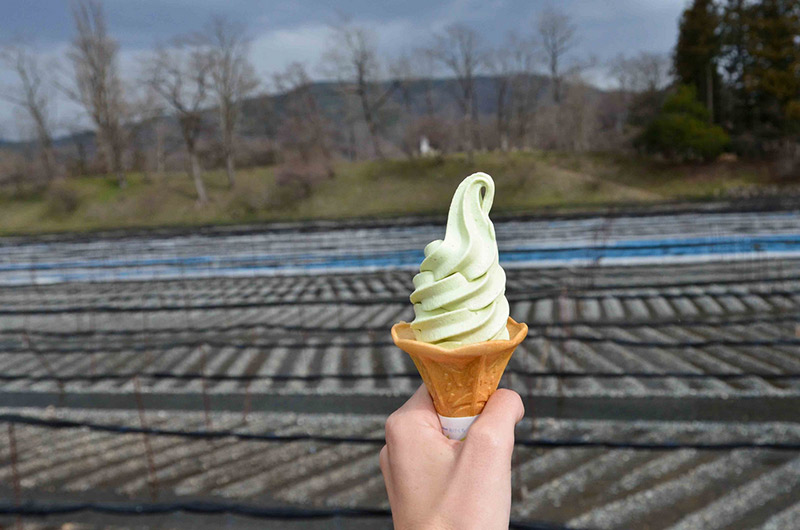
Something as awesome as wasabi can't be constrained by tradition, though, so now you can find all kinds of imaginative innovations, even in desserts. In Japan I've seen wasabi ice cream (no, I didn't try it) and eaten wasabi Kit Kat (white chocolate with a mild afterburn, and much better than it sounds). American companies have gotten into the game also: anyone want some wasabi candy? Um, yeah, no, me neither.
Wasabi Science
Wasabi is traditionally believed to have medicinal benefits, and modern science has confirmed some of these beliefs and discovered new possibilities as well. Aside from its antimicrobial powers, there's research suggesting that it has anti-inflammatory properties and may have effects on various types of cancer. This research doesn't seem to be at a state where you should be running out and consuming mass quantities of wasabi to cure anything, but if the potential health benefits would give you a little push to pay extra to try the fresh wasabi next time you're at your local fancy sushi place, go for it.
Japanese wasabi science isn't confined to medical uses, though. A team of researchers came up with a wasabi alarm that could be used to awaken deaf people in case of a fire or other emergency. They showed that canned wasabi extract sprayed into the air would wake up test subjects in less than two minutes.
In 2011, this research won the IgNobel Prize in Chemistry, which is awarded to "achievements that first make people laugh, and then makes them think." The scientific team's fellow awardees included researchers who proved that yawning wasn't contagious in tortoises and others that investigated how a person's decision-making was affected when they had to pee really bad.
Wasabi around the world

Although the rest of the world is still more familiar with that artificially-colored paste in the tube, we can be encouraged by the fact that growers in other countries have stepped up to meet the challenge of growing wasabi away from its home turf.
In the US, one company started growing it in Oregon in the mid-1990s. The Pacific Northwest, with its cool climate, seems to be the main place to go if you want to start a North American wasabi farm – there's also another company with growers in British Columbia, Michigan, Washington and Oregon. Some people even try buying the plants, and trying it themselves.
Wasabi is also being grown in New Zealand, and the first wasabi farm in Europe started doing business a couple of years ago in England.
Of all of these places, first prize for overseas wasabi lovers has to go to British Columbia, where the Vancouver Canadians minor league baseball team has the three mascots pictures above: Ms BC Roll, Mr Kappa Maki, and most important: Chef Wasabi.