Japanese College: The “Spring Break Of Life”

大学は人生の春休み – College is the spring break of life.

遊ぶのは大学のうち – You can only play while you’re still in university.

These are all various sayings which I have heard the Japanese use to describe their college lives. In my last article I mentioned how academics are really not Japanese universities’ strong points and this article aims to flesh this point out.

If you buy into the stereotype of Japanese people being hardworking you would be very very wrong when it comes to college students. As said before, if you’re looking for deep probing academic vigor and intellectual stimulation Japanese universities really aren’t for you.

What certainly is true is that barring certain exceptions such as med school, the majority of Japanese students don’t (and often don’t need to) take their college life seriously. But four years is a long time to just be slacking off and enjoying freedom – the question therefore is why go to college at all?

And what do I mean by “Spring Break”?

drinks

Photo by Odyssey

Not that rare a sight in the typical Japanese college student’s life

Perhaps to illustrate the point better, let’s use the example of an imaginary Japanese youth – let’s say his name is Takashi. Assume that he’s a current student in a mid-to-high tier university.

He doesn’t really study during college. But then he’s really not the only one. The statistics are clear – Japanese students do not study. An earlier Japan Times article quoted some University of Tokyo research which stated that Japanese students study far less than American college students. Takashi skips a few classes a week, and for the lessons that he goes to, even if his classmates are physically present a large number are having a mental vacation in dreamland while the lecturer drones on.

What do Takashi and his schoolmates do then? Some of his classmates spend their time on partying and doing gõkon and playing computer games etc. He occasionally joins his classmates for all-night mahjong games at his friend’s house. Some of his friends spend their time on part-time jobs. Heck, being from a relatively high-end university many of his friends who do not go to school spend all their time earning an income teaching high school students on how to work hard for their exams. Then there are those, especially sportsmen, who pour all their time into sports clubs or other student activities.

Basically, anything but their books.

Before and after
grades

Photo by Chris 73

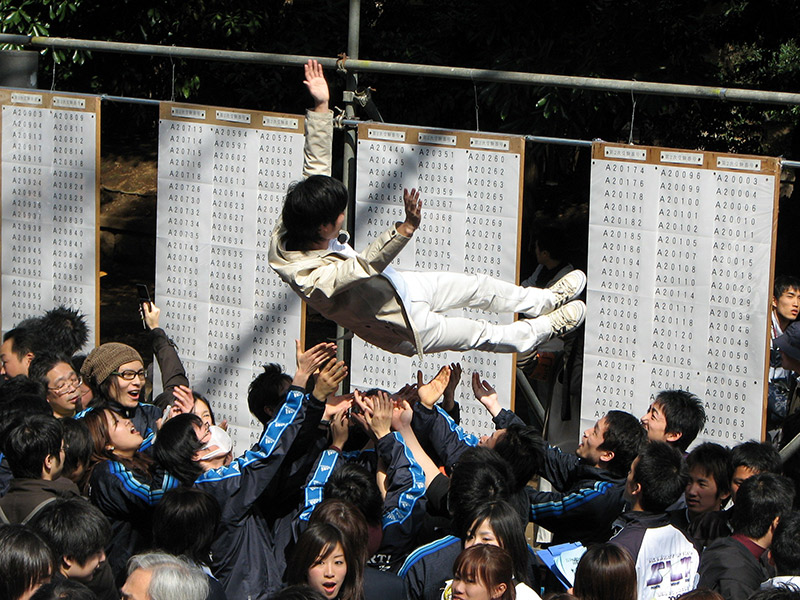
Congratulations on you getting accepted into a high ranking university – otherwise known as a four year “study break”!

Takashi was miserable in high school, as many Japanese students are – though this is very true for East Asia as a whole. Starting from the second year of high school Takashi started gearing up for the all important university entrance examinations. So, depending on his subject combination, he may have to slog through calculus and memorize a history curriculum that almost seems to aim to make students into mini-Wikipedias. Looking at his notes on classical Japanese, he tries to figure out the language of his great ancestors about 20 generations ago but all that comes to his head is a big maji de?! (like really?!).

Say he screws up an examination. If his family can afford it then he’s most likely off to extra classes at a cram school (juku). Actually, he’d likely end up going to those extra classes anyway even if he didn’t do so bad. If you fail to make it into your target university you become a ronin, which basically means you have to wait another year, study hard, and then take the entrance examinations again. It’s not something that most high schoolers want to experience once, let alone twice.

So after a possibly delayed year and after puzzling through both classical Japanese as well as English grammar, he finally enrolls in college. He moves from one of the more rural parts of Japan to Tokyo, the big city, for university. The first day he takes the train to school at around 8:30AM and gets squashed by the morning crowd of half-asleep suits and stifling neckties. In the morning Tokyo train, almost nobody smiles.

japanese-train

Photo by Wry 2010

He goes to school and finishes all his classes the first day – dutifully attending all of them. He finishes near 6PM and is just on time to be hit by the evening rush of people who actually don’t have overtime. Some other day within the first week he goes to an introduction session by one of the student clubs – maybe a sports club, maybe a band circle – and tries to board the train around nine. Even at this time the trains are still full, now from those who worked overtime. Another time he stays back for a shinkan(welcome) party and boards the train at 11PM. The crowds have thinned a bit but the number of people still in suits is obvious. Some of them are reeking of alcohol from a company nomikai (drinking party) and are entirely red in the face.

On the train rides home looking at the drunk salarymen on the train he realizes that he’s looking at a reflection of what he will be four years down the road. But then that’s what he came to college for anyway. Get a degree, a nice university’s name to your resume and start work, and work and work and work and work (and work).

The day after the shinkan party he had a class at 9AM. But he misses it because he can’t wake up. After all, since he’s going to work and work and work anyway, what’s the point of working so hard right now? It can wait.

Not getting up becomes a habit because work can wait and sleep can’t. Especially because his parents are not around to parent him, his attendance, especially for morning classes, slumps.

There’s other stuff too

lines

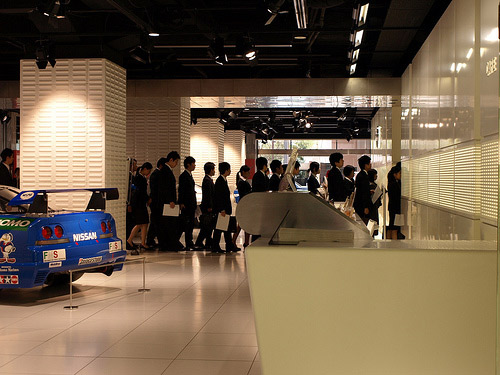
Job applicants heading for an interview at Nissan

The above is the “conventional” explanation for why students like Takashi don’t take their college life seriously, but if you think about it, if not studying actually had an impact on Takashi’s future career, he surely wouldn’t take things so easily.

Luckily, it does not. Japanese companies – based on anecdotal evidence – do not really look at an applicants’ grades when they apply for jobs. What they do instead is look at the university name and after document screening subject job applicants to a barrage of interviews, internal tests, discussions and the like right in the middle of the school term – which in itself indicates how much companies value the education that the universities provide for their students.

Takashi may have joined a sports club which requires him to wake up for morning practices in addition to afternoon practices which coincide with lessons. It is obvious which he will prioritize. If the club is vigorous enough it is likely that he will have to repeat a year in university.

But this to him is indirectly investment in the future – in exchange for holding up the reputation and achievements of the club, the alumni of the sports club are very likely to pull some strings such that the club members will get a foot up during their job searches. One friend of mine in a judo club even says that members have their names on the name-list highlighted in yellow during job interviews for companies where alumni are already working.

And more other stuff

lionPhoto by Tambako the Jaguar

But in the first place, why should Takashi come to class?

After all, for some classes he is packed into a lecture hall with 400 other people for a lecture – in such a case obviously no attendance is taken. Even if attendance is taken in other classes he can just ask his friends to sign on his behalf. In any case he can just study for the exams – someone in the class is attending the lecture and he can just ask that person for his notes later.

And about the exams, well they’re not that hard. After all, 80% of sociology papers involves multiple choice and filling in the blanks (note: true story, it happened to me). And since there are so many lectures with big class sizes – and because the lecturers do not want to commit suicide – the only form of grading occurs from that one end-of-term examination. After all, which lecturer would want to read 400 students’ assignments?

And even the workload for small classes isn’t that high. Many exchange students comment on how outside the Japanese courses (which can be intense), the amount of readings they have to do per class is really low compared to their home universities. In my university it is also not uncommon for students to take around 16 different courses in their first semester. That’s right, sixteen different courses. This does not mean that they pull all-nighters every day to do their work (they’re more likely to pull all-nighters drinking or at mahjong). It means that the courses themselves aren’t very intensive.

So in conclusion…

sakura-road

Photo by Stéphan D

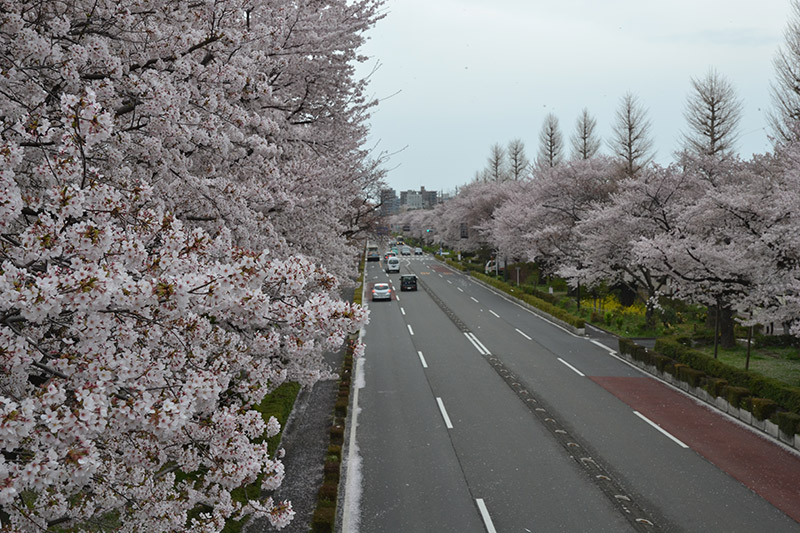
The view outside Hitotsubashi University in full spring

In Japan college isn’t that intensive at all. But this does depend on the subject (medicine is an exception), the university (there is a gradient) and of course the individual student. Takashi is just an example for one of the many Japanese students who really take their college “educations” as spring breaks – there are certainly many who do not.

However, that being said, not paying that much attention to school is not in itself a bad thing. After all, instead of trying to pay attention to a sleep-inducing lecture, some people do take their time out to do volunteering, activism or exploring the world outside the confines of their university.

But this is not the majority – so do not come to Japan expecting that you’ll be adding that much to your formal academic education. To be frank, Takashi is not, so neither should you.

Things are supposedly changing though. Employment prospects in Japan have supposedly been worsening over the past few years and companies are taking a closer look nowadays at what people do during their university days before hiring them. But the situation has remained largely unchanged in the everyday lives of Japanese college students.

This article may seem to conflict with the earlier article I posted about why you should come to Japan and to some extent it may. However, the point of coming to Japan is not the education per se but other reasons.

I’m therefore thinking about writing an article about not “why” you should come to Japan (like the previous one), nor about “what” actually happens here, but “how” to approach university in Japan, as well as what I think are the main types of approaches which people employ when they are here. Let me know what you think in the comments!

[hr /]

Bonus Wallpapers!

springbreakoflife-700
[1280x800] ∙ [2560x1600]

  • Flora

    I’d like to see an article on Japanese vocational/career schools. Considering that the time there is much shorter (1-3 yrs.) and it’s obviously the path less traveled than the traditional “cram school>uni>work>die” method, I wonder if the mentality is any different.

  • Anonymous

    An article on how to attend a university in Japan would be highly appreciated. What do you need (which Japanese level, any other documents)? What about the costs? How do you get over there as a foreigner? That would be really interesting, not only for me, I guess.

  • Justin

    I graduated from a language school in yokohama and will be going to Rikkyo uni in a year, this is pretty much what I always understood about university life in Japan from all my Japanese friends who went to uni. This is also why I choose to go to a Japanese uni, for the social immersion aspects that will boost my Japanese over the 4 year period to higher level. So for someone looking to take their Language skills from advanced – upper advanced to higher fluent level then there is something to be gained out of going to a Japanese uni in my opinion.

  • meroigo

    I go to such a school in Osaka. In my school there are courses for anime, manga, game making etc. If you don’t study on your spare time nor take the lessons seriously, you’ll become unskilled and will have a very hard time getting a job. The portfolio is everything.

    The first year was very nice, we had a lot of fun lessons and learned a lot of basic skills. In retrospect, it feels like they want everyone to really like school and want to pay for and come back for the second year. ;D

    The second year was planned around building your portfolio. Still learned a lot, but on top of that, MANY of days doing all-nighters in school. You must have the best portfolio!!!! Stressy stressy. I practically lived in school, went home now and then to get a shower and change clothes. Only one completely free day in the week. I overworked during this time and sat still in front of the computer so much that I got blood clots in my leg that later travelled to my lunges and gave me a lethal pulmonary embolism. Riding Japanese ambulance, being told when I wake up 3 days later that my heart stopped and they had to open up my chest and do surgery… Haha, a bit OT, but I got to experience the awesome Japanese medical care for 7 weeks! and, I can say I have experienced karoshi, but survived. :D

    The third year, in which I have around 3 months left of is… pretty much nothing. It’s supposed to be planned around job hunting, intern time and self-studies, so I have almost no lessons, and of the four days in the week I have lessons, three of them are from 16:40 to 19:50, and they are pretty much just self-studies. :D sooo freee…. TOO FREE. I’m so bored almost every day. Since I luckily landed a job at a game company in Tokyo in September, that I’ll start working at in April, I have almost no worries… Maybe this third year is like Japanese college… But I don’t think so. We don’t have any clubs, and many people are doing intern (not me, yay!…?) or live far away, so it’s not very fun, many school mates have pretty much disappeared from school…

    Just my personal experience at my particular school.

    …..anyways. I recommend vocational schools if you want to actually learn skills and do get a job in Japan! Enter one after 1+ year at a Japanese language school and you should be able to get a career in Japan that is not English teaching. Just watch out for your health and don’t overwork. :)

  • meroigo

    Go to a Japanese language school in Japan for 1-2 years and you should be able to get by at a Japanese university (and get better as you go). When the time for university applying comes, the language school will help you find one and help you with the work from start to end (they want to brag about their students getting in to universities). The costs are different, but I’d guess around 1 000 000 to 1 500 000 yen a year.

  • Austin fanboy

    I am glad you delivered, Austin.

  • Evan White

    I would love this. My college adviser is really bad at her job and has no idea where to begin to help or even shove me in the right direction.

    PLEASE right an article like this, whichever Tofugu writer is reading this!

  • orangedude

    I never really understood how people here in the US can party away their college years. I’m paying for school, and it’s not cheap; why would I want to waste that money (not to mention 4+ years of my life)? I’m not in college to have fun. I’m here to get my degree and then start my adult life.

  • Jordan Taylor

    I know Japan is trying to expand the number of programmes that are taught in English. I recently heard of this: http://www.experience-japan.jp/ which was held in London but the website has a decent list of participating universities that have programmes in English.

  • Mescale

    How many Universities have been sampled to give this information?

    What control group did you use for your study? Which Universities? Which countries?

    In the UK, at, at least 3 Universities(I have attended 2 and worked at one), University is a time where students typically are away from home for the first time, they spend their time getting drunk and doing stupid things. The amount of time they spend actually learning things is minor, but its OK because Universities exist to make money and if students failed their first year or subsequent years they wouldn’t get money so students have to try really hard to fail.

    Over the last 20 years in the UK at least the value of a degree course has dropped, many people get degrees these days, in things as useful and relevant to modern life as media studies.

    So Japan is no exception in the case of academic excellence, at least in your experience.

    However I do wonder if you are making generalisations based on your own point of view, and a limited sampling of data.

    What I think you mean to say is.

    Japan is crap, I thought it would be amazing and awesome, just like in anime, manga, TV, modern portrayal of Japan as wacky crazy cool place etc. But it turns out that its not, and now I am angry and disappointed and want to get back at Japan for my own misconceptions by telling everyone how they are crap. I mean how did I know that America, which has hella lot of resources, land, and guns, would offer better everything than Japan, a country made out of volcanos. Do you know they don’t even have central heating?

    Oh and just to let you know I didn’t read the article, don’t get upset if you actually wrote a balanced and interesting well researched and non-stereotypical article.

    I’m guessing you didn’t though its a statistics thing, you know its harder to actually do good things than pass off an opinion piece as a useful and realistic report on reality, but that is harder than doing a google search and copy pasting the first two results and sticking your name on it, and so I guess in a way its laudable.

  • Mescale

    There are usually some kind of foundation in your country run by the Japanese consulate to promote these kinds of things, In the UK for instance they are called the Japan Foundation (http://www.jpf.org.uk/). and they hold fayres and stuff which big universities come to and tell people how to attend.

    If you really want to go to university in Japan your first test should be finding out this information for yourself instead of expecting tofugu to give you the information. You could always research it, find out, and write an article and then submit it to tofugu.

  • BwokBwok

    Your comment makes no sense. Please read the article, then try again.

  • http://ale.incrowd.ws/ Ale

    It seems thatnthere is too much of ‘doing nothing’ in Japanese colleges. So do we actually get any education there? I wouldn’t be happy to just revise anything we’ve studied in our school (er, I’m currently studying at pretty good high school in Russia, we even have calculus as a subject here, lol).

  • Fatima

    I’d love to see an article about art universities in japan, if possible. I can’t seem to find that much information about it in my native language neither in english :(

  • Guest

    Have you actually graduated from a Japanese university ?

  • Guest

    Oops sorry I see you are attending a Japanese uni. Which uni and what major ?

  • Guest

    …Whoa, didn’t see that coming!

  • Guest

    The thing with the ambulance, that is

  • Austin

    Yep I am working on such an article but as you can imagine it kinda takes more time than the usual articles that I write because it takes more research and I have other stuff to write in the meantime as well. Stay tuned though!

  • Austin

    Just took a look at the link – very interesting! In addition to this though, just google “Global 13″ for a list (incomplete) of universities which provide full 4 year English programs for undergraduate studies under a Japanese Ministry of Education initiative.

  • Austin

    You can get a decent education in Japan especially if you’re in one of the higher ranking schools because in the end there are some good teachers around. But the issue is that Japanese colleges tend to (in my opinion) be overrated in terms of the education that they provide. Another problem is trying to get an education among a generally uninterested student body which doesn’t also like to discuss about serious topics.

    But mainly, I won’t say you’d get a “bad” education per se – just not something stellar. The point about coming in Japan (which will probably be addressed in a later article) is not the education but the experience, the exposure and the chance to explore.

  • Austin

    And I agree with you actually. My previous article talked about the value about going to Japan for college but yes the immersion to improve your skills is one of the major pluses to getting an education in Japan.

  • Cho Il Shin

    This is a goddamn depressing article. I really wanted to go to Waseda and now this…sighs

  • Cho Il Shin

    I would like to know that too. I wonder if Austin actually regrets attending a Japanese University…

  • HASHI

    HASHIHASHIHASHIHASHIHASHIHASHIHASHIHASHIHASHIHASHIHASHIHASHIHASHIHASHIHASHIHASHIHASHIHASHIHASHIHASHIHASHIHASHIHASHIHASHIHASHIHASHIHASHIHASHIHASHIHASHIHASHIHASHIHASHIHASHIHASHIHASHIHASHIHASHIHASHIHASHIHASHIHASHIHASHIHASHIHASHIHASHIHASHIHASHIHASHIHASHIHASHIHASHIHASHIHASHIHASHIHASHIHASHIHASHIHASHIHASHIHASHIHASHIHASHIHASHIHASHIHASHIHASHIHASHIHASHIHASHIHASHIHASHIHASHIHASHIHASHIHASHIHASHIHASHIHASHIHASHIHASHIHASHIHASHIHASHIHASHI

  • Miu

    It’s my dream to study in a vocational/career school and eventually work in Japan but I don’t have a sponsor. I can’t even afford to go to college in my own country. *cries*

  • Eto

    He’s a resident troll.

  • kishimi

    bummer , well im still gonna go do my graduate school there regardless,, i’m led to believe the lecturers there don’t have the same attitude as their students right?

  • アレゼンダ

    I’d like to raise a point and it is that not only do med students have to work hard, so does any student part of their university’s science and engineering departments. I’m currently a freshman in Waseda’s Engineering Department and I’m can attest to the fact that it is tough with all the calculus and science related classes that aren’t introductory; and it is only my first semester here. Plus, I believe that how hardworking Japanese college students are varies between individuals – I’ve seen my dormitory’s study room packed with both freshmen and sophomores nearly everyday after dinner.
    In my opinion, Takashi’s scenario is usually applicable only to those who come to Japan to pursue humanities or social sciences related degrees. If anything, Japan is not renown for having high academic standards in those areas especially since all professors in Japan are not required to have an education related degree (at least that’s for all the universities I’ve heard of). They came to the university because their research was being funded there, they were never taught to be teachers (explains why I have some brilliant lecturers who are terrible at teaching). This system is still functional for subjects that have less grey-areas (science related) as student can still study by themselves without relying too much on their lecturers’ ability to teach seeing as there are actually correct answers to questions whereas that would not be true for the more subjective courses.
    So I would advise anyone to not come to Japan if they really wanted an education in a field that isn’t science related (or just very black-and-white). Instead, go to the western world where lecturers actually need to be proficient educators (I believe that’s where they are but I may be wrong) unless, of course, you only want that piece of 紙 with your degree on it in which case, fight very hard to come to Tokyo cause you will have the time of your life over here. Best part is when you’re finally be able to watch anime the moment they’re released cause you don’t need to wait for subs anymore. :D

    P.S. I’m not entirely sure about vocational schools but I’ve heard that there are really good ones.

  • アレゼンダ

    Go go go! It’s worth it I swear, I’m a freshman in 早稲田大学理工学部 :D

  • Toby

    Hey Austin, I just finished all your articles here and found you are current student of UoT.
    Would you mind sharing, preferably writing an article, your life there?
    I am aiming to go into the Engineering school of UoT, or other great engineering schools in Japan and it would be great if I can get to know more about the school before I apply. Thanks in advance.

  • UnfortunateOne

    Jesus, that’s expensive….I won’t even be in my 20s by the time I have $15,000 to spare. Where do you people get your money?
    I feel like it would be impossible for me to go after I graduate high school (18 right now, one semester to go), let alone even after several years. I just feel so defeated when I see these astronomical prices.

  • meroigo

    I get student grants and big loans from my government. Some people might have scholarships or stipends. Japanese kids mostly get from parents’ savings.

  • Alexandra Franco

    The name of the program is Global 30. True you can take an undergraduate or masters degree in English with Japanese language courses. Currently an int student at the University of Tsukuba

  • http://ale.incrowd.ws/ Ale

    Whoa, I see the point! So the only thing now is where to get money :D

  • Mescale

    Once i read an article on tofugu and it turned out to be plagiarised from the top two google hits. blatently.

    that day i promised to return exactly the respect given to me on that day i read an article.

    i will never read an article on tofugu, i’ve been burnt once, never again.

    my comments may suffer from this

    but i doubt it