The Ainu: Reviving the Indigenous Spirit of Japan

If you were to ask people to describe “Japan” or “the Japanese” in one word, there’s a pretty good chance that you’d hear one word over and over again: “homogeneous.” The Japanese have long prided themselves on the homogeneity of their nation, and it sure is easy to believe that is the case, but the truth rarely lies on the surface.
5171315163_ee1cc9fd4c_z

In reality, Japan, like any other nation, is an ocean of diversity, home to multiple minority groups. One of these groups is Japan’s indigenous people, or the Ainu. Don’t be surprised if you haven’t heard of the Ainu. In fact, many Japanese themselves are unaware of the existence of their own country’s indigenous people.

But why? For hundreds of years, the Ainu have been either ignored, discriminated against, or forced to assimilate with mainstream Japanese culture. Obviously, none of these circumstances are favorable for propagating cultural stability or awareness. And unfortunately, this has led the Ainu language and culture to the brink of extinction.

However, with the government’s (long awaited) official recognition of the Ainu as Japan’s indigenous people in 2008, it appears that there has been a revival of Ainu pride among the few Ainu that remain, as they desperately try to preserve what culture they have left. Here, I hope to outline some of the most important aspects of the Ainu language and briefly touch upon the culture in hopes to bring light to one facet of Japan’s diversity.

The Origins of the Ainu

Historical_expanse_of_the_Ainu.svg

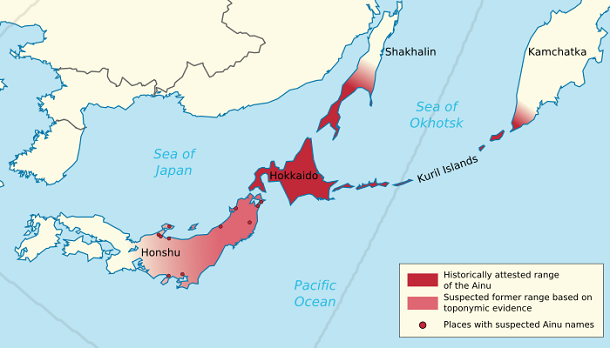
The Ainu people are historically residents of parts of Hokkaido (the Northern island of Japan) the Kuril Islands, and Sakhalin. According to the government, there are currently 25,000 Ainu living in Japan, but other sources claim there are up to 200,000. The origin of the Ainu people and language is, for the most part, unknown. However, there have been many theories on the subject.

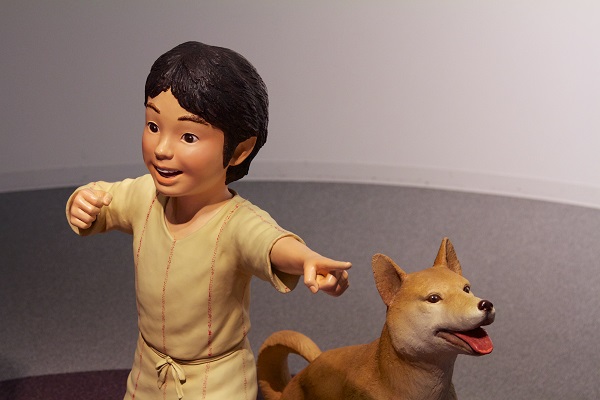
One theory suggests that the Ainu people are remnants of the Jomon-jin, or the hunter-gathers who inhabited Japan during the Jomon Period (14,500 BC – 300 AD) and perhaps even before. Around the year 300 AD, another group of immigrants known as the Yayoi people made their way to the islands of Japan, introducing new agricultural techniques and technology and integrating with the Jomon people. It is believed that the Yayoi group may not have reached as far as the Northern island of Hokkaido, allowing the Jomon hunter-gatherer way of life to survive in that area.
7D1_9779-2
The model of a Jomon period boy

One Ainu myth claims that “They lived in this place a hundred thousand years before the Children of the Sun came.” It’s interesting that this myth seems consistent with the theory of the Ainu descending from Jomon-jin. More recent research suggests that the historical Ainu culture could have come about through the merging of the Okhotsk culture and the Sastumon, a Jomon group very similar to the Ainu.

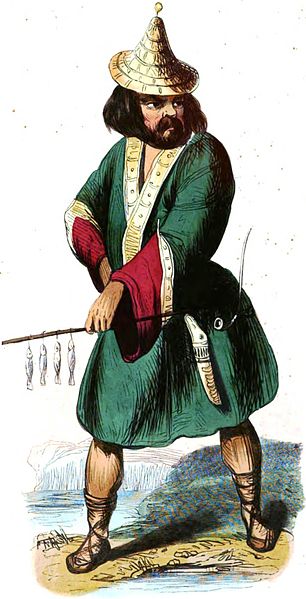
306px-Ainos_(Asie)._Auguste_Wahlen._Moeurs,_usages_et_costumes_de_tous_les_peuples_du_monde._1843

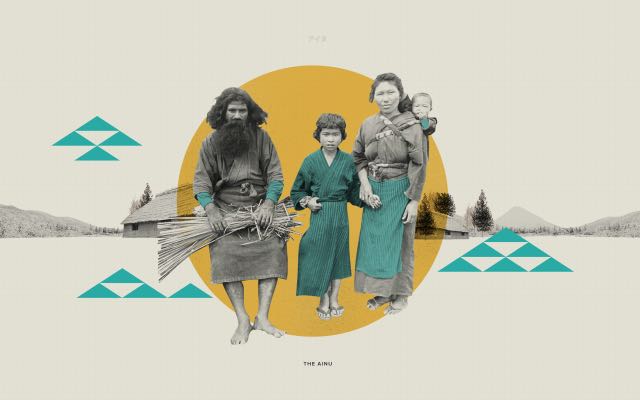
Physically, the Ainu stand out distinctly from the Japanese as a separate ethnic group. Ainu people tend to have light skin, a stout frame, deep-set eyes with a European shape, and thick, wavy hair. Full-blooded Ainu may have even had blue eyes or brown hair. In the past, the Ainu were proposed to be of Caucasian decent, given their appearance, but recently it has been proved through dental morphology and fingerprinting that the Ainu are in fact Mongoloid, not Caucasoid.

OLYMPUS DIGITAL CAMERAAn old Ainu man

These days, the concept of a pure Ainu is very blurred. Distinguishing the Ainu from other Japanese is almost impossible due to intermarriage with the Japanese, migration, and denial of the Ainu identity to avoid discrimination.

Ainu Culture
Bjs48_02_Ainu

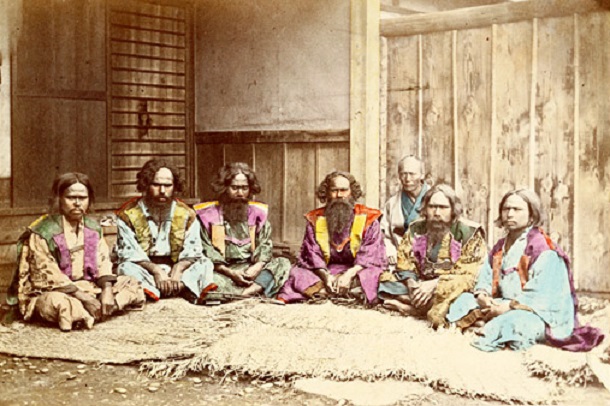
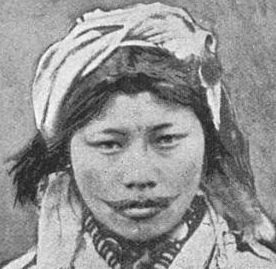
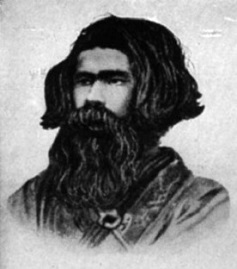
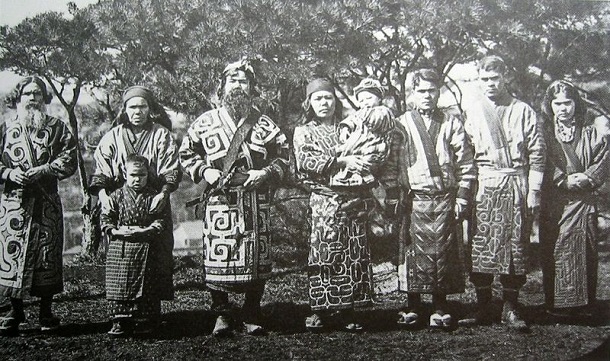
You can see just by the appearance of the Ainu that traditional Ainu culture is significantly different from Japanese culture. First of all, both men and women keep their hair at shoulder length and wear traditional Ainu garb. Men, never shaving after a certain age, usually have full beards, and women undergo mouth tattooing to signify their coming to adulthood.
Ainu_woman_Mongoloid_2NSRW_-_Asiatic_Types_-_Ainu_of_Japan

As hunter-gatherers, the Ainu lived off of the land. Common foods included deer, bear, rabbit, fox, salmon, root vegetables, and much more. Unlike the Japanese, the Ainu always cooked their food, never eating anything raw. Common hunting weapons included poisoned spears and bow and arrows.

430px-Brooklyn_Museum_-_Ainu_Hunters

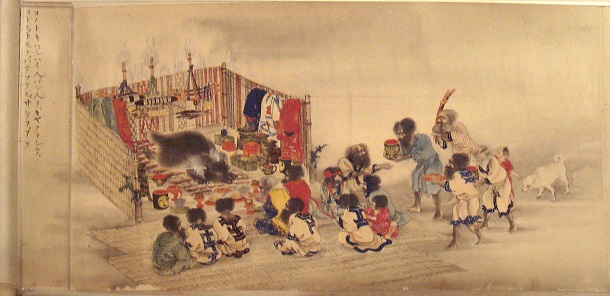
One way that the Ainu were similar to the Japanese is in the way of religion. The Ainu, just like the Japanese people, were animists and believed that all things are inhabited by spirits known as kamuy. While there are many gods in Ainu belief, one of the most important is known as Kim-un Kamuy, or the god of bears and the mountains. All animals are thought to be the manifestations of gods on Earth in Ainu culture, however, the bear is believed to be the head of gods and is therefore known as kamuy, or “God.”

AinuBearSacrificeCirca1870

Traditionally, the Ainu sacrificed bears in order to release the kamuy within them to the spirit world. One tradition, called lotame, involves the raising of a young bear cub as if it were an Ainu child and then sacrificing once it has come of age.
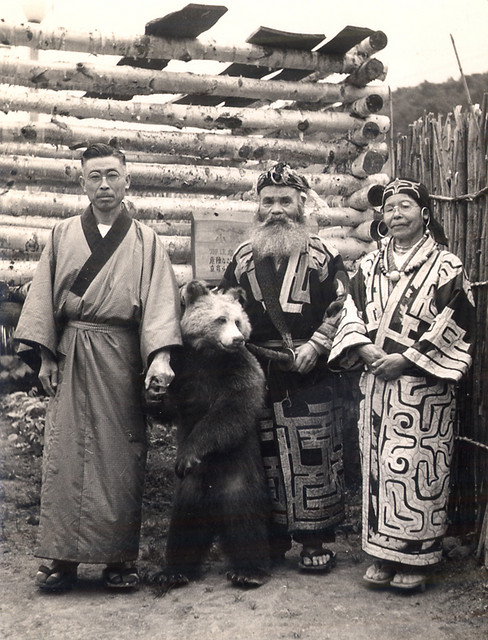
2286285728_d173091c34_za tourist with two Ainu people and a bear

During the Tokugawa Period (1600-1868) the Ainu became increasing involved in trade with the Japanese. At this time, they were able to maintain their culture and way of life to a certain extent, although there is some evidence that the Ainu became slaves.

However, the Meiji restoration brought great change upon the Ainu people in 1899. As Japan began reforming to Western standards, the government decided to unify Japan by annexing the Northern island of Hokkaido and creating a law that restricted the Ainu from participating in their own cultural activities. In other words, the Ainu people were stripped of their land, customs, and language in hopes that they would assimilate to Japanese culture. It wasn’t until 1997 that this law was lifted and the Ainu people were allowed to practice their own customs again, but by that time, much of the damage was done.

The Ainu Language: Something Unique
AinuGroup

The indigenous language of Japan is, much like the Ainu people, of unknown origins. With the restrictions placed on the use of the language in 1899, Ainu speakers have all but disappeared. Today the language is said to have less than 15 “native” speakers, all of which are above he age of 60, making Ainu a “critically endangered” language. Originally, the Ainu language had three main dialects: Hokkaido, Sakhalin, and Kuril. However, the Hokkaido dialect is the only one that survives today.

One interesting point about Ainu is that it does not have a written form. The language has lived by being passed down from parent to child for countless years and has historically been transcribed using Japanese kana. The lack of a writing system has of course hindered the ability of the Ainu to preserve their language after it was banned, and the use of Japanese kana has even influenced some Ainu pronunciations. Even so, the language has been able to live in the tradition of Ainu story telling, or Yukar, the language of which is mutually understood by all Ainu groups and is known as Classical Ainu.

Here is an example of a Yukar, or epic story, using Classical Ainu:

In the past, there have been many attempts to place Ainu and Japanese in the same language group, but such claims have been shot down again and again. As of now, there is no widely accepted theory regarding the relationship of Ainu to any other language and it is therefore known as a language isolate.

If you look closely at Japanese and Ainu, it is tempting to conclude the two languages are related, however, there are four features of Ainu that mark it as distinctly different from Japanese:

  1. Person is marked on predicates (person is expressed in predicates)
  2. Ainu is a polysynthetic language (ideas my be expressed through “sentence words”)
  3. There are no verbal inflections (verbs are not changed to express tense)
  4. There are verbal suffixes for plurals (plural forms are expressed in verbs)

One of the most prominent features of Ainu is the fact that it is a polysynthetic language. In other words, Ainu is a language in which main ideas are expressed through words composed of smaller word parts with individual meanings, also known as “sentence words”. A basic example of this would be the Ainu word ku-pirka, meaning “I am good.” A more extreme example would be the Yupik word tuntussuqatarniksaitengqiggtuq which means “He had not yet said again that he was going to hunt reindeer.” Interestingly enough, the polysyntheitic nature of Ainu is very similar to the languages of many North American indigenous groups.

So what does Ainu sound like? To the untrained ear, Ainu might sound a lot like Japanese. Just like Japanese, the Ainu language is an SOV (subject, object, verb) language using the five vowels a, i, u, e, and o. However, Ainu only has twelve consonants, excluding d, b, g from Japanese, and vowels are never elongated. In fact, Ainu does not differentiate between several consonants, such as b and p, and in this way it is more similar to Korean.  Another way in which Ainu is significantly different from modern Japanese is that it avoids vowel sequences. In order to avoid vowels “touching,” semi-vowels such as y or w are inserted between them. Sometimes vowels are even pronounced more like consonants, such as in the word Ainu where the “a” is pronounced with a glottal stop.

If you want to hear recordings of the Ainu language or learn some for yourself, check out this great Ainu talking dictionary.

Revitalizing Indigenous Spirit
5858525247_47c5aba835_z

Image by Alpha

For nearly 100 years the Ainu people lived in Japan under a policy of extinction by assimilation. They were forbidden by the Japanese government to practice Ainu customs or even speak their own language in hopes that the Ainu would vanish from the face of the planet, but did they succeed? With so few Ainu speakers left and many Ainu denying their own heritage to avoid discrimination, you might say so, but things seem to be looking up lately for Japan’s indigenous people.

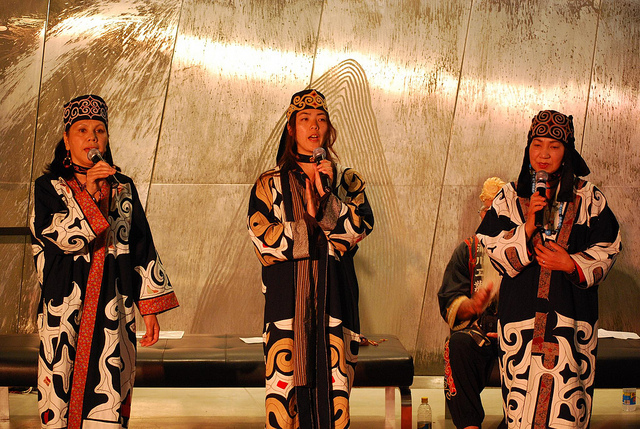
The year 1994 marked a great turning point for the Ainu people, as the first ever Ainu, Shigeru Kayano, entered the Japanese diet. Shigeru dedicated his life to promoting the well-being and awareness of the Ainu people. It was thanks to him as well as other supporters that the law forbidding Ainu culture was lifted in 1997. Since then, government funding and cultural freedom has allowed the Ainu people to start regaining and preserving their precious way of life through Ainu language courses, radio stations, and public performances.

Below is a woman playing the tonkori, a traditional Ainu instrument:

Still more recent landmarks in Ainu history include the official recognition of the Ainu as the indigenous people of Japan in 2008 and the formation of the Ainu political party in 2012. It seems that while there is still some discrimination of the Ainu people, those who rejected their heritage before are beginning to admit it openly or even embrace their identity with pride.  A great example of this is the band known as The Ainu Rebels. This band is a group of proud young Ainu who have mixed hip-hop and traditional Ainu music, and I have to say, I’m a fan.

Although the Ainu culture is on the brink of extinction, it seems that more and more effort is going into bringing it back to life. These days, young Ainu such as The Ainu Rebels are doing their best to create a new identity for their people and a Japan more open to minorities. Since the depth of the Ainu culture and language can’t be expressed in so few words, I recommend reading more about them or, if possible, experiencing Ainu culture for yourself.

  • Czime

    Awesome post! I love it! I am looking forwards to more like this!

  • http://www.tofugu.com koichi

    I’m simultaneously so happy that they are raising a bear like a human child yet so sad about what happens when it comes of age.

    ⊂( ̄(工) ̄)⊃

  • Minu

    thank you so much for writing this article. its well researched and updated. thumbs up to the tofugu team.

  • Mwani

    This is a freaking awesome article. Thanks for putting it together and I appreciate all your hard work! It’s so informational!! I learned more about the Ainu history and culture in this article than I ever knew before, thank you for the links as well!!

  • Guest

    I’m sure the bear was looking forward to this rite of passage his whole life, so its not all sad. :-)

  • Beetle BANE

    well apparently that edit messed up. sorry.

  • Beetle BANE

    I had read of the Ainu before and find it of an interesting history. I am totally glad that they are attempting a cultural revival, even if it might be on the brink of being too late.

  • Kaylan

    I was actually just looking into the Ainu not too long ago. Love the article~! I hope they’ll be able to continue the cultural revitalization – I want to see more cultures thrive again!

    I find Ainu sounds MUUUUUUUCH more similar to the First Nations languages than Japanese, though.
    ((Listening to it actually makes me remember in school when we had a man from the First Nations come to our school and had us all sit in a circle while he told stories and sang; or when my friends would sing small songs in Black Foot or do dances…miss those days :/))

  • http://akira.hana.bi/ Akira Uchimura

    Very nice article.

    A few years ago we went to the Ainu Museum in Hokkaod and she gave us this presentation playing the Mukkuri. It was just amazing. Wait to the end where she starts to “beatbox” with it.

    http://www.youtube.com/watch?v=uO9uDMB94M0

  • Sarah

    This is great!!! One of the best videos I’ve seen of the mukkuri. So, this is the performance that you saw yourself? You’re so lucky to have been there! Thanks for including this in the comments, this page really needed some mukkuri, it’s really a unique instrument =)

  • Sarah

    Yay!! I’m glad you’re excited about subjects like this!! =)

  • Sarah

    It is pretty awesome that they are trying to preserve their culture, isn’t it? I was excited to hear that, too. Japan was actually the last 1st world nation to officially recognize their indigenous people!

  • Casual Pirate Game Player

    If Ainu are the indigenous habitants, where do Japanese such as Koichi come from? Please don’t tell me that they come from the sun…
    If we talk about traditional Japan, are we actually talking about Ainu culture?
    We need a follow up!

  • http://akira.hana.bi/ Akira Uchimura

    Thanks for your comment and this great article Sarah. Yes this is a video I took of their presentation about 4 years ago. :)

    I also saw the Ainu Rebels present at the Shake Forward (http://www.wajju.jp/shake2008/ )event. It was very inspiring but also sad to know they disbanded soon after.Now the manager transformed to Ainu Pride http://www.ainupride.com/about.html

  • zachary T

    nice article. I have to say, spoken Ainu sounds like some Native American languages, but if theories of the Bering Strait crossing are accurate it should not be that surprising.

  • Beetle BANE

    Was it? I did not know that! That’s a bit messed-up really

  • Frank Fortune

    wow I learned a lot today… thank you!!

  • Silver Sabrewulf

    Wonderfully educational article. I’ve only known about the Ainu people for a relatively short time (about 5 years), but my knowledge never went far beyond “they are Japan’s indigenous people”. Learned a whole lot today.

  • Jonathan Harston

    Just looking at the geography is seems clear that Ainu Japanese migrated from the Siberian/Mongolian areas as part of the North American migration, and the Yamato Japanese migrated from Han/Manchu areas through the Korean Peninsula.

  • Reverie

    I really enjoyed this article! Special thanks for the linguistic bits, you really described the language in a way I could understand! I’m excited to learn a few sentences from the dictionary you posted and see how the language works more.
    I once saw a documentary on NHK about Oki a long time ago (2006?), it showed a “flashback” of him visiting his cousin’s museum and pulling out the tonkori and not knowing how it should sound, or be tuned, or how it was built to be played. He had to search to find someone who could tell him about it. It’s unbearable to think an instrument can sit, unplayed, and unknown, instead of being passed down in song. It makes me so very glad we get to see cultures’ languages and music appreciated and revived more and more.

  • DAVIDPD

    Kind of strange how almost every indigenous culture is wiped out by the more populous, dominant culture that invades the country. I really can’t think of one native population that has continued to thrive after the arrival of another, dominant culture crashes on shore.

  • Epell

    Koreans do distinguish b and p sounds though. I don’t get why all wikipedia articles/image search writes that 불 can be “bul” or “pul”.
    불=bul and 풀=pul, obviously to a natively speaker (me).
    At least one other guy thinks so (http://weknowmemes.com/2012/04/learn-how-to-read-korean-in-15-minutes/)
    Perhaps it has to do with IPA definition of b and p? I have no clue.

    Also some people may have heard of the Ainu from relatively popular Shaman King series (Horohoro’s tribe in Hokkaido).
    Obviously, it is fictionalized but some people did look up Ainu because of the series.

  • Birdbro

    I don’t want to be that guy but does Tofugu source their articles?

  • http://zoomingjapan.com/ zoomingjapan

    Very interesting article. I’m interested in the Ainu people, but I haven’t been in Hokkaido often enough yet.
    You’ll find a lot about Yayoi people in southern Japan, e.g. in Saga Prefecture, though, which is also extremely interesting. :D

    It’s sad that the Japanese government tried to deny the Ainu existence and was hoping for them to vanish forever. :(

  • Sarah

    I suppose I should source this, but I got my info by bringing this up with a linguistics professor at my school in Japan!

  • Pepper_the_Sgt

    If by “traditional Japan” you mean Japan after 500 A.D, then, no that’s not Ainu (although they were still around somewhere doing their own thing). Before 500 A.D. there’s not much documentation of Japan really. Just cruising through an overview of Japanese history on Wikipedia, it looks there’s a handful of references to Japan from the Chinese, and they seem to be referring to the Japanese people (“Japanese” meaning “not Ainu”). The Yamato clan became some kind of political power over the land around 300 A.D., and that’s where the imperial line comes from.

    My understanding is that no is really sure where the Japanese people came from, but the Ainu people were already on the land called Japan when they got there. It’s reminds me of Europeans sailing to America and eventually pushing out the Native Americans, just way earlier.

  • Pepper_the_Sgt

    I bet several people on Tofugu have played the PS2/Wii game “Okami,” right? The Oina people in the northern Kamui region (a different spelling of “Kamuy”) are inspired by the Ainu. “Oina” means epic poem in Ainu, and the people there transform wolves, which apparently is a reflection of the animistic religion. Most of the Ainu today are in Hokkaido, which is basically Kamui in the game (north, cold, snowy). Your little sidekick, “Issun,” and his race of tiny people are based on some folklore of the Ainu. There’s a lot of cool stuff, so if you want to have a Wikipedia tab explosion you can start here:
    http://en.wikipedia.org/wiki/Koro-pok-guru

    I actually first learned about the Ainu because I played Okami. Games can be educational!

  • 古戸ヱリカ

    More like BEAR mitzvah, eh? Eh?

  • 水音しゃひーろ

    If the word for spirit/God in Ainu is kamuy, could the Japanese word kami possibly come from Ainu?

  • Fredde

    Good post! but lol at “Japan … is an ocean of diversity”

  • Stuart Green

    Excellent! I love reading about the Ainu and Ryukyu Kingdom. If there are more “unknown” ethnic groups, please reveal them to us.

  • margaret

    Too cruel to bears – and owls.

  • totoro

    This was a fascinating article, thank you! I really want to do some more research on the Ainu now.

  • Mk Mitchell

    Thanks so much for doing an article in the Ainu. It’s hard to find a lot out about them. I loved the videos too. The Ainu language sounds very beautiful. When you see it written it seems very similar to Japanese but when you hear it spoken it really is different.

  • Hikari

    Thanks for the interesting article! :)
    I don’t know if you’ve already heard of them, but there’s a band called “Imeruat”, which means “Lightning” in Ainu language. They consist of videogame music composer Masashi Hamauzu and the vocalist Mina, a descendant of the Ainu. Their music is a combination of electronic sound, classical music and Ainu folklore, since Mina is also able to play the tonkori and the mukkuri. It may be not everyone’s cup of tea, but I like their music very much.

    http://www.youtube.com/watch?v=WrtwOkAvyoY

  • GoodGodGenocide

    They didn’t “try to deny the Ainu existence.” The word you’re looking for is “it’s sad that the Japanese government committed genocide and now refuses to acknowledge it in any way, going so far as to insist that Japan is ‘homogenous’, openly insulting the memories of the people they brutally wiped out.”

    The word you’re looking for is “genocide.” Japan is a nation built on genocide – a genocide that lasted all the way into the the late 20th century – nearly to the 21st century.

    Think about that. Japan was committing genocide, openly, well past the end of WWII, all the way to the end of the 20th century. And yes, before anyone tries to say, “It wasn’t genocide,” outlawing language and culture is something called “cultural genocide.” The article makes clear that the Ainu have been all but wiped out from public consciousness and memory because, though the people remain – the very IDEA of their existence is gone.

    Think about that. THAT is Japan. For all you people gushing about how all you want in life is to visit here or live here – think about that.

  • GoodGodGenocide

    Note that NOWHERE in the article is the word “genocide” ever mentioned. I understand why the Japanese want to deny the brutalities of their history (and of their contemporary culture, which is way more brutal than most people realize), but what is it with otakus insisting on treating Japan with kid gloves like this?

  • GoodGodGenocide

    How did the author get through this entire article without once using the correct term for what the Japanese did to the Ainu – “cultural genocide.” Seriously, how do you manage to write this much about the Ainu and not acknowledge the simple fact that they are victims of genocide?

  • GoodGodGenocide

    “If we talk about traditional Japan, are we actually talking about Ainu culture? ” Exactly one reason why Japanese people don’t talk about the Ainu – they mess up the national myth of Japanese purity. When people say, “It’s ok for the Japanese to be racist within Japan because it’s their nation,” this history is what we’re ignoring. The homogeneity of Japan is BUILT ON GENOCIDE. The only reason Japan is “homogenous” is because the Yamato Japanese brutally wiped out ALL THE OTHER PEOPLE on the archipelago.

    If we talk about traditional Japan, what ARE we talking about indeed. Japan has a rich history of ethnic and cultural mixing – lots of Japan’s greatest traditions come from China and Korea, and Chinese and Korean immigrants helped build this country way back in the Nara period.

    The concept of “traditional Japanese culture” is wrapped up in and shrouded in racial – and racist – myth and legend. The very concept of “homogenous Japan” is a DEEPLY racist concept that we, as non-Japanese, should have the human decency NOT to propagate. Japan is NOT homogenous – it only looks that way because of all the genocide.

  • 古戸ヱリカ

    “the Ainu people lived in Japan under a policy of extinction by assimilation”

    But hey, it doesn’t contain the word genocide, so I guess it doesn’t count?

  • Raccoon Child

    Shaman King! Yes! Bless your soul for mentioning it. ♥

  • kayumochi

    It is likely that the Japanese language and Shinto religion were shaped by the pre-existing Ainu culture on the islands just as the first wave of immigrants from the European mainland to the British Isles had their language and culture shaped by the pre-existing hunter gatherers who were cut off from the mainland by the formation of the English Channel. Later waves of immigration from Europe to the British Isles were shaped in the same way …

  • kayumochi

    Reminds me of the first (and subsequent) waves of *immigrants* from the European mainland to the British Isles: There were swarthy dark-haired hunter-gatherers tribes who had lived in the British Isles long before there was an English Channel and the *Isles* were connected to the mainland. The *immigrants* brought farming, new gods and a new language …

  • Cristian Aska Malatesta

    Latins, Sabines and Etruscans. They all were indigenous inhabitants arround the Rome area to end up to assimilate each other. None of their cultures have been truely annihilated, even though what we know today about Etruscans is really little.
    They simply mixed up time by time…

  • Jenny Coen

    I will learn any language and about any culture to have a bear friend such as the one holding that bespectacled gentleman’s hand.

  • Stan

    Entertaining and factual article. Great job. I just wanted to point out a small mistake I found regarding the Ainu bear ceremony. It is called “iomante” and not “iotame”.

  • Stan

    What do Ainu do to owls?

  • bob

    Finland is pretty much an entire group of ethnic Finnish peoples with pockets of Swedish living among them. The land the Fins lived on was part of Sweden for many years, and then Russia took it. Eventually, they had an opportunity to declare independence after the Russian Monarchy collapsed, but they were cornered into several unique political positions throughout the 20th century in order to maintain their independence (such as being an Axis power because Stalin hated them.) You should look up the Finnish Russian war if you want to know how hard they had to fight for self determination.

    As for the indigenous peoples in the north of Finland (Sami), no one really bothers them I think. It is too cold lol.

  • Maria

    There are forces behind this, and it comes down to be the forces of evil and good. The truth is that the Indigenous Population of the earth are the earth itself and know how to live in harmony. The force behind the civilization we currently have as dominant is a negative force. We should learn by the Ainu and the other inidgenous groups who have always lived in harmony with the earth.

  • Maria

    Thank you so much for so much precious information.