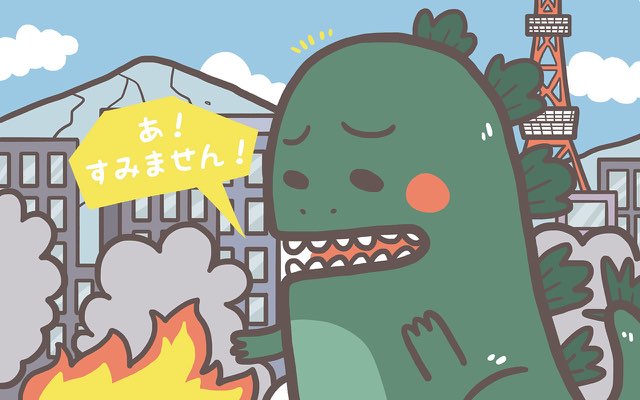
Imagine yourself on the city streets of Japan.
Here, let me paint a picture for you.
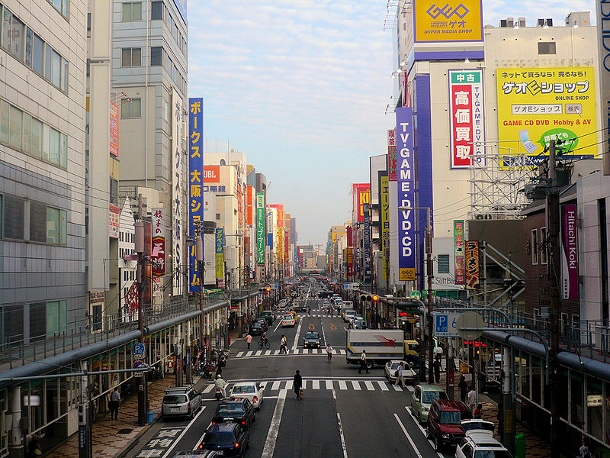
A crisp autumn morning, salarymen heading toward their places of work pace past you; a group of school boys loiter around the sidewalk, cackling at something unknown; a woman meanders around you on her bike when – oops! – you notice her wallet drop. “Sumimasen!” you yell, scooping up the wallet and running after her. “Sumimasen!” The woman’s brakes screech to a stop as she finally hears you, and she turns slightly to see what the commotion is about. “Ah! Sumimasen!” she exclaims as you reach her, wallet in hand.
If we were to translate the word “sumimasen” in the above situation into English, we could say that the best interpretation of the first use of the word, when you try to get the attention of the women, is “Excuse me!” However, the second use of the word, when the women receives her wallet, might be better translated as “Thank you.”
If you’ve been to Japan before then I’m sure you’ve realized that sumimasen is one of those words that you just can’t help but notice. Sumimasen, also often pronounced suimasen or sumasen when speaking, is one of the first words learners of Japanese pick up not only because it’s taught early on, but because it’s used so often and in so many situations.
Although most students of Japanese learn the word sumimasen as “excuse me” or “I’m sorry,” this versatile expression is laden with cultural background and can actually carry many subtle shades of meaning when thrown into the various contexts of Japanese interaction.
So why is sumimasen used so often and what does it actually mean? Well, several linguists have asked themselves that very same question and tried to answer it. I’m going to try my best to summarize some of their findings and describe the uses of sumimasen, an expression so important to the Japanese language and culture.
What Does Sumimasen Mean?
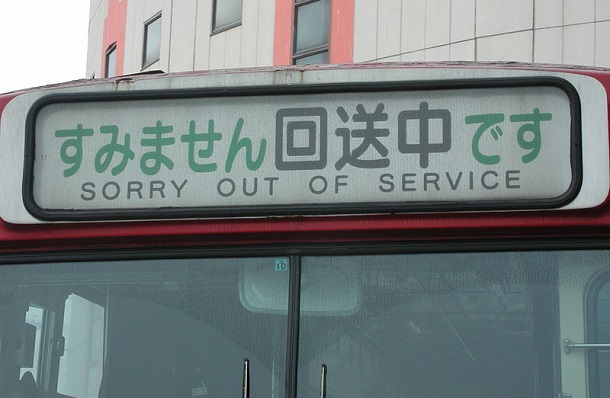
So, let’s get nerdy for a second (ok, for a while) and start off by asking ourselves one thing: what is sumimasen? From a sociolinguistics perspective, as you might guess from hearing the word so often in daily interactions, sumimasen is a ritual expression. In other words, the repeated use of sumimasen is often times more of a social routine than an expression of legitimate emotion. So, although it may seem like the Japanese are entirely too apologetic given all that sumimasen flying about, it’s really more about common courtesy.
According to this pretty sweet linguist Goffman, ritual expressions like sumimasen can be broken down into two sub-fields in linguistics: remedial expressions and supportive expressions.
Remedial expressions are those used when there has been a potential offence between two individuals. So, when you sling a paper bag of flaming dog excrement onto your poor old neighbor’s porch this Halloween, the appropriate remedial expression would be “I’m sorry.”
The second type of expressions, supportive expressions, are those ritual exchanges we use on a daily basis to maintain somewhat normal relationships with the people in our lives such as friends and family. An example of this would be using greetings when meeting other individuals, like, “Why, hello! How are you today?” instead of saying nothing and sulking by wearing the expression of someone who just sat on a cactus.

Most of the time, a ritual expression will fit into one of the two categories, remedial or supportive. For example, the expression “I’m sorry” would be remedial, while the expression “Thank you” would be supportive.
However, sumimasen is just so hard core it breaks all the rules. Another great linguist, Risako Ide, showed this by finding seven uses of sumimasen in recorded public conversations at a doctor’s office. She found that sumimasen is a unique expression in that it functions as both a remedial expression, and supportive expression, and everything in between.
How To Use Sumimasen
Sumimasen is a formal expression, so most of the time it is used in public conversations. For that reason, most research on sumimasen has been done in public settings, just as Risako Ide did using recordings from a waiting room in a doctor’s office.
Below I’ve listed the 7 functions of sumimasen according to Risako Ide. Separating the uses of sumimasen into definable groups makes it clear that the expression means more than “I’m sorry” or “excuse me” to the Japanese people.
1. Sincere Apology

Originally the expression sumimasen was used only as an expression of apology, such as gomennasai, or more formally, moushiwake gozaimasen. Therefore, using sumimasen as a sincere apology is pretty straight forward. You can use it when you’ve really messed up and you want to make a legitimately apology.
Friend: Hey, you ate all my matcha Kit-Kats again didn’t you!?
You: sumimasen.
I sincerely regret this. Therefore, using sumimasen is a perfectly viable option.
2. Thanks and Apology
While one use of sumimasen is a flat out sincere apology, it can also be used to express a sense of mixed regret and thankfulness. Say what? Perhaps you’ve run into this situation in Japan, or any other place for that matter:
You’re in line at seven eleven patiently waiting to purchase your dinner, a pack of Take no Ko (chocolate covered cookies) and a bottle of Calpis. You get to the front of the line, and the clerk rings up your selections to a total of 310 yen, so you hand her 400. “You don’t have 10 yen?” she asks hesitantly. “Oh, yes, I do.” you reply, digging in your wallet and then eventually dumping over your entire book bag to scrounge up the change. “Sumimasen,” the clerk repeats over and over again.
If you’ve been in this situation in Japan before, you might have thought the clerk apologized one too many times for a favor as small as requesting exact change. However, in this context, while the clerk may regret making you scrounge for an extra 10 yen, she is most likely expressing her gratitude to you for going through the trouble to help her out.
In this sense, sumimasen has the ability to express both a sense of regret and thankfulness. In fact, using sumimasen in situations involving debt to another like the one above could be regarded as a more polite thank you than arigatou, as it shows the speaker’s awareness of the other person’s trouble and also adds a tone of humbleness.
3. Making a Request

Sumimasen can also be used prior to making a request of someone. This use of sumimasen is similar to “excuse me” in English, as in “Excuse me, but could you please pass me the biscuits? They look so swell.” You might come across this in Japanese if you are required to pay a fee for something, or if someone asks to barrow money from you.
Using sumimasen to make a request would classify it as a remedial expression in that it attempts to downplay any offense someone might feel in the given situation. In this way, it is also similar to the English expressions “do you mind if” or “could you please.” So, if you need to ask someone a favor and you want to be a bit more subtle than “DO THIS OR DIE,” you might consider using sumimasen.
4. Getting Attention

Hey! Heeeey! Do I have your attention? Up until now all the uses of sumimasen we’ve discussed have been related to feelings of regret and thankfulness. However, using sumimasen does not always denote one’s pouring out of emotions.
Sumimasen can function as an attention-getter. While there are many other conversation starters in Japanese such as ano, konnichiwa, or even clearing your throat, sumimasen is often used between people who are not familiar with each other, making it the polite way to get someone’s attention. This is the same sumimasen we used in the story at the beginning of this post when the woman dropped her wallet, and it is identical to English’s “excuse me” used when talking to a stranger.
5. Taking Leave

Opposite of getting someone’s attention, sumimasen is also used when ending a conversation or taking leave. A typical conversation closing might look like this:
Dracula: Ja, sumimasen
Frankenstein: A, odaiji ni
Dracula: Well then, I’m off.
Frankenstein: Oh, take care then.
When using sumimasen as either a conversation opener or closer, how grateful or regretful you feel becomes somewhat irrelevant. At this point, sumimasen is more of a routine expression than anything else. And since it is being used as a greeting and no offense is involved, it has become a supportive expression rather than a remedial one.
However, since there are other greetings used to open and close conversations such as konnichiwa or sayoonara, sumimasen does still display a slight sense of thankfulness or regret for the attention that the speaker received in conversation.
6. Affirmative Response
As sumimasen leans more and more on the side of a supportive expression rather than a remedial expression, the meaning of sumimasen becomes more and more vague, making it difficult to translate and understand if you haven’t been marinated in Japanese culture.
Another function of sumimasen is to confirm something or respond to someone in an affirmative manner. Here’s an example:
Imagine that you are at the bank, sitting with a group of people waiting to be served at the counter. Suddenly, the man next to you is called. “Ieda-san! Omataseitashimashita (thank you for waiting)!” the clerk shouts, and the man responds with “sumimasen.”
Sumimasen? The first thing I would be thinking is “what in the world has this man done wrong?!” Absolutely nothing. Saying sumimasen in this context allows the man to respond to the clerk in a face-to-face situation while also acknowledging the fact that she is going through the trouble to call him and give him service.
In other words, using sumimasen here is the polite way to respond “OK” or “yes.” Honestly, this can be tricky to wrap your mind around if you’re not too familiar with Japanese culture, but it’s not uncommon to hear.
7. Ritual Greeting / Exchange of Acknowledgement

At this point, we are the furthest distance away from a sincere apology, the original function of sumimasen, that we can get. It’s all ritualistic yakking from here on out. Imagine the following:
A woman goes to the department store to buy a new bicycle which requires her to fill out a registration card. After she fills it out, and the clerk assisting her checks it, the clerk returns it saying “sumimasen,” and of course, she replies, “sumimasen.”
So much sumimasen. Does it even mean anything anymore? The first sumimasen is similar to number six, an affirmative response, as he acknowledges the fact that the registration card is complete. The second sumimasen? Perhaps a polite way of a receiving the card.
Whatever it is, the most basic way of looking at sumimasen in this context is as a “symbolic gesture of concern.” I guess awkward silences have to be filled somehow, and sumimasen just happens to be the way to do it. In a way, you could compare this use of sumimasen to high school students greeting each other in the hallway with “sup?” in the sense that it is only a symbol of acknowledgment and has no real meaning.
What It All Means
Alright, so I’m sure that you get it by now: sumimasen is used heavily in Japanese communication. As you can see from the examples above, this one word is used to express many ideas besides “I’m sorry.”
However, all functions of sumimasen do have one thing in common: the “acknowledgment of indebtedness to others in society.” Understanding this, we can clearly see how some Japanese societal values are reflected linguistically in the term sumimasen.
Japanese society is highly concerned with indebtedness towards others and also the individual’s social role in public. Even very small favors have the effect of forming mutual debts and responsibilities between members of the society.
The priority put on public appearance and debt in Japanese society is perhaps the reason why the term sumimasen is used so often in public interactions; it allows Japanese speakers to put themselves in a humble position and show their “debt” in many circumstances. Could this high prioritization of “debt” be the reason why the term sumimasen is more polite in places where alternative expressions such as “thank you” would normally be said in English and many other languages?