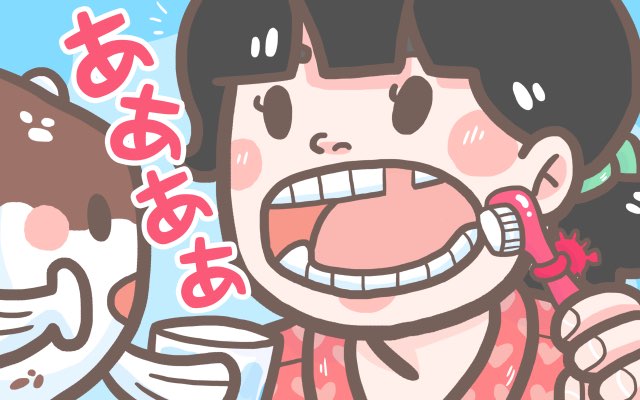
The Art Of Japanese Tooth Brushing

How many times should you brush your teeth a day? That might seem like a common sense question, but your answer may vary depending on how you were raised or even which area of the world you come from.

In some places, brushing your teeth once a day might be considered more than enough, but in other places, brushing only once could be considered a disgrace!

In Japan, the saying “cleanliness is next to godliness” might be the best way to describe tooth brushing culture. People are generally expected to brush their teeth after every meal, or as many as three times a day. Brushing your teeth may sound simple enough, but every place has their own thoughts on the subject, too. Let’s take a look at tooth brushing, or hamigaki, from the Japanese perspective.

The History of Hamigaki

Believe it or not, toothbrushes as we know them today haven’t been around forever, but that doesn’t mean that no one cleaned their teeth in the past. Before the invention of modern synthetic toothbrushes, people turned to nature for the tools to polish up their pearly whites.

In ancient times, the Japanese relied on toothpicks or tassel made from branches with antibacterial qualities to clean their teeth. It’s unclear when the Japanese picked up this habit, however, in Japanese Buddhist scriptures there is a story in which Buddha throws a used toothpick to the ground, causing a large tree to sprout forth from the earth. Therefore, toothpicks must have been in use shortly after the introduction of Buddhism to Japan at the latest.
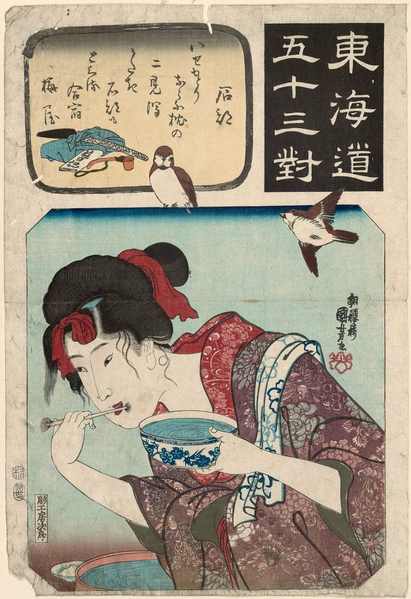
hamigaki

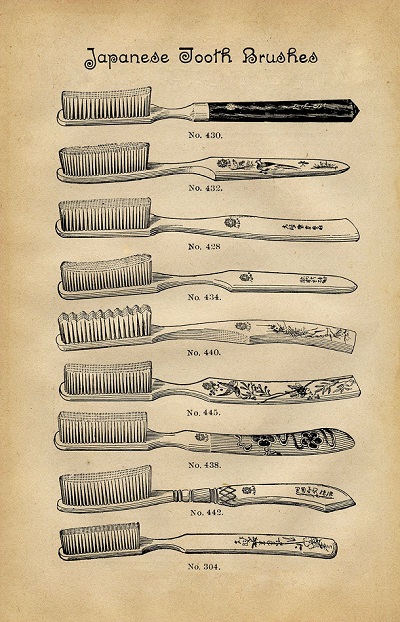
In 1223, the Zen Master Dōgen Kigen recorded that he witnessed Chinese monks cleaning their teeth using brushes made from horse-hair and attached to the end of an ox-bone handle. It may have been around this time that the Japanese were first introduced to the idea of a modern toothbrush. Later on, toothbrushes started to look like what we know today, especially after contact with the West. The following picture comes from an 1880′s pharmacy catalog:

toothbrushes-graphicsfairy002sm

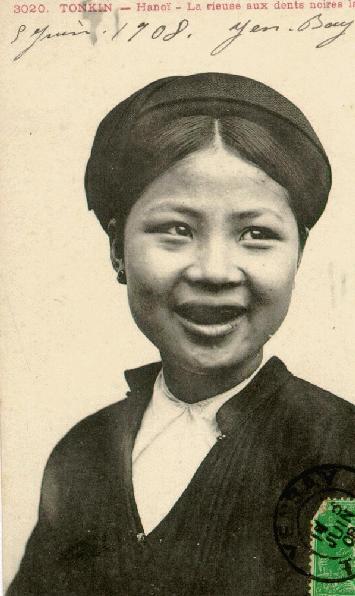
As a side note, another factor that contributed to the maintenance of teeth in Japan was the tradition of “ohaguro,” or the blackening of teeth.

Tonkin_woman

While this tradition was done primary for reasons of fashion and status, it also indirectly protected one’s teeth by forming a protective barrier around them. Usually this was done with a dark-brown concoction made of ferric acetate, made by dissolving iron filings in vinegar. When the solution was combined with vegetable tannins it would turn black and become non-water soluble [Source]. Oh, and you’d have to apply this once every day or every few days. I wonder how it tasted!

Hamigaki Culture Today
IMG_0973

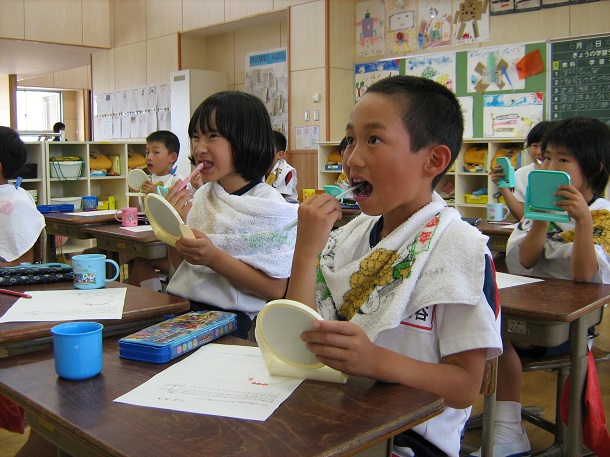
Often times a people’s values are reflected in the lessons taught to their children, and in the case of tooth brushing in Japan, this is especially apparent. One of the earliest memories many Japanese people share is learning how to brush their teeth with their parents. In fact, tooth brushing is considered a family bonding activity and is done so until a relatively late age.

For me, this was shocking news and what made Japanese hamigaki culture stand out to me, as I realized I didn’t have one memory of brushing my teeth with my parents. If you search YouTube for “hamigaki,” be careful – you could be captured for hours by all the adorable home videos of children learning to clean their little chompersIn order to save you from such a terrible fate, I’ll just show you some here:

As the ritual goes, children usually try to clean their teeth on their own first. Then, when they are all finished, the child will usually lay their head down on their mother’s (or father’s) lap where the parent finishes the job, making sure to get all the nooks and crannies.

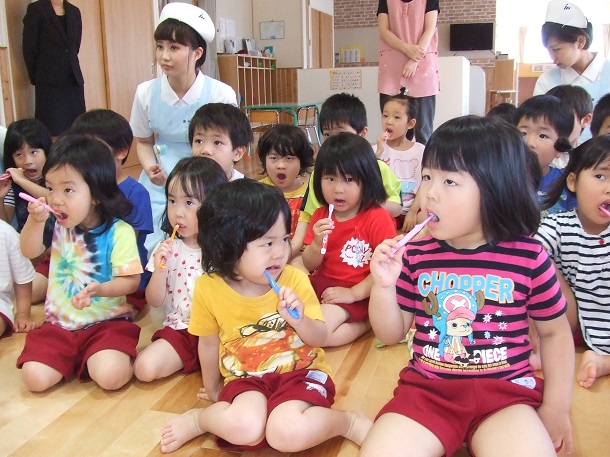
But tooth brushing is not just an activity done between parent and child. In Japan, children are expected to brush their teeth after every meal – even at school! In fact, Japanese school children are all made to brush their teeth as a group in the classroom every day.
DSCF5787

Of course, as you can imagine, keeping the attention of a group of 8 year-olds on a task as mundane as tooth brushing isn’t the easiest thing in the world to do, but Japan has a (cute) solution for everything it seems. Over the years, several tooth brushing songs focusing on the fun sound effects of hamigaki have been created to keep kids’ attention.

Honestly, I wish I had heard these when I was a kid:

This kid loves the tooth brushing song so much, he keeps asking his mom to do it over and over again or else he stops brushing his teeth!

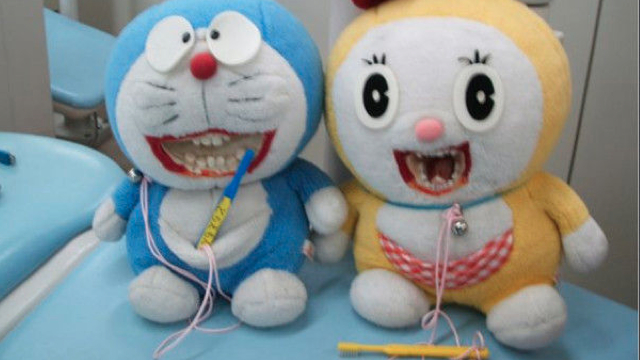
In addition to songs, many tooth brushing toys have been created to help demonstrate the correct way to brush your teeth and instill good habits in children’s minds. That, or just scare them into doing it. I’m not sure which. Even candy companies have developed their own teeth cleaning toys.
original

Either way, the amount of effort put into teaching kids good tooth brushing habits seems to have good results. According to What Japan Thinks, around 50% of adults brush their teeth after every meal, even if that means brushing in public. To be blunt, from the perspective of someone outside of Japanese culture it can be a bit strange to see your professor brushing his or her teeth in the office if you aren’t used to it.

Brushing Your Teeth In Japan

toothbrush_dance_by_prez42-d3kynvm

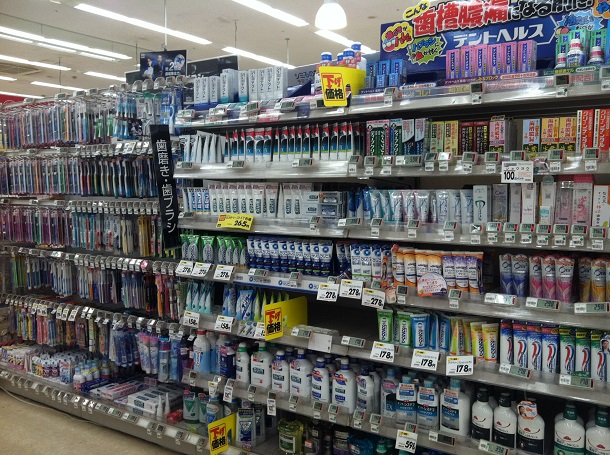
So, you’re in Japan and you forgot to bring your toothbrush. That, or you’re going to be there for a long time and you’re going to have to adjust to everyday Japanese culture. Looks like you’re going to have to make a trip to the store. However, when you get to the toothbrush aisle you will find yourself confronted with a million products, none of which look familiar to you. Excluding running out the door and not brushing your teeth for a year, what would you do?

There are several rumors out there concerning Japanese toiletries, and toothbrushes / toothpaste are not excluded, but here’s the truth of the matter.

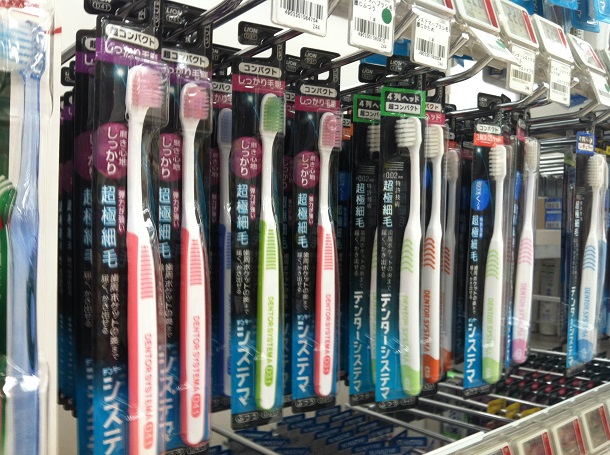
In general, Japanese toothbrushes, or haburashi (歯ブラシ), are made much smaller and softer than those in some other countries. Some people have problems with this, but they are made this way to make brushing less harsh on your teeth and gums, and also to make it easier to maneuver the toothbrush. If you happen to prefer more “petite” brushes, you might want to consider ordering one from Japan.
IMG_1548

When it comes to toothpaste (also known as hamigaki), there are about a million and a half brands on the shelf, all of which are in Japanese and can be very hard to sort through for those who can’t read the language.

IMG_1545

In addition, many people are under the belief that Japanese toothpaste doesn’t contain what could be considered essential ingredients, such as fluoride. After checking the ingredients of a few brands myself, I found that this is partially true. However, some brands do contain fluoride. If you’re in Japan and you’re looking for a brand of toothpaste that does contain fluoride, I would stick to using Aquafresh. That, or you can look for fluoride (フッ素, ふっそ) in the ingredients.

It seems funny to me that you would brush your teeth so many times a day and yet not use fluoride. Surprisingly, it also happens that some Japanese people don’t use toothpaste at all. In places where you don’t want to make a mess such as school toothpaste is also not used.

In Japan, teeth related products are made to be a much bigger deal than many other places. In America, I recall seeing some unmemorable ads here and there for toothpaste and toothbrushes, but none of those could compare to the magnitude of Japanese advertising campaigns in this field.

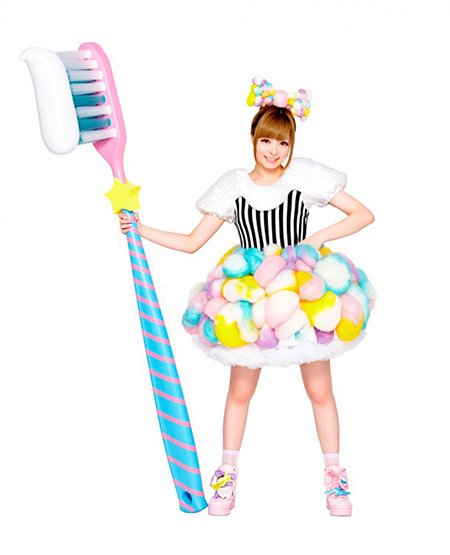
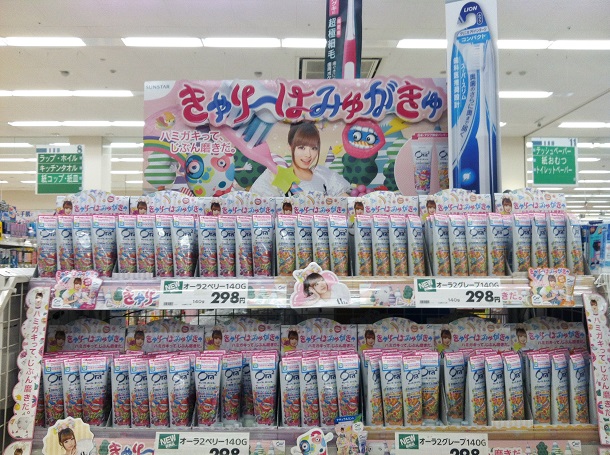
Recently, world renown J-pop artist Kyary Pamyu Pamyu signed on to be the selling face of Ora2 toothpaste.

news_1380461376_main

She will be advertising the product in countries such as Singapore and Thailand in addition to Japan, making this her first appearance in an ad campaign outside of her home country.
IMG_1542

With this toothpaste,  Kyary Pamyu Pamyu can take the kimo right out of your kimo-kawaii.

Personally, I find this campaign makes a statement about the role of oral health in Japanese society because I simply couldn’t imagine someone like Lady Gaga advertising Crest toothpaste. Besides, I really wouldn’t like raw meat flavored toothpaste.

The Future of Hamigaki
hamigaki-intro-2

So what is in the future of hamigaki? About a year ago scientists in Japan created a microscopically thin film that coats the teeth and prevents tooth decay and can even make the teeth appear whiter. Although this product isn’t available yet, it will be in the next couple of years. Perhaps brushing your teeth will become unnecessary in the future? Well, maybe not, but it’s a nice thought.

What do you think about hamigaki culture in Japan? How is it compared to your own culture? Let me know in the comments!

[hr]

Bonus Wallpapers

hamagaki-animated-700
[1280x800] ∙ [2560x1600] ∙ [Animated 1280x800] ∙ [Animated 700x438]

  • http://akira.hana.bi Akira Uchimura

    that photo of Doraemon and Doarmi chan with teeth is going to give me nightmares tonight.

  • Ushirogami

    This is an Italian commercial: http://www.youtube.com/watch?v=oiXvAPuHR0I after watching Kyary Pamyu Pamyu commercial I want to cry

  • Christopher Stilson

    Our little boy insists on brushing his own teeth, and growling as he does so because he’s being a kaijuu (because if you’re going to be chowing down on whole cities, you gotta brush after!)

  • Jonathan Harston

    A lot of British adverts are: Hello, I’m dentist and (edit) my patients’ (edit) teeth (edit) are very healthy because they (edit) use ShineySparklePaste.

  • Gianmarco Russo

    Noi Italiani siamo ben più trash dei giapponesi, dai.

  • Aya

    Aw, that is so cute! And so true. The Crabigator and Godzilla are actually toothbrush buddies

    http://i1356.photobucket.com/albums/q731/sanapple/toothbrushbuddies_zps282b2def.gif

  • Aya

    Aw, that is so cute! And so true. The Crabigator and Godzilla are actually toothbrush buddies~

  • http://www.tofugu.com koichi

    That kid is going to grow up to be me D:

  • Saimu-san

    That or they full on lie to you or over-exaggerate the facts to get you to panic buy their shiz.
    http://www.youtube.com/watch?v=j9aII8F_8y4
    Spitting blood when you brush your teeth?

    THEY’RE FALLING OUT! WASH YOUR MOUTH WITH THIS BURNING MINT WATER TO SAVE THEM!

    I can’t find it online but there was also an ad recently that said that bleeding gums when FLOSSING means you could have gum disease even though my dentist said it was normal.

    There’s also those ones on both side of the Atlantic where they scan a random person’s mouth and are supposed to show the “bacteria” on the teeth even though the rest of the mouth is clean. Lol.

  • lychalis

    preeeetty much – and don’t forget the drunken camera angles :D

  • Jonathan Harston

    I asked my dentist years ago (who’s been my dentist since I was born!), and she said: clean your teeth as often as they are needed. The “clockwork” cleaning regime is to get children into the habit of cleaning their teeth, they don’t *need* to be cleaned that often unless you’re eating toffee at every meal.
    I tend to clean my teeth in the shower, and as I’m not a coal miner, I don’t shower three times a day! :)

  • Jonathan Harston

    This advert is from the 1980s, but feels *sooo* 1950s, and has recently started being run again. It’s one of the few non-dentist talking-head adverts. http://www.youtube.com/watch?v=luVtgX4S3y4

  • linguarum

    On the other side of the coin, in America it’s encouraged to see a dentist for a checkup once every 6 months (whether you faithfully brush and floss or not). For whatever reason, that’s a tradition that never caught on in Japan. Most Japanese people never see a dentist unless there’s a problem. Maybe they don’t need to because they brush their teeth so much? ;-) On the other other side of the coin, with the frightening lack of orthodontics in Japan and a “yaeba” culture where having a snagglemouth is considered cool (http://www.tofugu.com/2012/04/25/why-crooked-teeth-are-straight-up-beautiful-in-japan/), you’d have to brush a lot.

  • HatsuHazama

    You’re forgetting all the language they use that makes the creation of toothpaste sound like something invented in the secret labs of CERN.

  • Vladimir Sumarov

    The theme of tooth brushing and Japan will be incomplete without this clip https://www.youtube.com/watch?v=B1jY7BLQVMc

  • eBunny

    If only we had these songs in our country, my teeth probably wouldn’t have been so terrible.

  • Dolphinwing

    Funny how different some cultures are from each other. When I first got braces I was told to brush after every meal. So I brought my toothbrush to school and brushed with just water in the bathroom. I was made fun of and people thought I had a screw loose for brushing my teeth in school so I stopped doing it XD

  • Decade

    I think its a good thing they did not include fluoride in the toothpaste. Fluoride, specially when consumed too excessively, are harmful. Thats why there is recent organic toothpaste produced without fluoride. Imagine you “consume” three times of fluoride everyday! The reason why fluoride was considerrd beneficial is roughly the same as the reason why polyunsaturated oil is healthy for you. They are exaggerated for commercial purpose!

  • Dolphinwing

    Same here in the U.S., it’ll either be “oh I’m a dentist and I recommend my patients use blahblah” or it’ll be a regular everyday person saying “I asked my dentist what I should use and she told me shinyteeth brand toothpaste”

  • Jonathan Harston

    Two years ago at my 6-montly checkup my dentist said there was little point, and told me to come every 12 months in future.

  • Jonathan Harston

    Do US adverts also have the same bad editing as UK adverts?
    Hello, I’m a dentist and
    when
    my patients ask me
    about their teeth
    I
    tell them
    I
    use
    ShineyBritePaste

  • ヘレン ちゃん

    I really appreciate Kyary bringing some much needed kawaii to this whole teeth brushing issue, cause that Doraemon & Dorami Chan….. creepy! :3

    Here are two kids animation vids I like.
    Both have some Japanese subs, so you can learn to brush your teeth AND learn Japanese at the same time!
    Low crime rates, & low cavities; Japan is just a win-win.

    http://youtu.be/Wxsnr7knQqI
    http://youtu.be/6MMU8N28GyI

  • ヘレン ちゃん

    This is so cute tho. ;3

  • 古戸ヱリカ

    I always try to consume less than two fluorides a day.

  • legendofleo

    Anything in excess is bad. That said, fluoride is added to tap water where I live.

  • LG

    I had a Japanese boyfriend who would brush his teeth only once a day (before bed) but he would brush for literally 20 minutes, and refused to use toothpaste. I thought it was strange, haha.

  • Fabian

    In my kindergarden in Germany it was totally normal that we brushed teeth together and the very first time there even came an “expert” who showed us how to do it correctly. So, actually it’s not that different from what you described here. Anyway – very nice and funny article. Thanks a lot!

  • Miamiron

    did this German “expert” demand you reply to his statements with “ja wohl, mein Zahnbürste Fuhrer”?

  • DeTo-13

    haha can someone make a video burning them so my life can return to normal

  • http://zoomingjapan.com/ zoomingjapan

    I can’t find a really good toothbrush here in Japan. I usually get my toothpaste shipped from back home.
    And I don’t like going to a Japanese dentist – although I go regularly and have been about 10 times already. But I don’t like it that there’s no privacy in those clinics. You can see the next patient right next to you and look into his / her mouth. T___T …..

  • lychalis

    that is remarkably efficient of you :D

  • Miss Cephalopod

    I also remember a book (Pixiebuch) about a crocodile brushing his teeth, stuff like that. I don’t remember much teethbrushing from kindergarten, but I do remember the dentist stopping by to talk to show us how to do it! (And he had the crocodile as a plushie.)

  • Miss Cephalopod

    In Germany I used to go three times a year. Overdoing it a bit, I think, but my mum’s been adamant about it. (Now that I live away from home I only once or twice.)

  • Mahad

    I never thought I would read about the history of tooth cleansing in Japan you just never know what you will find catching your eyes

  • Sarah

    I feel the same way lol, I think we should promote this

  • Sarah

    Yeah it’s pretty hard. Also, don’t you hate how you have to go for multiple visits for something that should only take one?

  • Sarah

    Wow really, did he say why he didn’t want to use toothpaste? I’ve heard of some people don’t similar things in Japan

  • Sarah

    I’ve seen these and love them, thanks for including them on this page!!!

  • Arobadope

    Expected to brush teeth after every meal > still have yellow looking teeth.

    You’d think something would be done about that. More proof cigarettes being bad for the body

  • http://www.hokkaidokuma.com/ HokkaidoKuma

    The funny thing is that while there is a lot of emphasis on brushing your teeth in this country, nobody ever flosses nor sees a dentist unless they develop major dental problems. It seems like everyone here has a mouthful of cavities despite all their brushing efforts. Def need to go at least once a year to get a cleaning if not 2x a year to be on the safe side.

  • starduest

    I’m surprised to hear of this. Many Japanese have fairly bad teeth and enough have serious plaque issues for me to have noticed in my time there – including junior high school students. When I visited the dentist in Japan, I was given a 30 min lecture on the basics of teeth-brushing until my patience wore out and I told the nurse that I’d learnt all this in primary school. It wasn’t even like I needed the lecture as my teeth and gums are healthy.

  • http://zoomingjapan.com/ zoomingjapan

    Oh yes! But it also seems to depend on the clinic. Where I previously lived they usually did everything in one go, but not my current clinic. So annoying! :(

  • http://www.seriouslyspain.com/ Seriously Spain

    Fluoride is an obsession with Americans but isn’t actually necessary to brush your teeth. In fact, it can be very harmful as it is toxic in larger doses. Many European countries now no longer put it in their water.

    I never use toothpaste that has fluoride or drink water that has it in it, yet I have never had a tooth cavity.

  • http://www.seriouslyspain.com/ Seriously Spain

    It’s very bad for you and isn’t used in most European countries nowadays. Only the US, the UK and a few other countries even use it anymore, but in America that’s because of the fluoride industry paying major amounts of money to lobbyists who convince politicians it’s necessary to get voting for it to be added to water.

    And most Americans are so gullible, they believe anything companies tell them so if a toothpaste company says “fluoride is good for you” they believe it, even though it isn’t true.

    it’s toxic and has quite damaging side effects, hence European countries removing it from their water supplies. Then again, Europe is always miles ahead of America.

  • legendofleo

    FYI I’m not from America. And I don’t have time to be getting into an irrational argument with someone who hasn’t looked at the science.

  • Decade

    This. Fluoride is, unfortunately, added to tap water where I live. but health expert have gave warning but the government just dont want to listen. Government says is not 100% correct afterall.
    :(

  • Decade

    You are the one who has yet looked at the science. If you believe 100% what government add to your foods. Thats it lol

  • Decade

    Problem is easy to consume fluoride excessively while you are not being aware. :(

  • Ryan

    The science is that water fluoridation suppresses thyroid function.

  • Ryan

    Yes, in fact; they do, except we call them “ads.”