You Can’t Have Your Keigo and Eat It Too.

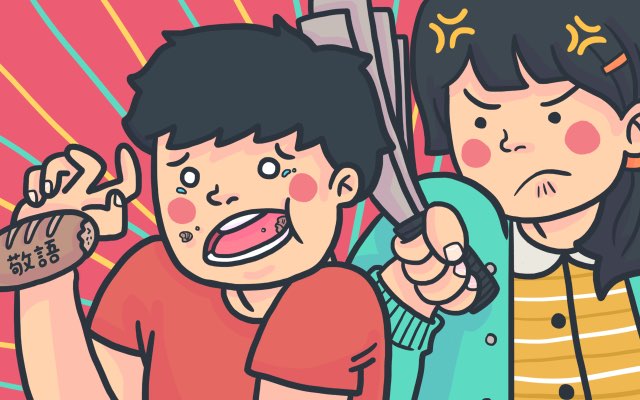
The Japanese language is a great language to learn, especially for those who love anime, but it can be particularly difficult for native English speakers. I have taught the Japanese language to native English speakers in Canada for a while now, and I often see that they struggle with three big differences in particular between the English and the Japanese languages: word order, particles and ‘FORMALITY(敬語/keigo, literally respectful language)’.

Although you could make the learning process much easier by understanding these three important differences between the English and Japanese languages, I’d say understanding ‘formality’ is very difficult even for Japanese people. In fact, it may be even more difficult for the Japanese people, as some leeway is usually given to those who aren’t Japanese.

Formality

Tōhoku_earthquake_high_five

I believe that it is generally considered a positive thing to be friendly to someone in Western countries. Although there are certain situations where more formality is required, friendly personalities usually tend to be well received. In Japan however, the situation is quite different, since the Japanese language has a “formality” system.

It is often considered rude to sound too friendly to a person who is older than you, has higher social standing, or is someone you have just met. I mean, Japanese people like people who have friendly personalities and the same is true for people of other countries.  However, it is generally preferable to be formal and polite when talking to acquaintances until you have developed a closer relationship that allows for more friendliness. Does this make sense?

Boomer

“This isn’t a good morning no matter how you say it.”

In English, it is just fine to speak the same way to everyone, within reason, right? For example, you would say the phrase “Good morning,” to your spouse, your boss, your friends, and to a complete stranger. Some people might omit “good” and just say “morning” but it doesn’t matter who you are talking to. Things are quite different in Japan.

Tell me, did you think, “Seriously? Even good morning is different in Japan?” Unfortunately, the answer is yes. There, you must speak differently to different people based on their age and their relationship to you, even when saying something as simple as ‘good morning’.

Good Morning

Okay, let me illustrate how the morning greeting can be different.  The formal Japanese morning greeting is “お早うございます/Ohayou gozaimasu”, the informal one is “おはよう/Ohayou” and a very casual one is “おっは〜/Ohha~.” This doesn’t mean that good morning in Japanese can mean various things like Gandalf wondered when Bilbo said ‘Good morning’ in ‘The Hobbit’:  ’Do you wish me a good morning, or mean that it is a good morning whether I want it or not; or that you feel good this morning; or that it is a morning to be good on?’

It’s merely a greeting with formal and informal ways to say it.  It is important to remember not only how to speak formally and informally, but to know when to do so.

When you get up and see your family such as your kids/spouse/parents/siblings, you would say, “Ohayou.” Some parents who are very strict about seniority, or even the order of family members, may force their kids to say  “Ohayou gozaimasu” to them.

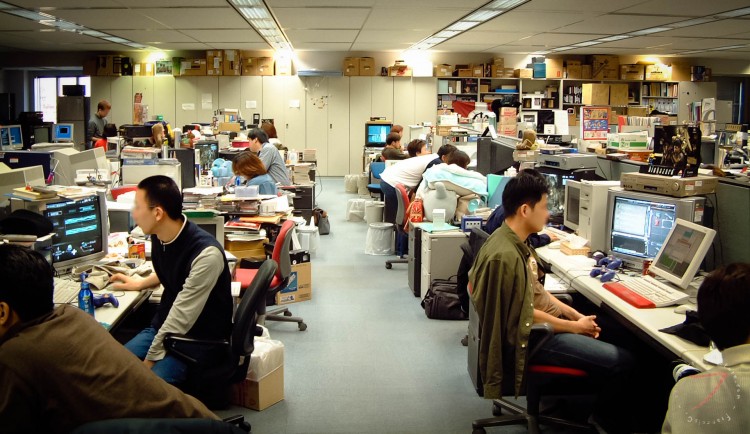
Japanese office

Photo by FrancoisCad

When you arrive at your office and see your boss, you must use, “Ohayou gozaimasu.” I’m scared to imagine what would happen if you use “Ohayou” or “Ohha~” to your boss… your neck may fly right after you say it.  Did any of you just tilt your head to the side in confusion wondering what that meant? 首が飛ぶ (kubi ga tobu), which literally means my neck flies, is a Japanese phrase meaning to be fired.

Then, what about your colleagues? They won’t be able to exert their authority to let your neck fly like your boss can, but you would speak formally to most of them, especially if they are older than you and/or they had started working there before you did. Many Japanese people think that colleagues who started working before you are all your superiors unless newer ones have the higher title.

Newer ones are called 後輩 (こうはい/kouhai) and older ones are called 先輩 (せんぱい/senpai). For a thorough explanation, check out our guide here. It’s “first come higher status” like “first come first serve”. To the ones you have developed close relationships with, you could drop the formalities and say “Ohayou”, but it may only be outside of office hours because some companies require you to be polite to any colleagues while working. The office is not the place to chat with your friends, but to work.
original

Now it’s getting more complicated, isn’t it? To simplify things, just keep in mind that newer members usually speak formally to older members, unless the newcomer has higher position in the company (I will say however, even though you may have a better title, it is good practice to speak formally to co-workers that were there before you just out of respect). When speaking to strangers, it is always a safe bet to use the more formal version.

When speaking to friends at school, you use “Ohayou” to all of your classmates but not “Ohha~”. It could sound too casual to someone who is not your close friend. Of course to teachers and to higher grade kids, you would use the formal “Ohayou Gozaimasu”. In school, lower grade kids are called 後輩 (こうはい/kouhai) and higher grade kids are called 先輩 (せんぱい/senpai).

Mistakes by Non-Native Speakers

gm

“Get out of my house.”

Now, imagine that a teenage daughter brings her boyfriend home for supper. This boy comes into her home for the first time, approaches her father, and says, “Hey gramps, what’s up?” What would you think of his manners? It’s just as rude as when Anthony Weiner called Republican mayoral candidate George McDonald “grandpa”, isn’t it? If you were her father, and even though you may be be too nice of a person to throw him out of your house right away, you probably wouldn’t invite him back anymore, would you?

However, language mistakes made by non-native speakers usually aren’t as important as mistakes made my native speakers.  I remember the day when my Canadian boyfriend at the time, who is now my husband, met my mother for the first time at a Japanese restaurant. At that time, she was working at an elementary school taking care of a kid who was suspected of having severe ADHD (though his parents never agreed).

He was such a brat.

Whenever she said ‘good morning’ to him, he answered back with ‘f**k you’, ‘shut the f**k up, Grandma’ or something else in his long list of shocking replies.  He also punched and kicked her whenever he was in a particularly bad mood. Needless to say, my mother became so exhausted working there. So while we were at dinner, my husband tried to use Japanese to speak to my mother. His intention was to ask her about that little boy.

He began his sentence like this – “Anata no (your) mukatsuku (annoying/troublesome) kodomo (child)…”. He didn’t know how to say ‘made you upset’ in a polite way so used the word ‘mukatsuku’ instead, which among Japanese people is considered to be a somewhat rude word that is mostly used among friends.  The other problem with his attempt was that he never said ‘school’ or ‘student’, so it seemed as though he was referring to me.  I was the annoying/troublesome child.
146716

My mother’s face was classic and my husband quickly realized that he should ask for my help.  After everything was explained, it was laughed off by everyone because he was Canadian.  If he was Japanese, it would have been a disaster.  Now it is simply a funny story that we still bring up from time to time, though my husband still cringes when he thinks back on his first meeting with my mother. He wishes that he knew how to speak formal Japanese at the time. He was very happy to get invited back.

Mistakes by Native Speakers

Concept image of a lost and confused signpost against a blue cloudy sky.

Being a native speaker, I get a special thrill every time I encounter a situation when I have to use formal Japanese. As you can see, it’s ridiculously complex even when you just say good morning. The Japanese language has many formal word forms and their use is mandatory in many social situations.

In keigo, there are three main categories: respectful language (尊敬語/sonkeigo), humble/modest language (謙譲語/kenjougo) and polite language (丁寧語/teineigo). Sometimes two more categories are also used, too: courteous language (丁重語/teichougo) and word beautification (美化語/bikago).

I won’t mention the details about any of them today, but it’s very difficult to use them properly in a perfect situation, even for Japanese people. So, when we start working after graduating school, companies usually offer training sessions on the proper use of formal Japanese and other business manners.

face-to-face

However, lacking some proper formalities is not a big problem as long as you are talking to someone in person. You can show your politeness with your face, the way you talk, or your behavior. So, I’d say the most difficult situation is chatting online or emailing when you can’t see their face or hear their voice.

Actually, I just encountered this problem recently when I sent a business message. It was a mass email so everyone read the exact same thing. Many of the recipients were just fine, but there were two people that got upset: one thought it was so vague because of the keigo and the other one thought it was unfriendly because it had too much keigo.

Laptop_facepalm

Later on, I did a little investigating which involved my correspondence and I found out that many of them liked its politeness. Honestly, I got bit confused and felt a little regret that my native language is one that requires these formalities.  I do understand its purpose, but it can be tough to please everyone.  On a more positive note, I was given a great lesson on how difficult it can be to walk the thin line of using formal Japanese.

A Controversy Over if Keigo is Necessary?

Asian-couple-argument-

As you see, using keigo is very difficult, so if you’re someone who would like to avoid learning formal Japanese because you find it unnecessary, you wouldn’t be the only one. On 2-Channel, I came across a thread discussing the controversy over whether keigo is necessary, or not. Please let me introduce you to some opinions out of it.

1他人と人間関係を築くという事は大変煩わしい事だと思いますが、

「敬語」を上手く駆使しなければ円滑な社会生活を送れないという日本の文化によって、より一層人間関係が大変なものになっていると思うのです。

俺は敬語を多用する日本の言語文化が嫌いです。

皆さんはどう思われますか?

It’s difficult as it is already getting along with someone and trying to make friends, but what makes things even more complicated is that we aren’t able to speak freely to each other because we need to stick to the cultural formalities. I hate the Japanese culture, which forces us to use keigo. What do you guys think about this?

7敬語がある事によって人とのコミュニケーションおいてに求められる能力のハードルが すごく高くなっていると思うんです。

コミュ障と言われている方達が沢山いますが、もしも日本に今ほど敬語が存在しないのであれば彼らはコミュ障ではなかったもしれません。

I think keigo makes communication more difficult. There are a lot of people called コミュ障 (comyu-shou), which is an abbriveation of コミュニケーション障害 (communication shougai) meaning communication disabilities. If there weren’t as many forms of keigo in the language that there are, those people might not have been coined comyu-shou.

8下級生にタメ口使われてる

I’ve been spoken to by lower grade students with informal Japanese.

13距離を置けるからむしろハードル下がってる

It’s easier to communicate (for comyu-shou) because you can create more personal space by using keigo.

15敬語は楽でいいよね

上でも下でも同格でもとりあえず敬語喋っとけば問題ない!

I like keigo because it’s easier.

It wouldn’t cause problems when using keigo, regardless of whether you are talking to higher, or lower standing people.

25以前床屋でこんな事がありました。

新人の店員が俺にタメ口で話しかけてきたんです。

俺はこう思いました。

(俺の事なめてんのかこいつ)

俺は腹が立ちその店員の態度に不快感を感じたまま店を後にしました。

その店員は、親しみを込めてタメ口を使ったのかもしれません。

しかし、店では敬語を使われるという事に慣れている俺は、

それをフレンドリーさの表現とは受け取る事ができませんでした。

これは敬語が多用され浸透している国ならではの問題ではないでしょうか。

The following occurred in a hair salon just the other day.

A freshman started talking to me with casual Japanese.

I thought, “Is he looking down at me?”

I got upset and left the place with an unpleasant feeling.

He might have used casual Japanese trying to be friendly.

However, I’ve got used to hearing formal Japanese as a customer, so it really didn’t seem to be a friendly expression to me.

This problem only occurs in countries that use a lot of formalities, doesn’t it?

30 年上年下を気にする必要が無いのでいいと思います。

It’s good with me as long as I use keigo not only to older people but also to younger people.

35そうですね。

私もそう思います。

私はこう思うんです。

完全に敬語、もしくは、完全にタメ口、

どちらかに完全に統一すればいいと思うんです。

そうすれば言葉を使い分ける労力が無くなりますし、

敬語を使われなかったから腹が立つ、といった事も無くなります。

Yeah, I agree. I’d say, we should standardize our language and use strictly, either casual Japanese, or formal Japanese. If we could, we wouldn’t need to waste our energy choosing words and we wouldn’t be upset by being spoken to without keigo.

45敬語で話すの会議とタメ口で話すの会議はタメ口の方が意見バンバンでるんだとさ”

Did you know that more ideas come up in a meeting when people speak with casual Japanese in comparison to speaking with formal Japanese?

5敬語は現代には必要ない

Keigo is unnecessary these days.

These opinions are from 2-channelers who are known to have comyu-shou, so they might be slightly biased. Personally, I agree that it would be much easier to communicate with people if the Japanese language was standardized in either the formal or casual form, but it doesn’t seem like it will happen any time in the near future. So, for now, mastering the Japanese language must include mastering formal Japanese.

Hot-List-Lubricate-moving-parts

It’s very likely that the way the language is today is the very way that it should be and couldn’t work any other way.  Perhaps there are unseen disadvantages to having a language without keigo, or solely with keigo.  One thing is certain however, I really do like the following quote, but I’m sure this won’t mean the end to this discussion for many of you.

Moving parts in rubbing contact require lubrication to avoid excessive wear. Honorifics and formal politeness provide lubrication where people rub together. Often the very young, the untravelled, the naive, the unsophisticated deplore these formalities as “empty,” “meaningless,” or “dishonest,” and scorn to use them. No matter how “pure” their motives, they thereby throw sand into machinery that does not work too well at best.

-Robert Heinlein


Bonus Wallpapers!

keigo-animated-700
[2560x1600] ∙ [1280x800] ∙ [1280x800 Animated] ∙ [700x438 Animated]

  • Don

    I am a fan of this aspect of Japanese language and culture. I don’t think politeness/formality and friendliness are mutually exclusive, either; I think showing respect in this manner is actually more friendly than just saying “sup” to someone when you meet them for the first time.

  • Christopher Stilson

    In some respects, I’m glad that I’m mainly pursuing literacy, not conversational fluency…

    I don’t really find it that difficult to keep track of, but then I never actually have to speak it to people who actually know what I’m talking about. I think my son is going to be very confused about it when he’s older, though, since I tend to go by what I think sounds best rather than what is necessarily appropriate to the situation (a lot of unnecessary honorific ‘o-’, formal ‘yes’ and ‘no’ because they’re easier to tell apart, and saying ‘ohayou gozaimasu’ to him every morning because I like saying ‘gozaimasu’). Of course, that’s assuming he grows up thinking of Japanese as anything other than another of his papa’s myriad eccentricities.

  • Ravengenocide

    They might not be, but is it really necessary to have 3-5 different levels of keigo depending on the situation and person you are speaking to?
    Consider the story about the hair salon. The freshman used the wrong type of keigo and was considered rude by him/her. Without having such a convoluted formality system in Japanese this would have never happened. Politeness is a good thing, but I don’t feel like it’s necessary to surround your whole language with it, it makes it way to complex without the benefits.

  • M Gonda

    err… I thought I’d get help on how to really use keigo or the words that are actually used in keigo…
    kinda disappointing.

    could you please come up with an article about which words fall in the different categories of keigo: sonkeigo, kenjougo, teineigo, and teichougo as well.

    Thank you.

  • Mitch Nesbitt

    I am definitely a very lean back and casual guy, so I would not have a problem with the lack of keigo. To me politeness is shown more through actions. But then again, maybe using keigo is the action of politeness. Either way I’ll keep practicing it.

  • Beetle BANE

    I find it funny that using too much formal keigo can give the impression of unfriendliness and that not enough is also clearly frowned upon. I imagine that a situation where you expected to use varying types of formality will ensue with sitcom-worthy amounts of awkwardness.
    Also, that story about ‘the troublesome child’ was so funny and cute!

  • http://www.twitter.com/christaran Chris Taran

    I hate any type of formality so much, that if someone calls me “mister” (and this is regardless of the persons age) I find it INCREDIBLY insulting. My name is not “Mr.” anything. It’s just Chris. I also never want to be called “Uncle Chris” or anything of the sort.

  • Tora.Silver

    Now, imagine that a teenage daughter brings her boyfriend home for supper. This boy comes into her home for the first time, approaches her father, and says, “Hey gramps, what’s up?” What would you think of his manners?

    I wouldn’t think anything of his manners. Dead people don’t have manners.

  • Don

    That seems a little harsh and insecure to me… It strikes me more as showing a certain amount of respect by default to somebody that you either don’t know or that is in a position that suggests they have more experience than you do in a particular situation (i.e. a teacher or manager). From what I understand, when you grow to know someone on a personal level, the formalities are dropped. Maybe the realities of how they are used make people feel otherwise but I don’t see an implication of “I’m better than you and you’d better address me as such” there.

  • Don

    I don’t know, since I’m not Japanese and don’t have any experience with it, but I feel like it probably wouldn’t be so complex if you grew up with it. It seems like the proper convention in that situation would to use formal language, so why would the freshman (whom I am assuming is Japanese) think that using casual language would come off as friendly rather than impolite?

  • http://www.twitter.com/christaran Chris Taran

    I find showing respect to someone you look up to be a bit different I guess. If I met someone in my industry that I looked up to, I would respect their opinion on the subject, but I find that to be a completely different thing.

  • Don

    Surely there is a way in Japanese to handle these kinds of situations?

  • M4K0T0

    In my opinion the difficulty for a foreigner is not to undertand whether they have to speak (more) polite(ly) or not, but which phrases they are able to choose from. If i compare these so-called rules not for when to use polite SPEECH but for when to BE polite to other people to the “rules” i find in my home country, Germany, i must admit that they are the same. The difference might be, that in the german and probably a lot of other languages there are not so many ways to express the degree of politeness – in (usual) grammatical forms like in japanese. So in german – and probably in english, too – you also have to think how to say something “correctly”, but without some clearly more or less polite forms like in japanese. In the end i guess it’s – at least for the german language – also very difficult to use polite speech as a foreigner.

    I can understand the problem japanese people have with accidentally offending people because of keigo, but i think it’s not the only language suffering from this problem. Whenever i need to write a letter/email in german i also have to think a lot about whether it is too formal or maybe too informal – in the end it always depends on the person recieving it and their judgement. The problem the japanese language has is, i guess, that you can mostly clearly say. “oh, this phrase is more polite than this phrase, and this is less”. In the german language at least you often can’t really say that, so most people can’t really complain because there’s not impartial opinion about these often rather grammatically difficult phrases.

    Does this make any sense at all? Did I say anything new after all? I’m not even sure.. :D

  • Christopher Stilson

    The same is true of pretty much any language. I spend hours agonizing over even things as trivial as Facebook posts to make sure there’s nothing inadvertently offensive in it. Communicating by writing (either conventionally or over the internet) adds an additional level of complication because there aren’t as many ways of reading intent. In many respects, I think the proliferation of emoji in Japanese (and the rest of the world to a much smaller degree) online communication is a big step forward in making sure that people aren’t accidentally offended by what ought to be a neutral or even friendly statement – the problem is, such modes of expression are rarely considered appropriate in any formal environment.

  • Senjougahara

    I hate keigo with a passion. I never liked arbitrary speech patterns that represent politeness, even in English. To be polite in English, you just have to be overly nice and gentle. For example, you wouldn’t ask a professor,
    “Will you grade our homework by Friday?”, you’d ask
    “Will our homework be graded by Friday” or even better
    “Will be receive our homework grades by Friday”.

    The reason for this change isn’t grammatical, it’s logical. All we’re doing is shifting the declared responsibility away from the professor.

    Similarly, we use the “would” to put requests/suggestions in the subjunctive mood, which sounds more polite because it adds a hypothetical air to the situation. Compare “Would you be available” to “Will you be available”. The latter sounds demanding, because essentially the responder has to onus of making the claim that “being available” 100% will happen. factually. Sometimes the equivalent plain form doesn’t have “will” and may have a different verb, e.g. “I would like to have steak” vs “I want (to have) steak”, but throwing “would” in there still gives it that hypothetical feeling, and thus the request doesn’t seem as demanding.

    Also in America, the rules of formality are starting to disintegrate. At my university it is customary to call professors and faculty by there first name, and use casual English. Many request that we not say “professor “. We’re even on a first name bases with members of the administration. At the company where I am interning, we also use first names, contractions, and abbreviations, etc. That’s one thing I’ll always prefer about American culture–that many times, there are no real rules.

  • hmnerv

    I actually have the opposite problem with my mother language – Portuguese – its too much informal and people can talk to others like they are long time friends even though they barely know each other (and sometimes don’t really get along).

    Situations that feel like “ohh, I’m being so nice to you, why don’t you do what I ask” are quite usual and can be tricky to evade without being blunt or being very patient (which I’m not).

    I think a japanese would be shocked to work at my job, I really do say something like “おはよう” to my boss and he does the same so you can get the picture.

    I get the feeling part of keigo’s purpose – specially with requests – is to prevent the other side from being pressured into an answer. Maybe its my interpretation but I get the felling keigo helps to defined borders and prevent people from being pushy or demanding.

    In this aspect, portuguese language (and culture) are the opposite from japanese… many times I think to myself “why can’t we just have a salt of keigo…”

  • Mami

    Thank you for your comment. You are mainly pursuing literacy, eh? Do you read novels? Who is your favorite author?? :)

  • Mami

    I understand that no human is any better or worse than any other, but that’s why we should respect each other I believe. In that meaning, I like using ‘sir’ or ‘madam’ when I ask a stranger direction or so, in order to show my respect and thankful.

  • Mami

    I agree. Using ‘Mr.’/'Mrs.’/'Ms’ doesn’t give me an implication of such things either.

  • Mami

    I see.

  • http://www.twitter.com/christaran Chris Taran

    Apologies, I have a difficult time being moderate when I write out my opinions (spending 17 years on message boards has had that negative affect on me…), but I suppose if a complete stranger needed to get my attention, and clearly has no way of knowing my name, saying ‘sir’ would be completely understandable.

  • Mami

    Thank you for your comment. :) Wow, I’m impressed. You have an excellent understanding of how that works. More importantly, you explain it very well.

  • Christopher Stilson

    I’m not that literate yet :) I’m getting practice by translating light novels (specifically the ‘Hyakka Ryouran: Samurai Girls’ series by Suzuki Akira – it was chiefly the theme music for the first season of the anime that made me want to learn Japanese in the first place), but my goal is to be competent enough to be able to read ‘Ooka Seidan’ (since the only English translation of it that I know of has been out of print for eighty years).

  • Senjougahara

    But politeness and friendliness are very different.
    When someone says “sup” or is very casual, it usually has not ulterior motives. It’s either said for no additonal reason, or to seem friendly. However, when people are polite it could be a self-focusing reason. It could be because they don’t want to offend you, but also because they don’t want to be judged. People are often polite for the benefit of themselves, not the reviver. I read that in academic settings, professors use more keigo than students, and it’s a sign of social status. “Hey look at me my keigo stick is bigger than yours”. It’s kind of oppressive, really.

  • Mami

    Yeah, I understand what you mean. That’s why bosses in Japan don’t use keigo to laborers when they are really pushing for a task to be completed, I guess. :P

  • Mami

    I agree. There should be some sort of code or set of manners utilized when meeting people for the first time. However, I do like to feel comfortable in those situations and not have to worry about formalities too much. :)

  • Mami

    Wow, I’ve never thought about like that before. Interesting point.

  • Mami

    Yeah, I agree. Keigo can go a bit too far, can’t it.

  • Mami

    Even for me, the difficulty comes primarily in choosing which form of keigo to use in any specific situation. It can be really tough to judge sometimes. But, yeah. It shouldn’t be that difficult.
    As for the freshman example, people come from many varying backgrounds and the truth is that many people are not exposed to keigo often enough to become good at it. In this situation, I believe the freshman should at this point, because he is working, try to learn and use keigo. However, he may not realize that this is a situation in which he should use keigo because nobody tells him that he is coming off as rude or impolite. As we saw from the column, this could’ve been a chance for the customer to say, ‘Hey, you should be using keigo to me!’ But that would also be very unlike Japanese people.

  • Yuume

    I don’t think formality shows that someone is more or less than you. I think it shows that you respect that person. I can see how it can be considered “more or less” in Japanese because it’s more of a seniority thing, but I think it is reciprocated because they will also use keigo and formalities with you as well and talk to you like you are still part of the party/company you are both in (what I mean is the respect and same keigo speech is used in return). People who deserve respect aren’t just people who work hard or are high up in an industry. Elders and people who are still learning deserve respect too because they have experience to share or will be building off of your experience and interactions with them.

    Formalities, to me are more of a respect than showing that someone is better than me. Until you make me angry, we are still on the same level as a human being, and even then, unless you did something just utterly heinous, I’ll probably still address you like a civil person with formalities, but I suppose that could have to do with upbringing (like some people here said, if you grew up with it, it just happens naturally). I think keigo though is just really tedious, not really difficult. But from my studies, everything in Japanese culture seems to be about mutual respect, from formalities when speaking with other people to their shinto religion and respecting all living things.

    Personally, I don’t like to be called “Miss” or “Misses” anything either, it freaks me out. I’m like, “Ah, no! Please don’t!” (Plus, it makes me feel old >_w<-

  • Mami

    I can’t promise anything but I’ll ask Koichi if something can be made similar to what you described.

  • Mami

    Actually, I just found a link that you might like: http://en.wikipedia.org/wiki/Honorific_speech_in_Japanese

  • Mami

    Yes, you do make a good point. Japanese formalities almost come down to a formula, which kind of has a quantitative value like math or money or something, whereas the level of politeness in other countries is measured more by feeling. Thanks M4K0T0 :D

  • LordKyuubey

    I loved this article! Specially since I don’t have the chance to use informal language too much and is stuck at keigo. The last bit about Japanese discussing keigo was very interesting; they seem to struggle a bit here too so it’s kind of a relief to find out even they have their own difficulties.

  • Mami

    That’s a very good point. I was actually scolded for sending an emoji message to my boss in my first week of work :P haha

  • Mami

    Yes, it is an act of politeness.
    Good for you. Keep at it. ∩(*・∀・*)∩ganbatte~~♪

  • Mami

    Hahaha I love it. It’s cute tooƪ(Ơ̴̴̴̴̴̴͡.̮Ơ̴̴͡)ʃ

  • Mami

    Your best bet in this situation is to use keigo to both of the people, because it won’t come off as rude to either.

  • Mami

    Hahaha lolololololololol

  • Mami

    Yeah, I struggle too as I mention in the article. I think that I’ll get the hang of it in two or three hundred years. haha :P

  • Mami

    No apologies necessary at all. In fact, thank you for posting. It’s great to hear as many opinions as possible. It all adds to the discussion.

  • Mami

    If you even did get off topic, you should do it more often:P Great post. Thank you.

  • Mami

    Wow, that’s great. Good for you. Now I’m wondering if you really Japanese music as well and if it can be used as a learning tool for you, too. :)

  • Sugoida

    美化語?面白そうだ!
    どこでそれについて読める?
    ありがとう、マミさん。

  • Moogiechan

    I have a book on keigo that has a sticky situation, with no real aswer:
    A wife is speaking about her husband to her mother in law. If she speaks honorifically about him, she is exalting her won husband, which is wrong. If she speaks humbly about him, she is denigrating the other woman’s son — also bad.
    Any ideas how to handle something like that?

  • Christopher Stilson

    I tried that, but it didn’t really work for me. I actually prefer not to think about the lyrics of songs and appreciate the voice as an instrument, which is why I listen almost exclusively to non-English performers (the Finnish band Värttinä is one of my favorites just because of the sound of the words). Fortunately, the aural appeal doesn’t go away for any of my non-native languages (not that there’s any German music I really want to listen to), but I appreciate it less if I have to actually interpret the meaning rather than the basic aesthetics.

  • Mami

    すごいださん、コメント有難う。

    こんなサイトを見つけたよ!

    https://syllabus.byu.edu/uploads/k7MOeJYe6NcS.pdf

  • Mami

    I see. Actually, I tried to learn English from English songs as well, but it was very difficult for me. I have difficulty catching what lyric is. So I was curious if the Japanese songs can be a difficult tool to study.

  • Mami

    That’s a tough situation, for sure. But I wouldn’t think that she is exalting her won husband if she speaks honorifically about him. I mean, she definitely should call him with ‘san’ because some mother-in-law may not like daughter-in-law calling her son his first name. However, speaking about him with sonkeigo is weird. What she should do is to speak about him as making ‘herself’ humbly, then it works.(kenjougo) And of course, she should use sonkeigo to her mother-in-law. Does this make sense?

  • Christopher Stilson

    They’re probably helpful just for the unconscious exposure – 75% of my music playlist is j-pop/j-rock, and because I work in an isolated office by myself I can play my ‘weird foreign music’ (as my wife and my mother call it) all day without bothering anybody, and I’ve definitely registered enough of the lyrics to realize that 「心」 appears in almost every song.

    But by and large, I’ve picked up fewer actual words from music than I have from TV shows, and far more than both of them put together from this translation work, although it does take longer to stick: a word I pick up from a piece of music takes about 30-40 repetitions, ideally in other songs, while a word from a TV show I’ll generally have down after 20-25, especially if it occurs frequently (I figured out what ‘daijoubu’ meant after about seventeen episodes of Cardcaptor Sakura, because they say it constantly), but it took about sixty or seventy repetitions to internalize some words from the novel just because it was so much easier to look them up with the handwriting recognition feature in my dictionary than it was to remember them (and I still don’t remember all the various pronunciations of 下, even though it appears on practically every page – I invariably pick the wrong one).