Joshi-Mane: Female Manager Sensation in Japan

What do you imagine when you hear the word ‘manager’? I’d guess that most of you would probably think of your bosses at work. Does hearing the word coincide with a negative image or feeling? Well, when Japanese people hear the word ‘manager’, things are quite different. In fact, there is nothing negative about it, especially from a guy’s point of view.

Female Managers for Engineers

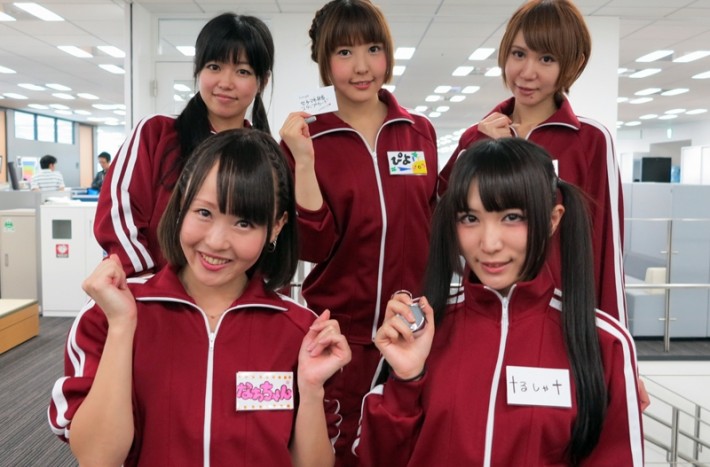
08On September 2nd, a Japanese company called DWANGO Co., Ltd. implemented a new project called ‘女子マネ弁当 (Joshi-Mane Bento)’, which involved placing many female ‘managers’ in the office to motivate the company’s late-arriving male engineers, who tend to show up to work in the afternoon, to come in earlier. 女子マネ (joshi-mane) is an abbreviation of 女子マネージャー (joshi-manager) meaning female managers. 弁当 (bento), as you probably already know, is a single-portion takeout or home-packed meal common in Japanese cuisine.

So, DWANGO hired 15 female managers to come in and motivate its workers. Surprising? Sad? Do you think it would be an effective form of motivation? It’s a difficult assessment to make. I know that if I heard there were going to be 15 more managers at my workplace, ‘motivated’ would not be the operative word. However, it seems that the new system worked out very well there. Keep in mind that they are managers, not bosses. They’re there to help manage you, not boss you around.

What are Joshi-Managers?

If you say ‘manager’ in Japan, it often indicates a ‘towel boy’ (aka waterboy) rather than an ‘office manager’. Towel boys are the kids who hang out at the sidelines with bottles of water and hand towels to the athletes at sports games. So if you say ‘joshi-mane/joshi-manager’, it is generally referring to a female manager who takes care of sports players like towel boys do.

They also take care of equipment, sports team records, and more. Now, you can imagine that a lot of boys develop crushes on their joshi-mane, possibly because they are so helpful and supportive of all the players on the team during the school year.

Joshi-mane has taken an especially important role in Japanese school culture. In fact, you find them in a lot of Japanese manga comics, novels, movies, and dramas. My favorite one is Minami Asakura, who is the heroine of a Japanese high school baseball manga called “Touch”. She’s a Meisei baseball team manager.

There is also another famous baseball team manager named Minami in a best-selling book by the title of “Moshi Dora” that is an abbreviationn of the title: もし高校野球の女子マネージャーがドラッカーのマネージメントを読んだら (Moshi Kokoyakyuno Jyoshi Manejyaga Drucker no Management wo Yondara / If the Girl Manager of a High School Baseball Team Read Drucker’s ‘The Practice of Management’). The novel follows Minami as she uses Peter Drucker’s famous tome on management to guide the team to success.

DWANGO and Joshi-Mane Sensation

dwango

The Dial-up Wide-Area Network Game Operation, better known by the acronym DWANGO was an early online American game service. It launched in 1994, but its operation and all its services stopped in October 1998. There is one remaining division still in operation in Japan which continues to do well today. Its subsidiaries include Niwango, which runs the popular video sharing website in Japan called ニコニコ動画 (Nico Nico Douga).

It’s a telecommunications and media company, so there are a lot of engineers working there. Historically, men have been known to vastly outnumber women in the field of engineering. Thus, it won’t surprise you that the large majority of this company’s engineers were male, which is why it’s easy to see how the resolution to the following issue was reached. Engineers tend to work late into the night and it often causes them to be late for work in the morning.
09

Nobuo Kawakami, the chairman of DWANGO, who’s also a Studio Ghibli producer, was contemplating how he could resolve this issue. One day, he got an idea: If the engineers were given the option of having cute girls in maid costumes hand out bento boxes to them, they might come into work on time. This experiment was more successful than Kawakami thought it would be. He then set out to improve his system and decided to hire cute female managers (joshi-mane) next. Surely, he believed, the engineers would come to work on time and work even harder.

How the ‘Joshi-Mane Bento’ System Works

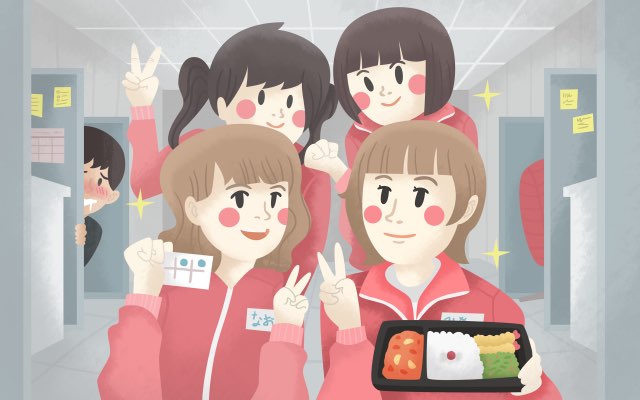
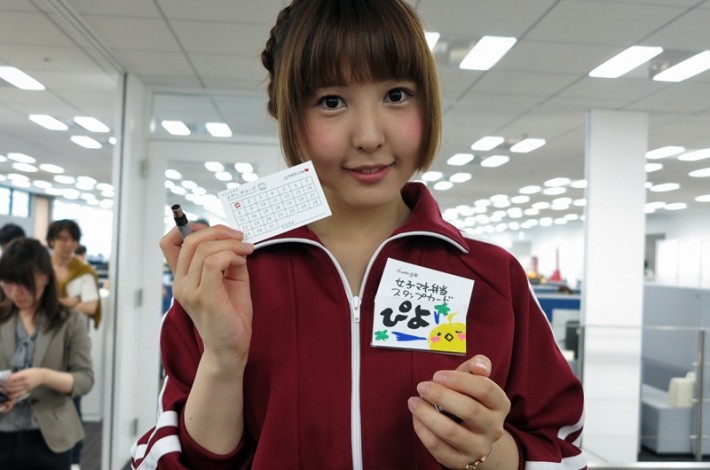
01Kawakami also decided that his joshi-mane girls had to wear crimson gym uniforms to make them look more like real team managers in hopes that it would be more effective in helping the engineers. Kawakami said that reason he chose that color was simply because he liked it. Their job is not strictly being in the office to encourage the workers.

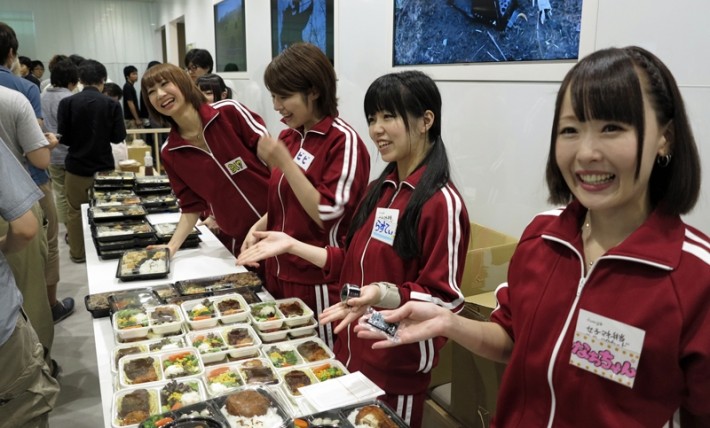
Remember, the name of the project is ‘Joshi-Mane Bento’, so joshi-mane girls hand out nutritious bento lunch boxes to the engineers to help keep their tummies full and their minds sharp. Unfortunately, the bento boxes are not homemade by the joshi-mane girls, but there are 6 to 7 different kinds and all of them are supplied by DWANGO free of charge. Pretty cool, eh?
06

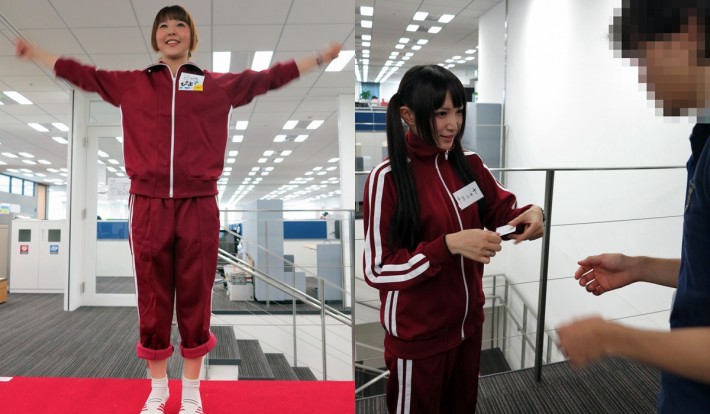
Sounds like a good deal, doesn’t it? Well, here’s the rub – in order to be allowed to receive a bento-box, you must arrive to work on time. Joshi-mane girls are also responsible for light, traditional Japanese exercises called ‘ラジオ体操 (radio-taisou)’ at 10:30 every morning. It seems that those who join the radio-taisou get a stamp on a personalized card. The stamp on your card is thing that gets you the bento-box.

This stamp is the thing that proves you showed up to work on time. So, this project not only leads engineers to come to the office on time but it also helps them get in, or stay in, shape by encouraging daily exercise and providing nutritious lunches. The atmosphere created by all the cute girls is an additional encouraging bonus for the workers. How genius is that? If you were a male engineer, you would want to join the company right away, wouldn’t you?

Of Course, There are Objections

objection-Haruhi-SuzumiyaHowever, this program obviously made some people displeased. Some call it a great innovative idea, whereas others call it old fashioned sexism or sexual harassment. The latter insists that Japanese women have also made some gains since the implementation of the Equal Employment Opportunity Law in 1986, but in light of the recent DWANGO sensation, it is being questioned again.

Although joshi-mane culture is widely accepted in Japanese sports and schools, controversy has even arisen over the voluntary work of team managers at schools because the girls’ duties are seemingly the same as the chores of housewives. In regards to the roles joshi-mane play on sport teams, I wouldn’t call it sexim because I actually know a few girls who became joshi-mane because they simply liked sports and wanted a proactive way to support the teams of their favorite sport.
02

If you think that these types of roles discriminate against women, why isn’t the same standard applied to towel boys? There are actually male managers, however few, in Japan, as well. Yet, I agree with and can understand where a lot of the opinions surrounding DWANGO are coming from, though I do also find some of them a little severe. Morning sucks! Tell me about it. But I personally think that it’s little pathetic that these workers can’t even show up to work on time unless a bunch of cute girls are going to put on smiles for them.


So what do you think of the joshi-mane culture or adapting it as a company system? Is there a similar culture in your country? Do you think that it’s a good idea? Let us know your opinion and/or about your particular country in the comments below!

  • http://niyoels.tumblr.com/ niyoels

    As a female developer, I would be terribly uncomfortable if something like this was implemented in my company. Not only would it hurt my pride as a working female seeing these girls in my office but I would likely look down on my co-workers who can only be persuaded to come to work on time because of them

  • トシ

    Wow, that’s… incredibly sexist, really.

  • Aya

    It’s pathetic to resort to something like that being implemented in a company (not to mention belittling, if you’re a sassy working female like me), but I’ve really come to appreciate the role of female managers in sports teams. I suffered a knee injury a year back, and I couldn’t really do much in our kendo club. I still came to the dojo nonetheless and tried to do my best to help everyone out. I kept score, tied ribbons during competitions, tended to booboos, cheered my friends on, handed out ice packs and tea/water to the seniors who needed it. I couldn’t train with my friends, but I thought it was a great way to support the club and help out. I think managers are important as the next guy on the team, and I think what they do takes a lot of dedication and love to the sport and to the guys playing.

    And yay, for mentioning kokoyakyu! Haha, it’s always been a secret dream of mine to be a manager of a highschool baseball team and watch them reach Koshien! But alas, I guess I’ve passed that age. :(

  • Sarah

    100 points for the waterboy clip LOL

  • 水音しゃひーろ

    1. Is it the same concept as managers for artists? Is it the same concept as personal assistants?
    2. If most of the workers in the company are females, and we put male managers in it, will it still be considered sexist?
    3.If it were sexist why are the girls working for this sort of thing? (Guess it’s personal choice)

  • http://www.twitter.com/christaran Chris Taran

    You’d think I’d be used to how sexist Japan is after years of being interested in the country, but nope, still manages to kind of blow me away with how bad it is there in 2013. No wonder they are ranked so low on gender equality (101st last I checked.)

  • トシ

    1. have no idea.
    2. yes it would.
    3. because they don’t even know what they’re putting up with in the big picture. see that everyday. and women are also sexist, and help maintain the system as it is.

  • Shuji Terayama

    As a male developer, I would be terribly uncomfortable if something
    like this was implemented in my company. Not only would it hurt my pride
    as a working male seeing these boys in my office but I would likely
    look down on my co-workers who can only be persuaded to come to work on
    time because of them (you see what I’m getting at? You probably don’t.)

  • 水音しゃひーろ

    If we look at it in a good way, wouldn’t it provide more jobs to the Japanese? We should to open opportunities to males else well so that it balance out.

  • Beetle BANE

    While it does seem a little ‘interesting’ in that they chose cute girls to motivate the male engineers, it does provide a little good in keeping them motivated as well as exercised and fed (Typing that almost made me think of keeping care of a pet haha).
    One might wonder if they are going to get a few dapper male managers to motivate the female ones that they may have. Even so though, it is a very strange idea that seems like a bit of a waste of money(in that I don’t personally see how girls handing out lunch is much more of a motivator than just getting the free lunch at all).

    And while it is a bit suspicious on the lines of sexism, if it is meeting its purpose in an effective and efficient manner, then my problems with it are smaller. Although, one might imagine that mingling with managers subtracts from the time one could be using to be productive…

  • Me

    “However, this program obviously made some people [*DISPLEASED].” Not ‘unpleasant’.

  • http://niyoels.tumblr.com/ niyoels

    I think the role of a manager on a sports team is way different from this. The team can work their hardest and practice while the manager will take care of other chores and tasks that need to be done and frees the players from having to worry about them. The manager is an important member of the team. Here, the joshi-mane is there to look cute to get people to come in to work to look at them. The manager is an ornament.

  • http://niyoels.tumblr.com/ niyoels

    If you’re saying it’s a different story if it were male managers, no, it’s not. Having essentially cheerleaders in the office and co-workers who come in just to oggle them, male and/or female, is demeaning in either case.

  • Chelsea

    When I first saw this, I thought it was great, because hiring women for more leadership positions is a great step forward. But, again this is a time when the english language doesn’t translate all of the connotations that Japanese uses. This “manager” position it totally sexist and demeaning, and does not help the already strained gender equality in Japan.

  • http://niyoels.tumblr.com/ niyoels

    Though the radio taiso and healthy meals is something positive, I’d like to see if it has the same results if someone else was doing it, good looks not required.

  • Aya

    Ahh yes, that’s what I was trying to say. :) Managers are an integral part of a sports team, whereas the company that was mentioned in the article, the managers were there simply to look cute and act as ornaments. (Apologies if my English didn’t make any sense~)

  • Shuji Terayama

    Surely it wouldn’t be the same, but you wouldn’t complain on the internet about it. These girls are payed to do this. If they want to get a better job they should’ve chosen a better workplace. The same for the huge AV industry in Japan, no one forces them to work there, but it’s probably the only way next to being actor/idol/talento whatever to make more money than the other gender/from the other gender. Seriously, there are worse problems in Japan than woman working as manager. Talk about Sexism with a japanese guy or girl in the street and try to ask them about the problems, you’d probably get something like 仕方がない. You know why I know this? Because my girlfriend is Japanese and has to endure this shit daily. Why are there seperated trains, because you can’t trust a japanese men enough to not to grope a woman? Instead of resolving these issues they always fuck around with the most bullshit ideas I’ve ever heard, like Instead of firing a teacher and get his license away for fucking minors or beating minors they only get transfered to another school.

  • tonton101

    Well this is sad and pathetic. DWANGO’s system seems anodyne enough but it is nothing more than a perpetuation of longstanding gender stereotypes. These women are little more than office cheerleaders. This is akin to hiring a “sexy secretary” whose office duties are frivolous while it is her looks that provide the true mileage; adorning the office like some kind of living decoration, as it were.

    I do not think that joshi-mane in sports is a good analogue to DWANGO’s system. In the former situation, women actively volunteer to these joshi-mane position partly out of personal intent/interest and cultural/physical restrictions. The voluntary aspect is thus a bit more forgiving than DWANGO’s system. In the case of DWANGO it hired these women with the expressed intent of trundling them out as office cheerleaders, eye-candy, and psuedo-housewives/mothers. In other words, DWANGO management not only drew upon hoary gender ideals (which in Japan’s case are not hoary at all) in their hiring intent, but also encased the duties of the job in a shell of gender stereotypes. These women probably do not have the freedom to implement alternative (and probably less demeaning) employee incentivizing strategies. I mean DWANGO could easily have hired these women as, say, HR Managers and have them devise strategies to incentivize employees without subjecting them to gross sexism. I’m pretty close to giving up all hope of any kind of sensible measure of gender parity surfacing in Japan.

  • Jomann

    sounds like the author is just bringing in ideas of sexism I didn’t see anything related to the actual workers complaining about it.

  • トシ

    This. Thank you for writing this.

  • John

    Thank you for the points.

  • http://niyoels.tumblr.com/ niyoels

    Yes, it’s their choice but encouraging it by having jobs like this isn’t helping the situation. In no way was I saying this is the biggest problem, it’s just the topic at hand. Japan has a lot of social problems, not just sexism, that I don’t care to argue over. I agree there are plenty of examples of Japan handling these situations poorly usually because their solution is to work around it rather than actually handling it. And yes, people won’t talk about it because it’s normal for them. That doesn’t mean it should stay that way.

  • Mescale

    I’ll tell you how you make your Engineers come into work on time.

    You fire every one which doesn’t come in on time.

    Its not hyper-dimensional-anti-calculus.

  • Mescale

    You don’t make sense.

    It sounds like your supporting this idea whilst saying that its terrible, how Japan, instead of dealing with problems, finds ways to skirt around them.

    In which case wouldn’t 女子マネ be a bad thing? Wouldn’t it be better to find a proper solution, instead of avoiding the issue.

    If you’re going to troll someone do a good job, if you’re going to be a dick then at least be consistent.

  • Jose Gallardo

    This looks like fun. I could care less for any “underlying” inequities. I am always willing to try anything new with an optimistic attitude. Once I started thinking less and purposely trying to be a bit more ignorant, I enjoy things much more. Its like I always tell myself, things make more sense when you think without logic.

  • Morient

    Exactly! If I showed up for my job consistently late, I would be terminated immediately with no free bentos included.

  • Tora.Silver

    Idk, I would consider the *probably* man who came up with this idea pretty unpleasant.

  • Senjougahara

    I’m confused as to how this could possibly be considered sexual harassment. I mean, they get payed, are fully aware of their responsibilities, right? As long as there’s no unwritten rule along the lines of “…oh yeah, and the male workers can make you do things out of the contract against your will”, this isn’t harassing or sexual. In my opinion, there’s nothing inherently wrong with this system. Maybe it’s just my strong association with the word “manager” as “boss”, but I don’t think the job is demeaning, because they in a way still have power. Just because there primary goal is to make the engineers happy, doesn’t mean it’s not valuable. If an elementary school hired clowns, would that be demeaning? There’s nothing wrong with making people happy or motivated for a living, especially with Japan’s “self-determination” rates. For female works in business they could also hire someone of either gender to play a similar role.

    People probably are going to make a big stink about how most of the engineers are men, and all the managers are women. But two things:

    1. Jobs are chosen to fit demand and availability. It’s no surprise that they only hire female managers, when most engineers are presumably straight relatively young males. It’s just a statistical fact, not the oppression of other people. And there’s nothing stopping women from picking engineering as a career (or at least that’s true in the states).

    2. As for workplace hierarchy, we can’t all be the top dog. Maybe people should start respecting the jobs of the lower members of the workplace. If I were a female receptionist or an assistant all this talk about workforce sexism would make me feel depressed, as if my job had no value. Even Ayn Rand, whose philosophy incorporates the idea “I swear by my life, and my love of it, that I will never live for the sake of another man, nor ask another man to live for mine.”, knew that it doesn’t matter what you produce or contribute, it’s valuable as long as you do it well.

  • Senjougahara

    Why do they have those separate trains? Is everyone really that oblivious on the trains that it’s free reign for perverts?

  • Joel Alexander

    I enjoyed the anime version of Moshidora. Didn’t know it was a book.

    On the subject of women who are actual managers, the Toyoko Inn chain is known for almost exclusively hiring women – the Wikipedia page states that in 2001, “nearly all of its hotel managers were married women” (though doesn’t specify whether the remainder were not women or just not married).

  • Mitch Nesbitt

    I’m not gonna say it’s sexist, but it’s probably sexist.

  • Senjougahara

    >DWANGO’s system seems anodyne enough but it is nothing more than a perpetuation of longstanding gender stereotypes

    True. But ignoring the shock value of buzz words, lets look into this. What is so wrong with stereotypes? As I understand it, culture is positive feed back loop, for better or worse. Why should you change your behavior to influence the will of others? You’re not creating and value by doing that, only forcing your own ideals upon the masses. As for inaccurate stereotypes, we don’t have some heaven sent duty to protect people from their own irrationality.

    >These women are little more than office cheerleaders. This is akin to
    hiring a “sexy secretary” whose office duties are frivolous while it is
    her looks that provide the true mileage; adorning the office like some
    kind of living decoration, as it were.

    Yeah I get it, objectification. Because people share properties and roles similar to objects, doesn’t mean they are equally as valuable. Sexiness is an inherently human property. It makes no sense to make this akin to decorations.

    > I do not think that joshi-mane in sports is a good analogue to DWANGO’s system. In the former situation, women actively volunteer to these joshi-mane position partly out of personal intent/interest and cultural/physical restrictions. The voluntary aspect is thus a bit more forgiving than DWANGO’s system.

    This is actively fallacious. Just because something is done for free doesn’t meant people aren’t being exploited. Also everything everyone who is not a literal slave does for work is “out of personal intent”, it’s called free will. This argument would be valid if the DWANGO’s managers were being underpayed or forced to do things out of contract, but this is a legal exchange of money for service. Also, those “cultural/physical restrictions” is literally sexism. Ethical or not, women are not drafted to male sport teams. At least there is an option for women to be engineers. If DWANGO refuses to hire women who apply, _that_ is sexism.

    > In the case of DWANGO it hired these women with the expressed intent of trundling them out as office cheerleaders, eye-candy, and psuedo-housewives/mothers. In other words, DWANGO management not only drew upon hoary gender ideals (which in Japan’s case are not hoary at all) in their hiring intent, but also encased the duties of the job in a shell of gender stereotypes.

    There is nothing wrong with being a housewife and such. You’re the one devaluing those roles, not the company or it’s engineers. There’s nothing inherently shameful with being a cheerleader or eye-candy, as hard as that might be for society to grasp. If you’re actually producing value, people should, well, value you. Simple, right?

    >These women probably do not have the freedom to implement alternative (and probably less demeaning) employee incentivizing strategies.

    Hardly anyone has the ability to change their job description.

    >I mean DWANGO could easily have hired these women as, say, HR Managers and have them devise strategies to incentivize employees without subjecting them to gross sexism.

    That’s not what sexism means. Nobody is being unjustly discriminated against. Discrimination is when you treat people differently based on preconceived notions, not when you hire a girl you think people will think is cute. And once they have their job, having them do things based on that property is still not sexism. It’s justified because that’s there job. It would be sexism if they hired these women under the guise of being HR, and then made them hand out bento. Nice double meaning of gross here, tho. And the bit about hiring them as real HR, is actually a good point. That strategy would probably work. DWANGO is most likely too lazy to invest in that, most likely harder to pull off endeavor. Who knows why, the company probably does have real managers. But then it’s up to women to apply to those jobs. I know of no law to prevent that. And if they don’t hire qualified women, that’s the real problem here.

  • Mami

    1. I believe that it’s the different concept from those.
    2. I would say so if they are placed simply to encourage the women.
    3. As for them, choosing the job is their choice. However, the person who come up with the idea of this job or agreed with it are sort of sexist, aren’t they? Those people lack their management ability to encourage people. They needed female instead of dealing with people in other way. Again, it’s pathetic.

  • Mami

    Oh, would you say those women are also sexist, too? Sorry, I just confused about the definition of sexist…(><)

  • Mami

    I wonder if some males are actually interested in doing that. I’m also curious how much money those girls would get.

  • Mami

    Yeah, it sounds fun.:P

  • Mami

    It’s pretty different from making children happy from making workers happy though. Those workers get paid as well. They are not like students. Do you think that it’s normal if the company actual managers (not 女子マネ) take male workers to a stripper club to motivate them? Well, it may sound a little different since strippers give them a sexual service. However, using female to motivate male brings similar effect. Therefore some people insist that this system is a sort of sexism. Personally, I don’t really care very much, but I just think that they are pathetic.

  • Mami

    Oh, is that right? I didn’t know about the Tokyo Inn chain. I don’t know why…

  • Mami

    Yeah. I agree with you.

  • Mami

    I like the pic:) yeah, although I passed the age too, I was dreaming about to be a manager of a high school baseball team and go to koshien as well. Well, it never happened because I was a member of volleyball team myself in high school:P And I belonged to a kendo club in junior high:P

  • Mami

    私もそう思う〜〜〜(>v<)

  • Mami

    Ummmm…it might not have sounded that wired if they weren’t forced to wear the crimson gym uniform…
    But, I wonder why their boss can’t lead them to do radio taiso without the girls…They are boss, aren’t they?

  • Mami

    I agree with you. It seems like a bit of waste of money for sure. However, when thinking that some otaku people pay a lot of money to just hand-shake a cute アイドル girl, this may give those geeky engineer guys extra motivation rather than just free lunch…:( I personally don’t understand though.

  • Mami

    yeah…probably

  • Mami

    Some Japanese people also say that it’s sexism though.

  • Mami

    Oh! Did I make an English mistake??? Sorry (><)

  • Mami

    I agree!

  • Mami

    Thank her too!

  • Mami

    nice:D

  • Mami

    Arigatooooo もう100点追加で!!!:P