Joshi-Mane: Female Manager Sensation in Japan

What do you imagine when you hear the word ‘manager’? I’d guess that most of you would probably think of your bosses at work. Does hearing the word coincide with a negative image or feeling? Well, when Japanese people hear the word ‘manager’, things are quite different. In fact, there is nothing negative about it, especially from a guy’s point of view.

Female Managers for Engineers
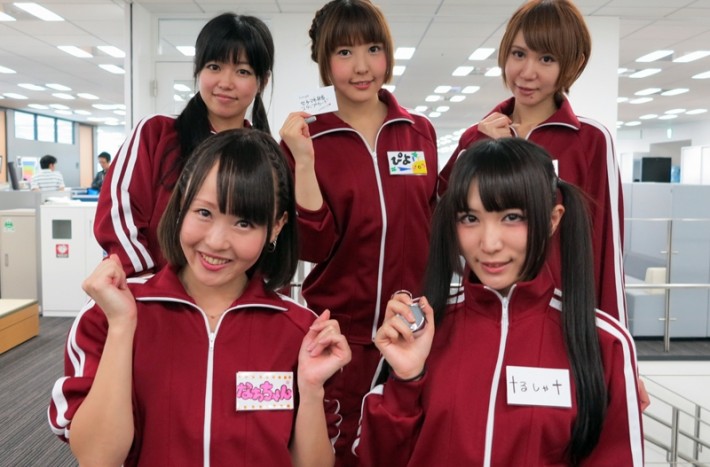
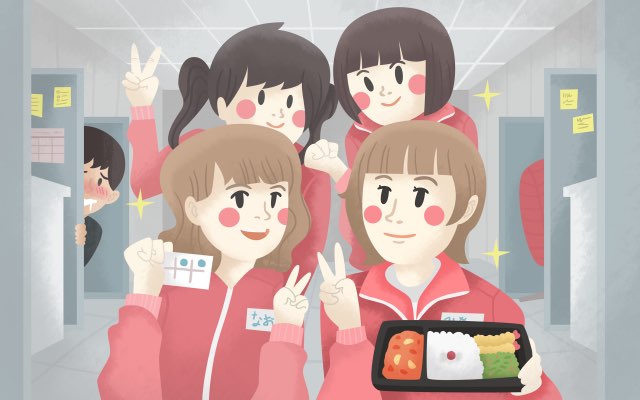
08On September 2nd, a Japanese company called DWANGO Co., Ltd. implemented a new project called ‘女子マネ弁当 (Joshi-Mane Bento)’, which involved placing many female ‘managers’ in the office to motivate the company’s late-arriving male engineers, who tend to show up to work in the afternoon, to come in earlier. 女子マネ (joshi-mane) is an abbreviation of 女子マネージャー (joshi-manager) meaning female managers. 弁当 (bento), as you probably already know, is a single-portion takeout or home-packed meal common in Japanese cuisine.

So, DWANGO hired 15 female managers to come in and motivate its workers. Surprising? Sad? Do you think it would be an effective form of motivation? It’s a difficult assessment to make. I know that if I heard there were going to be 15 more managers at my workplace, ‘motivated’ would not be the operative word. However, it seems that the new system worked out very well there. Keep in mind that they are managers, not bosses. They’re there to help manage you, not boss you around.

What are Joshi-Managers?

If you say ‘manager’ in Japan, it often indicates a ‘towel boy’ (aka waterboy) rather than an ‘office manager’. Towel boys are the kids who hang out at the sidelines with bottles of water and hand towels to the athletes at sports games. So if you say ‘joshi-mane/joshi-manager’, it is generally referring to a female manager who takes care of sports players like towel boys do.

They also take care of equipment, sports team records, and more. Now, you can imagine that a lot of boys develop crushes on their joshi-mane, possibly because they are so helpful and supportive of all the players on the team during the school year.

Joshi-mane has taken an especially important role in Japanese school culture. In fact, you find them in a lot of Japanese manga comics, novels, movies, and dramas. My favorite one is Minami Asakura, who is the heroine of a Japanese high school baseball manga called “Touch”. She’s a Meisei baseball team manager.

There is also another famous baseball team manager named Minami in a best-selling book by the title of “Moshi Dora” that is an abbreviationn of the title: もし高校野球の女子マネージャーがドラッカーのマネージメントを読んだら (Moshi Kokoyakyuno Jyoshi Manejyaga Drucker no Management wo Yondara / If the Girl Manager of a High School Baseball Team Read Drucker’s ‘The Practice of Management’). The novel follows Minami as she uses Peter Drucker’s famous tome on management to guide the team to success.

DWANGO and Joshi-Mane Sensation
dwango

The Dial-up Wide-Area Network Game Operation, better known by the acronym DWANGO was an early online American game service. It launched in 1994, but its operation and all its services stopped in October 1998. There is one remaining division still in operation in Japan which continues to do well today. Its subsidiaries include Niwango, which runs the popular video sharing website in Japan called ニコニコ動画 (Nico Nico Douga).

It’s a telecommunications and media company, so there are a lot of engineers working there. Historically, men have been known to vastly outnumber women in the field of engineering. Thus, it won’t surprise you that the large majority of this company’s engineers were male, which is why it’s easy to see how the resolution to the following issue was reached. Engineers tend to work late into the night and it often causes them to be late for work in the morning.
09

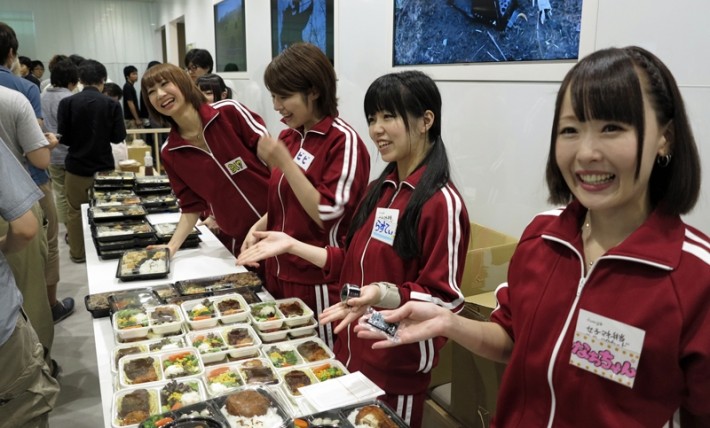
Nobuo Kawakami, the chairman of DWANGO, who’s also a Studio Ghibli producer, was contemplating how he could resolve this issue. One day, he got an idea: If the engineers were given the option of having cute girls in maid costumes hand out bento boxes to them, they might come into work on time. This experiment was more successful than Kawakami thought it would be. He then set out to improve his system and decided to hire cute female managers (joshi-mane) next. Surely, he believed, the engineers would come to work on time and work even harder.

How the ‘Joshi-Mane Bento’ System Works

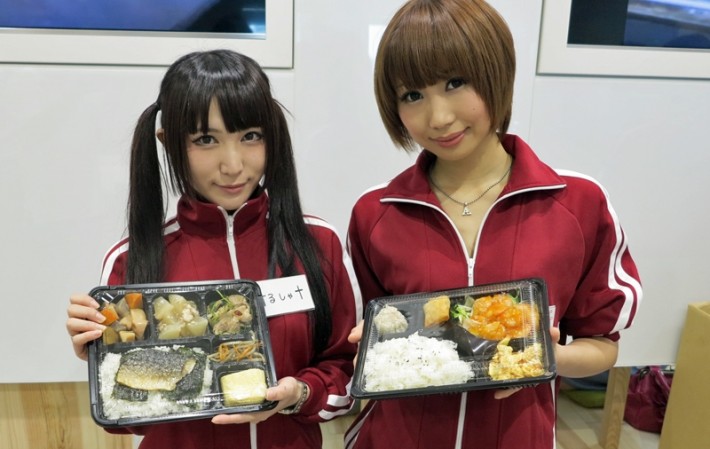
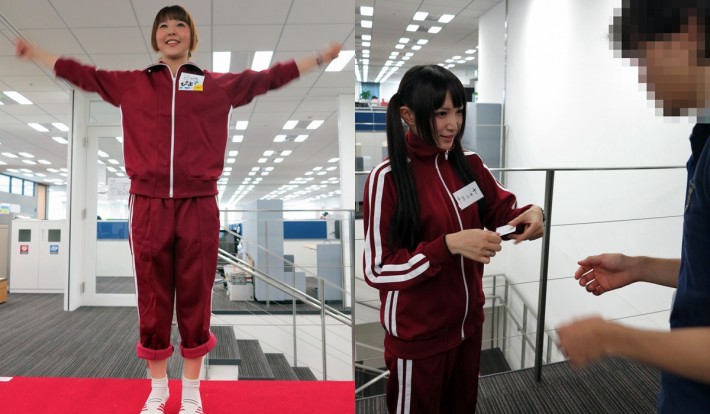
01Kawakami also decided that his joshi-mane girls had to wear crimson gym uniforms to make them look more like real team managers in hopes that it would be more effective in helping the engineers. Kawakami said that reason he chose that color was simply because he liked it. Their job is not strictly being in the office to encourage the workers.

Remember, the name of the project is ‘Joshi-Mane Bento’, so joshi-mane girls hand out nutritious bento lunch boxes to the engineers to help keep their tummies full and their minds sharp. Unfortunately, the bento boxes are not homemade by the joshi-mane girls, but there are 6 to 7 different kinds and all of them are supplied by DWANGO free of charge. Pretty cool, eh?
06

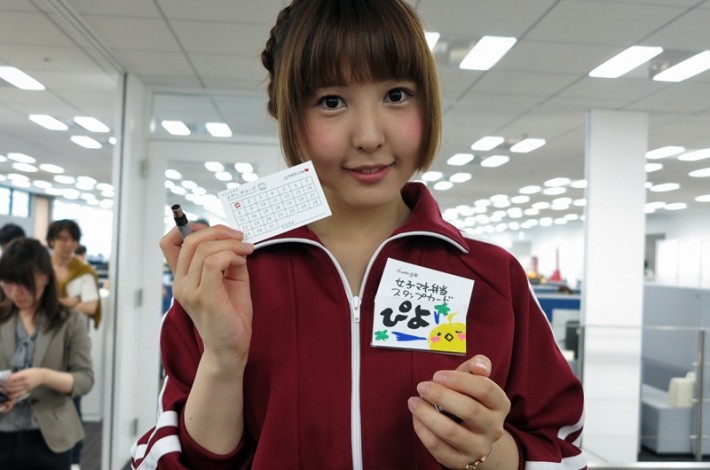
Sounds like a good deal, doesn’t it? Well, here’s the rub – in order to be allowed to receive a bento-box, you must arrive to work on time. Joshi-mane girls are also responsible for light, traditional Japanese exercises called ‘ラジオ体操 (radio-taisou)’ at 10:30 every morning. It seems that those who join the radio-taisou get a stamp on a personalized card. The stamp on your card is thing that gets you the bento-box.

This stamp is the thing that proves you showed up to work on time. So, this project not only leads engineers to come to the office on time but it also helps them get in, or stay in, shape by encouraging daily exercise and providing nutritious lunches. The atmosphere created by all the cute girls is an additional encouraging bonus for the workers. How genius is that? If you were a male engineer, you would want to join the company right away, wouldn’t you?

Of Course, There are Objections

objection-Haruhi-SuzumiyaHowever, this program obviously made some people displeased. Some call it a great innovative idea, whereas others call it old fashioned sexism or sexual harassment. The latter insists that Japanese women have also made some gains since the implementation of the Equal Employment Opportunity Law in 1986, but in light of the recent DWANGO sensation, it is being questioned again.

Although joshi-mane culture is widely accepted in Japanese sports and schools, controversy has even arisen over the voluntary work of team managers at schools because the girls’ duties are seemingly the same as the chores of housewives. In regards to the roles joshi-mane play on sport teams, I wouldn’t call it sexim because I actually know a few girls who became joshi-mane because they simply liked sports and wanted a proactive way to support the teams of their favorite sport.
02

If you think that these types of roles discriminate against women, why isn’t the same standard applied to towel boys? There are actually male managers, however few, in Japan, as well. Yet, I agree with and can understand where a lot of the opinions surrounding DWANGO are coming from, though I do also find some of them a little severe. Morning sucks! Tell me about it. But I personally think that it’s little pathetic that these workers can’t even show up to work on time unless a bunch of cute girls are going to put on smiles for them.


So what do you think of the joshi-mane culture or adapting it as a company system? Is there a similar culture in your country? Do you think that it’s a good idea? Let us know your opinion and/or about your particular country in the comments below!

  • Mami

    I personally really appreciate it too. I hated the packed trains…:(

  • Mami

    Just an English question…what do you mean by sincerely in this sentence?
    I always use it only in a letter. :P

  • Mami

    Thank you for clarifying. I almost misread it. :P Btw, ‘facetious’ was my new word, so I almost still misread your comment if I looked into a dictionary.

  • Mami

    I think that you are right. Although it’s not a school but an office, I’d go early to get my bento box for free.

  • Mami

    I understand what you mean and 萌え is actually sometimes used as a meaning ‘lovable’, as well. I don’t say that every guys feel sexual attraction from those girls, but maybe some of them. However, I have a prejudge for otaku…this may be a otaku discrimination, but I feel like otaku people just love those 萌え girls…

  • Mami

    nice bet.

  • Mami

    Nice.

  • Mami

    uhmmmmm

  • Mami

    What did you imply??

  • Mami

    Where are you from??

  • Mami

    Oh, sorry. rapchee already asked you below…

  • Mami

    Actually, it’s prohibited employers from recruiting only guys or girls by law. I’m not sure how this could have been legal.

  • Mami

    I see. Thanks.

  • Mami

    Right!

  • Mami

    people here are too nice.

  • Mami

    Wow…your work place sounds damn awesome! What do you do, if I may ask?

  • Mami

    Thank you for explaining the Japanese reality.

  • Mami

    Some company still let woman serve it, whereas others let just kohai, no matter whether it’s a woman or a man, do.

  • Mami

    I’m not sure if they have woman engineers, but you can see some girls in some pictures.

  • Mami

    I see. good point.

  • Mami

    男マネ for guy’s team? I have actually never seen 男マネ for girl’s team:P

  • Mami

    Do ya?

  • Mami

    I do too, btw.

  • Mami

    Sweet.

  • Mami

    He said that he ended up not doing so.

  • Mami

    Do they so?

  • Mami

    Yeah, having a good lifestyle is a great thing, for sure.

  • Mami

    lol Don’t you get up early even for your friends!?!?!? lol

  • Mami

    booth babes??

  • Mami

    i c.

  • Mami

    Well…it was kind of gross to me…just because it reminded me the combination of ‘otaku’ and ‘joshi-mane’…this may be an otaku discrimination, so I don’t say that it’s right, but I just had to think so…

  • Mami

    Yeah, that’s true. many Japanese people agreed that this is feminism. There are actually both side people about this system though. But majority of the supporters that I’ve seen was guys.

  • Mami

    Right!

  • AnonymousCoward

    I think its a negative thing. I’ve worked with very talented developers/engineers and understand why companies try to provide incentives instead of apply a “stick” approach. The reality is that a good developer or engineer can be important to not just a department, but a company. You lose that guy and its like if you were a factory owner trashing your own machines. The line workers can’t do anything without that core piece.

    The individuals I am referring to would be demeaned by being treated this way. Many were indeed single men who very much wanted a wife, but they were also men of pride and accomplishment. “Mid tier” types like myself (who are replaceable) would feel very uncomfortable in the same situation, to the point of cringing. We would lose standing in the eyes of others just by being associated with something like this.

    As to the sexism- I agree its extremely sexist, but understand that its the tip of the iceberg. Sexism isn’t just about words. These women might be comfortable with being used as a ‘carrot’, but other women who wish to get ahead by other means would be impacted by this choice. The advantages to using women this way are short term only. To demonstrate this, just consider the value of experience. An experienced “manager” who was a cute girl but is now older and fatter, is not desirable for the job of getting young men out of bed. Why has her value in this scenario decreased when her experience has increased? Because the nature of the work is simply not profitable. Its not her age that was the problem (Many men are coaches even when they’re grey), it is her ‘sexyness’. If her job requires ‘sexyness’ it is sexist. Any other argument fails to that address that right?

  • rapchee

    honestly, truly
    in letters it’s a shortened version “I’m your sincere servant”, which I find a bit ridiculous
    http://en.wikipedia.org/wiki/Valediction

  • rapchee

    can i use なるほど in this case? i mean instead of “of course”

  • Christopher Stilson

    Companies using cosplay for advertising purposes at gaming conventions. For instance, Square Enix keeps a person on payroll whose job is to dress like Lara Croft and be ogled by nerds at E3.

  • Mami

    No you can’t use なるほど in this case. なるほど means more like ‘I see I see’. What you should say instead is ‘もちろん’.

  • rapchee

    なるほど^_^

  • http://perpetuallybored.com Calreth

    If engineers are working late into the night, which seems to be the root cause of them coming in late the next day, shouldn’t something be done to address the problem of late and long work hours the previous day instead?

    Also, can we get a wallpaper of the cover art? :)

  • bomblol

    Creepy. In the US, while I can’t see this happening at a large corporation, at tech conferences and such, sometimes creepy sexist “bring in cute girls to encourage the guys” stuff happens as well, but it tends to cause a huge stir, at least as of late, and make people lose their jobs. A good list: http://www.alternet.org/media/beyond-titstare-8-more-sexist-moments-tech-events?page=0%2C0&ak_proof=1&akid=.93192.aN_lr6&rd=1&src=newsletter896373&t=11 I don’t see how anyone can find this acceptable. As someone who will likely be working in similar professions and environments in the future, I would be made incredibly uncomfortable by this, and I’m a male. I can’t imagine how any female coworkers would feel.

  • ninpou_kobanashi

    Salaried engineers don’t punch in. For example, I am working on a weekend, but normally come in late so that I can work with teams in the US East Coast, West Coast, and China.

  • Henro

    Mami, what I’m implying is that the social problems in Japan are not the fault of a foreign power. No one forced Japanese culture to be the way it is. When I criticize Japanese culture, I am not criticizing a weak, oppressed people with no choice.

    The Japanese have never been colonized. Even when under American occupation, they enjoyed a great deal of freedom and self-determination. Japan is a democracy. Everything that happens in Japan happens because the Japanese people want it to happen. Nothing happens in Japan that is not desired by the Japanese. If the Japanese are oppressed, it is because OTHER JAPANESE people are doing it to them. No foreign power has EVER oppressed a Japanese person. (And that’s not even getting into Japanese immigration policy; Japan maintains complete control over the foreigners who live here, so it’s not like we’re this rampaging, invading force.)

    This means that it is fair to criticize Japan – it is a 1st world nation; it is the world’s 3rd largest economy; the Japanese people enjoy power and privilege within their borders.
    No one forced Japan to be the way it is. Japan CHOSE to be this way. They can CHOOSE to change, or they can choose not to.

    What I’m implying is: if Japan is sexist, then that is what the Japanese people have chosen for themselves, and I will criticize is without remorse.

  • Henro99

    People absolutely get away with sexism, racism and homophobia in the workplace in America, so I won’t hold Japan to a higher standard than my own country. That said, this kind of blatant violation of labor laws would not go unnoticed in America. You can’t be so open and obvious in America and get away with it. Did no one at DWANGO call the cops?

    I mean, look: yes, you can get away with this kind of sexism in America, but SOMEONE will notice – there will be a boycott, or a protest, or a lawsuit – SOMETHING will happen. At the very least, I appreciate that about my home country – we don’t take this kind of thing sitting down. Someone would at least call the BBB and report the company for blatant disregard of labor laws.

  • Mami

    Thank you for your comment and sorry for my ignorance, but could you teach me what BBB stands for, please?:) Thank you.

  • Henro99

    Oh, don’t apologize “for your ignorance.” I was being an ass by using an American abbreviation that you have no real reason to understand. That’s MY fault, not yours.

    BBB is the Better Business Bureau – it’s common in America, and it’s basically a consumer advocate group; they rate and grade businesses and keep a database of companies that do illegal and unethical things.

    This means that, even if the police can’t do anything about a company, the BBB will have a record of the bad things a company does, and you can get that information from them. So, for example, the police probably can’t do anything about DWANGO’s illegal hiring practices – but the BBB can put out a report that says, you know: “DWANGO has sexist hiring practices and is not a good business.” BBB can also give recommendations for companies that DON’T do illegal things.

    Um, here’s a wiki link: http://en.wikipedia.org/wiki/Better_Business_Bureau

    Canada probably has something similar, though I don’t think there’s anything like this in Japan. To be honest, a lot of Japanese business methods are HIGHLY illegal in America, so there are some MASSIVE cultural differences at play here. (Zaibatsu system, for example, is so unspeakably illegal in America, I can’t even put it into words.)

  • iErika

    My previous company requires every team to have at least one female member (I personally think it is for encouragement purposes rather than diversity). I was that one female.

  • erly

    I test video games :3

  • Wrathful

    In the professional environment, people are supposed to be in professional manner, diligent and punctual. If they need to have system like DWANGO to motivate the workers, that explains how poorly trained those workers are. I always had this thought that Japanese companies are all so professional, perhaps I was wrong after all.

  • Skyeaten

    I guess I like the idea that DWANGO is finding a less sever/strict way of trying to encourage their employes to work hard and be on time. It’s just unfortunate that Japan has never really minded the using the opposite sex as eye candy to do this. Besides most these girls must be really young compared to the employees, which to me seems like it can only encourages pervs to be pervy. 情けない。