My Japanese Education

One day, even though I had plans to hang out with my friends Johnny Depp and Orlando Bloom, Professor Anderson gave me some homework: “Make one million sentences in English.” About that time, they both of my star friends were really busy filming the “Pirates of the Caribbean,” so it was my only chance to go out with them both together at the same time. Nevertheless, I chose to do my homework instead of going out because I was so diligent. I am still proud of the moment I made that decision.

johnnybloom(My Ideal Guy: (Johnny Depp + Orlando Bloom)/2 drawn by Mami)

This sounds like a dream, doesn’t it? I wish this was true, but unfortunately not…

“Tell me about your greatest moment as a student.” That was my homework from the ESL school that I used to go to. As you can probably tell, I wasn’t particularly ‘diligent’ and that is why I made up a silly short story for my homework. Getting a high grade or making a great presentation could be thought of as a “great moment” for most students, but honestly I couldn’t come up with any good examples at the time no matter how much I thought about it.

Education is often analyzed in terms of outcomes, results, or as a process. But here I would like to put this assumption aside, and just concentrate on the experience itself, specifically in Japan. Wouldn’t you like to know what it is like?

Educational system in Japan

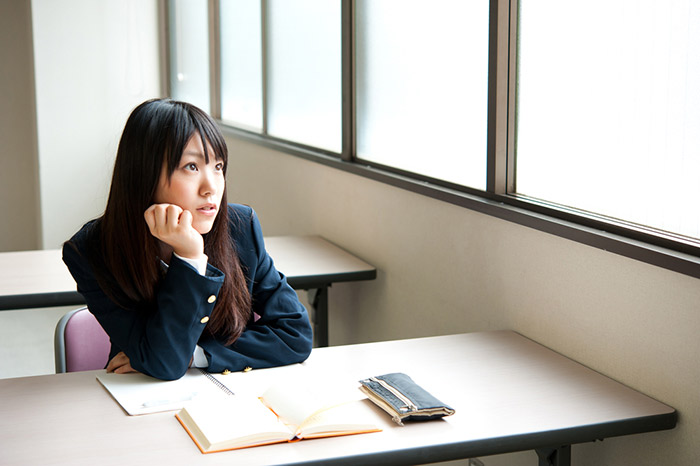
japanese-schoolgirl

Japanese Schoolgirl photo by Shutterstock

In Japan, the educational system in is the same as it is where I am now (Canada).

6 years of elementary school
3 years of junior high school
3 years of high school
4 years of university

This was actually reformed after WWII from the old 6-5-3-3 system to what you see above. Of these years of education, high school and university are not mandatory, though high school enrollment is over 96% nationwide in nearly all cities of Japan. Around 46% of Japanese high school graduates go on to college or university.

Most schools operate on a three-term system with the academic year starting in April when the cherry blossom bloom, and end in March of the following year. So in March there is a graduation ceremony, and I remember a lot of students were crying because of hay fever creating a very grave atmosphere.

There are some people who claim that Japan should change the school-year system to be the same as North America, because this difference sometimes causes inconveniences to students who wish to study abroad in places such as the US, Canada, and so on. The same problem would happen to foreigners who wish to study in Japan as well. They graduate from their school in June or July, but have to wait until April to go to a Japanese school.

Personally I would be a little sad if the Japanese school-year system was changed. It’s such a beautiful moment to say goodbye to your friends underneath the cherry blossoms in full bloom.There are so many good songs about graduation and cherry blossoms, too, and they would all be ruined! Although I understand the student side of perspective, I’d like them to leave that system as a Japanese culture.

「さくら(独唱)」/森山直太朗

卒園式の歌(さよなら僕たちの幼稚園) 号泣

Too Many Study Hours
school-girl2

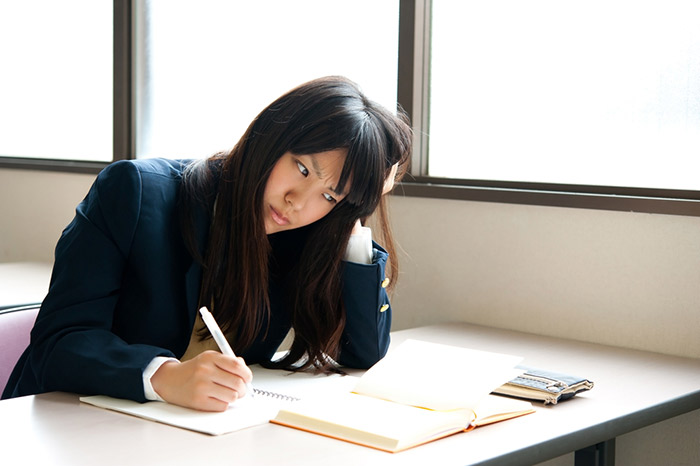
Japanese Schoolgirl photo by Shutterstock

Other than the lower grades of elementary school, an average school day on weekdays in Japan is seven to eight hours depending on the school and what grade you’re in. That’s one of the longest school days in the world! Despite this, a student’s studying doesn’t usually finish even after school lets out. Not only do they have drills and other homework after school, but there’s also extra classes to attend at their public schools or at private “cram schools” known as 塾 (じゅく/juku). Especially with junior high and high school students, much extra time outside of regular school is spent studying and preparing for their entrance examinations. Even during vacations (six weeks in the summer and two weeks for both winter and spring) there is often homework to be done and jukus to attend. Hours outside of school hours are spent at juku.

If my memory serves me correctly, I started going to a cram school in my third grade of elementary school. I still remember when we had a “New Year’s Eve all-night studying (年越し徹夜勉強会:としこしてつやべんきょうかい/toshikoshi-testuya-benkyoukai)” event in my fifth grade. Teachers encouraged us not to fall asleep but to keep studying until the morning. It would have been very fun to stay up later with friends, if only we weren’t studying. However, 初日の出 (hatsu-hinode), which means “the new year sunrise,” was quite memorable and made everyone’s new year resolution the same: achieve better grades and study hard. I found it pretty fun at first, because teachers actually prepared a little games for us, too. However, maybe around one o’clock, my eyelids started getting more and more heavy. I tried to study but couldn’t concentrate on it anymore and I doubt that it was only me. It wasn’t a efficient way to study at all. It was all about discipline.

Although studying itself is good for everyone, studying too much can make people stressed out. Therefore, if I could change the Japanese school system, I would remove the big entrance examinations and cut down the amount of private school education, because I think that is an overload of work for children. Second only to bullying, the number of children committing suicide due to “anxiety for the future” is increasing. Most of this is due to worry about how one will perform on examinations.

Japanese Classroom System
japanese-classroom

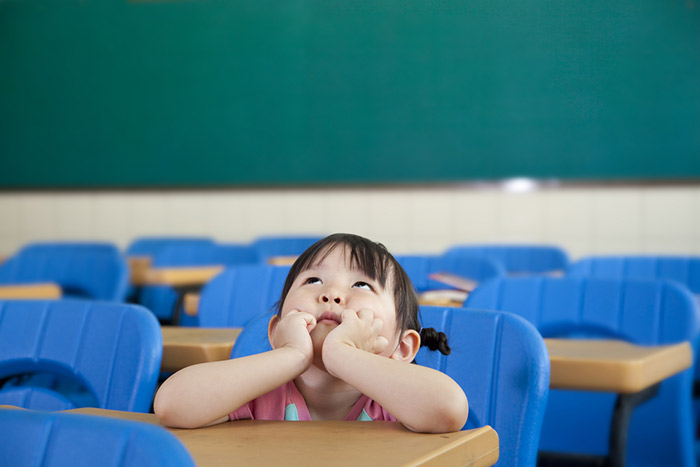
Japanese Classroom photo by Shutterstock

I was surprised that many schools in Canada don’t seem to have fixed classrooms because in Japan every class has its own fixed classroom. In most cases in Japan, the students take all the courses in the same classroom with the same classmates, except for practical trainings and laboratory works. In my case, grades 3-4 and grades 5-6 were 2-year fixed classrooms, though it’s usually just a 1-year fixed classroom system.

In elementary school, one teacher teaches all the subjects in each class, whereas the teacher changes depending on a subject in junior high and high school. Instead of the students moving around to the teachers, the teachers move around to the student (besides the exceptions I mentioned earlier).

Another thing that’s different about the Japanese classroom system is that most elementary and/or junior high schools provide lunches on a standardized menus known as the 給食 (きゅうしょく / kyuushoku). The students are all divided into groups called 班 (はん / han). With lunch, this is important because one han is the 給食当番 (きゅうしょくとうばん / kyuushoku-touban). This particular han’s job is to take responsibility for the 給食. They pick up their classmates’ lunches in the school kitchen / lunch delivery area, carry the lunches to the classroom, serve their fellow classmates, makes sure that the food settles down into each kids’ stomachs, and then carries everything back. There is usually about a week rotation for which each han is the 給食当番.

If you’re not on the lunch duty han, your han could be doing something else that’s helpful. For example, students in a Japanese school are responsible for doing the cleaning of their own school. Sometimes there is a han that takes on the duty of cleaning (掃除/そうじ/souji), and they are known as the 掃除当番 (そうじとうばん / soujitouban). I think this is a great system because it is a good way for kids to learn how to socialize and be responsible. It also makes them more aware about causing a mess, since either they or a friend will have to clean it up!

School Uniforms
school-uniform

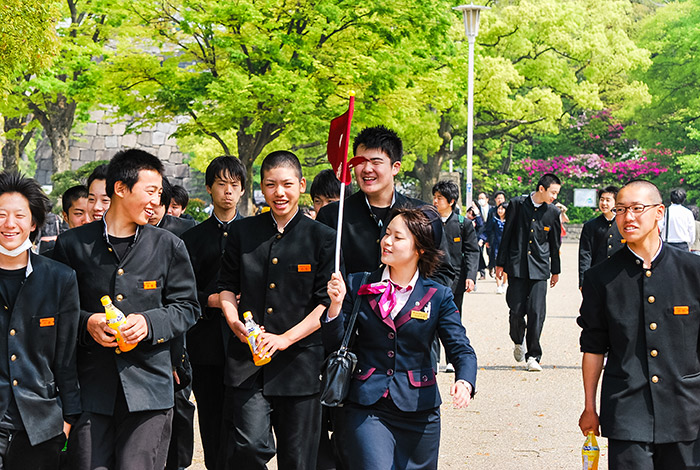
Some elementary schools and nearly all junior and high schools require their students to wear school uniforms. In my case, I wore school uniforms from kindergarten to high school.

Although some people believe that students, or at least high school students, should be able to choose the clothes they want to wear in school, I’d say that the best policy is that they wear uniforms because it’s more affordable and convenient.

Students tend to be very concerned about fashion and fitting in, so if they can choose the clothes they want to wear at school, they will prefer to wear brand-name clothing. For example, I remember that girls put a lot of money into brand-name socks or loose socks, which are a style of baggy socks. A pair of socks are sometimes 1,000-2,000yen. What a rip off! Thank goodness socks are the only brand-name thing for us to put on due to the uniform. If we were allowed to wear whatever we wanted, people would have certainly added hundreds of thousands of yen in clothing costs in a single year.

Also, uniforms are very convenient. Students do not need to worry about what they will wear to school. For instance, they do not need to consider what colors match with what, which style looks best, and what their classmate will think of their clothing. If everyone wears the same uniform, all of these choices are made in advance , so you don’t have to feel self conscious about your clothes. It saves more time for students and they can concentrate on studying more, though it just gave me longer sleep in the morning.

Furthermore, uniforms tend to be made of strong materials and they are easy to clean. I wore uniforms from kindergarten to high school and I had two uniforms for each warm season and cold season. When one was dirty I would wash it and wear the other one. This way my school clothes were always clean and ready to be worn. Uniforms are very practical!

They are not good all the time, though. As in many countries, uniform policy is strictly adhered to. There is a set length for skirts and teachers would take out tape measures to check. Japan has four seasons and its weather and temperature can vary greatly. However, uniforms usually only come in two varieties: winter and summer. Anything in-between can be a bit uncomfortable.

I also remember that my teacher wouldn’t allow me to put pants on because of the uniform policy, even though it was a freaking cold day. It might become less practical and ununified, but I think it would be good for students’ health to wear warmer clothes on cold days and lighter clothes on warmer days. Heck, let the boys wear skirts in the summer if they want to! I still believe that I have bad circulation because of the school uniforms.

A Great Difference
japanese-group

Photo by gwaar

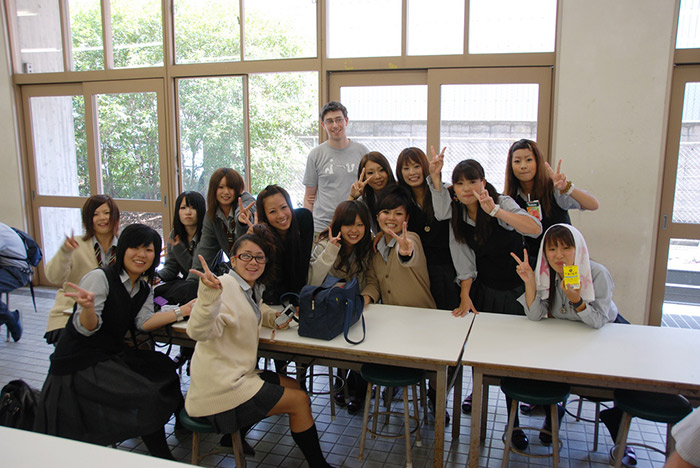
A great difference between the Japanese school system and the North American School system is that the North American people respect and encourage independence whereas the Japanese people control individual responsibility by maintaining group rules. This explains one characteristic of Japanese social behavior (or maybe even Asian social behavior).

I realized this fact in ESL school in Canada. There were students from all over in the classroom: Saudis, Brazilians, Spanish, Chinese, Korean and me, Japanese. While the teacher was talking, myself, the Chinese, and the Korean students never butted in to ask questions or to announce our opinions. We waited until the teacher was completely finished, whereas students from other countries spoke out anytime.

We talked about this in the classroom once and figured out that this difference was caused by each country’s school system: in Asia, we mostly have lecture style lessons and in other countries, they spend a lot of time doing discussion style lessons.

A Joke

To finish this article, I wanted to end with a famous joke called “A Brilliant Japanese Student In An American Classroom.” I wonder if you find an odd bit in this joke… you got it? Yeah, the Japanese guy named Hideo speaks out too actively, doesn’t he? Which is pretty different from what you’ve learned about Japanese students from this article today. I don’t think the average Japanese student puts his/her hand up as much as this guy, either.

A BRILLIANT JAPANESE STUDENT IN AN AMERICAN CLASSROOM

It was the first day of school and a new student named Hideo, the son of a
Japanese businessman, entered the fourth grade. The teacher said, “Let’s
begin by reviewing some American history.”

Who said “Give me Liberty, or give me Death?” She saw a sea of blank faces,
except for Hideo, who had his hand up.

“Patrick Henry, 1775.” he said.

“Very good! Who said ‘Government of the people, by the people, for the people,
shall not perish from the earth’”? Again, no response except from Hideo:

“Abraham Lincoln, 1863.”, said Hideo

The teacher snapped at the class, “Class, you should be ashamed. Hideo, who is
new to our country, knows more about its history than you do.”

She heard a loud whisper: “F-k the Japanese.”

“Who said that?” she demanded.

Hideo put his hand up. “Lee Iacocca, 1982.”

At that point, a student in the back said, “I’m gonna puke.”

The teacher glares and asks “All right! Now, who said that?”

Again, Hideo says, “George Bush, to the Japanese Prime Minister, 1991.”

Furious, another student yells, “Oh yeah? Suck this!”

Hideo jumps out of his chair waving his hand and shouts to the teacher, “Bill
Clinton, to Monica Lewinsky, 1997!”

Now, with almost a mob hysteria, someone said, “You little sh*t, if you ever
say anything else, I will have you killed.”

Hideo yells at the top of his voice, “Gary Condit, to Chandra Levy, 2001.”

The teacher fainted

Hope you enjoyed the joke! For me, the Japanese education system is weak because it makes Japanese students get more and more conservative as time goes by. I think Japanese students should be more vocal and participate in a conversation like Hideo. Well, maybe Hideo is too much, but at least a little more. Many of them don’t have curiosity about the world or ambition to study overseas, either.

I think that this problem has been caused by the big examination system because they are forced to be in a competition to get into the better school from very early in their life. Their end goal is often set up to get into the best university by their parents and/or teachers. Hence, many of them don’t gain curiosity about anything other than getting a good mark and they become like drones.

I’m pretty sure that you all probably have such interesting personal stories about your own educational experience. Tell me about your country’s education system. How is it different? How is it the same? What do you like / dislike? I think all educational systems in the world have good parts and bad parts, so maybe if we learn from each other we can make education better around the world! Arigatou.


Bonus Wallpapers!

myjapaneseeducation-animated-700

[2560x1600] • [1280x800] • [1280x800 Animation] • [700x438 Animation]

  • Mami

    Ah, I see. Do you still play hockey? It’s very popular here in Canada. Yet, to me, it looks very dangerous! They move at a very high velocity and sometimes fight too. Ice skating in Japan is very expensive, by the way. It’s like 2000yen for a couple hours…so I have skated only 3 times in my life and that is probably why that I feel more fear for hockey…haha

  • Mami

    Thank you for sharing England’s system! Are school uniform skirts always purple and are its blazers black?
    I didn’t know the exam system. good to learn. Thank you!!!

  • Mami

    Thank you for sharing your experience and system! That’s great that you actually went to elementary school in japan for a year. You must have learned a lot of things and also made a lot of friends there.

    In Japan(or at least in my school), either dying hair or putting make up wasn’t allowed. (all elementary, junior high and high school). Teacher randomly had a ‘checking’ day to make sure if students (especially girls) keep the school code. (uniform/dying hair/make up, etc). They even had ‘cleansing oil’ in their hands and took our make off if they found it. We sprayed black ‘temporary hair dying spray’ on our hair in a bathroom to hide that our hair was died when teacher called out that they were gonna check.

    I didn’t have phycology but we had ethology and philosophy and I believe we didn’t have ‘law’ but it was a part of a subject.

  • Mami

    Thank you so much, Midnight Tea-san! I’m very happy to hear that you enjoyed my article!
    どうぞ、これからも、よろしくお願いします!

  • Mami

    motorcycles! I think we were prohibited to take motorcycles to school because they are quite dangerous. we also need a permission to take a car to college or university, i believe…but i’m not really sure about cars part since I didn’t use it. Most of students took trains to go to school, because they have special price for students and they are so reasonable.

  • Mami

    I’m not exactly sure, but you need some transcription proved by your school to transfer schools and once they approve it, you can go to a different school. You are usually transfer to a school, which is at similar level.

  • Mami

    Oh, sorry. I didn’t argue…I think I’ve been using ‘!’ mark wrongly, so it might have given you an impression that I was arguing you?? maybe?? If so, I’m sorry.

    Yeah, I didn’t really like tests either. It was stressful and they sometimes caused a little conflict among friends too. Sometimes you got a good mark for yourself, but it could be a bad mark for your friend who is very smart and you get a nasty feeling to him/her. I didn’t like the moment.

  • Mami

    I hope so, too!

  • Niklas Barsk

    I didn’t play hockey. It was everyone else in my class that did. I guess it can be a bit dangerous, but you have a lot of protection and when you are a kid tackling is not allowed in Sweden at least.

    In my school we had one PE class every week and during winter we were usually at the hockey rink doing ice skating maybe 4-6 times every year. So where I grew up everyone got experience of skating even if you didn’t play hockey. The hockey rink had old skates that you could borrow as well if you didn’t have any of your own so I didn’t have to buy any just of PE class.

    Speaking of PE, during winter we also did cross country skiing a few times per winter and also there you could borrow skis if you didn’t have your own.

    We also spent a lot of time at the swimming pool. Every second week the PE class was swimming and it was like this from the first grade until the 11th grade. A lot of the time at the pool was free time we could spend just playing, but we did a lot of swimming practice. Out of the four techniques it was only breaststroke and backstroke, but we did a lot of other things as well. In the beginning it was just to learn to swim, but in the later grades we had to swim longer and longer distances and I think we got up to 1.5 km as longest.

    We also did swam a bit under water and dived from the side of the pool and tried swimming with clothes, treaded water for up to 10 or 20 minutes in the higher grades and some rescue training where we dived down 3 meters and picked up a doll and swam to shore with it.

    Basically a lot of things related getting used to water and making sure that you can handle most situations and not get into trouble if you ever fall into water.

    I’m not sure if all schools in Sweden have the same amount of swimming. I grew up in a small town with only one school and the sports center and indoor swimming pool just next to the school. Since the sports center was unused during the days it was no problem having the pool occupied by classes a lot of the time. In bigger cities with much more schools it might be more difficult to find that much time for everyone.

  • Mami

    Thank you for sharing your experience and ideas! It’s very interesting.

    Yeah, that teachers are trying to teach kids that don’t want to learn and students are wasting time preparing for exams instead of actually learning could be said in Japan, too. It’s so difficult to make kids want to study if it’s already a given-thing. There are a lot of kids who want to learn in Africa or a lot of girls who want to learn in certain religious countries. I think that it’s very important to think how you could make kids motivated in wealthier countries. Kids need to think and/or figure out why they should learn and what they are interested in.

    I was really interested in reading ‘stories’ or making them, instead of learning science and others. I really liked fantasies when I was a kid. I still couldn’t believe that my teacher for grade 3 to 6 told my mom that she should force me read more realistic books instead because I was good at japanese literacy but weak at science or history. It was good that my mom didn’t like what the teacher said. She thought it was okay that I read a lot of fantasy stories or novels instead of scientific books. Now, I’m interested in scientific facts too, but I would have become hating reading if I was forced. Learning what you like is a great way, I think. Not taking an exam.

  • Mami

    Thank you Spritix! I will(^^)

  • Niklas Barsk

    I was pretty lucky with my class during year 1-9 as most people in it was pretty motivated to study and not to un-diciplined. But the other class on the same grade was almost the opposite. The boys in that class was not at all motivated and almost competed against each others who could get worst grades. When I went to school the grades 1 to 5 where 1 is the lowest and 5 is best. In that class you would almost get bullied for studying too much if you got a 3.

    The only somewhat motivated boy in that class had a pretty hard time and considered for a very long time to choose some of the less study heavy courses at “Gymnasium” (高校) where you are supposed to start working after you’ve finished. But in the end he choose to study the more math and science heavy course which prepares you for continuing on to the university.

    He ended up in my class and in then later also went to the same university as me and got a master of science degree in computer science and now he has a very good job with good income while all the other boys in his old elementary school class has low paying dead end jobs or are unemployed.

    When hearing that story I’m really lucky that I was randomly put into the class I was in. Otherwise I have no idea how I wound have managed school or if I would be where I am today.

  • Niklas Barsk

    We have no entrance examination. Instead you get into 高校 and university based on your grades.

    We had many regular normal examinations and homework during the school year and the result of these influenced the grade you eventually in that course.

    I think the kids learn a lot even though you don’t have super much homework or huge entrance exams. Some years ago kids in Sweden used to be among the best in the world when it comes to math, but nowadays they are more avarage.

    I think the biggest reason for the decline in results are that all the schools are trying to save money with bigger and bigger classes and fewer teachers. When I went to school my class was 18 people in year 1-9 and 14 people in year 10-12. I think the classes in bigger cities is much bigger than that.

    As a teacher you don’t really get that good salary and there is a lot of work with the ever growing classes so being a teacher is not a very high status job and it’s getting harder to find really good teachers.

  • Lydia Waalkens

    Haha! You make it sound like Santa emerges from the sea like Poseidon or Triton!! That would be pretty cool.
    But yeah, It wasn’t fun having to walk a couple of km from the bus stop at the end of the day with the summer sun on our backs… I don’t know how we survived (^_^)
    First term would usually be January to the Easter Break. Second term was till Winter (usually around June). Third term finished around September. Then finished in December.

  • laurenhiya21

    Ah I hate how ugly Canadian school uniforms tend to be… The one year I had to wear a uniform, it was a golf-like t-shirt and navy pants or the ugly dress. Luckily girls could wear either one but I still hated wearing it. (plus it was itchy as hell ><;)
    I still wouldn't be able to survive in a Japanese school though, as I had a hard enough time staying awake in high school… At least I have shorter hours, breaks between classes, and Fridays off in college or else I would of gone crazy DX

  • Senjougahara

    “It’s so difficult to make kids want to study if it’s already a given-thing.”
    That’s very true. I never thought about it like that before. Although it’s hard to implement, I think a flexible curriculum is important. Back in 3rd grade, I used to really hate math (which is ironic, as I study computer science and take a lot of theory classes), specifically addition and subtraction. At my elementary school, addition and subtraction was normally taught to 1st graders, so I was behind by 2 years. Eventually my mom discovered that I was able to do the work, but I was just making many mistakes out of boredom and lack of interest. For some reason, subtraction gave me the math version of writers-block.

    So my teachers switched me to multiplication, and I actually caught up by the end of the year. That was a really important event in my life. It was sort of like a butterfly-effect. Since I entered 4th grade at the proper level of math, it quickly became my strongest subject, and it remained so until I graduated from high-school If my 3rd grade teachers had not let me try multiplication, I don’t think I would have become nearly as interested in math.

  • Jared Harding

    Hey Mami, do you remember what times your schools would start and end?

    As for me, here in Vancouver, WA, we had Elementary School from 9:45 AM to 4:15 PM, Middle School was from 8:45 AM to 3:15 PM, and High School was from 7:45 AM to 2:15 PM. So every time we went up to a different level, we also had to wake up an hour earlier. I think this was mainly for the school buses, so they would not take all of the students home at the same time. This saves time in traffic and money on buses, because after the buses were done taking home the High School Students they would go to the Middle School and take home the Middle School Students and then the Elementary School Students last. Speaking of which, how did you get to school? Did you have a bus specifically for students, or did you take a normal public bus, or something else???

  • shahiir mizune

    My school has a place to park motorcycles. So, no problem.

  • Julei

    hi! noooo! depends on the school! mine is navy blue, but I’ve seen pretty out there uniforms! the SATS we do are v. different from the American ones!

  • Julei

    Also depending on where you live, you either have this system ( primary, secodnary and sixth form) or high school etc. method. :)

  • http://blackragdoll.blogspot.com/ Black Ragdoll

    Thank you for writing this article! I’ve always been curious about the Japanese education system. It makes me a bit sad to hear about the work overload, but personally I’d want my children (if I have any!) to go to school in Japan, at least for a period of their life, in order to learn proper discipline. It’s pretty different here in Norway, and schools aren’t very strict at all, which leads me to believe the Japanese/Asian students are more intelligent. I wish you’d write something about school clubs too though, we don’t have them and I always see them in anime and wondered if that’s a credible representation. Maybe in a future post? (:

  • Christopher Stilson

    Neither of us know more French than is required to read cereal boxes, but knowing French is a good professional skill in Canada (while it’s not actually an eligibility requirement for a lot of government jobs outside of Quebec, given two equally qualified candidates the one who knows French is more likely to get the job) and French immersion has a better retention rate than regular language classes. I don’t really like the sound of French personally, but I’d like him to at least be able to read it.

    He’s already got a head-start on the multilingualism – he’s picking up what he hears of Japanese pretty well so far (despite the fact that I don’t think I know it any better than he does at this point and the only time he hears it ‘conversationally’ is from the TV). Currently his favorite word is ‘neko’, which he pronounces ‘eko’ and which he thinks means anything that’s furry and cute.

  • MandaMac

    Kids in wealthier countries certainly have some issues; I think we become so accustomed to our wealth and privilege(compared to the rest of the world)that we have no motivation to better ourselves.

  • KaoriCamellia

    I went to school in Brazil for ~2 years or so, in Minas Gerais and Espirito Santo (one side of the family is Brazilian, the other Japanese). I definitely remember the classrooms being fixed as well. Both of the schools I went to had uniforms, including the catholic school I attended, but the uniform rules were pretty relaxed (we even have alternate uniform shirt colors and could wear jeans!).

    Personally, I find most Japanese uniforms to be fairly cute, both guys and girls. I always love to see photos of sneakily-customized uniforms as well. I think I agree with Mami that weather-appropriate stuff is important; I hate wearing skirts in cold weather.

  • Mami

    Oh, that’s too bad. Have teachers been like that for a long time? In Japan, teachers are used to be called ‘holly job’ and everyone respected them, though some of them beat students up by using their authority though. Now, teachers are not that strong. Parents are stronger than they used to be. Therefore the classes like that people yelling and talking all the time are increasing in Japan too. It’s called 学級崩壊(がっきゅうほうかい/gakkyuu houkai).

  • Mami

    That’s great that the kids learn a lot even though they don’t have super much homework or huge entrance exams. I’ve actually heard that educational system in Sweden is said the most successful system. I know some Japanese teachers went to Sweden to learn you guys’ system.

    I agree with the teacher and students ratio. It’s difficult to teach many kids by one teacher. I taught Japanese language to 10-ish kindergarden kids once a week. Even though the number was 10-ish, it was still more difficult than teaching one or two in person. It would be so hard if the number become 30 or 40, which is common students number in a class in Japan.

  • Mami

    I see. I think we have cross country skiing too if they live in Hokkaido or other very snowy region. I grew up in Nara, so we didn’t have such lessons. Nara doesn’t have sea either, so we swam in an outside or indoor pool as well, but other regions beside sea, they swam there I believe. I’ve thought that Sweden is very cool even in summer…oh, wait. You used an indoor swimming pool. That makes sense.

  • Mami

    Ahhh…that’s so cute. Eko…I like it:P
    Yeah, wish I knew French I thought when I came to Canada. I’d like my kid (if I had) to learn French too, for sure. My husband mother was French and German teacher but unfortunately he didn’t study hard for both languages, so he can’t speak them and I can’t learn from him. boo

  • Mami

    That’s good that the uniform rules in Brazil is pretty relaxed. Japan should be more relaxed, too. Grrr….lol

  • Mami

    I may write about it. I’ll ask Koichi later if he like the idea.:) Thank you for giving me and advice.

    Some people seem to go to Japan as soon as their summer vacation start (maybe July first ish) and put their kids in a Japanese school since Japanese summer vacation starts around July 20th. I’m not sure if everyone can do this, but if your country’s summer vacation starts earlier than Japan’s, it might work. I heard this way from Japanese people who live in different countries whose wives or husbands are foreigner. I hope it’s allowed to everyone so you can use this method when you have your own child!

  • Mami

    I think all Elementary, junior high and high school started at 8:25. University was more flexible.
    Elementary school and junior high finished around 3:45(maybe 2:30 for elementary school in lower grade) and maybe 4:00 or 4:15 in high school….i don’t exactly remember though. It was very easy to go to junior high for me because it was 10 minutes walk from my house. However, the elementary school was 40 minutes walk and high school was 45 minutes walk + 1 and a half hour train ride. University was 25 minutes walk + 1 and 40 minutes train ride. You can tell that I’d always been sleepy for my school period. haha
    To Elementary school, some school have a bus. We mostly walked as a group called 部団(ぶだん/budan). So I had to be a certain point to join the group at 7:15 a.m. The group was classified by regions where people live. It’s a bit odd, but boys and girls were different group…I didn’t think anything wired about that at that time, but it’s strange. In junior high, we walk or ride a bicycle. Only people who live far from the school were allowed to ride bicycles. In high school, we walk, rode bicycles, took trains or took bus. Not special school bus though. It’s very cheap to buy a bus pass or train pass for students in Japan.

  • Mami

    Tell me about it. I didn’t like my school uniforms either. Some school uniforms are so cute but others are so ugly. That sucks if your school has ugly uniforms.

  • Mami

    I see:D Thank you for telling me!

  • Mami

    This might be such a subject change, but ‘ice-cream’ was used to be KING’s dessert. That explains how wealthy we all become now, I always think.

  • Mami

    Wow, that’s a very interesting and great story. That’s so good that your mom discovered what you could do and what your week point was. I think that people have their pace especially when they are kids. I learned from Niklas Barsk’s comment above that Sweden used to have a great education system and result. Yet it’s getting a little worse because government decreased the budgets so now there are less teachers for more children and it obviously caused a bit worse result for children’s mark. (Although it’s still not bad, it’s not #1 anymore) I thought that means putting children at their proper level is very important. It’s more difficult to figure out what they are strong at or what they are weak at if there are so many students that one teacher has to take care of. Yet I understand about the budget too. So like your mother, parents should pay attention more at their kids and they should figure out what they can do or not and/or what is good for their kids. I also know It’s not as easy as jut saying so though.

  • Mami

    Oh, because I used the term ‘the ocean’? haha Santa like Poseidon or Triton…cool.

    I c. Thank you for explaining the 4 terms!

  • Mami

    i c.

  • MandaMac

    Things are the same in the U.S. Teaching used to be a respected job, but not any more. When I was in school, the teacher’s word was LAW. You didn’t cross your teacher, you listened and paid attention and did as you were asked. Of course, too, we had a lot more discipline in school than exists nowadays. We were never “beat up”, but we did have corporal punishment in school, although it took a lot for things to get to that point. But still, your teacher was to be respected, firstly because they were your teacher, and secondly, because they had many, many ways to discipline you and make your life unpleasant if you didn’t. You rarely saw kids talking in class; yelling-definitely not. You were flirting with danger by whispering in class and passing notes.
    And parents…well, parents had more respect for teachers, too, and trusted that if a teacher did or said something, then they had a good reason for it. If your kid got paddled, mom or dad wasn’t on the phone calling the superintendent to complain, they just accepted that little Johnny must have been naughty enough to have deserved what he got. 500 sentences? Well, little Johnny shouldn’t have been talking in class. Nowadays though, parents have the power. One phone call to the school and a threat of a lawsuit, and no teacher dares to issue any sort of consequence for a students actions…they can do whatever they want. My mom has been teaching for 40 years, and retires at the end of this semester. She said that for the last 10-15 years, she’s HATED teaching, primarily because of student behavior. A student can pretty much do whatever they want to do, and a teacher has no recourse. She said it’s hard to teach anything in a classroom of chaos.

  • Mami

    Yeah, i understand. And I also think that more kids have some issues such as AD/HD. My mother worked in an elementary school in japan 2 years ago as a supporter for one kid who is said ‘AD/HD’(his parents has never agreed with, so the school couldn’t get an official support for him and my mom was unofficial supporter. poor kid.) I also worked as a child care after school when I was in university for 2 years and 10 out of 50 or so had some issues including AD/HD, Autism and Down syndrome. I thought it was pretty big ratio comparing to when I was a kid. I asked my uncle and aunt who have been a teacher for decades and they said that the number of kids with some issues seems to be increasing, too. Furthermore, my friend who teachers in a nursery school says 90% of kids in her class have some issues and the classroom is disorganized. She feels kids with some issues are increasing too. My point is this kind of stuff could make things difficult for teachers to teach kids as well. It seems that classroom can be in a chaos more easily than it used to be.
    Moreover, nowadays they have smart-phones too. So many distractions in a classroom…

  • MandaMac

    There really ARE more kids with ADD/ADHD nowadays in the classroom, as well as autistic kids, although there are starting to be more and more specially designed classes for students with autism-I have a good friend who teaches in a program for children with autism. I don’t know that the change in the number of ADD/ADHD kids is as big of a deal….they can function fine in a classroom IF THERE IS STRUCTURE AND DISCIPLINE. I know….I was an ADD/ADHD kid. The thing most parents and educators don’t take into account is that kids with ADD/ADHD NEED a structured environment, regular routine, and consistent discipline. To this day, at 36 years old, if I don’t have structured parameters to function within, everything goes to pot. If there is a sudden change in my routine, it throws my whole day. When I was a kid, one unexpected deviation in the expected routine and the world crashed. Classrooms nowadays are so much more free-form; there is a lack of structure, little routine, and no discipline. A child with ADD/ADHD is going to be at a huge disadvantage in a classroom where they have no defined parameters. It becomes a nasty cycle: kids with ADD/ADHD can’t function, which creates more disorder in the classroom, which means the ADD/ADHD kids have more trouble functioning…..you know.

  • Mami

    Thank you for sharing your experience. I’m so glad to learn from ADD/ADHD side perspective. You are probably right that we need to learn about ADD/ADHD kids and try to make an ideal structured environment for those. It’s tough though because there is some events in school. When I was working as a child care, ADD/ADHD kids were totally confused and upset on such a day. We knew the un-routine stuff caused them being in bad mood, but we couldn’t help. He was one student in a classroom and all the teachers and his classmates knew the difference would ruin his day, but they had to. I haven’t gotten in touch with my co-workers, kids or their parents anymore, so I don’t know how they were doing anymore. Yet, to me, it seemed that their issue would continue forever, but is an ability of adjusting usually getting improved? (I’m sorry if I sounds rude. I’m just wondering…I’m curious how you realized/accepted that you used to be an ADD/ADHD kid and how you changed. You don’t need to answer me if you don’t want to and again, please don’t take me wrong and I’m so sorry if I sound rude to you. I’d like to learn about it.
    Yeah, I’ve also heard that more and more specially designed classes for autism students in canada as well, since my relative, who is in an elementary school, has that problem. Yet her parents took a choice to put her into a normal classroom with a support dog and a supporter, i believe. She may be sometimes in a special class too.

  • MandaMac

    I think the best way to deal with ADD/ADHD kids is to maintain a structured school environment overall…and it doesn’t just benefit the ADD/ADHD kids, it benefits ALL kids, in my opinion. A small example of how important “routine”, “structure” and a “plan” is to an ADD/ADHD kid: When I was little, and my mom would go run errands, I would always ask where we were going, and she might say “I’m going to pay the electric bill and go buy groceries.” And that was the plan. And as long as we went and paid the electric bill and bought groceries, it was all fine. But heaven forbid she decided that after she paid the electric bill she was going to stop at Goody’s and browse the big 50% off sale before we went to the grocery store, because clothes shopping WAS NOT part of the “plan” and therefore it totally threw me for a loop and inevitably I’d get mad, and be in a crappy mood for the rest of the outing.
    As far as talking about my ADD/ADHD, I have no problem, and I promise I don’t think you are rude at all! I actually wasn’t diagnosed until I was a junior in high school. When I was in elementary school, no one even knew what ADD/ADHD was. We were just problem kids. Although, with the amount of structure and discipline that existed when I was in elementary and middle school, it wasn’t the same kind of problem it would be nowadays. Most of what I know about myself and my ADD as it related to my younger years is based off research and reflection and memory of how I was as a kid. In retrospect, once I knew I had ADD, my behaviors and quirks as a kid made sense. But again, I think as that type of child, being in a learning environment that was big on routine, structure and discipline minimized the effect my ADD had on my education.
    Once I figured out what my “problem” was in high school, then I had a different struggle, and that was how to function as an adolescent/adult with ADD. Remember, even at the time I was diagnosed, not much was known about ADD/ADHD in children. Even less was known about ADD in adults. A lot of psychiatrists thought that it was strictly a childhood affliction that faded as one entered adulthood. We now know that isn’t the case. I knew it wasn’t the case for me. So, I just had to figure out how to manage. In order to be productive, I really have to schedule my day. Routine is STILL important, and I need a general plan every day to be able to function. But I’ve also had to learn how to adapt to changes and not let them bother me so much. It’s hard-I still have a tendency to want to fly off the handle if things don’t go according to “the plan.” I also had to learn how to adapt to having a shorter attention span. For instance, when I clean my house, if I had to just go into a single room and work in that ONE ROOM until it’s clean, I’ll lose focus, and chances are, I’ll quit. However, I have a plan, I know which rooms I have to tackle for that day, and I might spend 10 minutes in the bathroom, 10 in the kitchen, sweep the living room, take dishes to the kitchen and then go finish the bathroom, and on and on. All three rooms get done, but they get done in such a way that my shorter attention span is not such a handicap.
    Now, I will say, that that isn’t the case with everything. I think for all kids and adults like me, there are some things that are overwhelming interests that we CAN focus on for long periods. But they are our passions, and that’s why we can focus on them and not on other things. I think it’s important for parents and educators to identify those “passions” in ADD/ADHD students and find ways to relate less interesting topics and learning to those “passions”. It aids their ability to focus, in my opinion. That’s one reason why I’m going to school for a degree in East Asian Studies. It’s a passion. An area of overwhelming interest. Now, one could say that it could be more of a risky degree for someone of my age to get, but I know myself, and I know that if I tried to go back to school for something I wasn’t passionate about, I would struggle badly, because I would lose focus and interest. So the best route for me to get a degree is to choose something that identifies with a “passion”…..I also have a passion for reading, but last time I checked, no one was handing out B.A.s for reading books…lol.

  • Susana

    I’m latin american from Panama. The school system 9-3 and 4 to 6 on college depending on the career you choose. Before was 6 of elementary and 3 of junior but 2 years ago they merge it but one. but the kids still have to change from place because some schools only have until 6 grade. The amount of hours varies from public schools, 5 hours; to private, 9 hours. All the schools use uniforms, i think the same as you of the uniforms. They are easier, and you don’t have to look what you are going to wear every morning. Almost all the public school use the same uniform. The ones that varies are the private schools, and we use just one type because we have just two seasons, rainy and dry (summer). In most of the schools you dont have to change from classroom unless is a special subject lab, phisics and so…
    I think the uniforms are better for students. Because it reduce one of the aspects of social presure. Some private schools put skirts-pants on their girls unirforms, they are very comfy.

  • mitra

    hi
    ,I live in Iran and reading through comments I saw some people complaint about the school uniforms in japan.what would you people do if you were here? first of all,boys and girls are completely separated up to university.I mean completely different schools.and our uniforms here for girls include scarf and in many cities chador,because of the teaching of islam that all women should hide their beauties from strange men.99% of iran’s population is muslim.however,we also have christian , jewish , and zoroastrianism .
    the school system used to be 5-3-4,bus last year they chabged it to 6-3-3.
    in elementry and junior high every one study the same thing but once we reach high school depending on what we want to do in future we choose between 3 different school system,some stay in normal high schools which divides itself to 3 in 2nd grade to science,mathematics,humanities studied.some go to art schools,and others to mechanical school.
    I myself was in high school and my major was humanities study and we studied a lot of literature ,history, geography,philosophy , logic.no biology of any sort and very little math.
    also as for foreign language there’s no choice.english and arabic from junior high through the end of high school.

  • Mami

    Thank you soooooo much for your writing. I’ve learned a lot. I really appreciate that you explained all this. I’d remember what you wrote here and try to think of making routines, if I had kids in future. No mater if they are ADD/ADHD like you said, I will. And I will eventually seek the best timing to ‘teach’ to adjust irregular things too, though those things sometimes happen randomly as they are.
    I’d say that it’s very cool for you to go to school with such a passion. To my self, I’m thinking of going back to school, too. I have B/A degree in Japan, but they don’t care about that in Canada. Before choosing any course, I need to get a certain mark on TOEFL test or something like that. I’m pretty bad at speaking because I get so nervous when I speak in front of people. Doesn’t matter if it’s in Japanese or in English, but I get way more nervous when it’s in English because I’m afraid of screwing up grammar or pronunciation or etc. I believe speaking test for TOEFL is something that you talk to computer and the recorded sound would be sent away to markers, but I’d still get nervous, for sure. I need to prepare for it well…I just want to try out how it is, but it’s very expensive to just try out…boo. Anyway, I wish you all good luck with your East Asian Studies degree. You’ll probably learn about Japan more than I know about Japan…haha. I’m looking forward to learning from you about it, too! Again, Thank you very much.

  • MandaMac

    You are very welcome.
    Oh my gosh! I’m the same way about speaking foreign language! I am totally afraid of messing up and sounding stupid. Of course, I was that way about English, too…my mom said I was like that as a baby. I never “baby talked.” I wouldn’t say a word until I could say it right, consequently I didn’t start talking as early as most kids. Guess I didn’t want to sound stupid, LOL. I know native speakers of a language are usually forgiving of a not-so-good accent, or errors in grammar or whatever, but still…I’m with you, I can’t stand the thought of screwing up. I know that my comprehension of Japanese far outstrips my speaking ability, and probably will until I screw up my courage and actually spent much more time speaking.
    And I wouldn’t worry about screwing up if I were you, either…even native English speakers mangle it. I grew up in the American South, and people here STILL screw English up, and it’s their native language! The first time my husband(who is from Colorado) heard my best friend(who is from SE Tennessee)speak, he could barely understand what she was saying.
    I’m sure we’ll BOTH do well, though. Good luck with YOUR test!

  • Mami

    Thank you very much! Wish us the best luck!!! xoxo :D

  • Mami

    Thank you for posting your country’s system. It’s always great to learn new perspective and I was actually wondering how Muslim people’s perspective would be. Thank you so much. That’s very interesting. You said that 99% of people in iran are Muslim, but is there any minority religious students in your school? Do those (not Muslim people) have to ware scarf too as a school uniform?

  • Mami

    Thank you for sharing your country’s system. Speaking of skirts-pants, we call them キュロットパンツ(kurotto pants) in japanese. I don’t know where they came from though…haha:)

  • Mami

    btw, no Oyaji gyagu this time?? :P