My Japanese Education

One day, even though I had plans to hang out with my friends Johnny Depp and Orlando Bloom, Professor Anderson gave me some homework: “Make one million sentences in English.” About that time, they both of my star friends were really busy filming the “Pirates of the Caribbean,” so it was my only chance to go out with them both together at the same time. Nevertheless, I chose to do my homework instead of going out because I was so diligent. I am still proud of the moment I made that decision.

johnnybloom(My Ideal Guy: (Johnny Depp + Orlando Bloom)/2 drawn by Mami)

This sounds like a dream, doesn’t it? I wish this was true, but unfortunately not…

“Tell me about your greatest moment as a student.” That was my homework from the ESL school that I used to go to. As you can probably tell, I wasn’t particularly ‘diligent’ and that is why I made up a silly short story for my homework. Getting a high grade or making a great presentation could be thought of as a “great moment” for most students, but honestly I couldn’t come up with any good examples at the time no matter how much I thought about it.

Education is often analyzed in terms of outcomes, results, or as a process. But here I would like to put this assumption aside, and just concentrate on the experience itself, specifically in Japan. Wouldn’t you like to know what it is like?

Educational system in Japan

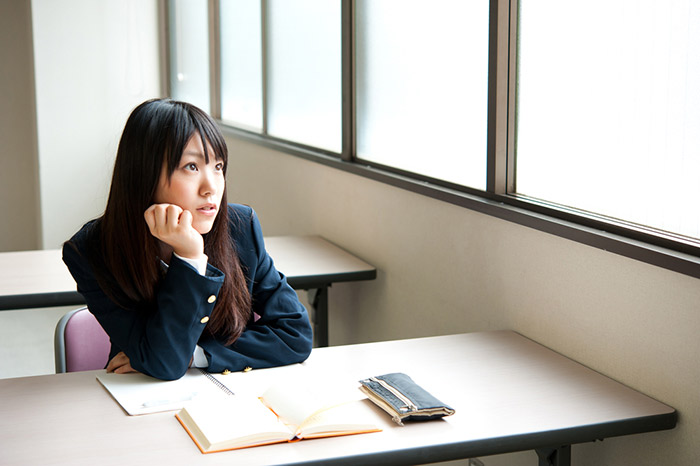
japanese-schoolgirl

Japanese Schoolgirl photo by Shutterstock

In Japan, the educational system in is the same as it is where I am now (Canada).

6 years of elementary school
3 years of junior high school
3 years of high school
4 years of university

This was actually reformed after WWII from the old 6-5-3-3 system to what you see above. Of these years of education, high school and university are not mandatory, though high school enrollment is over 96% nationwide in nearly all cities of Japan. Around 46% of Japanese high school graduates go on to college or university.

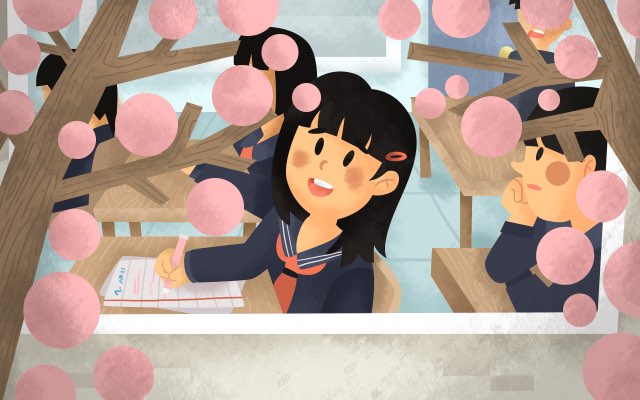
Most schools operate on a three-term system with the academic year starting in April when the cherry blossom bloom, and end in March of the following year. So in March there is a graduation ceremony, and I remember a lot of students were crying because of hay fever creating a very grave atmosphere.

There are some people who claim that Japan should change the school-year system to be the same as North America, because this difference sometimes causes inconveniences to students who wish to study abroad in places such as the US, Canada, and so on. The same problem would happen to foreigners who wish to study in Japan as well. They graduate from their school in June or July, but have to wait until April to go to a Japanese school.

Personally I would be a little sad if the Japanese school-year system was changed. It’s such a beautiful moment to say goodbye to your friends underneath the cherry blossoms in full bloom.There are so many good songs about graduation and cherry blossoms, too, and they would all be ruined! Although I understand the student side of perspective, I’d like them to leave that system as a Japanese culture.

「さくら(独唱)」/森山直太朗

卒園式の歌(さよなら僕たちの幼稚園) 号泣

Too Many Study Hours
school-girl2

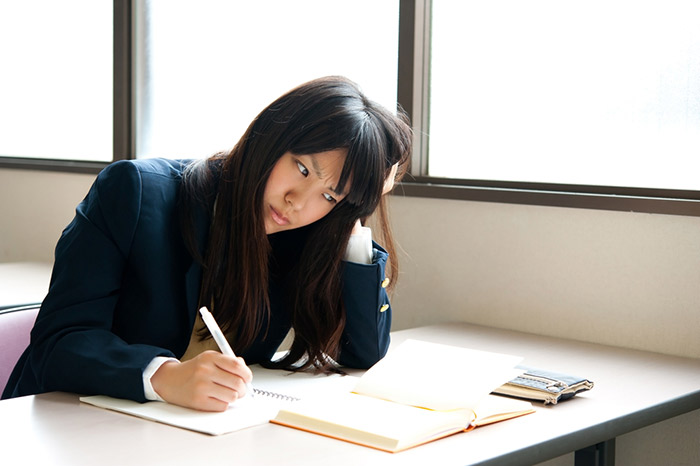
Japanese Schoolgirl photo by Shutterstock

Other than the lower grades of elementary school, an average school day on weekdays in Japan is seven to eight hours depending on the school and what grade you’re in. That’s one of the longest school days in the world! Despite this, a student’s studying doesn’t usually finish even after school lets out. Not only do they have drills and other homework after school, but there’s also extra classes to attend at their public schools or at private “cram schools” known as 塾 (じゅく/juku). Especially with junior high and high school students, much extra time outside of regular school is spent studying and preparing for their entrance examinations. Even during vacations (six weeks in the summer and two weeks for both winter and spring) there is often homework to be done and jukus to attend. Hours outside of school hours are spent at juku.

If my memory serves me correctly, I started going to a cram school in my third grade of elementary school. I still remember when we had a “New Year’s Eve all-night studying (年越し徹夜勉強会:としこしてつやべんきょうかい/toshikoshi-testuya-benkyoukai)” event in my fifth grade. Teachers encouraged us not to fall asleep but to keep studying until the morning. It would have been very fun to stay up later with friends, if only we weren’t studying. However, 初日の出 (hatsu-hinode), which means “the new year sunrise,” was quite memorable and made everyone’s new year resolution the same: achieve better grades and study hard. I found it pretty fun at first, because teachers actually prepared a little games for us, too. However, maybe around one o’clock, my eyelids started getting more and more heavy. I tried to study but couldn’t concentrate on it anymore and I doubt that it was only me. It wasn’t a efficient way to study at all. It was all about discipline.

Although studying itself is good for everyone, studying too much can make people stressed out. Therefore, if I could change the Japanese school system, I would remove the big entrance examinations and cut down the amount of private school education, because I think that is an overload of work for children. Second only to bullying, the number of children committing suicide due to “anxiety for the future” is increasing. Most of this is due to worry about how one will perform on examinations.

Japanese Classroom System
japanese-classroom

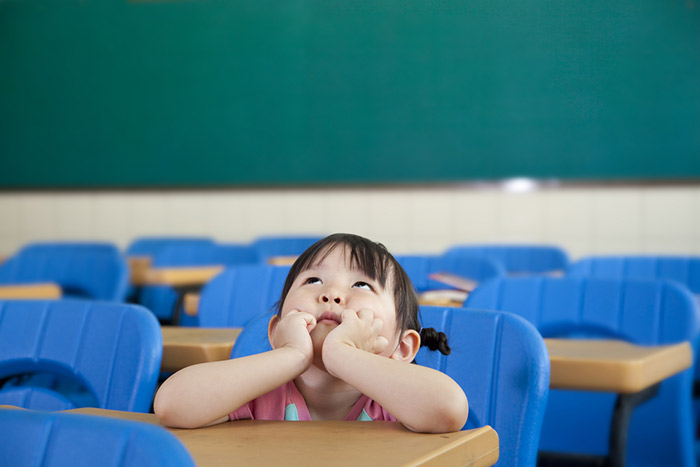
Japanese Classroom photo by Shutterstock

I was surprised that many schools in Canada don’t seem to have fixed classrooms because in Japan every class has its own fixed classroom. In most cases in Japan, the students take all the courses in the same classroom with the same classmates, except for practical trainings and laboratory works. In my case, grades 3-4 and grades 5-6 were 2-year fixed classrooms, though it’s usually just a 1-year fixed classroom system.

In elementary school, one teacher teaches all the subjects in each class, whereas the teacher changes depending on a subject in junior high and high school. Instead of the students moving around to the teachers, the teachers move around to the student (besides the exceptions I mentioned earlier).

Another thing that’s different about the Japanese classroom system is that most elementary and/or junior high schools provide lunches on a standardized menus known as the 給食 (きゅうしょく / kyuushoku). The students are all divided into groups called 班 (はん / han). With lunch, this is important because one han is the 給食当番 (きゅうしょくとうばん / kyuushoku-touban). This particular han’s job is to take responsibility for the 給食. They pick up their classmates’ lunches in the school kitchen / lunch delivery area, carry the lunches to the classroom, serve their fellow classmates, makes sure that the food settles down into each kids’ stomachs, and then carries everything back. There is usually about a week rotation for which each han is the 給食当番.

If you’re not on the lunch duty han, your han could be doing something else that’s helpful. For example, students in a Japanese school are responsible for doing the cleaning of their own school. Sometimes there is a han that takes on the duty of cleaning (掃除/そうじ/souji), and they are known as the 掃除当番 (そうじとうばん / soujitouban). I think this is a great system because it is a good way for kids to learn how to socialize and be responsible. It also makes them more aware about causing a mess, since either they or a friend will have to clean it up!

School Uniforms
school-uniform

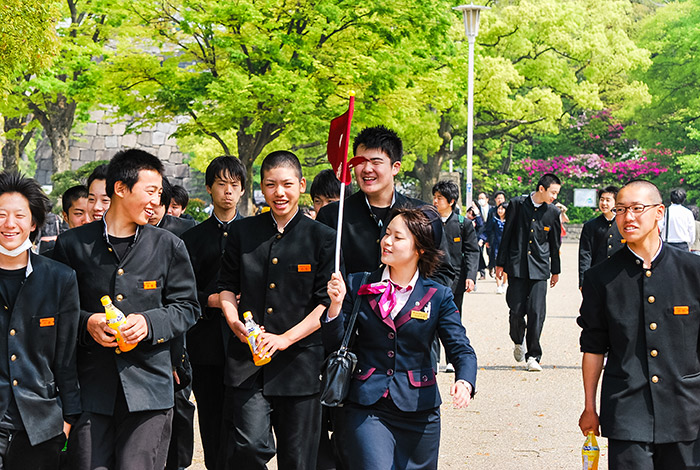
Some elementary schools and nearly all junior and high schools require their students to wear school uniforms. In my case, I wore school uniforms from kindergarten to high school.

Although some people believe that students, or at least high school students, should be able to choose the clothes they want to wear in school, I’d say that the best policy is that they wear uniforms because it’s more affordable and convenient.

Students tend to be very concerned about fashion and fitting in, so if they can choose the clothes they want to wear at school, they will prefer to wear brand-name clothing. For example, I remember that girls put a lot of money into brand-name socks or loose socks, which are a style of baggy socks. A pair of socks are sometimes 1,000-2,000yen. What a rip off! Thank goodness socks are the only brand-name thing for us to put on due to the uniform. If we were allowed to wear whatever we wanted, people would have certainly added hundreds of thousands of yen in clothing costs in a single year.

Also, uniforms are very convenient. Students do not need to worry about what they will wear to school. For instance, they do not need to consider what colors match with what, which style looks best, and what their classmate will think of their clothing. If everyone wears the same uniform, all of these choices are made in advance , so you don’t have to feel self conscious about your clothes. It saves more time for students and they can concentrate on studying more, though it just gave me longer sleep in the morning.

Furthermore, uniforms tend to be made of strong materials and they are easy to clean. I wore uniforms from kindergarten to high school and I had two uniforms for each warm season and cold season. When one was dirty I would wash it and wear the other one. This way my school clothes were always clean and ready to be worn. Uniforms are very practical!

They are not good all the time, though. As in many countries, uniform policy is strictly adhered to. There is a set length for skirts and teachers would take out tape measures to check. Japan has four seasons and its weather and temperature can vary greatly. However, uniforms usually only come in two varieties: winter and summer. Anything in-between can be a bit uncomfortable.

I also remember that my teacher wouldn’t allow me to put pants on because of the uniform policy, even though it was a freaking cold day. It might become less practical and ununified, but I think it would be good for students’ health to wear warmer clothes on cold days and lighter clothes on warmer days. Heck, let the boys wear skirts in the summer if they want to! I still believe that I have bad circulation because of the school uniforms.

A Great Difference
japanese-group

Photo by gwaar

A great difference between the Japanese school system and the North American School system is that the North American people respect and encourage independence whereas the Japanese people control individual responsibility by maintaining group rules. This explains one characteristic of Japanese social behavior (or maybe even Asian social behavior).

I realized this fact in ESL school in Canada. There were students from all over in the classroom: Saudis, Brazilians, Spanish, Chinese, Korean and me, Japanese. While the teacher was talking, myself, the Chinese, and the Korean students never butted in to ask questions or to announce our opinions. We waited until the teacher was completely finished, whereas students from other countries spoke out anytime.

We talked about this in the classroom once and figured out that this difference was caused by each country’s school system: in Asia, we mostly have lecture style lessons and in other countries, they spend a lot of time doing discussion style lessons.

A Joke

To finish this article, I wanted to end with a famous joke called “A Brilliant Japanese Student In An American Classroom.” I wonder if you find an odd bit in this joke… you got it? Yeah, the Japanese guy named Hideo speaks out too actively, doesn’t he? Which is pretty different from what you’ve learned about Japanese students from this article today. I don’t think the average Japanese student puts his/her hand up as much as this guy, either.

A BRILLIANT JAPANESE STUDENT IN AN AMERICAN CLASSROOM

It was the first day of school and a new student named Hideo, the son of a
Japanese businessman, entered the fourth grade. The teacher said, “Let’s
begin by reviewing some American history.”

Who said “Give me Liberty, or give me Death?” She saw a sea of blank faces,
except for Hideo, who had his hand up.

“Patrick Henry, 1775.” he said.

“Very good! Who said ‘Government of the people, by the people, for the people,
shall not perish from the earth’”? Again, no response except from Hideo:

“Abraham Lincoln, 1863.”, said Hideo

The teacher snapped at the class, “Class, you should be ashamed. Hideo, who is
new to our country, knows more about its history than you do.”

She heard a loud whisper: “F-k the Japanese.”

“Who said that?” she demanded.

Hideo put his hand up. “Lee Iacocca, 1982.”

At that point, a student in the back said, “I’m gonna puke.”

The teacher glares and asks “All right! Now, who said that?”

Again, Hideo says, “George Bush, to the Japanese Prime Minister, 1991.”

Furious, another student yells, “Oh yeah? Suck this!”

Hideo jumps out of his chair waving his hand and shouts to the teacher, “Bill
Clinton, to Monica Lewinsky, 1997!”

Now, with almost a mob hysteria, someone said, “You little sh*t, if you ever
say anything else, I will have you killed.”

Hideo yells at the top of his voice, “Gary Condit, to Chandra Levy, 2001.”

The teacher fainted

Hope you enjoyed the joke! For me, the Japanese education system is weak because it makes Japanese students get more and more conservative as time goes by. I think Japanese students should be more vocal and participate in a conversation like Hideo. Well, maybe Hideo is too much, but at least a little more. Many of them don’t have curiosity about the world or ambition to study overseas, either.

I think that this problem has been caused by the big examination system because they are forced to be in a competition to get into the better school from very early in their life. Their end goal is often set up to get into the best university by their parents and/or teachers. Hence, many of them don’t gain curiosity about anything other than getting a good mark and they become like drones.

I’m pretty sure that you all probably have such interesting personal stories about your own educational experience. Tell me about your country’s education system. How is it different? How is it the same? What do you like / dislike? I think all educational systems in the world have good parts and bad parts, so maybe if we learn from each other we can make education better around the world! Arigatou.


Bonus Wallpapers!

myjapaneseeducation-animated-700

[2560x1600] • [1280x800] • [1280x800 Animation] • [700x438 Animation]

  • Mami

    Yeah, I sometimes wore han-down uniform from neighbor older girls though. And pretty many kids start wearing a little bigger uniform first, so that they don’t need to buy a new uniform when they grow up. I prefer the U.S style uniform. Unisex uniforms sounds very fair. Since high school girls have to wear skirt, they tend to become victims for molester in a commuting train too. That’s not really nice.

  • Mami

    My high school had the same names! I had to attach a pin ‘F’ or ‘S’ on my uniform.

  • Tiffany Harvey

    Yeah, I’d say most of the students were quiet & didn’t want to talk, but there were a few that would talk a lot. The teacher would call on people to make sure everyone talked a little.

  • Mami

    Awww….that’s terrible that you had only one uniform for the whole year! You have 3 or 4 terms eh? I haven’t thought that there is 4 terms. Speaking of Australia, I like to see Santa coming from the ocean!

  • Gianmarco Russo

    I don’t think things would be different if uniforms were more colorful…to me, the problem is the prohibition of wearing the clothes you wanna wear, and the subsequent costraint deriving from fixed uniforms chosen by the school authorities.

  • Mami

    Hi Jasmin! I appreciate that you share all your experiences. That’s awesome and very interesting especially you have experienced not only one school.

    In Japan, we put ‘id’ called 名札(なふだ/nafuda) and it’s usually pin. Some schools don’t require to wear uniforms but all schools require this 名札, I believe. I like the idea of ‘free day’ from your charter school. That sounds fun. We had a no uniform day when we were in high school once or twice a year, as we went to out side school activity. I remember that I was kind of shocked that a handsome guy in a school uniform wore purple pants and wired jacket…haha.

    White day and blue day sounds a cool system though, because there are only two patterns. In my high school, we actually had fixed classroom, but some of combined classroom for big entrance examination purpose as well. (Depends on which type of major you are going to in, subjects for the exam was slight different.) That means you have to remember in which subject you stay in your classroom or which subject you have to move and to where. I think I ended up not getting used to it and still walked into wrong classroom once in a while. lol

    I agree with that your opinion that too much or too little of anything can have bad consequences. Even cake. If it’s too little, I wouldn’t be happy, but if it’s too much, I would feel gross, though I love cake. (By the way, think about ‘Japanese’ cake, not only American cake, only If American cake is as much sugary as Canadian. I love cake but Canadian cake are too sweet. Japanese girls love to go to ‘all you can eat’, but when I talked to Canadians about that, they all felt sick in the bad way…but now I understand. The cake they imagine is different from (or way sweeter than) one that Japanese imagine.) Balance and happiness is key!!! yay

  • Mami

    It technically could, but most likely not happen in japan…strike is very very rare in japan.
    (But sometimes major trains stop because of weather matters or someone committed suicide or so. In that case, workers and students receive the proof that the train is delayed or stopped in order to submit to their companies and schools, or else they will get bad point.)

  • Mami

    Hum, those people just simply should buy uniform-like clothes to wear them for a school. They are sold in many clothing stores now for pretty cheap. I agree that it’s cool unless people doesn’t like uniforms. I don’t know why but teachers (at least my generation’s) forced pretty many small things…such as eating everything in きゅうしょく. I hated black beans when I was a kid, but it was on a lunch plate provided. It took me a long time to finish it and I was still eating during the cleaning time. (This happened when I was in a kindergarden. I can’t believe that I still remember! lol) I think teacher was supposed to make kids eat everything up unless the kids have allergy or so…(Maybe it’s a bit different now, because of the so-called monster parents). Sometimes it might be necessary…it might be train ‘not-giving-up mind’, but forcing isn’t fun, for sure.

  • Niklas Barsk

    I went to school in Sweden and at my school the days were from 8 to 13 most of the days in the first years. Then it gradually became longer until all days were more or less from 8 to 15 by the seventh grade and then it stayed at that length for the last six years.

    I’ve heard from friends at other schools that their days were until 16 or sometimes 17 in the last couple of years, but since all schools must have the same amount of teaching I guess they just had a more “inefficient” schedule with more breaks between the classes.

    At my school we had a fixed classroom and a fixed teacher for the first 6 years (actually one teacher/room the first 3 years and another the next 3 years). In the seventh grade we started having different classrooms and teachers for all subjects.

    One difference from other countries is that we don’t have fixed timeslots for breaks and classes so that everyone in the school has classes at the same time. So there are no bell or similar that sounds when a class is over or when it begins.

    Instead every class have a separate schedule of their own with different length classes and different length breaks in between. Here’s an example of a random schedule I found on the internet from the ninth grade:

    http://cdn1.cdnme.se/cdn/7-2/1979340/images/2011/schema_129654537.jpg

    Gray is breaks, “LUNCH” is lunch and the rest is some kind of class.

  • Mami

    Hi Sholum, thank you for sharing your all experience and ideas. It’s great. I thought that it was opposite as you wrote. I thought they teaches how to think for yourself in stead of taking tests and skimping by in US. Thank you again. I learned a lot of things from your comment.

  • Mami

    Thank you for teaching me. That’s very interesting.

  • Mami

    Thank you for sharing your experience and that’s wonderful that you retain your sense of curiosity and desire for learning beyond answering questions correctly!!!
    And, whoa, 9am-7pm!!! That’s a long long school day. It was the art major, so maybe different, but still whoa! So, now are you an artist???:)

  • Chaice

    D: yeah, I end up spending most of my free time sleeping because I’m tired all the time.

    Nope, I’m still in school! I graduate next year. :)

    I don’t plan on becoming an artist, though. That’s not the intention of my school, anyway. The purpose of my school is to provide a well-rounded education through the arts and the academics. Even though I love theatre a lot, I don’t think I’m passionate enough to become an artist! It’s a bit disrespectful to do that, I think.

  • Mami

    A year and a half old. He must be sooooooo cute! maybe a period to start taking some infant words then? a French school. That might be a good idea that he can take an advantage to speak both language when he becomes adult. Can you or your wife speak French too?

  • Mami

    Thank you so much for sharing your experience. I’m pretty surprised that there is no standard education in America. no standard even for public schools? but still, is there a common standard curriculum that you have to take including attendance policy in order to go to next grade? I wonder. Yet I understand that there are so many different types of school in US and they are all different. The same things could be said to Japanese schools as well. For example, my mother used to teach a small school in countryside, which had less than 20 students in total. (grade 1 to 10) So some of grades were combined into one grade and teachers took care of a different grade’s kids at the same time. I didn’t really hear much about the school, but I assume that they had a little different parts from a school that I went to. Again, thank you so much for explaining what you experienced and what you thought about that. It’s all very fascinating to learn! (and sorry for my poor English. In the article, you can see Koichi fixes a lot of my English. I’m still learning!!! :P)

  • Mami

    Yeah, it was very interesting too. I really enjoyed learning from you guys comment, because you two had not only one experiences. It’s very important thing to introduce something to someone. I should have interviewed my friends, who went to different schools, about their educational experiences to show you guys more accurate information or exceptions or etc…

  • Mami

    Thank you for telling us your country’s system. As you probably know already, we call teachers by their family name + sensei or just sensei. That’s very different too. I think, in North America, they call their teachers by Mr.~ or Ms./Mrs.~ unless the teachers tell you to call them by their first name. Now I wonder how people in the world call their teacher. It’s very interesting.

    I’m surprised that you don’t have clubs in the Nordic countries!!!

  • Mami

    Thank you so much for telling us your country’s system with the picture. It’s surprising that you don’t have bell sounds or so…we usually use this sound as a school bell: http://www.youtube.com/watch?v=XDadkFkFN9o. When you say, it’s ‘キーンコーンカーンコーン’ like ‘King Kong Kang Kong’. I recently found out that Canadian (or at least my husband) sing like ‘Ting Tong Ting Tong’. haha It’s very interesting that every class has a different schedule too. Is a teacher responsible for scheduling the curriculum??

  • Mami

    Ah, I see. That’s very cool idea to educate kids through the arts and the academics. I think I misunderstood first, sorry. Good luck with your rest of schooling and ENJOY it!!!!!! (^v^)/

  • Mami

    I see. That’s right. Thank you for telling me your opinion!

    What do you think if it’s a part of compulsory and if government actually provide the uniforms too? (sorry, I’m just curious…)

    In that case, I personally think that it would male all sense as long as the uniforms are unisex like US. I learned that uniforms in US are likely unisex type here and I think that’s great. and I don’t think that it’s very important that students can choose any clothes whatever they want as long as uniforms are fair and confy. Some companies have their own uniforms as well. I think it’s okay to wear uniforms while you belongs to a school, a company or something like that…unless it’s fair and not too strict. I agree that fashion-consciuosness is another step important for the shaping of one’s own mind, but in my opinion, students can still choose your clothes for afternoon or weekend if they are wealthy enough and/or they are interested in. I think it’s weird that some people are attracted by the Japanese education system only because of uniforms, too though. I didn’t even known that some people actually think so…

  • Mami

    おんなじだ〜〜〜!onnnajida~~~~!! Sounds very similar!!!!

  • Mami

    Ah, that’s cute. We had a special bag called ランドセル while elementary school…and certain bags for each junior high and high school. We wrote messages each other on the bag too. Your story reminded me that!!! (^^)/

  • Mami

    どういたしまして!

  • iamoyashiro

    wow this was a very interesting article! And nice drawing, mami!

  • Dharma Mauricio

    Ooh yes, gakuran are really something!

  • Sonali Nahata

    Aww I wish I could go back in time and experience school in Japan u_u

  • SamuraiAvenger

    Hai,
    I tried to find a good photo of “sailor dress” in old times, but I didn’t.
    So I placed the “gaku-ran” boys picture instead.

    I forgot, but it’s from an old 80s movie.

    セーラー服とはまったく関係ない写真を貼りつけたのが、わたしの投稿のお茶目ポイントです。

  • Gianmarco Russo

    “What do you think if it’s a part of compulsory and if government actually provide the uniforms too?” My opinion is always the same, sorry. xD Anyways, I think that unisex uniforms can be oh help in certain situation…for instance, as you stated in the article, for a girl the possibility of wearing pants during winter months may be way more comfortable…and to a wider extent, I guess that generally pants are comfier than skirts! xD

  • Mami

    I only went to school with guys in gakuran, so i thought blazer was more cool when I was a student.

  • Mami

    Yeah! true(^^)/ It was soooooooo cold…skirt on a snow day!?….awwww

  • Mami

    Thank you so much iamoyashiro san!!!

  • Mami

    とってもお茶目でした♪面白い写真を見つけてくれて、有難う!!w

  • Mami

    awww…I want to experience school in indea! I’d love to learn the secret of calculating math! (I heard that it’s very different in India.)

  • Dharma Mauricio

    I think gakuran are more attractive to westerners because they are more unique to Japan. Like, every country has blazers! wwww〜

  • Razzie

    Oh don’t get me wrong I completely agree…
    (and I have a feeling I’d probably often fail said test I’m very slow and when I’m stressed which test tend to do I miss read things all the time)
    I just hated having to do all the extra stuff plus the test..
    there is the advantage though that we only have one test and can take it many times

    I also think that there is the advantage of there are many kinds of schooling here…
    public (which usually sucks)
    private (if you have money and helps with getting into a good college)
    and I know several people that were home schooled
    which of course helps with learning at your own pace and I’ve hear of people easily graduated at 16 like that…(if your motivated)

  • Razzie

    I also just realized that I have a question as far as the exams go
    I moved around a lot
    so I’m sure it happens
    how is it delt with if say you go to a really good school
    but then you have to leave wether its in the middle or the end of the school year…

  • Spiritix

    I really enjoy reading your stuff, Mami! It looks like what most of what my teacher told me is true (he’s not a native Japanese, so some of his teachings are questionable). Keep writing please. :)

  • KaoriCamellia

    I hope one day the Japanese system can change some of the poorer aspects while keeping a lot of what sets it apart/is a part of the cultural heritage intact!

  • SamuraiAvenger

    Yes,
    we can’t stop loving Knuckle Bine.

  • shahiir mizune

    In my country, some students, including rural students have their own motorcycles. Costs maybe more or less than 5000 Malaysian Ringgit. Cars (student owned) are rare at school . My friends who drive park their cars in the public library’s parking lot behind my school.

  • Niklas Barsk

    Ah, yes that’s the same sound as Big Ben makes. The last couple of years some train stations in Sweden have started to use the first four notes of that chime when they are about to make announcements.

    I think it’s different from school to school who creates the schedules. But I think it’s one person that creates the schedule for the whole school since it has to take into account all classes, all teachers and all the rooms so there are no collisions. It’s like laying a big puzzle.

    My dad was a teacher at the local “中学校” and I remember that he was the one that created the schedules for that school. It usually took him a week of work on and off during the summer break to get it done.

    In Sweden the summer break is about 10 weeks and a new school year starts after the summer break. Other than the summer break there is a one week autumn break around the beginning of November, then a two week Christmas break and on the spring there is a one week “sports break” to encourage people to go to the mountains for skiing and similar things. And then a bit later in spring there is another one week break for Easter.

    Homework over any of these breaks are completely unheard of. Homework from a Friday to a Monday is also very rare, I don’t think I’ve ever had it, but I’m not sure. Tests and examinations are also very rarely on Mondays or shortly after any of the breaks so you never have to think about school on the non-school days and you can just relax and have fun.

  • Niklas Barsk

    In Sweden, instead of clubs many kids do some kind of sport. But this is not connected to the school in any way and it’s not mandatory to join a sports club or similar.I remember that in my class all the boys except me and another guy was playing hockey so that was really popular where I grew up.

    When you do sports you have practice maybe 1 to 3 times a week and then possibly some matches or competitions during the weekends. On the weekdays this is on the evening so it’s not directly after school so you have time to get home and eat dinner and since you probably need help from your parents to get to and from the practice.

  • Senjougahara

    While I think cram schools and the like are a huge flaw in the Japanese education system, I can’t say america is much better. From what I remember of school, lower elementary school was ok, in that students were moderately interested in learning, and the amount being taught was acceptable (or perhaps I have low standards for young children).

    But when kids start gaining a better sense of self and group dynamic things get bad. By middle school, I’d say that most students stopped caring about school work. Nearly everyone I knew (and partially including me!) was a huge slacker. Most people cared about sports and socializing disproportionately larger than learning. That pattern continued into high school where some of the more shameful things in life started to prevail. It wasn’t until the end of Junior year, when everyone was applying to college, that people on average started working hard.

    One the other side of things, standardized tests were a joke, they fundamentally did not test how well you understood material. Rather, they tested your ability to take tests, which is reflective of how well you’re willing to prepare for them. All in all, the take away theme of school is “wasted energy”, teachers trying to teach kids that don’t want to learn, and students wasting time preparing for exams instead of actually learning.

    I probably sound really bitter about the whole ordeal, but it is what it is. Also I don’t think school is 100% awful -quite the contrary, learning to socialize, to be structured, and how to learn are three very very important skills for everyone to develop. I think schools in america could vastly improve by getting rid of standardized testing, and instead hire more teachers to manually track how students are doing. Also learning should be focused on developing skills, not rote memorizing facts. And for things that are fundamentally about memorization, perhaps a form SRS could be used.

  • Midnight Tea

    I really enjoyed this! You’re very good at putting the reader in the moment, revisiting precious memories. I was always very curious about the experience of growing up in the Japanese school system, only having high school anime and certain video games to compare it to. Thank you very much, Miss Mami!

    You also have some very insightful criticism, too, that I think deserves reflecting on.

  • さなこ-ちゃん

    Here in the uk, i agree with the uniform but our uniform is very strict and you can’t wear certain fabrics -.-
    But we are allowed natural colour hair dye and subtle make up (but i don’t get told off if i come in with white eyeliner or fake eyelashes) .i’m 14 right now, so i think i’d be in the second year of junior high….? Do they alllow things like this in junior high?
    And yes, we have very discussion like lessons where we move tables and interact with each other. We have to move classes aswell, and instead of having our own desk, we have a group table with 4 or 5 people on them.
    Also, at my school we have some…..stranger lessons like psychology and law. Would you ever get those lessons in japan??
    One thing i am jealous of is how japanese student councils have a bigger say as ours rarely meet up and most ideas dont get put forward because some staff dislike them -.-
    The festivals (like the sport festivals) seem a lot more fun too! In my school, it is very disorganised and i end up sitting in the heat for tye whole day, unsure of where my event is or when should i go…
    We also have no clubs in our school, we take part in sports events but instead of there being a club, they just go around the PE classes asking anybody to take part~. Sometimes i wish our school had an art club or a dance club.
    Also, when is the japanese school year? Is it from september to july like it is here?
    Our school system is very starnge, compared to the countries. First from 3 , there is a voluntary pre school and something called reception at age 4-5. Then we enter primary school for 2 years. At 7 years we go into junior school until age 11. Then we go into high school until age 16. At age 13 we start doing our proper exams and qualifications, called gcse. We do these until 16. Then we go to a place called post 16 , where we do another harder qualification called a-level. These are like college degrees XD
    We go to post 16 for 2 years. Alternatively, we can go to community collgege , which is easier to get into and is suitable for people wanting to do apprenticeships and focus on one area. You get less qualifications from here. In post 16, there are more academic subjects like maths, law , literature etc. then we can apply for university of get a job through an apprentice ship. You can get a bachelors degree in 3 years. For an extra year for the best students you can do a bachelors degree, and for an extra 2 years (i think) you can get a phd and them aim for higher in the area of work youre in( e.g. For lawyers, they can then try to do the bar)
    I went to elementary school in japan for a year and i remember being shocked at how different it is! Now that i think about it, it’s probably us that is different.

  • Julei

    hi! I live in England where most schools ( 95% ish?) wear school uniforms, varying from purple full length skirts to black blazers with above the knee skirts. Where I live, London, we have a system of 7 years in a primary school, 5 years in a secondary school and 2 years in a Sixth form. Where I go to school, we have three full exams a year, from ages 11 to 14. Once we go to our GCSE subjects it depends, some people do more subjects than others, some do 10 while others end up doing 13 or 14.

    At each Key stage you do some form of exams, KS1,KS2,KS3 you do SATS in the last year, KS4 you do GCSE’s, and KS5 you do A-levels.

    Welcome to the world of English edu. ‘.’

  • Mami

    I see. good to know!

  • Mami

    Awww…
    HUNTER☓HUNTER!?!?

  • Mami

    Wow, I’m surprised that one person makes all schedule. I bet it took him a while to get it done. Wow.

    You have sports break in Spring, eh? Our sport’s day or sports week is usually autumn and most schools have a sport competition called 運動会.

    As for homework and examinations, that’s so cool. Didn’t you have a big entrance examination either? Do you think that kids still learn a lot without homework and/or examinations? (we had even daily kanji mini-test or so…everyday!)

  • Lisa

    Also, in Gymnasium some schools offer evening courses (at least where I went) – ‘rare’ languages where students from several come to one school to create a full class, such as Japanese, Chinese, Russian, Arabic etc. They are usually from 17 ~ 19… But I don’t know how common that is in other cities.

    I was always disturbed by the lack of dicipline though, some classes are worse than others (and I had horrible luck with my class at the end of the cumpulsory years)… people yelling and talking all the time and the teachers being able to do essentially nothing. There are rules, but very few (or no) consequences where I’ve been to school.