My Japanese Education

One day, even though I had plans to hang out with my friends Johnny Depp and Orlando Bloom, Professor Anderson gave me some homework: “Make one million sentences in English.” About that time, they both of my star friends were really busy filming the “Pirates of the Caribbean,” so it was my only chance to go out with them both together at the same time. Nevertheless, I chose to do my homework instead of going out because I was so diligent. I am still proud of the moment I made that decision.

johnnybloom(My Ideal Guy: (Johnny Depp + Orlando Bloom)/2 drawn by Mami)

This sounds like a dream, doesn’t it? I wish this was true, but unfortunately not…

“Tell me about your greatest moment as a student.” That was my homework from the ESL school that I used to go to. As you can probably tell, I wasn’t particularly ‘diligent’ and that is why I made up a silly short story for my homework. Getting a high grade or making a great presentation could be thought of as a “great moment” for most students, but honestly I couldn’t come up with any good examples at the time no matter how much I thought about it.

Education is often analyzed in terms of outcomes, results, or as a process. But here I would like to put this assumption aside, and just concentrate on the experience itself, specifically in Japan. Wouldn’t you like to know what it is like?

Educational system in Japan

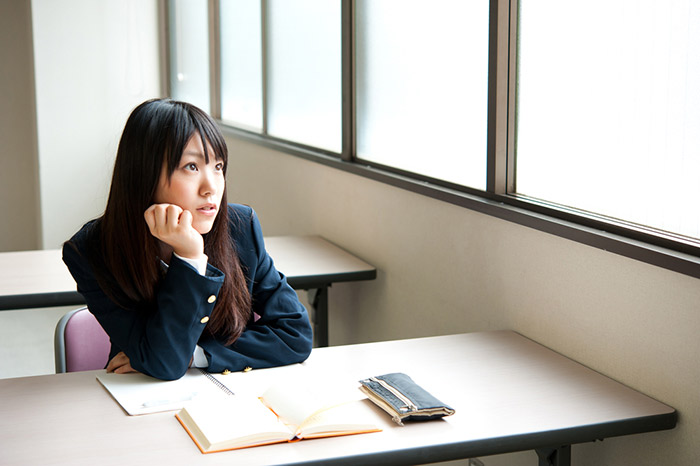
japanese-schoolgirl

Japanese Schoolgirl photo by Shutterstock

In Japan, the educational system in is the same as it is where I am now (Canada).

6 years of elementary school
3 years of junior high school
3 years of high school
4 years of university

This was actually reformed after WWII from the old 6-5-3-3 system to what you see above. Of these years of education, high school and university are not mandatory, though high school enrollment is over 96% nationwide in nearly all cities of Japan. Around 46% of Japanese high school graduates go on to college or university.

Most schools operate on a three-term system with the academic year starting in April when the cherry blossom bloom, and end in March of the following year. So in March there is a graduation ceremony, and I remember a lot of students were crying because of hay fever creating a very grave atmosphere.

There are some people who claim that Japan should change the school-year system to be the same as North America, because this difference sometimes causes inconveniences to students who wish to study abroad in places such as the US, Canada, and so on. The same problem would happen to foreigners who wish to study in Japan as well. They graduate from their school in June or July, but have to wait until April to go to a Japanese school.

Personally I would be a little sad if the Japanese school-year system was changed. It’s such a beautiful moment to say goodbye to your friends underneath the cherry blossoms in full bloom.There are so many good songs about graduation and cherry blossoms, too, and they would all be ruined! Although I understand the student side of perspective, I’d like them to leave that system as a Japanese culture.

「さくら(独唱)」/森山直太朗

卒園式の歌(さよなら僕たちの幼稚園) 号泣

Too Many Study Hours
school-girl2

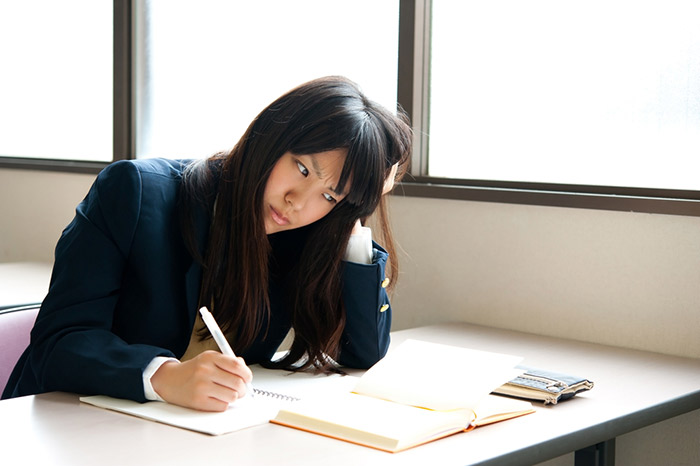
Japanese Schoolgirl photo by Shutterstock

Other than the lower grades of elementary school, an average school day on weekdays in Japan is seven to eight hours depending on the school and what grade you’re in. That’s one of the longest school days in the world! Despite this, a student’s studying doesn’t usually finish even after school lets out. Not only do they have drills and other homework after school, but there’s also extra classes to attend at their public schools or at private “cram schools” known as 塾 (じゅく/juku). Especially with junior high and high school students, much extra time outside of regular school is spent studying and preparing for their entrance examinations. Even during vacations (six weeks in the summer and two weeks for both winter and spring) there is often homework to be done and jukus to attend. Hours outside of school hours are spent at juku.

If my memory serves me correctly, I started going to a cram school in my third grade of elementary school. I still remember when we had a “New Year’s Eve all-night studying (年越し徹夜勉強会:としこしてつやべんきょうかい/toshikoshi-testuya-benkyoukai)” event in my fifth grade. Teachers encouraged us not to fall asleep but to keep studying until the morning. It would have been very fun to stay up later with friends, if only we weren’t studying. However, 初日の出 (hatsu-hinode), which means “the new year sunrise,” was quite memorable and made everyone’s new year resolution the same: achieve better grades and study hard. I found it pretty fun at first, because teachers actually prepared a little games for us, too. However, maybe around one o’clock, my eyelids started getting more and more heavy. I tried to study but couldn’t concentrate on it anymore and I doubt that it was only me. It wasn’t a efficient way to study at all. It was all about discipline.

Although studying itself is good for everyone, studying too much can make people stressed out. Therefore, if I could change the Japanese school system, I would remove the big entrance examinations and cut down the amount of private school education, because I think that is an overload of work for children. Second only to bullying, the number of children committing suicide due to “anxiety for the future” is increasing. Most of this is due to worry about how one will perform on examinations.

Japanese Classroom System
japanese-classroom

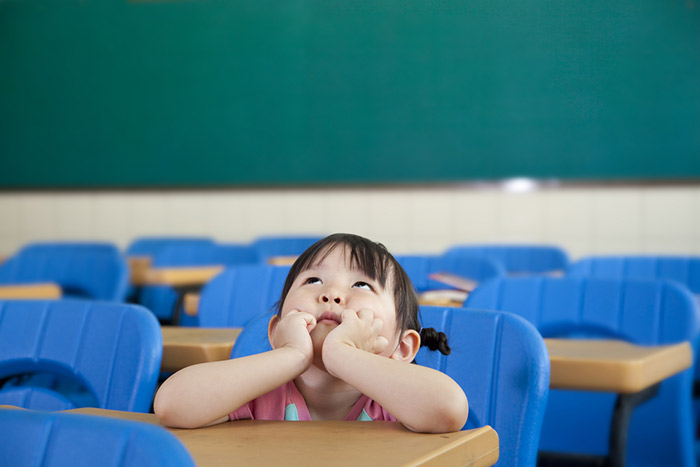
Japanese Classroom photo by Shutterstock

I was surprised that many schools in Canada don’t seem to have fixed classrooms because in Japan every class has its own fixed classroom. In most cases in Japan, the students take all the courses in the same classroom with the same classmates, except for practical trainings and laboratory works. In my case, grades 3-4 and grades 5-6 were 2-year fixed classrooms, though it’s usually just a 1-year fixed classroom system.

In elementary school, one teacher teaches all the subjects in each class, whereas the teacher changes depending on a subject in junior high and high school. Instead of the students moving around to the teachers, the teachers move around to the student (besides the exceptions I mentioned earlier).

Another thing that’s different about the Japanese classroom system is that most elementary and/or junior high schools provide lunches on a standardized menus known as the 給食 (きゅうしょく / kyuushoku). The students are all divided into groups called 班 (はん / han). With lunch, this is important because one han is the 給食当番 (きゅうしょくとうばん / kyuushoku-touban). This particular han’s job is to take responsibility for the 給食. They pick up their classmates’ lunches in the school kitchen / lunch delivery area, carry the lunches to the classroom, serve their fellow classmates, makes sure that the food settles down into each kids’ stomachs, and then carries everything back. There is usually about a week rotation for which each han is the 給食当番.

If you’re not on the lunch duty han, your han could be doing something else that’s helpful. For example, students in a Japanese school are responsible for doing the cleaning of their own school. Sometimes there is a han that takes on the duty of cleaning (掃除/そうじ/souji), and they are known as the 掃除当番 (そうじとうばん / soujitouban). I think this is a great system because it is a good way for kids to learn how to socialize and be responsible. It also makes them more aware about causing a mess, since either they or a friend will have to clean it up!

School Uniforms
school-uniform

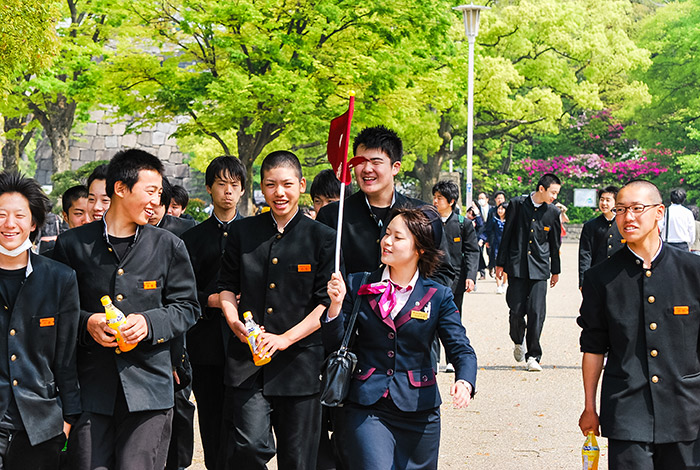
Some elementary schools and nearly all junior and high schools require their students to wear school uniforms. In my case, I wore school uniforms from kindergarten to high school.

Although some people believe that students, or at least high school students, should be able to choose the clothes they want to wear in school, I’d say that the best policy is that they wear uniforms because it’s more affordable and convenient.

Students tend to be very concerned about fashion and fitting in, so if they can choose the clothes they want to wear at school, they will prefer to wear brand-name clothing. For example, I remember that girls put a lot of money into brand-name socks or loose socks, which are a style of baggy socks. A pair of socks are sometimes 1,000-2,000yen. What a rip off! Thank goodness socks are the only brand-name thing for us to put on due to the uniform. If we were allowed to wear whatever we wanted, people would have certainly added hundreds of thousands of yen in clothing costs in a single year.

Also, uniforms are very convenient. Students do not need to worry about what they will wear to school. For instance, they do not need to consider what colors match with what, which style looks best, and what their classmate will think of their clothing. If everyone wears the same uniform, all of these choices are made in advance , so you don’t have to feel self conscious about your clothes. It saves more time for students and they can concentrate on studying more, though it just gave me longer sleep in the morning.

Furthermore, uniforms tend to be made of strong materials and they are easy to clean. I wore uniforms from kindergarten to high school and I had two uniforms for each warm season and cold season. When one was dirty I would wash it and wear the other one. This way my school clothes were always clean and ready to be worn. Uniforms are very practical!

They are not good all the time, though. As in many countries, uniform policy is strictly adhered to. There is a set length for skirts and teachers would take out tape measures to check. Japan has four seasons and its weather and temperature can vary greatly. However, uniforms usually only come in two varieties: winter and summer. Anything in-between can be a bit uncomfortable.

I also remember that my teacher wouldn’t allow me to put pants on because of the uniform policy, even though it was a freaking cold day. It might become less practical and ununified, but I think it would be good for students’ health to wear warmer clothes on cold days and lighter clothes on warmer days. Heck, let the boys wear skirts in the summer if they want to! I still believe that I have bad circulation because of the school uniforms.

A Great Difference
japanese-group

Photo by gwaar

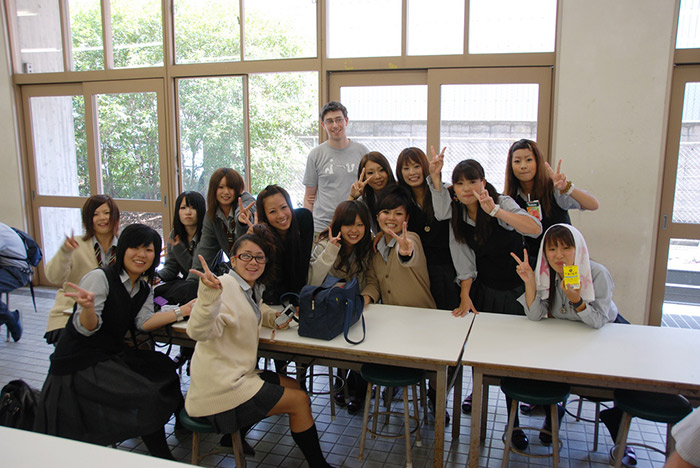
A great difference between the Japanese school system and the North American School system is that the North American people respect and encourage independence whereas the Japanese people control individual responsibility by maintaining group rules. This explains one characteristic of Japanese social behavior (or maybe even Asian social behavior).

I realized this fact in ESL school in Canada. There were students from all over in the classroom: Saudis, Brazilians, Spanish, Chinese, Korean and me, Japanese. While the teacher was talking, myself, the Chinese, and the Korean students never butted in to ask questions or to announce our opinions. We waited until the teacher was completely finished, whereas students from other countries spoke out anytime.

We talked about this in the classroom once and figured out that this difference was caused by each country’s school system: in Asia, we mostly have lecture style lessons and in other countries, they spend a lot of time doing discussion style lessons.

A Joke

To finish this article, I wanted to end with a famous joke called “A Brilliant Japanese Student In An American Classroom.” I wonder if you find an odd bit in this joke… you got it? Yeah, the Japanese guy named Hideo speaks out too actively, doesn’t he? Which is pretty different from what you’ve learned about Japanese students from this article today. I don’t think the average Japanese student puts his/her hand up as much as this guy, either.

A BRILLIANT JAPANESE STUDENT IN AN AMERICAN CLASSROOM

It was the first day of school and a new student named Hideo, the son of a
Japanese businessman, entered the fourth grade. The teacher said, “Let’s
begin by reviewing some American history.”

Who said “Give me Liberty, or give me Death?” She saw a sea of blank faces,
except for Hideo, who had his hand up.

“Patrick Henry, 1775.” he said.

“Very good! Who said ‘Government of the people, by the people, for the people,
shall not perish from the earth’”? Again, no response except from Hideo:

“Abraham Lincoln, 1863.”, said Hideo

The teacher snapped at the class, “Class, you should be ashamed. Hideo, who is
new to our country, knows more about its history than you do.”

She heard a loud whisper: “F-k the Japanese.”

“Who said that?” she demanded.

Hideo put his hand up. “Lee Iacocca, 1982.”

At that point, a student in the back said, “I’m gonna puke.”

The teacher glares and asks “All right! Now, who said that?”

Again, Hideo says, “George Bush, to the Japanese Prime Minister, 1991.”

Furious, another student yells, “Oh yeah? Suck this!”

Hideo jumps out of his chair waving his hand and shouts to the teacher, “Bill
Clinton, to Monica Lewinsky, 1997!”

Now, with almost a mob hysteria, someone said, “You little sh*t, if you ever
say anything else, I will have you killed.”

Hideo yells at the top of his voice, “Gary Condit, to Chandra Levy, 2001.”

The teacher fainted

Hope you enjoyed the joke! For me, the Japanese education system is weak because it makes Japanese students get more and more conservative as time goes by. I think Japanese students should be more vocal and participate in a conversation like Hideo. Well, maybe Hideo is too much, but at least a little more. Many of them don’t have curiosity about the world or ambition to study overseas, either.

I think that this problem has been caused by the big examination system because they are forced to be in a competition to get into the better school from very early in their life. Their end goal is often set up to get into the best university by their parents and/or teachers. Hence, many of them don’t gain curiosity about anything other than getting a good mark and they become like drones.

I’m pretty sure that you all probably have such interesting personal stories about your own educational experience. Tell me about your country’s education system. How is it different? How is it the same? What do you like / dislike? I think all educational systems in the world have good parts and bad parts, so maybe if we learn from each other we can make education better around the world! Arigatou.


Bonus Wallpapers!

myjapaneseeducation-animated-700

[2560x1600] • [1280x800] • [1280x800 Animation] • [700x438 Animation]

  • トシ

    Yeah I hear and read a lot of people saying they only want to study in Japan ’cause of the uniforms. I think that’s kind of crazy. It’s cool if people like the uniforms (and I do think they look good for the most part), but the fact that the students are forced to wear them would never strike me as a good thing.
    Like, come on, let people wear what they like and feel identified to. That’s to everyone, not only Japan.

  • Mami

    Oh, are those likely from UK english? haha I see.
    That’s very interesting. Yeah, they could be afraid of appearing less smart, I agree with that too.

  • Mami

    For sure!!! Do you have a plan to go on exchange?

  • Mami

    That’s true, but you can make more friend without fixed classrooms though.: )

  • Christopher Stilson

    Not quite – he’s only a year and a half old :) Actually it’s a toss-up as to whether the school near our house will even have room for him by the time he’s ready to go to kindergarten (assuming we haven’t moved to Vancouver by then). Schools in Edmonton in general have difficulty in maintaining the necessary infrastructure to support their student population, and the way that kids are funneled into various schools by their location leaves a lot to be desired. We’re strongly considering putting him in a French immersion school simply because they have a better teacher-student ratio generally.

  • トニー

    Great article! You’re shaping up to me one of my favorites on the Tofugu Team! (:

    I go to a private Catholic school in the United States. Catholic schools tend to operate by different standards than publicly-funded schools and are controlled by the local diocese or archdiocese of the area. Personally, I really dislike this, as I’ve had to take a religion class every year, when I could be taking more courses that could be more beneficial to me. We also use school uniforms, which I agree is preferable to having to pick out clothes every single day! I have to be at school be 7:45 AM which means I have to wake up at 6:30 every day Monday through Friday. Bleh. At least, we get out of school a bit earlier at 2:30 PM. We also don’t get as many holidays as the public schools, since we only get days off for mandatory government holidays and Catholic holidays.

    Recently, the archdiocese of my area decided it would be a good idea to give all the high school students iPads. I love the iPad and the digital textbooks and all that, but it’s created a lot of problems. For example, if there’s just one glitch in the wi-fi network, suddenly we have no access to our books or anything. Not only that, but I reckon that 70% of the student body is just playing games during class, haha. It’s pretty distracting.

  • KaoriCamellia

    I consider myself lucky to not have had to go to a Japanese school like my cousins, as I grew up in the US. I know for a fact that I would probably be a much different person. It’s not that I necessarily think the system is ‘bad’; that is too subjective really. But I agree with you in that it stifles creativity and initiative. On the other hand, many of the school-age Japanese (including my cousins) have been vastly more motivated to do well in school than most of the kids I grew up with in North America. So there are some obvious trade-offs.

  • Razzie

    I for one am a horrible test taker especially standardized tests
    so I think entrance exams would have been a big problem for me
    at the same time for colleges if all you have to do is take an exam
    and not right essays and get recommendation letters
    that sounds a lot better to me I hated having to do all that extra stuff in addition to tests…

  • Mariana

    Yes! ..in three years. xD
    I’m going to get a part-time next year when I turn fourteen so that I can start saving up. c:

  • Colin

    Excellent article, Mami!

    When you look at the differences between the North American school system and the Japanese it seems like a hybrid of the two would be great. I grew up and live here in Canada (am 31 years old now) and I can surely say that our school system in no way whatsoever prepares people for the actual realities they will face in either the work force or even University. There is essentially zero discipline needed to complete High School. Sure you have to do well on the tests and assignments, but you’re mostly allowed to do whatever you want when you want; talk about rude awakening once I entered the work world and realized that reality was exactly opposite from the environment I’d been in for the first 17 years of my life.

    And as for University, the work load difference between High School and University is like comparing a camp-fire to a nuclear bomb. Again, rude awakening. (at least it was when I graduated from High School in 2001; it may be a bit different now).

    The problem is our schools are so lax that kids develop in a world that essentially bends around them and their needs, all the while the reality that awaits them is quite the opposite. I think our society would really benefit from some sort of actual discipline as a part of the school system.

    What we need is a combination that takes the discipline of a Japanese system and blends it with the independent thinking of a Western system.

    Again; good article.

  • James O’Neill

    Primary and Secondary school do come from UK English.
    We attend primary school for 7 years up to the age of 11. Some schools separate the first three years ‘infant school’ and the last four ‘junior school’. Secondary school is from 11 to 18, the last two years are called 6th Form and aren’t compulsory. In lots of schools 6th Form is more relaxed with fewer rules, no uniform and more independent study time. Lots of students also choose to spend these two years at college rather than school (college in the UK is like a half way point between school and university where you have more choice in subjects than at school).

  • Lorinc Del Motte

    The gakuran, definitely.

  • Alvin Brinson

    I am a new ESL teacher at one of the largest school districts in the U.S. Having studied Japanese culture for quite a while, I was surprised to find that much of the training I received this summer from my school district, as far as discipline and classroom procedures go, is closer to what I would expect to see in a Japanese school than a traditional American one. There is a recognition that students need to have a highly structured school environment. Unfortunately, many teachers and administrators still prefer to do things their own way. This leads to a situation where every classroom is different, so those teachers who do embrace a highly defined structure do not receive much support for enforcing it. I think the biggest problem remaining is that every teacher is seen as the king of his or her own classroom, rather than the focus being on providing a unified structure for the students. Ultimately, I think that the ideal classroom would combine the Japanese structure with American learning theory.

    PS. Typos are to be blamed on the fact I wrote this comment on my phone.

  • jogu

    Well, here’s my mildly interesting education history in California.

    For my first two years of schooling (kindergarten and 1st grade) I went to a magnet school. This school had a uniform policy, as a boy I had to wear a white or blue shirt (polo or button up) and and blue slacks/shorts. This school also went up to the 6th grade, unlike most other schools around here. For second grade I transferred to a school near my house that went up to 5th grade. This new school had no uniform policy. Both of these schools ran for a little over 6 hours, and started later in the morning (8ish). In the 3rd grade we took a test, and students that placed in the 99th percentile are placed into an advanced education program called GATE, more specifically Seminar. As one of those students I was occasionally taken out of the standard class and put into another class which focused mainly on critical thinking. For 4th and 5th grade I was put into a combination class, and the teacher taught both 4th and 5th grade students at the same time. My teacher at the time took it upon herself to teach me the 5th grade material, even though I was in 4th grade. The teacher approached my parents to skip the 5th grade, but my parents declined and I ended up largely repeating the 5th grade.

    Thus begins middle school, which still follows the GATE program and placed me in Honors/Advanced courses wherever possible. Mostly this meant smaller class sizes, and a quicker pace than the standard classes. The daily schedule was largely the same as elementary school, except that you now have a different teacher for each subject and move from classroom to classroom. My 6th – 8th grade education was fairly standard and uneventful. Club activities/other extracurricular activities weren’t through the school.

    Then high school. High school more or less ran the same as middle school, it just started earlier and was longer (about 7 hours 7:30~2:30). At this point there are school sports and clubs. My freshman year I attended a morning bible study due to my families (not mine) beliefs. I would wake up at about 5:30, to get to the bible study at 6 which lasted an hour, though this is definitely not the norm and not in anyway related to standard education. I would then go to school for the standard 7 hours. I also played a sport my freshman year, so for about half of the school year I had practice until about 5pm. So my standard school day was from 6am to 5pm, and then I would come home and do homework. Obviously this was a lot, especially for the first year of high school and my grades suffered. My sophomore year I quit both the bible study and playing sports to focus on my grades. My sophomore year was completely uneventful, however halfway through the first semester of my junior year I became sick and began to miss quite a bit of school and my grades were very poor. Due to this trouble, I was pulled out of standard high school (by my parents) and put into a charter school, which doesn’t have to follow standard curriculum.

    The charter school was set up as an independent study, you would go in a few times a week for a few hours and study and get help from the teachers if you needed it. However, for the most part you taught yourself from the text book, turned in the packets, and took a final test on the subject. You really only took one course (maybe two) at a time and a course would take maybe a month to complete. I didn’t stay in this program for very long because I ended up taking a test called the CHSPE (California High School Proficiency Exam) which gives you the legal equivalent of a diploma in the state of California. This allowed me to graduate a year early and begin going to a community college. And that’s where I am now. I will likely be taking the units I’ve earned at community college and transferring them to a university next year, where I will finish my bachelors for less money than it would have cost to go there for all 4 years.

    Definitely not a standard education in America, or even California, but it is my experience and I think shows the flexibility of education in California. That was much longer than expected, so if you read the whole thing, thank you.

  • DAVIDPD

    Wicked good article.

  • Yoshi Kirihata

    Mami san, your blog of “Tofugu” is so charming. A figure in it so “kawaii”,
    a song and motion picture you choose is so moving, and moreover, as I had
    commented it before, you have an abundance of talent in drawing a picture, don’t
    you?

  • lauren

    Teachers encouraged us not to fall asleep but to keep studying until the morning.

    >>>
    jeez that’s hard-core… not to mention it’s bad for kids to stay up for their healthy. they talk about that all the time on japanese tv i wonder why they encouraged that. i guess it was a one time thing????????? but seriously why do elementary kids gotta do that/

  • Tiffany Harvey

    In the US I would say from elementary through high school nearly everything was lecture style lessons. Mostly in college too, though we did have some classes like “Ethics” that would involve more discussion.

  • Sonali Nahata

    Haha, it was the most awesome year for us. Even our handwriting would undergo a really big change after suddenly starting to use a fountain pen. Being able to use it was a skill to be acquired after a lot of practise. Some would even practise in the holidays before the year started, so that they’re able to take down notes properly when school started. The one downside of using fountain pens was that we would get ink on our thumb and uniforms at the end of the day.

  • shahiir mizune

    The good thing about uniforms are they make students look equal with one another. So there is no differentiation between the rich and the poor.

  • Vague

    Heh, it’s pretty fun to read how different the school systems are around the world. :) For example, here in the Nordic countries, our school system follows a 9-3 pattern. 9 years of basic, compulsory education, and 3 years of secondary education, called gymnasium. Gymnasium isn’t compulsory, but most people attend anyway. After that, you can go to university and whatnot.

    The length of a school day varies a bit, but I think it’s around 5-7 hours/day, depending on the grade. But that’s it. No clubs and no cramming school. Just homework (which is pretty easy most of the time, at least until gymnasium). Discipline is also pretty lax. First of all, we don’t use uniforms. Second of all, asking the teacher questions mid-lecture is pretty common (though we do have to raise our hands! We’re not completely undisciplined!). Plus, we always call our teachers by their first names. Using their last names would be REALLY weird, at least where I live. Oh, and each class has their own classroom, just like in Japan.

    It’s far from perfect, but I generally like the way it works. I just wish we had clubs, like in Japan.

  • Momo

    We follow a very British way of system, 6 years of primary school -> 4-5 years of secondary school -> 2 years junior college/3 years of polytechnic -> 4 years of university. Within this, every advancement to the next level of education has its own major examination. And we have what we call ‘streaming’ during primary and secondary school as well, as mentioned, to class the students based on their academics.

  • Flora

    I learned about the fixed classroom system after we got a transfer student from Tokyo my sophmore year of high school. Apparently, he didn’t know either, cause he went into the wrong class more than a few times & got teased for it. =/

    I wanted to help him out, but the only class we had in common was lunch (plus, the language barrier). After that, I always wondered why there wasn’t more to help students coming from countries with different school systems.

  • Flora

    Another thing; is America the only country that has names for each year of high school & college (Freshman, Sophmore, etc etc)?

  • Flora

    Not really. I went to uniform schools almost all 12 years of school – clothes are only one of many ways socio-economic status can show through. All the wealthier students drive themselves to school & have their own student parking, all the poorer students are bussed in; the wealthier students have nicer shoes or smartphones, I’ve seen some classmates go to school in torn-up shoes or even slippers; the kids who can afford it eat out for lunch, the broke kids are stuck eating the prison food at school (on assisted pricing or free lunch, no less).

    And all the students are aware of who does or has what. Uniforms don’t hide anything.

  • Flora

    I find it odd that female students are allowed to wear skirts to school at all. I’m not sure how it is in other countries, but U.S public schools all have unisex uniforms – polo shirt with khaki pants. Even in non-uniform schools, the staff are pretty unlikely to let you come in with a skirt & no tights or shorts underneath. We’re too antsy about teen sex for that.

    I’m not a fan of uniforms. They don’t really serve any purpose and just put an extra strain on lower-income families. Kids grow fast – it’s bad enough they have to buy school supplies every year, but 9 times out of 10, every kid in the house needs new uniforms, too!

  • Lydia Waalkens

    Japanese uniforms are so cute!
    We have uniforms too in Australia which I was thankful for really. Though, it was just the one uniform for the whole year.
    Can you imagine wearing a heavy knee length skirt, blouse, and tie through all seasons (anything from 14 – 38 degrees C!!) and only a jumper or blazer for winter. At least the boys got to change from long pants to shorts over summer…
    I just don’t think teens (in general) are mature enough to not pick on people for what they wear. Haha!
    Our school terms are fantastic in my opinion too. We finish the school year mid December in time for Christmas and start again near the end of January. And we have 3, or 4 terms depending which state you’re in. And we generally start the school day at 9am and finish at 3pm. But I feel like we don’t pressure out students anywhere near has much as you guys do for academic achievement (we could probably do with a little more).

  • Jasmin Rodriguez

    Hello Mami nice blog post, I always wanted to hear about Japanese education (from a source other than anime) :)

    From my personal experience in the US, I find that there is no exact school system (except for the school year being from Aug/September to June/July). I used to move a lot as a kid and have lived in three different states (I once lived in a city 10 minutes from Portland, Oregon where Tofugu offices are) and they were all different. I think it might be because I have gone to public, charter/magnet, and private school. But any one else who has changed schools more than two times probably experienced this. I have gone to public schools that used uniform though not all the time to those that don’t to some where we had to wear id’s around or necks or else suffer from detention (more like nap time). And at the schools where we could choose what to wear we had silly rules like “no hats” or “no hoodies”. I call them silly because I don’t think enforcing rules like that work unless there is uniform. It’s hard to spot and people can get away with it quite easily. Also, we couldn’t wear certain colors because of gang related issues. When I went to charter school we did have uniform but if we did really well on tests and not getting in trouble, we would get a free day (a day we didn’t have to wear uniform). I attend a private university, we don’t have to wear uniform.

    So that’s the U.S on uniforms from my experience. Another thing that varies among schools in the US is the way the school day goes. I went to a high school where we had blue days and white days. For example, if Monday was a blue day you would attend four classes for two hours each. And the next day would change to white day where you would attend four other classes also for two hours. It took me a while to get used to that :/ I walked into the wrong classroom more than once, but luckily that happened to be be my first year of high school so I wasn’t the only one. The most common US school day (in my experience) consists of 7 hours with 30 minute lunch and in high school each class is an hour (usually called periods) and you have them four five days a week. And after school most kids just hang out with their friends (I wasn’t one of them). I just went home and ate right away then homework (which was actually pretty short other than math).

    The thing I do like about the US school system is that we are allowed to be individual and creative, but at the same time that (in my opinion) is creating some nuances. Giving this much freedom and individuality has allowed some students to believe they don’t have to be responsible simply because it’s not their personality. For me, since I was a bit shy in school, I didn’t really like the whole discussion aspect (though I do love listening to discussions). I always avoided getting picked to discuss (actually even now in college though not as much) but the individuality aspect has helped me feel more comfortable with that. On the other hand, too much stress on studying and grades can lead a student to feel really anxious and leave them with no curiosity. I personally believe that too much or too little of anything can have bad consequences. Balance and happiness is key :)

  • Jasmin Rodriguez

    This a bit unrelated, but what would happen if the major trains in Japan went on strike (can that happen)? I ask because where I’m from (San Francisco Bay Area) the major form of transportation decided to go on strike and it might happen again soon. I read somewhere that the SF Bay Area is one of the areas with most commuters so this is not good. I know that in Japan the train is a very common form of transportation so I got curious.

  • Jasmin Rodriguez

    I just posted about the same things you just said! I agree there is no standard education in America (also from my experience). Even while being in the same school I experienced many changes.

  • Sholum

    I was pretty lucky with my schooling. Even before I started school, I was constantly exposed to reading and curiosity was greatly encouraged by my family. I had a lot of problems in school thanks to my differences and poor social skills, but I had some great teachers along with being in a school that actually implemented it’s SAIL program (Students Actively Involved in Learning), which exposed me, along with other advanced students, to critical thinking, abstract thinking, logic, and such.

    In middle school, I did poorly in every class except for strings, partially due to the structure making things boring as well as some personal problems. I think I actually enjoyed summer school (y’know, ’cause I didn’t participate in the boring classes) more than the regular school year.
    For highschool… Well, I was enrolled in an online charter school as soon as they were approved by the state. If you think someone who hates structured, closed, ‘you do as I say’ classes can get through a school that’s attended by connecting to the internet through your own personal computer that has no restrictions on use…

    So, I learned a lot of things on my own and proceeded to be held back multiple times for failing basic classes. My GPA was terrible and I was two years behind. So I dropped out and got my GED. I went straight through the fast-track classes, took the next available test, and aced it (in the top percentile for the country). I forgot to mention that, while I hate structured classes, I rather enjoy test taking. Since the whole GED process is just a string of tests, I was quite happy doing it for a couple weeks.

    Having done that, my highschool grades and GPA mean absolutely nothing, so now I’m attending college. College isn’t too bad, but I was lucky with my instructors so far. I can tell that it’ll be horrible if I get a bad teacher or professor. Of course, it’s quite a lot of stress going to college, working, and pursuing my own studies all at the same time. I can’t wait to get to the good stuff instead of going through all the English and such that my school requires.

    To condense that some, I had a weird school experience that was nothing like the normal grudgingly getting by that most people seem to do. Now that I’m in college, it’s pretty much the normal thing that everyone does, except I have no fondness for loud parties, drinking, smoking, drugs, or anything like that. I’m more worried about keeping my grades up so that I can continue to get financial aid (or is it aide?).
    Also, no one should feel embarrassed for getting their GED instead of graduating. In fact, I think it’s something to be proud of.

    As a side note, I think the school system in the US is inherently flawed. the basics of it that most people experience do not teach you how to think for yourself at all. It teaches you how to take tests and skimp by. How many people will continue to learn on their own after finishing school? Why would they want to, with all the soul sucking it does? Of course, I guess they’re just trying to mold you into the perfect government or corporation worker, but still, if I have to pay for it, I’d rather it be done right.

  • Chaice

    I’m from Singapore too, but I’m not studying in the standard school system. I’m actually at School of the Arts, where we study the IB syllabus, and I’d have to agree that the O/A level system (which Momo described) is very different from the kind of learning experience that I’m currently experiencing at the moment.

    Based on personal experience, I’d like to think that I have been lucky enough to retain my sense of curiosity and desire for learning beyond answering questions correctly. In my school, we take IB art subjects (Theatre, Dance, Visual Art, Music or Film) in addition to 5 other IB subjects (one specialisation from each of these: Language 1, Language 2, Humanities, Science, Math) and 3 core subjects (Theory of Knowledge, Extended Essay and CAS). I think varied nature of the curriculum and how the assessments are structured forces us to make sure that we keep our learning process alive – it becomes very difficult to do well, I think, if it’s not.

    Having the arts ingrained alongside academia helps with that as well, I think. I can only speak for myself, but I honestly think that learning theatre has taught me how important things like passion and teamwork and commitment is even in the academics, and I think it’s helped me retain my sanity all these years even with the crazy workload. :’DDD

    Although I have to agree, the workload in Singapore is insane. I’m in school from 9am – 7pm++ every day, and during the weekends too if we have rehearsals for showcases and the like. We don’t have club activities in my school because we don’t have the time – the art major we take kind of makes up for it, I guess. It’s not the same, though.

  • Mami

    Sounds awesome!!! Good luck with that(^v^)/

  • Mami

    Thank you for explaining that. It’s so great to learn how different each country’s educational system is.

  • Mami

    Ouch, ink!!! I bet!!! lol
    but I assume that the ink on thumbs and/or uniforms are a part of good memories??

  • Sonali Nahata

    Yeah back then it was a pain, but now it’s a good memory :) On the last day of college, classmates get together and write their names on each other’s t-shirts too, for something to remember the college days by :D

  • Mami

    ありがとうトニーさん❤ Wow, you had to be at school at 7:45…however, I woke up at about 6:30 too when I was in a kindergarden and an elementary school. The school is very far like 50 to 60 minutes walk for kids. Ah, I should have mentioned about this, but we have to be at 7:15 at a certain point because we went to school as a group called ‘部団(ぶだん)/budan’ that was classified by teachers depends on which area you live. Usually someone in grade 6 is the 部団長(ぶだんちょう)/budanchou meaning the leader of 部団. 部団長 is changed daily or weekly and she/he can have a little yellow flag like a tour guide. This yellow flag is mostly used for crossing the road to aware cars of kids. We didn’t form 部団 on the back way except for Saturday, because everyone leaves different time except for Saturday.

    iPads!!! Yeah, for sure that it’s pretty distracting aside being very useful…but I want one!! jealous. lol

  • Mami

    Thank you for sharing your idea. Yeah, every system has bad point and good point I think as well. There are some obvious trade-offs, for sure!

  • Mami

    ……….. / ⌒ ヽ
       (   ゚ д゚ )  えっ
       /  、 つ
      (_(__ ⌒)ノ
       ∪ (ノ

  • Mami

    Some private colleges and universities accept students by a essay or recommendation too, but the numbers of the students are limited. (actually some public schools accept by that, but it’s more limited and very difficult to get in by that.) The problem of the entrance system is you can’t apply not many schools because usually exam dates are on the same day. (especially public school). I know someone who failed the exam and in order to get in a high school this year, he had to go to very lower level school for him. If someone fails for high school exam, that’s disaster…because you don’t usually wait for next year, but going lower level school causes more trouble. You don’t get enough skill to challenge for applying good colleges or universities. There might be more bad juveniles there…etc Anyway, my point is, the entrance exam system is ridiculous!!! (I don’t remember many of them that I studied for the entrance exam now, either.)

  • Mami

    Thank you Collin. My husband is Canadian, who is going to turn 30 soon. He explained to me how much different the workload between high school and university was as well. I also know some Japanese families who are temporary in Canada for father’s work or so. They put their kids in a school here and were shocked that they don’t get any homework until grade 3. (In Japan, kids get homework even in grade 1. They are worried if their kids can adjust Japanese school well, when they go back. Yeah, so, I agree with your idea: blending each system’s good points.

  • Mami

    Thank you for sharing your idea. I agree that students need to have a highly structured school environment. Although It’s difficult to make their ideal environment with ideal teachers, it’s very important to learn about educational organization theory. Then, I just typed ‘educational organization theory’ on google…whoa, off course…5 millions site showed up. I was encouraged to learn about that by your comment, but now I have no idea where to start…lol

    My brother in law is a ESL teacher and he is thinking about working for a university at some point. In that case, he has to think about that kind of things too and make a lot of papers about that. Are you thinking about working for university or college in the future as well?

  • Mami

    Thank you DAVIDPD san(^^)

  • Mami

    Arigatou Kirahata san!

    吾輩はやれば出来る子である。
        ∩∩
       (´・ω・)
       _| ⊃/(___
     / └-(____/
      ̄ ̄ ̄ ̄ ̄ ̄ ̄
     やる気はまだない

       ⊂⌒/ヽ-、__
     /⊂_/____ /
      ̄ ̄ ̄ ̄ ̄ ̄ ̄
    (笑)

  • Mami

    Yeah, it’s once a year or something. It’s like making kid’s mind strong…I guess.

  • Mariana

    ありがとう!

  • Mami

    Oh, really? That sounds like the same as Japanese school. We had ‘Ethics’ involving more discussion as well, though Japanese kids were pretty shy…at least in my school case.

  • Mami

    This is pretty much true in Japanese public school. I should have mentioned about this, but we had to go to school as a group called ‘部団(ぶだん)/budan’ that was classified by teachers depends on which area you live. (walking) If you are very country side, you take a school bus but it’s kind of mandatory, too. All the shoes in school are decided. Lunch was 給食….etc. I wouldn’t say that so all difference between rich and poor was disappeared, but it definitely covered quite a lot.

  • Mami

    This is true too, all the students are aware of who does or has what, especially girls, like I mentioned about brand name socks in the article. I wasn’t bothered such things very much though. I assume that this is more clear when you go to a private school in Japan. In public school, we were decided which bag to use too. so only thing we can spend on money was socks…at least in my case…haha

  • Mami

    Wow, I wonder why there wasn’t either. At least teacher should have taken care of him more. You were very nice though.