My Japanese Education

One day, even though I had plans to hang out with my friends Johnny Depp and Orlando Bloom, Professor Anderson gave me some homework: “Make one million sentences in English.” About that time, they both of my star friends were really busy filming the “Pirates of the Caribbean,” so it was my only chance to go out with them both together at the same time. Nevertheless, I chose to do my homework instead of going out because I was so diligent. I am still proud of the moment I made that decision.

johnnybloom(My Ideal Guy: (Johnny Depp + Orlando Bloom)/2 drawn by Mami)

This sounds like a dream, doesn’t it? I wish this was true, but unfortunately not…

“Tell me about your greatest moment as a student.” That was my homework from the ESL school that I used to go to. As you can probably tell, I wasn’t particularly ‘diligent’ and that is why I made up a silly short story for my homework. Getting a high grade or making a great presentation could be thought of as a “great moment” for most students, but honestly I couldn’t come up with any good examples at the time no matter how much I thought about it.

Education is often analyzed in terms of outcomes, results, or as a process. But here I would like to put this assumption aside, and just concentrate on the experience itself, specifically in Japan. Wouldn’t you like to know what it is like?

Educational system in Japan

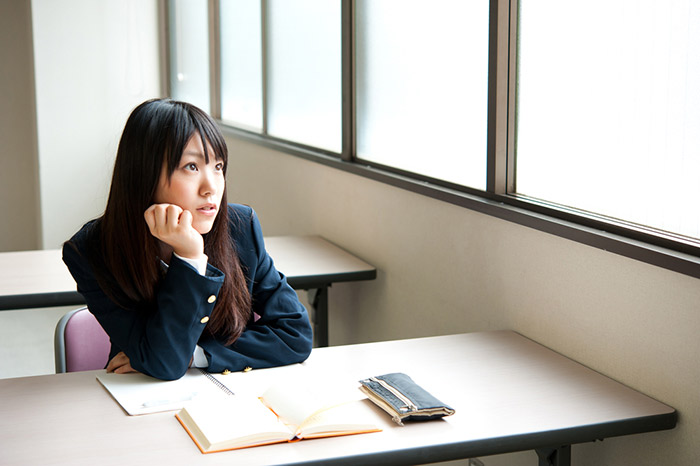
japanese-schoolgirl

Japanese Schoolgirl photo by Shutterstock

In Japan, the educational system in is the same as it is where I am now (Canada).

6 years of elementary school
3 years of junior high school
3 years of high school
4 years of university

This was actually reformed after WWII from the old 6-5-3-3 system to what you see above. Of these years of education, high school and university are not mandatory, though high school enrollment is over 96% nationwide in nearly all cities of Japan. Around 46% of Japanese high school graduates go on to college or university.

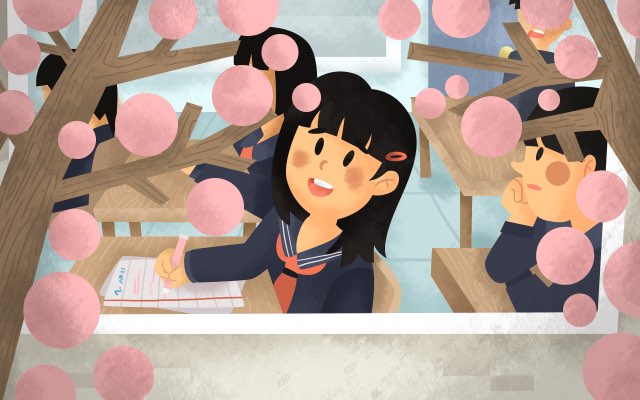
Most schools operate on a three-term system with the academic year starting in April when the cherry blossom bloom, and end in March of the following year. So in March there is a graduation ceremony, and I remember a lot of students were crying because of hay fever creating a very grave atmosphere.

There are some people who claim that Japan should change the school-year system to be the same as North America, because this difference sometimes causes inconveniences to students who wish to study abroad in places such as the US, Canada, and so on. The same problem would happen to foreigners who wish to study in Japan as well. They graduate from their school in June or July, but have to wait until April to go to a Japanese school.

Personally I would be a little sad if the Japanese school-year system was changed. It’s such a beautiful moment to say goodbye to your friends underneath the cherry blossoms in full bloom.There are so many good songs about graduation and cherry blossoms, too, and they would all be ruined! Although I understand the student side of perspective, I’d like them to leave that system as a Japanese culture.

「さくら(独唱)」/森山直太朗

卒園式の歌(さよなら僕たちの幼稚園) 号泣

Too Many Study Hours
school-girl2

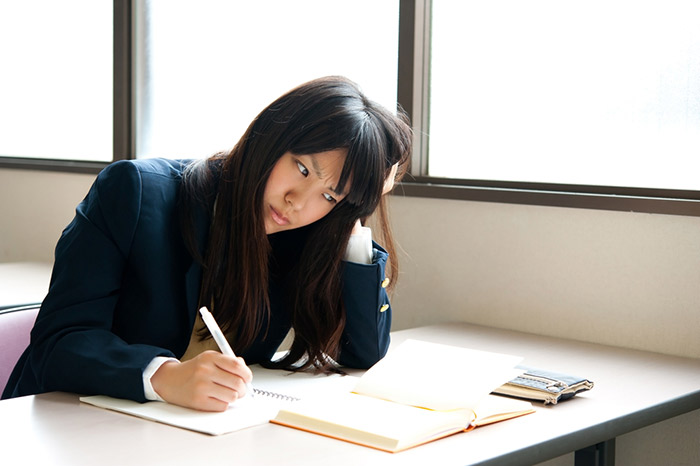
Japanese Schoolgirl photo by Shutterstock

Other than the lower grades of elementary school, an average school day on weekdays in Japan is seven to eight hours depending on the school and what grade you’re in. That’s one of the longest school days in the world! Despite this, a student’s studying doesn’t usually finish even after school lets out. Not only do they have drills and other homework after school, but there’s also extra classes to attend at their public schools or at private “cram schools” known as 塾 (じゅく/juku). Especially with junior high and high school students, much extra time outside of regular school is spent studying and preparing for their entrance examinations. Even during vacations (six weeks in the summer and two weeks for both winter and spring) there is often homework to be done and jukus to attend. Hours outside of school hours are spent at juku.

If my memory serves me correctly, I started going to a cram school in my third grade of elementary school. I still remember when we had a “New Year’s Eve all-night studying (年越し徹夜勉強会:としこしてつやべんきょうかい/toshikoshi-testuya-benkyoukai)” event in my fifth grade. Teachers encouraged us not to fall asleep but to keep studying until the morning. It would have been very fun to stay up later with friends, if only we weren’t studying. However, 初日の出 (hatsu-hinode), which means “the new year sunrise,” was quite memorable and made everyone’s new year resolution the same: achieve better grades and study hard. I found it pretty fun at first, because teachers actually prepared a little games for us, too. However, maybe around one o’clock, my eyelids started getting more and more heavy. I tried to study but couldn’t concentrate on it anymore and I doubt that it was only me. It wasn’t a efficient way to study at all. It was all about discipline.

Although studying itself is good for everyone, studying too much can make people stressed out. Therefore, if I could change the Japanese school system, I would remove the big entrance examinations and cut down the amount of private school education, because I think that is an overload of work for children. Second only to bullying, the number of children committing suicide due to “anxiety for the future” is increasing. Most of this is due to worry about how one will perform on examinations.

Japanese Classroom System
japanese-classroom

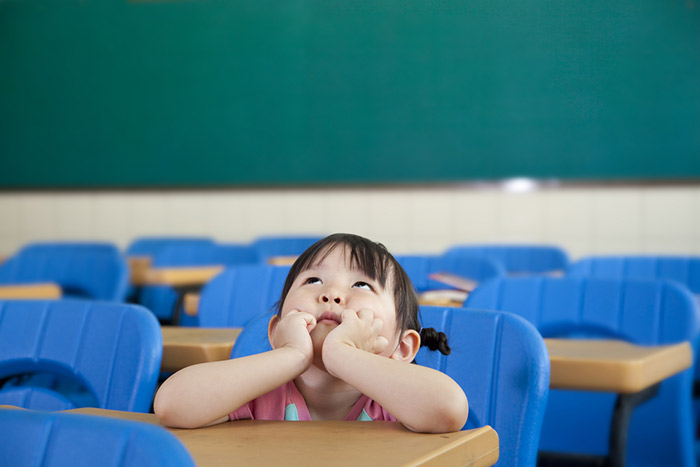
Japanese Classroom photo by Shutterstock

I was surprised that many schools in Canada don’t seem to have fixed classrooms because in Japan every class has its own fixed classroom. In most cases in Japan, the students take all the courses in the same classroom with the same classmates, except for practical trainings and laboratory works. In my case, grades 3-4 and grades 5-6 were 2-year fixed classrooms, though it’s usually just a 1-year fixed classroom system.

In elementary school, one teacher teaches all the subjects in each class, whereas the teacher changes depending on a subject in junior high and high school. Instead of the students moving around to the teachers, the teachers move around to the student (besides the exceptions I mentioned earlier).

Another thing that’s different about the Japanese classroom system is that most elementary and/or junior high schools provide lunches on a standardized menus known as the 給食 (きゅうしょく / kyuushoku). The students are all divided into groups called 班 (はん / han). With lunch, this is important because one han is the 給食当番 (きゅうしょくとうばん / kyuushoku-touban). This particular han’s job is to take responsibility for the 給食. They pick up their classmates’ lunches in the school kitchen / lunch delivery area, carry the lunches to the classroom, serve their fellow classmates, makes sure that the food settles down into each kids’ stomachs, and then carries everything back. There is usually about a week rotation for which each han is the 給食当番.

If you’re not on the lunch duty han, your han could be doing something else that’s helpful. For example, students in a Japanese school are responsible for doing the cleaning of their own school. Sometimes there is a han that takes on the duty of cleaning (掃除/そうじ/souji), and they are known as the 掃除当番 (そうじとうばん / soujitouban). I think this is a great system because it is a good way for kids to learn how to socialize and be responsible. It also makes them more aware about causing a mess, since either they or a friend will have to clean it up!

School Uniforms
school-uniform

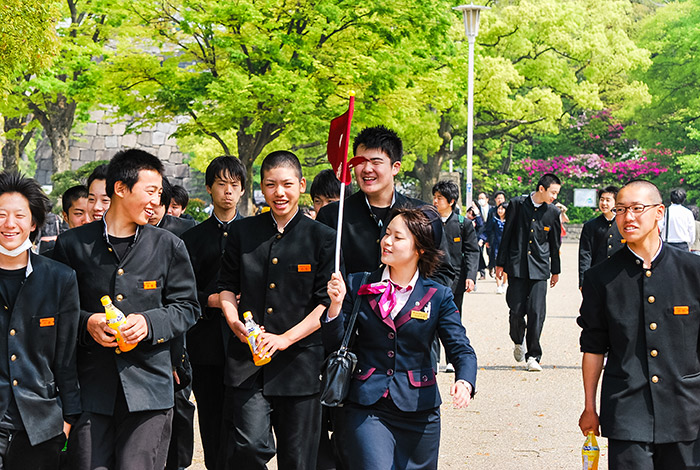
Some elementary schools and nearly all junior and high schools require their students to wear school uniforms. In my case, I wore school uniforms from kindergarten to high school.

Although some people believe that students, or at least high school students, should be able to choose the clothes they want to wear in school, I’d say that the best policy is that they wear uniforms because it’s more affordable and convenient.

Students tend to be very concerned about fashion and fitting in, so if they can choose the clothes they want to wear at school, they will prefer to wear brand-name clothing. For example, I remember that girls put a lot of money into brand-name socks or loose socks, which are a style of baggy socks. A pair of socks are sometimes 1,000-2,000yen. What a rip off! Thank goodness socks are the only brand-name thing for us to put on due to the uniform. If we were allowed to wear whatever we wanted, people would have certainly added hundreds of thousands of yen in clothing costs in a single year.

Also, uniforms are very convenient. Students do not need to worry about what they will wear to school. For instance, they do not need to consider what colors match with what, which style looks best, and what their classmate will think of their clothing. If everyone wears the same uniform, all of these choices are made in advance , so you don’t have to feel self conscious about your clothes. It saves more time for students and they can concentrate on studying more, though it just gave me longer sleep in the morning.

Furthermore, uniforms tend to be made of strong materials and they are easy to clean. I wore uniforms from kindergarten to high school and I had two uniforms for each warm season and cold season. When one was dirty I would wash it and wear the other one. This way my school clothes were always clean and ready to be worn. Uniforms are very practical!

They are not good all the time, though. As in many countries, uniform policy is strictly adhered to. There is a set length for skirts and teachers would take out tape measures to check. Japan has four seasons and its weather and temperature can vary greatly. However, uniforms usually only come in two varieties: winter and summer. Anything in-between can be a bit uncomfortable.

I also remember that my teacher wouldn’t allow me to put pants on because of the uniform policy, even though it was a freaking cold day. It might become less practical and ununified, but I think it would be good for students’ health to wear warmer clothes on cold days and lighter clothes on warmer days. Heck, let the boys wear skirts in the summer if they want to! I still believe that I have bad circulation because of the school uniforms.

A Great Difference
japanese-group

Photo by gwaar

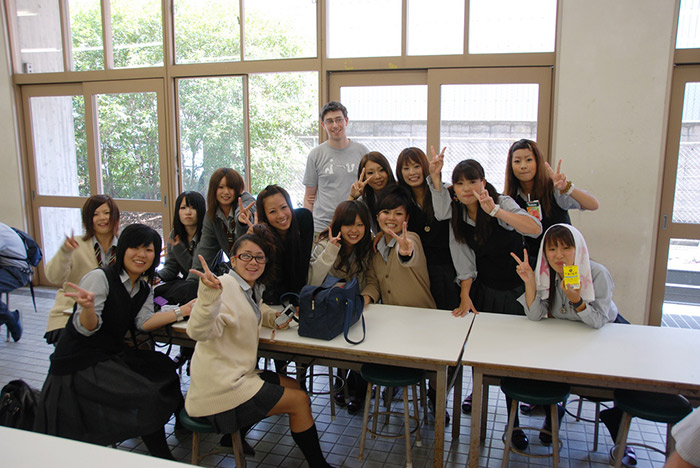
A great difference between the Japanese school system and the North American School system is that the North American people respect and encourage independence whereas the Japanese people control individual responsibility by maintaining group rules. This explains one characteristic of Japanese social behavior (or maybe even Asian social behavior).

I realized this fact in ESL school in Canada. There were students from all over in the classroom: Saudis, Brazilians, Spanish, Chinese, Korean and me, Japanese. While the teacher was talking, myself, the Chinese, and the Korean students never butted in to ask questions or to announce our opinions. We waited until the teacher was completely finished, whereas students from other countries spoke out anytime.

We talked about this in the classroom once and figured out that this difference was caused by each country’s school system: in Asia, we mostly have lecture style lessons and in other countries, they spend a lot of time doing discussion style lessons.

A Joke

To finish this article, I wanted to end with a famous joke called “A Brilliant Japanese Student In An American Classroom.” I wonder if you find an odd bit in this joke… you got it? Yeah, the Japanese guy named Hideo speaks out too actively, doesn’t he? Which is pretty different from what you’ve learned about Japanese students from this article today. I don’t think the average Japanese student puts his/her hand up as much as this guy, either.

A BRILLIANT JAPANESE STUDENT IN AN AMERICAN CLASSROOM

It was the first day of school and a new student named Hideo, the son of a
Japanese businessman, entered the fourth grade. The teacher said, “Let’s
begin by reviewing some American history.”

Who said “Give me Liberty, or give me Death?” She saw a sea of blank faces,
except for Hideo, who had his hand up.

“Patrick Henry, 1775.” he said.

“Very good! Who said ‘Government of the people, by the people, for the people,
shall not perish from the earth’”? Again, no response except from Hideo:

“Abraham Lincoln, 1863.”, said Hideo

The teacher snapped at the class, “Class, you should be ashamed. Hideo, who is
new to our country, knows more about its history than you do.”

She heard a loud whisper: “F-k the Japanese.”

“Who said that?” she demanded.

Hideo put his hand up. “Lee Iacocca, 1982.”

At that point, a student in the back said, “I’m gonna puke.”

The teacher glares and asks “All right! Now, who said that?”

Again, Hideo says, “George Bush, to the Japanese Prime Minister, 1991.”

Furious, another student yells, “Oh yeah? Suck this!”

Hideo jumps out of his chair waving his hand and shouts to the teacher, “Bill
Clinton, to Monica Lewinsky, 1997!”

Now, with almost a mob hysteria, someone said, “You little sh*t, if you ever
say anything else, I will have you killed.”

Hideo yells at the top of his voice, “Gary Condit, to Chandra Levy, 2001.”

The teacher fainted

Hope you enjoyed the joke! For me, the Japanese education system is weak because it makes Japanese students get more and more conservative as time goes by. I think Japanese students should be more vocal and participate in a conversation like Hideo. Well, maybe Hideo is too much, but at least a little more. Many of them don’t have curiosity about the world or ambition to study overseas, either.

I think that this problem has been caused by the big examination system because they are forced to be in a competition to get into the better school from very early in their life. Their end goal is often set up to get into the best university by their parents and/or teachers. Hence, many of them don’t gain curiosity about anything other than getting a good mark and they become like drones.

I’m pretty sure that you all probably have such interesting personal stories about your own educational experience. Tell me about your country’s education system. How is it different? How is it the same? What do you like / dislike? I think all educational systems in the world have good parts and bad parts, so maybe if we learn from each other we can make education better around the world! Arigatou.


Bonus Wallpapers!

myjapaneseeducation-animated-700

[2560x1600] • [1280x800] • [1280x800 Animation] • [700x438 Animation]

  • LordKyuubey

    “an average school day on weekdays in Japan is six hours”. Is this an error? Six sounds pretty few for Japan. XD

  • Dharma Mauricio

    The boys uniforms in Japan are so….. sexy………. *nosebleed*

  • コーデです(^_^)v

    I was thinking the same thing. I think I went to school from 8AM through 3:30 PM, Monday through Friday. However, we had a half hour lunch and 5 minute breaks between classes.

    I like the fact that the students have one teacher for 1-2 years and one set classroom :)

  • Mariana

    I have like 7:30 hours per day

  • Gianmarco Russo

    I’m from Italy. School system here is very different both from North America and Japan. We have just one thing in common with Japan: every class has its classroom. Besides, Italian school system may not be the best one in the world, but this is due more to the lack of fundings and adequate facilities (laboratories and the like) rather than the organization of the education system proper. I like Italian schools because here students are encouraged to mold their own mind and ideas, it’s not all about boring lectures and stupid multiple-choice tests. For instance, since my junior high-school we were encouraged to have kinda debates about politics and social matters, like immigration, gay marriages or euthanasia.

  • Pepper_the_Sgt

    My high school schedule was like that, too. One year, though, they experimented with extending the break from five minutes to six. How nice…

    College is so much better than high school. If I happened to have classes that were back-to-back, there was at least a fifteen minute break. One semester I actually had a schedule where I was in class from 8:00 to 4:15, but I had an hour and half lunch break and those fifteen minute breaks between classes. Oh, and I only had class on Tuesdays and Thursdays that semester! No classes on Monday, Wednesday, or Friday. It was magnificent. I also learned a lot more in college, despite (because of?) being in class less.

  • http://www.tofugu.com koichi

    yeah, that was an error – it’s all fixed now, though, thank you.

  • トシ

    Nice article.
    Here in Brazil we have fixed classrooms as well, and that might even happen in some small colleges (like the one I went to), except for classes that demand specific stuff.
    It worries me as hell the way education has turned into competition money-making, all over the world, it makes people hate to study and learn new things on the long run. People need to discuss things and enjoy learning, not be diciplined ’till they turn into damn robots.

    I think the Japanese school uniforms are cool, but I would HATE to study in a Japanese school specifically because of that. If people tried to make me wear a skirt or any girl’s clothing like that, there would be countless murders. If they let me wear the boy’s one, then fine, but I doubt that. lol
    I only had to wear uniforms on elementary school, and those uniforms looked like sports ones, so they were very nice.
    But in general, I think uniforms are very limiting and robot-making, even if they do prevent some issues like you said in the article.

  • Mami

    Sorry about the error and thank you for pointing it out!

  • Mami

    Sorry, 6 hours was an error, but 7:30 eh? wow. Regardless of your grade?

  • Mami

    Hahaha, we say ‘鼻血ブー’(Hanaji buuuu’

  • Momo

    Singapore is pretty much the same in terms of school culture, bar a few things. Our school starts around 8 and ends at 1 or 2. And then you might have club activities or remedial lessons that may even stretch to as late as 5 or 6. And then depending on your parents, they may add a host of tuition into your already heavy workload.

    Academic is deemed very important here. We even have systems that separate the clever ones from the academically weaker ones at the age of 9. It’s basically a rat race from the get go. Most parents start pushing the kids for classes as early as 4 or 5, and failure will cause mass hysteria within the family. I suppose it is all to do with the society, much like Japan. Jobs vacancies are really competitive and you really need to have at least a degree in order to get a job with a decent salary in order to even feed yourself, considering the high cost of living in our country.

    We have school uniforms too, and I’ve got to say, I’m starting to like it. I think it’s an age thing, I was very opposed to it during my school days, but as I look back now, I have to agree that it’s just necessary to avoid problems that you have mentioned in your article. Not to mention I quite dig the girls in school uniforms even during my younger days. It was a nice distraction during boring classes when you just plain ignore your teachers and ogle at your crush dressed in neat and cute uniforms. Opps.

  • Mami

    Thank you for sharing your country’s educational system. I think it’s great that it wasn’t all about boring lectures and stupid multiple-choice test. I think we had a debate class as well, but it was once in a while. And most of the students were so shy.

  • Mami

    No classes on Monday, Wednesday or Friday!!!??? Wow. That’s so cool!!!

  • Mami

    Where is your country? I think 8am is pretty early…you have to be there by then? I had to be school by 8:25, so I usually arrived at school between 8 to 8:15.

  • Gianmarco Russo

    We weren’t that shy…these debates turned into actual quarrels sometimes! xD

  • Gianmarco Russo

    I agree with you about uniforms…I cannot stand for people who are attracted by the Japanese education system only because of uniforms! Moreover, fashion-consciuosness is another step important for the shaping of one’s own mind, and wearing an uniform for the most of your teenagehood is not that inspiring.

  • http://www.tofugu.com koichi

    haha, I did that too… being able to work your college schedules like that is so nice

  • Sarah Mouradian

    I must disagree to a point about uniforms, at least for here in America. I think the uniform system works great for Japan, but unfortunately could not work as well here. Although I do not have as many years of experience as you do with wearing uniforms, I did wear one from 1st to 4th grade before I switched schools. Many private (or occasionally public) schools here that require uniforms often give quite a few options on what student can wear, which causes more money to be spent on uniforms and an increase in the chance that students will be bullied for or feel insecure about their appearance (especially when the uniforms are not flattering to most people). Not only here are you more likely to spend much more money on uniforms, there are also the clothes parents have to buy for students to wear on weekends or after school, which can be pricey even when not buying name brands. So, yeah, I agree and disagree about uniforms since I think it could be handled much better here.

    The education system varies a little bit from what you said is the same in where you are in Canada. What is becoming/is more common in Canada* and the U.S. is such –

    5 years of elementary school (excluding preschool, pre-k, and kindergarten)

    3 years of middle school/junior high (junior high is virtually never used here now)
    4 years of high school
    4 years of university

    Although interestingly my mom who graduated from high school in 1980 went through a system like the one you described.

    Something interesting when comparing Japan to North America as a whole is something very unique about the school year in parts of Canada (at least for high school). Instead of having 6-7 classes per year, they have 8. They it works is students have 4 classes per semester with the class lengths a little longer. Compared to most of the U.S., this is very different. At my school we have 7 classes a day (although some people are dually enrolled at the local community college and some senior students opt for early release/late arrival so they only have 4-6 classes in school), and each class is about 40-50 minutes. Our average school day is 7 hours, although on Wednesdays it is 6 hours with the class lengths shortened. I never understood why Wednesdays were shorter for all the schools in my school district/county lol.

    One final interesting comparison is that while in Japan cram schools supplement further learning, online education is growing to a similar status. The state of Florida has one of the best virtual school systems (through it, I’ve finished one class, am working on completing two right now, and will be taking another soon), and just recently a law was passed that all students whose graduating year is 2015 or higher are required to take at least one online class before they graduate high school. I’m fairly confident that the number of required classes will rise in the next few years to become a further learning supplement on top of the 6-7 classes in the school day. Unfortunately, I think the motives behind the requirement aren’t so much to encourage further education but to cut back on the amount spent on teachers per year, which is already fairly low in my state.

    Anyway, really cool article! For some reason I really love comparing education systems across the world.

    *I have some knowledge of parts of the Canadian school system from my girlfriend who lives and grew up there.

  • Sarah Mouradian

    Oh no I forgot another thing I wanted to add!! In my school experience, student interaction with asking questions and commenting is encouraged, but also scrutinized if not done at the right time. Both students and teachers are annoyed by classmates who are constantly calling out things and asking questions before the teacher is done speaking.

  • Christopher Stilson

    I wouldn’t have survived Japanese school. I understand that skipping grades is almost completely unheard of, and since my schooling was practically characterized by not following the same curriculum as the rest of the class, I would have come out of twelve grades of standardization completely brain-dead.

    I don’t really mind studying, but I hate being graded on it, so the competitiveness of the experience would also be counterproductive to me. Uniforms… well, from a liberal American standpoint I object to it, but on the whole it would have made things a lot easier (and there certainly were a few times in high school that I was jealous of the cheerleaders who got to go to class in their snazzy uniforms).

    I’m by no means a fan of the US school system, but at least it was (mostly) able to accommodate my idiosyncrasies. It’s a few more years before my boy will start in the Canadian system, but I hope he has a better time of it than I did south of the border.

    The bowing thing, though… I wish they did that here. I can get behind showing respect to individuals much more than showing it to a flag.

  • Dharma Mauricio

    Hmm, interesting! I know 鼻血 means “nosebleed”, but what does the ブー stand for?

  • Mami

    That’s awesome. If there was someone who is very serious on the debate, that student was thought that she/he is a bit different in a bad way in my school.

  • Mami

    Oh, fixed classrooms in Brazil too, eh? Yeah, I understand that a kind of educational style tend to make kind of robots. When they start working, they are called 社畜(しゃちく/shachiku), which is a pretty bad online slung punning 家畜(かちく/farm animal or domestic animal). The kanji 社 means company and 家 means house. I wouldn’t say that the school uniforms are robot-making as long as teachers aren’t strict too much. I just think that students should be able to make a change a little bit if you want or put warmer clothes if it’s too cold or so.

  • Mami

    I wondered why usually those uniforms are dark(black, navy blue, brown…etc) colored or white…do you think if they are a bit more colorful, it could be a bit more inspiring???

  • Mami

    That’s an onomatopeia for splashing out of a small hole sound. When you squeeze a bottle of ketchup too hardly, it may make a sound like ‘ブー’ or ‘ブッ’ . The difference between ‘ブー’ and ‘ブッ’ is that ‘ブー’ lasts longer than a moment(nose-bleeding usually continues for a while) and ‘ブッ’ lasts only moment like ketchup one! :P

  • Mami

    I didn’t know that Singapore is very serious for academic as well. I wonder if it’s like an Asian thing, since I know that Korea and China are also the same. Your school finish at 1 or 2, so you have a quite long club activity hours(or remedial lessons) every day, eh? 1 or 2 to 5 or 6 is pretty long. Do you guys do multiple club activities or just one??

  • Sonali Nahata

    Here in India the school system is quite similar to that in Japan.

    Similarities:

    1. 6 hours of school everyday
    2. Uniforms till end of high school
    3. Same teacher for all subjects throughout elementary school
    4. Same classroom and class for the whole year
    5. Cram schools
    6. Priority given to passing graduation exams (finals) at the end of high school, junior college, and senior college

    Differences:
    1. We have the 4+3+3+2+3 system in most of the schools in my city, where 4+3+3 is known as primary+secondary+high school, 2 is outside school (known as junior college) with no uniform restriction, and 3 is senior college/university, for which you may switch to another institution if your final score in junior college is the minimum required by the college/university you want to switch to (minimum defined by cut-off marks). This is apart from nursery school, junior KG (kindergarten), and senior KG, which are before 1st grade. Students are around the age of 5-6 when they start 1st grade.

    2. In my school, we used pencil till grade 4, and then switched to fountain pens in grade 5, which made us feel like we’ve “grown up”. We would show it off to our juniors. School was 5 days a week till secondary school, but changed to 5 and a half days in high school. I’m not sure if this happened in all schools here.

    3. In some other schools and other cities, high school of 3 years and junior college of 2 years is combined to make high school of 5 years, in which case students have to continue wearing uniforms for 2 more years.

    4. Speaking up is not encouraged in school, but it is in college and cram schools. If you have a question in school, you may consult the teacher after class or after school is over for the day.

    5. For maintaining discipline, we have monitors for each class, prefects for groups, and head girl/boy for each class year, all chosen by the teachers. I guess this system was adopted from the British while they were ruling over India.

    6. We have 4 seasons too, but most of the schools starts in June, the rainy season and ends in April, summer. Our memories of the start of a school year are associated with going shopping for umbrellas, raincoats, and rain shoes every year before school starts. We have a 2-month holiday period before the next school year, and a week of holiday twice or thrice in between, owing to festivals.

  • トシ

    Well, I do think uniforms are standardizing and robot-making in a very, very bad way, because they largely come from a very limited view in gender matters. You can’t just go and force all girls to wear skirts and all boys to wear pants if some of them hate that.
    I can say that for me, the few times when I was forced to wear a dress or a skirt when I was little, I really wanted to die. And no, I’m not even transgender, just a gay girl who likes to wear her own stuff and who felt attacked when people didn’t understand a simple thing like that.
    Uniforms are very limiting of people’s different personalities.
    If at least there were various different types of them that children and teenagers could choose and combine what fit them best, that would make things a little better.

    The high school I went to didn’t have uniforms, they did and still do have identification cards with our names and pictures, that we used to register our presence for the classes.
    That’s a better idea than uniforms, in my opinion.

    Sorry if I seem harsh or anything, sometimes I come off like that lol but that’s not my intention.

  • Mami

    Thank you for sharing your system and experience. It was so interesting!! I think the name of the school, Canada use ‘middle school’ as well and primary school instead of elementary school. Do you call elementary school ‘primary school’ too?
    I agree that disturbing someone speaking is pretty much annoying anywhere in the world, but we were not going to call out things and/or asking questions even after teacher finished explaining something. Students in Japan (at least my age) was so shy that many of them didn’t even ask anything even when the teacher asked. I remember that my teacher ended up asking us, ‘If you don’t have any question, put your hands up’ instead of ‘If you have any question, put you hands up’, so that students who don’t get use to raise their hands can be tricked and they had to ask something to the teacher.

  • Maf

    I’m from Mexico and in my elemantary years, we had to use uniforms from Monday to Thursday. On Friday however, we were allowed to wear anything we wanted for the simple reason being the end of the week.

  • Lorinc Del Motte

    I agree, as far as school uniforms go, the Japanese (and any country influenced by them) have the best.

  • Dharma Mauricio

    Wow, great to know! Thank you for your explanation!

  • Mami

    Your welcome! We often say, ‘オナラブッ’ too, fyif. lol

  • Momo

    We are a very materialistic country, that I can assure you.

    Club activities, we’re basically stuck in one and it is compulsory. But even then, you only really need it to kinda make your testimonial “look good”. On top of that, You take on average a total of 8 subjects in school, and it’s not exactly active learning. You are taught to find ‘the quickest way to the answer’ rather than ‘the reason why this is the answer’. One of the baddest way to learn. From what I can see, we are really just piling on the theories and regurgitating it all out.

    We are definitely one of the best place in the world to get your qualifications. But whether or not you really learn from it is an entire different matter.

  • Mariana

    Yes. :)
    Though I go to an international school; regular Portuguese schools have a weird schedual (some days they only go to school in the morning, some days they only go in the afternoon, some days they go the whole day).
    School starts at 8:20AM and finished at 3:40PM every day, so it’s 7:20 hours. >w<

  • Mami

    I see. it’s very similar to Japanese school.

  • SamuraiAvenger

    Some people still take it wrong that Japan’s ” sailor fuku” could derive from marine/navy uniform.
    But actually, “sailor fuku” derives from sailor dress, which was popular (for kids) in Western countries around the late 19th to early 20th century.

    セーラー服の普及は、軍国主義とは関係がありません。

  • Mariana

    Oh, cool! :)
    Perhaps that will make it easier for me to adapt when if I go on exchange. :p

  • Mami

    Thank you for sharing your school system and telling us the differences. That’s very interesting. I really like the difference #2. It’s so cool that you guys start using fountain pens. We didn’t allowed to use even mechanical pencils or battle pencils until grade 5, i think. I’ve actually never seen anyone in school using fountain pens in japan.

  • Mami

    That’s different. Did some students still wear school uniforms on Friday too?

  • Mami

    I understand. I prefer pants rather than skirt too. School uniforms sometimes becomes a problem among gender and religious matters, for sure. Now I just have simply wondered who started making school uniforms and why…

  • Mami

    I see. Do you have big examinations to enter high school and college/university? I think that Japanese school teaches in kind of the same way, because teachers have to make students prepare for the entrance examinations, so I wonder if you have the same kind of exam system.

  • Sarah Mouradian

    Primary school and secondary school aren’t really terms used in the U.S. I mostly think of the UK when I hear those terms lol

    Sometimes that is the case here, too. I’ve been in classes where no one wants to comment or ask questions, where as other classes people will constantly ask and make comments. Strangely, higher-level classes are most often the places where people are afraid to say things. I guess they’re afraid of appearing less smart? I guess it all depends on the group of people.

  • LordKyuubey

    Oh, ok. I thought I was reading it wrong, that’s why I mentioned it. I really like how they have fixed classrooms in Japan. Seems more efficient to me that a few teachers move around instead of hundreds of students.

  • Mami

    Wow, cheerleaders in snazzy uniforms in a classroom! I would be jealous of it, too. haha
    Yeah, we don’t have skipping grade system. I wish we had, because people grow at a different speed especially when they are kids. and it’s pretty tough to be surrounded by higher level kids when you are slow learner. But I also heard that skipping grades cause skippers to miss some basic knowledge to learn…so i think no skipping grades in canada anymore because of that reason…at least in ontario, i believe.
    So your kid is in pre-school now? Good luck with him(^^)/

  • yuriko

    This reminded me somewhat of AKB48′s 桜の花びらたち。

  • Mami

    学ラン(gakuran) or ブレザー(blazer), which boys uniforms do you prefer??

  • Mami

    nice.

  • Mami

    Thank you for your explanation and the cool pic! lol
    Where did you find such a picture!! lol