
Words words words! Tofugu has done various posts about various types of wordplay in the past, but I thought that I would contribute my own compilation of fun things that you can do with those (Japanese) sounds that make meaning.
So in Japanese, the word “to play” (遊ぶ) is very versatile. One can use 遊ぶ when talking about hanging out with friends, playing around on a phone, or just doing anything fun. kotoba asobi , or “word play,” can just mean “words having fun.” For all we know, those words could be going to karaoke, playing video games with their friends, or drinking the night away. You go words, be young! YOLO!
In this post, I’ll be touching on some well-known Japanese puns, palindromes, tongue twisters, riddles, and games. Like all languages, Japanese is full of fun language based play. Knowing and understanding them will not only help you to understand Japanese better, but will make you sound more fluent, too. I know that my standard for rating other people’s fluency relies heavily on how good of a pun the other person can tell. Speaking of puns…
Puns ダジャレ
Dajare 駄洒落 are Japanese puns. Dajare literally means “wordplay” in Japanese, and those words sure do play. In English, puns tend to be a regular sentence with a vital word replaced with a similar-sounding word that makes the situation absurd or changes the meaning.
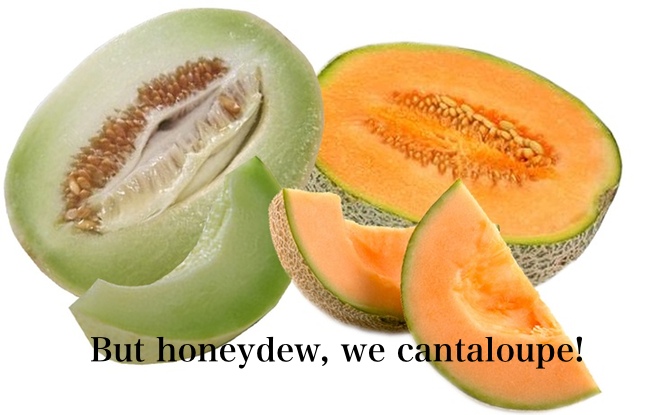
However, Japanese puns tend to have the same syllables said twice, carrying a different meaning the second time yet still making a completely understandable sentence. Here’s an example of a classic:
- Iruka ga iruka? イルカがいるか
- Is there a dolphin?

When delivered, Japanese puns are to be said with a straight face, and are often reacted to with an even straighter face, as no one finds them funny. As someone once said, puns are more funny to the teller than the receiver.
Here’s another example of dajare along with both ways the sentence can be taken:
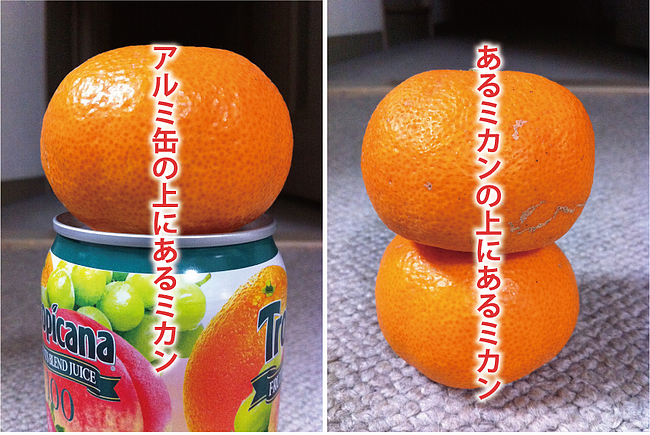
- アルミ 缶の 上にあるみかん
- There is a mikan orange on an aluminum can.
Arumikan (aluminum can) no ue ni (on it’s top) aru mikan (an orange). What changes in this gag is the meaning of arumikan, and whether you want to split it after the aru or the arumi. So really, dajare are up to interperetation. Is it an orange on a can or an orange on an orange?
This next one I find particularly clever, and it is currently rated number one on the dajare compilation website Dajare Station. Feel free to think of your own and submit them to the website!
- 傷んだ 廊下にいたんだろうか
- You were in the damaged hallway, weren’t you?
This one is a little harder, let’s break it down word by word again: itanda (damaged) rouka (hallway) ni (in) itan (were existing) darou ka (right?). This forms a completely normal and coherent sentence that just happens to be cleverly constructed of the same words twice.
Yet again, I must remind you that dajare are lame and will get you laughed at for NOT being funny- yet I still love them, and so do many people who often tell them. Those brave souls should always wear a sweater though, because when a pun is bad, the feeling in the room becomes cold, or samui 寒い. One can feel free to say that as a reaction to whatever oyaji gyagu 親父ギャグ or old man gag, was told.
Palindromes 回文
“Go hang a salami, I’m a lasagna hog!” Palindrome in Japanese is kaibun, which literally means “spinning sentence.” With English palindromes, you can read it backwards and forwards and it still spells the same word/sentence. The word “race car” is a famous (and simple) example. However, Japanese palindromes vary drastically from English ones because of the writing system. Because Japanese is written with a character for each syllable, kaibun have an impact when spoken as well as when read.
A tofugu related kaibun is below! Of course I had to add one
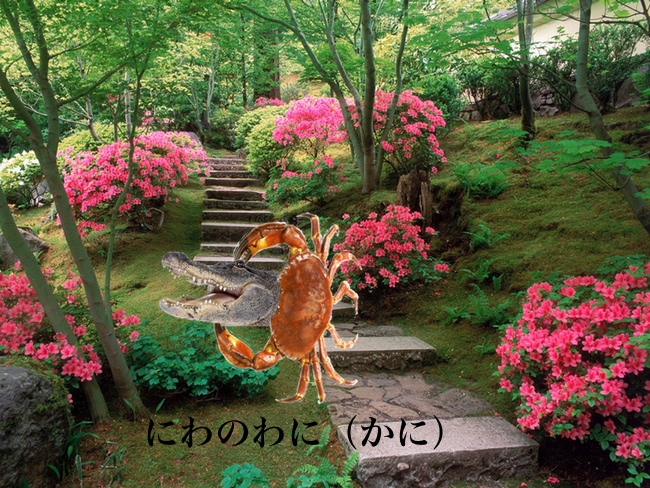
- にわのわに
- Alligator of the garden (or is it a crabigator?)
Palindromes are fun to make up yourself if you have time, and making your own kaibun can help be a refresher on the Japanese words and phrases you know. If you can’t think of any yourself, there are plenty of books you can check out.
Shiritori しりとり
I can’t remember when I first learned how to play Shiritori, but it’s a great time-waster/ road trip wordplay game. One person starts with a random word, and the next person has to think of a word that starts off with the last syllable of the previous word. If someone says a word that ends with n ん or can’t think of a word, then they lose. Only nouns are allowed (otherwise you’d constantly have to think of words that start with ru る and i い). For example, a game of shiritori can go like this:
fugu フグ → Gunma 群馬 → 魔法使い mahoutsukai → いんげん ingen and the poor green bean-lover loses.
For the budding artist, picture shiritori is way more fun. It’s the same concept, but you draw whatever you think of when it’s your turn.
I remember my first experiences as an exchange student playing picture shiritori with my friends on a chalkboard. You always find out who the most creative in the group is. Just make sure you look up words that start with ru in the dictionary before you play- those are the ones that really get you.
Goroawase 語呂合わせ
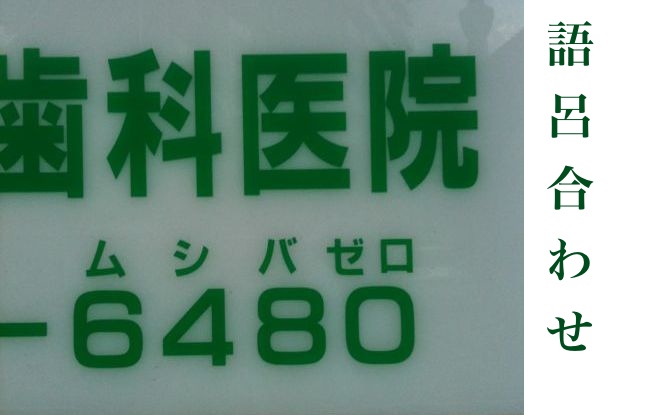
Earlier, Koichi did a whole long article about Goroawase, or using numbers to represent sounds that make up words. Make sure to check it out! 4649! But, for the lazy, here’s a quick explanation:
Goroawase is kind of like a code language using numbers. The numbers can represent different sounds that have to do with how the number is pronounced, and through the combinations of those possible pronunciations, you can make sentences or words.
For example, 1 can be read as i for ichi, 9 as ku, and 2 as ni. Knowing these, you can easily make a mnemonic for remembering the date 1192, ii kuni (wo tsukurou) which translates to “Let’s make a good country”. This mnemonic was used in classrooms to remember the date of the beginning of the Kamakura Period. Sadly though, the date has recently been believed to have actually been 1185. Can you hear all those lazy students crying? I sure can.
Tongue Twisters 早口言葉
Everyone knows “She sells sea shells by the sea shore.” But do you know any Japanese equivalents? Some Japanese tongue twisters are ridiculously easy, but others are the devil’s spawn. Here are three: one easy, one medium, and one difficult. Try saying them 3 times fast!
- Nama mugi nama gome nama tamago 生麦生米生卵
- Raw wheat, raw rice, raw egg
- Tonari no kyaku wa yoku kaki kuu kyaku da 隣の 客はよく 柿食う 客だ
- The guest next door is one who often eats persimmons.
- Migi mimi ni miri migi ni mini migi mimi 右耳2ミリ 右にミニ 右耳
- A right ear that is 2 millimeters on the right is a mini right ear.
So did you say them? Or did you fail and say “minigiginignimimimimnininini”? Learning how to speak fast through tongue twisters can help you get used to speaking other non-twisty Japanese words too.
Riddles なぞなぞ

Riddles in a non-native language can be very challenging, but very rewarding. They allow you to think about the language non-literally and teach your brain to interpret and think about things in different ways. Many Japanese riddles have to do with presentation and often include dajare and written meaning. Try these out! (Highlight the blank space to see the answers and explanations.)
- 問題: おかしは3じいまはなんじ?
- Snacks are at 3 o’clock, what time is now?
答え:「2字(2ji)」
(This one is tricky, because the word ji means both time and letter(character). If okashi has three characters, お・か・し, then ima い・ま has two character, so 2 o’clock.)
- 問題: 1 日に2 回あるのに、1 年に1 回しかないものって 何?
- What is there twice in one day, but once in one year?
答え:「ちの字」
(Another character-based riddle, did you get this one? The character ち(chi) shows up twice inいちにち (ichinichi)but only once in いちねん(ichinen).)
- 問題: パンはパンでも 食べられないパンは、なに?
- Bread is bread, but what bread can you not eat?
答え:「フライパン(furaipan)」
(Pan_in Japanese means bread, but the word frying pan is the same. You can’t eat a frying pan.)
- 問題: パンはパンでも、 空を 飛ぶパンはなんだ?
- Bread is bread, but what bread flies in the sky?
答え:「ピーターパン(Peter Pan)」
(Same concept as above. Did you get this one?)
If you liked these, just Google nazonazo and you are bound to find more. Some are good, some are bad, and some are impossible to figure out. But hey, it’s the same everywhere. I’ll never be able to understand that albatross riddle…
Eeny Meeny Miney Mo…
Eeny meeny miney mo, catch a tiger by its toe, if he hollers let him go, eeny meeny miney mo. The Japanese version of choosing one object between a few varies from region to region. They all start with どちらにしようかな (I wonder which one I should choose). Here is the Tokyo version!
Some other regional variations include:
Fukuoka
- どれにしようかな 天神様の 言う 通り 赤豆白豆三度豆 うまい 豆
- Which one should I choose, the way god in heaven says, red bean white bean three times bean, delicious bean.
And the very morbid Okinawa version
- どれにしようかな 天の 神様の 言う 通り 鉄砲うってバンバンバン 月火水木金土日
- Which one should I choose, the way god in heaven says, guns attack bangbangbang Monday Tuesday Wednesday Thursday Friday Saturday Sunday.
So now that you know these, you can whip them out when your friend asks you to choose between chocolate with almonds and chocolate with peanuts. Or which friend you want to invite to a sweepstakes win vacation (T-pain!). Which one?
Have Fun~!
Wow! Now you know a bunch of cool new Japanese to impress your friends, language buddies, or teachers. We went over puns (the highest form of intellect), palindromes (cigar toss it in a can it is so tragic), shiritori (ringo, goroawase, senmon, doh), goroawase (4649!), tongue twisters (Peter Piper? Is that you?), riddles (what’s in my pocket?), and even wordplay for choosing someone or something (I choose you, Pikachu). Speaking of choosing something, which of these did you like the best? Personally, the dajare will always be the most pun. Do you have any fun dajare, kaibun, or hayakuchi kotoba that you made up or have heard anywhere?