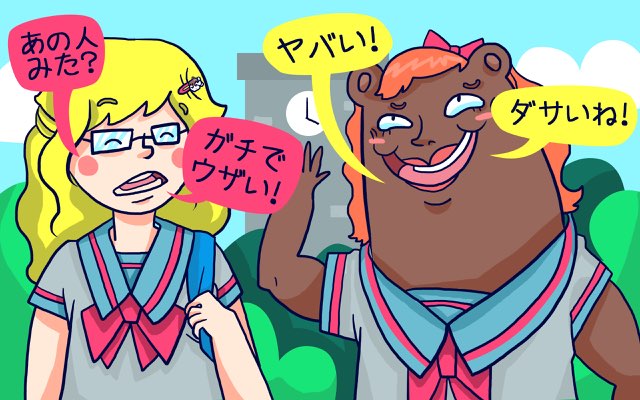
You’ve been studying Japanese your hardest for a while now, and it’s finally your time to go to Japan. You get there and you’re able to convey your points to people, but you don’t understand anything they’re saying! It’s all alien jargon to you! People are throwing these scary sounds out at you and like spitballs, they stick onto your skin while you have no idea how to interpret them! Oh yeah, people use slang over there too!
Even if you feel like you know some slang from watching movies or anime, here’s a list of some essential words that will come in handy when you’re in a group of Japanese people, especially kids or youth, although many people of a more finely-aged demographic can often be seen using these words too.
Watch this video before you learn some of these words, then watch it again afterwards, and see what you can recognize.
So how did that go? Let’s do some learnin’ and then come back later. Hopefully the next time you watch it a lot more will make sense. Let’s start with verbs:
Verbs
Shareteru しゃれてる
Shareru is a verb that comes from the adjective oshare which means fashionable. By itself it can most properly be used to mean stylish, but recently shareru is used to describe anything good. Just as the word umai is a synonym of both oishii (tasty) and jouzu (skillful/good at), you can use shareru (and its present-tense form shareteiru which gets slang-ized into shareteru) to refer to something that is good. This is more popular among teenagers.
- A:さやかはいつもかわいい服を着てるね!
- A: Sayaka always wears such cute clothes!
- B:そうね、いつもしゃれてるね!
- B: You're right, she's always doing it right!
Shiketeru しけてる
In a sense, shikeru is the opposite of shareru. You use shikeru when something is bad, distasteful, or leaves you with an empty feeling. This is also more popular among teenagers. I’ve seen games and sports played by Japanese teenagers who shout “Shiketa!” when they miss and “Shareta!” when they score. (Both past forms of the word)
- A:お母さん、今日の夕飯しけてるね!
- A: Mom, today's dinner sucks!
- B:そんなこと言うな!
- B: Don't say that!
Ikareteru いかれてる

Whoa dude, you’re going crazy! Ikareru can mean many things, but if you hear someone call their friend ikareteru after they said or did something strange, they’re being called crazy. It’s nothing seriously insulting in the slang version when it is used between friends. Having been called ikareteru more than a few times, I am usually fine with the sentiment. You can also say atama itteru 頭いってる.
- A:最近ずっと考えてるけど、AKBのメンバーと結婚しようと思う。
- A: I've been thinking about this for a while but, I think that I'm going to get married to an AKB member.
- B:頭いってる!お前いかれてる!(Atama itteru! Omae ikareteru!)
- B: You've lost it! You're completely crazy!
Ukeru ウケル
This is another funny example of the Japanese language using verbs where the English equivalent is an adjective. Ukeru literally translates to “to take,” but in slang-lang is used as a reaction to something that is funny. It’s in the verb category although it’s more of an interjection
- A:最近、自分はかわいいかなって思ってる。(Saikin, jibun wa kawaii kana tte omotteru.)
- A: Lately, I've started to realize that I might be cute.
- B:wwwww~ウケる!
- B:lololololol~ You're hilarious!
Adverbs & things

- chou 超
- meccha めっちゃ
- maji[de] マジで
- gachi ガチ
If you’ve been learning Japanese in a classroom, you’ve probably learned the adverb “very” as totemo or sugoku. But in english, do we exclusively use “very” as an adjective when we talk to people? I for sure know that when I talk with my way cool friends, we totally use words that are super convenient and create emphasis instead of “very”. For example, a Japanese conversation can go like this:
- X:これ、とてもかわいいね。すごく安かったし、とても便利だよ!本当に!
- X: This is very cute. It was surprisingly cheap, and is very convenient. Really!
Although this way of speaking is very proper, it’s not really what you’ll hear young people say on the street or talking to friends. It would go more like this:
- X:これ、超かわいいね。めっちゃ安かったし、マジで便利だよ!ガチで!
- X: This is super cute. It was totally cheap, and really convenient. Seriously!
Chou and meccha can be used interchangeably unless you’re in the kansai area, where meccha is the go-to word.
Maji, meaning really or seriously, (which comes from majime which means serious,) actually seems to have been used since the Edo peroid. Gachi has the exact same usage as maji. Let’s let AKB48 show us a few ways to use maji!
Adjectives
- yabai ヤバい
- uzai ウザい
- kimoi キモい
- dasai ダサい
- Busu ブス
- zurui ズルい
- bimyou びみょう
- saitei さいてい
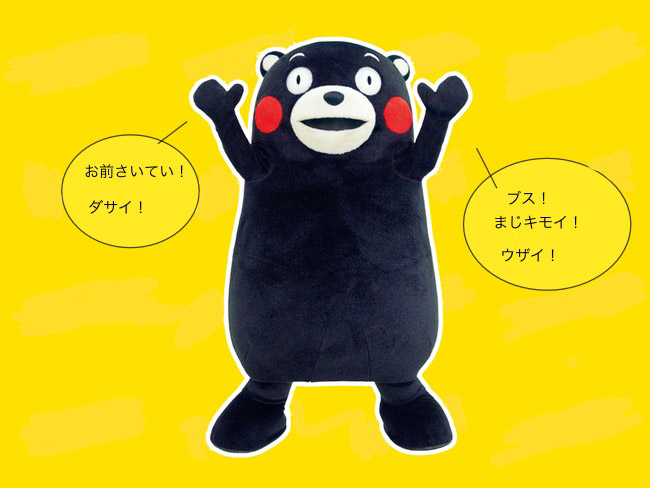
These adjectives are often used as interjections. Note that some are written with katakana until the hiragana i. This is the most common way to stylize slang words, but can also be written in either all hiragana or all katakana.
Yabai
Said when something bad happens. Confusingly can also be said about good things too. People started to use yabai as “uncool” in the 80’s, and then in the nineties as "sugoi," an interjection meaning “wow” “amazing.”
- A:ヤバい!雨降ってきた!
- A: Oh crap! It started raining!
- A:猫ちゃんの写真みて!
- A: Look at the picture of this kitty!
- B:ヤバい!かわいい!(Yabai! Kawaii!)
- B: OMG! So cute!
Uzai
Annoying. Used to describe a person. Can also mean gloomy, troublesome, loud, or bothersome. If you’re calling something or someone uzai, it’s never with a positive connotation.
- A:あっちゃんはいつもツイッターで何人ものツイートをリツイートしてて、うちは読みたくない!ウザい!
- A: On twitter, Acchan keeps retweeting so many people's tweets that I don't want to read! It's so annoying!
- B:そんなにいっぱいだとめっちゃウザいよね。
- B: If there's that many it gets totally annoying.

Kimoi
Gross. Comes from kimochi-warui which can mean gross, bad feeling, or sick to the stomach. Kimoi less versatile in that it can only mean gross. (On a side note, things can be both kimoi and kawaii at the same time!)
- A:コウイチくんみて!鼻水出てる!キモイね!
- A: Look at Koichi-kun! His nose is running! Isn't he gross?
- B:キモイキモイ!こびとづかんにみえる!
- B: Gross gross! He looks like a kobitodukan!
Dasai
Lame or uncool. Can be used to describe objects or people. The Japanese view on what is lame might differ from your view- despite my example below, Asia loves crocs! Hipster glasses also bombard the nation. Because eyesight in Japan is the worst in the world, there are many people who wear contacts under their lensless glasses.
- A:山田くん、クロックス履いてる!ダサくない?
- A: Yamada-kun is wearing Crocs! Isn't that lame?
- B:ダサイよね!
- B: You're right, he's so lame!
Busu
Ugly. Originated from busaiku, the longer form of ugly. It’s pretty serious, so be wary of people’s feelings, even when joking. Seriously. You don’t want to be called ugly.
- A:AKB48のメンバーの中にかわいい子いる?
- A: Are there any cute girls in AKB48?
- B:いや、みんなブス。
- B: Nope, they're all ugly.
Zurui
Sneaky. Can also be used as “not fair!” or “you suck!” Think of the sly and cunning fox in old children’s stories.

- A:今日は学校サボって、遊園地行った!
- A: Today I skipped school and went to an amusement park!)
- B:ずるい!
- B: You sneaky bastard!
Bimyou
Not very good. Kind of between maa maa and mazui when using it to describe foods. Definitely has as negative connotation. It can be used about anything that’s a little less than giri-giri, or not good.
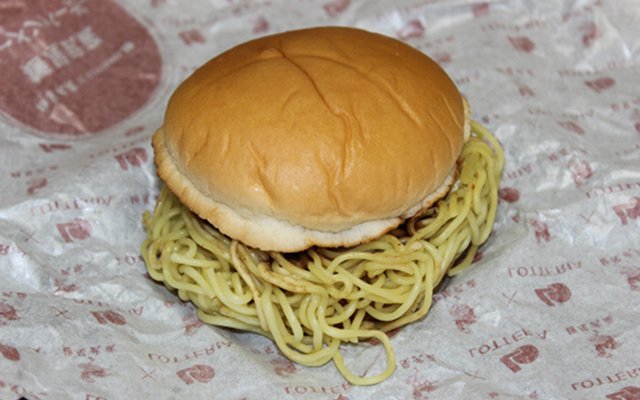
- A:ラーメンバーガー美味しかった?
- A: Was the ramen burger good?
- B:ううん、微妙だった(笑)
- B: No, it kind of sucked lol
Saitei
The lowest (worst). The word itself can mean the ultimate lowest in a non-slang situation as well, like in math or statistics. As slang though, you can use it to describe any person, thing or situation.
- A:最近のポップ音楽きらい。特にジャスティン・ビーバーとか最低。
- A: I hate today's pop music. Especially Justin Bieber, he's the worst.
- B:あのガキ?ウケるよね!
- B:That kid? He's a joke!
Text Slang
Nowadays, people one their スマホ(smartphone) use various アプリ(apps), including ones like Twitter, where these useful little buzzwords originated.
- なう nau now
- うぃる wiru will
- わず wazu was
Now, will and was. The use of these words is very different from the use of them in English. Basically, you just slap them onto the end of whatever you are doing, going to do, or did do. This is better learned through examples, so here are some of your favorite celebrities demonstrating the lovely use of nau, wiru, and wazu! (These are almost exclusively text slang and are hardly ever used in speech.)
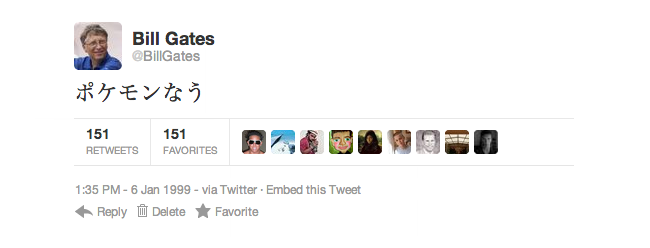
You didn’t know that Bill Gates was a huge Pokemon fan?
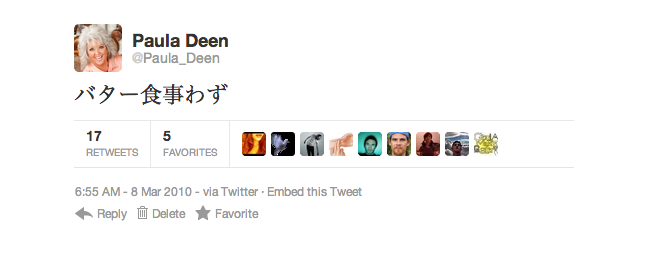
And that’s why you’re off the air.
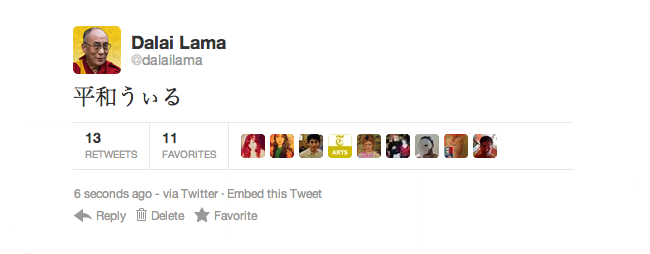
You go, Dalai Lama!
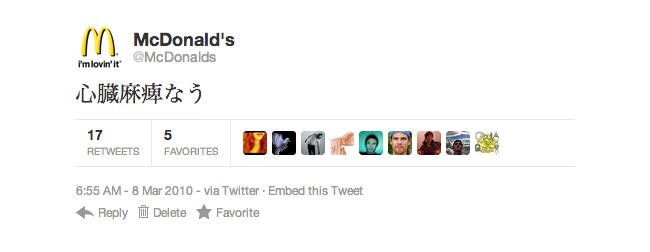
Heart attack now- at least you’re being honest, McDonald’s.
Get the Hang of Japanese Slang
So go ahead and watch the first video again. Now memorize these and impress your Japanese friends. You’ll get a fun reaction.
This list is short and basic, but essential. Once you know these, you’ve got a basis for the harder stuff, so study up!