
“Gaijin”

I’m constantly being reminded that the comments section of Tofugu (or any site, for that matter) can really take on a life of its own. My post a few weeks ago about weird ramen took an unexpected turn in the comments as people began to discuss my usage of the word “gaijin.”

Gaijin (外人, short for 外国人), or “foreigner” in Japanese, is a complicated word that means a lot of different things to a lot of different people.

Some people take the word lightly; when the Tofugu team was in Japan and a roller coaster we were riding unexpectedly malfunctioned, we joked that it was because the ride wasn’t designed to hold the weight of our giant gaijin bodies.

But for some people in Japan, “gaijin” can be a hurtful and alienating word. It can mean refusal of service at businesses, a barrier to entry for housing, or even threats of harassment or violence.
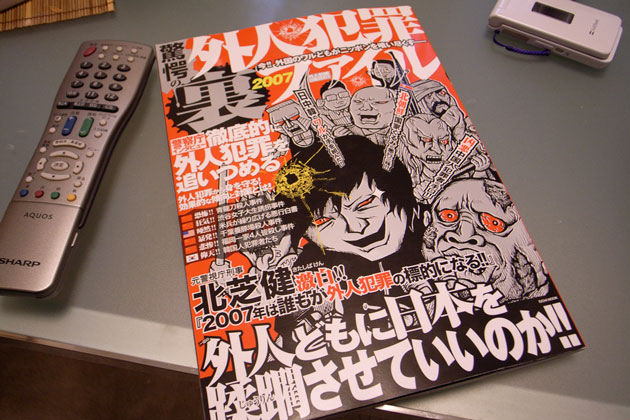
gaijin-crime-file

Photo by w00kie

I thought that I’d reach out to some bloggers living in Japan to see what their thoughts on the word “gaijin” were. I got a lot of great, varied, and nuanced responses.

Many people take no issue with the word and even embrace it to some extent. Lots of websites aimed at expatriates in Japan, like GaijinPot and countless other community sites and blogs, have absolutely no problem with using the word “gaijin.”

Hikosaemon, a man who’s lived and worked in Japan for over a decade, sometimes sees “gaijin” used in inappropriate contexts, but doesn’t believe that there’s necessarily anything wrong with the word itself:

To me, the word “gaijin” is slang for someone who looks like a non-Japanese. Because it is slang, it is not appropriate for formal contexts, but as slang, the appropriateness of its casual use is contextual—99% of the time, I think the way it is used is fine. It is the 1% of used with malice that causes most of the controversy. I do not subscribe to the view that its limited malicious use means the term should be made taboo. The term gets a lot of focus by people new to Japanese culture who become aware of the exclusivity of Japanese social circles and struggle with the feeling of isolation the culture can give new arrivals (just as it gives migrant Japanese within Japan).

The composition of the term as “outsider” and the feeling that this reinforces exclusion heightens sensitivity about the psychology behind the term and its use to many foreigners, as indeed it did myself in my early years in Japan. However, reactions to the term I think tend to show more about the person reacting than any psychology on the part of the speaker. Those with the greatest sensitivity to the term often seem to be bringing their own complexes to the table about perception of race in their home countries, and their own level of adjustment and language ability in Japan. It’s a convenient slang term that I use myself, and generally have no issue with others using unless the usage is in an inappropriate context—which is a problem you can’t fix by changing the word. We will just go from “Bloody gaijin” to “Bloody Gaikoku No Kata”, the term here is not the issue. It reminds me to periodic adjustments of politically correct terms for intellectually disabled people.

Hikosaemon touches on an the important issue of formality; for some, the informal 外人 is inappropriate in certain situations, but the more formal 外国人 or even the honorific 外国の方 are perfectly acceptable.

And while Hikosaemon wasn’t necessarily offended or alienated by the term, he and everybody I talked to recognized that “gaijin” is a word that can have a powerful effect on people.

I was lucky to talk with the Gakuranman who actually did a lengthy write-up about the word a few years back. He also thinks that the formality of the word makes a difference:

The word ‘gaijin’ (literally ‘foreigner’ or ‘outsider’) evokes a multitude of differing responses depending on who you ask. Although for most Japanese people the term is akin to saying ‘gaisha’ (foreign car) or ‘gaika’ (foreign currency) and no harm is meant, the word itself has picked up a lot of baggage over the years through repeated misinterpretation and reinforcement among foreigners who have visited Japan. Expats in Japan are often surprised and offended at being labelled as outsiders, especially if the term is used towards them despite their repeated efforts to assimilate. Some will even go as far as to think it a racist term because of the way it appears to ignore cultural diversity.

Those who have spent the better part of their life living in Japan generally come to accept the word and learn to distinguish between the negative, neutral and positive uses it can have in different contexts. Personally, I think it to be a clumsy expression to use within increasingly multicultural communities and feel it is better off avoided where possible because of the tendency to unwittingly alienate and offend people. If you absolutely must make the distinction between non-Japanese and Japanese when describing somebody in Japanese, use the word in full—‘gaikokujin.’ Otherwise I suggest sticking to personalized information about the individual.

Some people might not get personally get offended at “gaijin,” but are sympathetic to those that are. Eryk from This Japanese Life seems more or less indifferent to the word, but is understanding to those who attach negative connotation to “gaijin.”

Before I talk about the word “gaijin” I should mention that I am white. As a white American guy, my race has never been a liability. When Japanese natives on a train mutter “gaijin” to each other, I’m not offended.

White people have this superpower where we don’t think we’re actually a race, so we can laugh it off when we’re attacked for being white. But our Kryptonite is our corresponding need for victimization. When white, highly educated Americans from wealthy families spend a year abroad and get outraged by some overheard “gaijin” remark, I feel like it’s just the daily opportunity for outrage. I don’t care.

I have never been threatened by the kids with shaved eyebrows and pink tracksuits who call me “gaijin” just loud enough for their friends to hear it. There is no long, complicated history of shame that comes from being a white dude. The word “gaijin” does not register, for me, as a synonym for disgust and contempt.

“Gaijin,” though, is not like the words cast at minorities in English. Some expats seem to think that if they aren’t offended by it, they’re entitled to say mean, dumb things about other people. But there are words that are implicitly attached to threats of violence, words that carry the real resonance of hatred, words that tell a person, deliberately, that you think of them as nothing more than their race, or gender, or sexuality.

Someone reading this might have been traumatized by violence, or threats of violence, tied to being “gaijin.” If that’s happened to you, you have every right to hate that word. For foreigners who come to Japan with a history of oppression, “gaijin” on the lips of the nationalist parades marching through Osaka might be an ugly reminder of that kind of logic. But the word, perhaps stupidly, is nothing I’ve ever been afraid of.

I was happy that Ashley of Surviving in Japan had a bit of a unique perspective on the matter.

In our discussion, Ashley mentioned that her husband is a white American who was born and raised in Japan. It seemed clear to me that his situation influenced her opinion on the split between feeling Japanese and being considered as Japanese.

When I first arrived in Japan, I frequently heard that “gaijin” was a derogatory term—this is how some expats described it, anyway. But they also often referred to themselves as “gaijin” instead of “gaikokujin”. In my experience it’s often used this way in jest, as those of us who are unfamiliar with Japan repeatedly commit faux pas. There’s a steep learning curve to understanding Japan, its people and culture, and it’s difficult to ever truly fit into society. Even some Japanese who don’t meet social expectations are at risk of being ostracized.

I don’t believe “gaijin” in and of itself is derogatory, but it can be used that way. I didn’t experience this much other than kids stopping in their tracks, pointing at me and saying “gaijin!” I suppose one could say it would be equivalent to an American child who points at someone they “think” isn’t American and yelling “foreigner!” It’s rude.

That brings us to the point that anyone who doesn’t “look” Japanese in Japan is typically considered an outsider, which shows an underlying preference that being Japanese means that they have to “look it.” But what if you’re of another Asian ethnicity? What if you’re Japanese-American? Or what if you’re not Japanese at all, but were born and grew up in Japan? Depending on how you were raised, you might grow up feeling like you are “Japanese”, but then are constantly reminded that you won’t ever truly fit in because you don’t “look” the part. Bi-racial children (half-Japanese in particular) may, and often do, face similar obstacles.

So I don’t believe “gaijin” is always an issue, although it is attached to a set of stereotypes (which also vary, depending on your skin color and nationality). The main issue is this pervasive attitude of who can and can’t be truly accepted into society; and in many cases, gaijin can’t.

I would like to note that I’ve met many Japanese people who don’t have or agree with this attitude.

Other people I talked with had a staunchly negative view of the word. Jasmine of Zooming Japan is understanding of some of the contextual uses of “gaijin,” but on the whole feels that the word is very alienating, a constant reminder that complete assimiliation is next to impossible.

For the word “gaijin” it depends on who says it and in what context, but in general I consider it as rather negative.

Even though I know that most Japanese people don’t mean any harm, by using the word “gaijin” they make me feel like an outsider, like someone who doesn’t and will never belong here.

Based on my daily experience here in Japan the word “gaijin” is not equal to “foreigner”, but to “you ≠ we”. I often see that when Japanese people travel abroad and say: “Look! So many gaijin everywhere!”

They don’t even realize that they have become the gaijin for the time being.

That’s why the strongest association I have with the word “gaijin” is “outsider” or “somebody who is different.”

Being different can be something good or bad in the eyes of a Japanese person. For some, foreigners are beautiful, passionate and exotic, others think all foreigners are criminals. Based on that, the word “gaijin” can mean something good or bad.

Most of the time I hear people say “gaijin” and not “gaikokujin” or “gaikoku no kata” which I would prefer because it sounds more polite and doesn’t have such a strong connotation of “outsider”.

In the end it’s not the word itself, but the whole mindset that stands behind it:

If you live in Japan and people stare at you on a daily basis or kids point at you and scream “Gaijin!!!!”, then you will feel awkward.

You are not only different, but you also do not belong there. You are not Japanese. You are only a visitor, a tourist or a short-term resident. You will leave and go back to your own country. The idea that you might have been born in Japan and could be part of the “we” doesn’t even exist. And that’s very sad.

One of the most fascinating things I learned during this discussion was that Japanese use the word “gaijin” even in contexts where they’re the foreigner. And I thought it was especially interesting that not on did Jasmine point this out, but also Leah from The Lobster Dance.
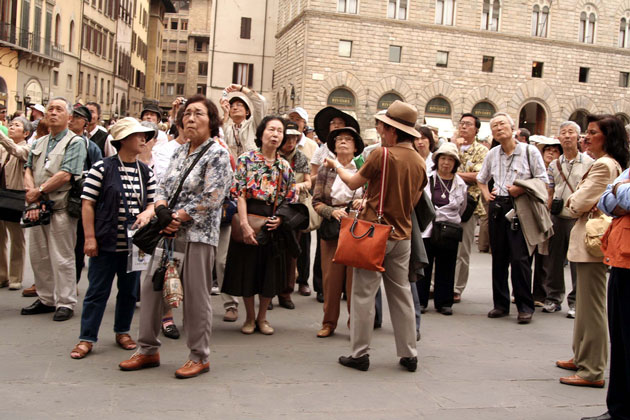
japanese-tourists

Photo by JD Lasica

Like Jasmine, Leah also has quite a strong opinion against “gaijin,” feeling that it’s a limiting, alienating word.

I used to be of the mindset that gaijin could only be used BY foreigners. I even wrote a cooking section of my blog that used to be called “The Gaijin Chef.” Yet in the past few years, I’ve begun to understand betters the social implications of linguistics.

Why does this word make me so uncomfortable now? Part of it is the lack of respect, especially toward people in my generation who were born and raised in Japan but are not ethnically Japanese. They are not foreigners. If your Japanese parents immigrated to the US and raised you there, you would probably consider yourself American or Japanese American, depending on your view of the terminology as it relates to your personal experience. However, a child born to two non-Japanese parents in Japan and who has lived their whole life in Japan will not be considered Japanese. There’s a very strong link between race and nationality in Japan, and one of the ways it is supported is linguistically. Gaijin lumps tourists, immigrants, permanent residents, and citizens all together that appear to be a very limited concept of “foreign,” both in terms of appearance (white, sometimes black) and of experience.

Likewise, part of the reason I hate that word is the cavalier manner it induces when used. For instance, when Japanese people go abroad, they continue to use gaijin to refer to the native population. “There are so many gaijin in America!” No, you are the foreigner in this situation, but the attitude is that “Japanese people can’t be gaijin/foreigners.” I feel that the term just encourages a xenophobic and rude mindset, and getting people to understand why it is linguistically problematic will be a step in the right direction.

As for those who use it to refer to themselves, I think a lot of people go through a phase where they think, “Well, I am an outsider and it doesn’t bother me.” I’m reminded of several incidents in which some acquaintances who did not speak Japanese well claimed that to have never experienced racism in Japan over the course of the 3-6 months they had lived here. In a short period of time, that might be true, and without listening skills, it’s quite easy to miss. But as with sexism, everyday racism is not usually blatant or violent; microaggressions are easier to ignore or excuse, especially by the perpetrators. When you are not The Other, it requires imagination and often experience to even understand a fraction of what it is like to live as The Other. I understand the line of thinking “I’m foreign, so I will use gaijin,” but there’s a lot of cultural baggage associated with the term, and I don’t think we can reclaim it.

I was surprised at the diversity of opinions on “gaijin,” and am grateful to everybody who shared their views on this sometimes divisive and controversial topic. It’s clear from the variety of responses I got that there’s a lot of thoughtful dialogue about this word, and that there’s no one clear position on it from the expat community living in Japan.

What do you think of the word “gaijin?” Please share your story about your experiences in the comments.

  • Scott Lavigne

    I know, but there it was.

  • ZXNova

    I’ve actually been wondering about that. How is it like for black people in Japan… I would think that Black people are more rare in Japan than White People, so I really do wonder how they are treated. In a whole general way, of course.

  • FoxiBiri

    The word gaijin is something we have to overcome, and it can be a very tiresome. I was the kind of person who rolled their eyes at people who I felt get a little too offended by any discriminating terminology, but after living in Japan and hearing the word whispered every hundred or so steps… well it was very humbling. No matter who you are it makes you doubt your confidence a little, it’s the reason you sit in your apartment while your tummy growls, or why you’re always wearing headphones when you get to the supermarket. It wears on you, it certainly does. What bugged me the most was just how openly they talk among themselves about the foreigner not even 10 feet away. The thought that they didn’t even consider if I could understand them, that tons of foreigners try and establish themselves and spend years learning the language and fighting to be viewed as educated, passionate, people in Japanese society. It’s just kind of a slap in the face to all those spending each and everyday studying for that kanji test.
    But you know that’s life! It’ll be more or less the same no matter where you go. As long as you venture outside of where people look and act like you, you will be a gaijin, or at least that’s what I told myself. It’s a struggle, but if one can attain an attitude that isn’t bothered by discrimination, if one can lead by example that we can and are in fact not on holiday and contributing to society in important ways, if we can prove to other that we are brave and hardworking, then we can overcome it. I’m not saying let’s all change how Japan thinks or that they are in the wrong, I just think we can use it to our advantage to better our perception of being ignorant to the language around us. Everybody should always try to be the best person they can be :) and we’re not at our best when we’re spiteful are we? Haha, or the perception will be that all gaijin are either ignorant or spiteful xP

  • Flora

    I find that the same people who have a problem with the word “gaijin” are often heavily invested in the concept of “fitting in” and being treated as a “same” in society. I stumbled across a long-forgotten blog post from a Black woman in Japan who pointed something out – most people who live in Japan are white people or in some other way were the majority where they came from. For many who come to Japan, this is their first ever experience being an extreme racial minority (which may explain their reaction to anything they perceive as being exclusionary).

    As a Black American, I have to agree with that sentiment. Being a minority your entire life means that you often become numb to little “microagressions” like that. Essentially, you have to – if I took time out of my day to get offended at every little thing that could be perceived as racist against Blacks, I wouldn’t have time to do anything else.

    Personally, I think “microagressions” and things like that are all complete bollucks. A word only has as much power as you give it. Even if it was used as an insult, why does it have more power over you than any other insult (i.e. fat, stupid, etc.)? Either you let it roll off, or you carry it with you until they all form a chip on your shoulder. No one likes the guy with the chip on his shoulder.

    I’m not Asian and, until I change my nationality, I’m not Japanese. I don’t expect to be treated as such. I don’t mind the word gaijin because I’m not the same. And, so long I’m being treated as an equal by the people I care about, I don’t care.

  • http://www.locoinyokohama.com Locohama

    peep my blog, loco in Yokohama, or my book. I can’t speak for all black people here. Only for myself. I think each person’s experience here has some elements that are similar but is ultimately determined by the luggage and conscientiousness one comes here with.

  • PostColonialInJapan

    Note that the two women (who probably have experienced sexism and discrimination in their home countries) are against the word – while the white men are ready and willing to excuse Japanese racism. “There is no long, complicated history of shame that comes from being a white dude.” Oh, well, good for you. Yes, this is 100% about the white man in the room. This is 100% about how you, the white male, feels in the situation.

    Uh-huh. Sorry white people. There are MORE people in the world than you, and “gaijin” is used to describe people who AREN’T white males like you. Just because YOU don’t feel a “complicated history of shame”, it doesn’t mean other people don’t. Arguing for the word “gaijin” because you PERSONALLY don’t feel threatened by it is, frankly, dumb. That’s basically white privilege: “I don’t feel threatened by racism because I’m white, so racist slurs are a-ok in my book.”

    I’m with the women: gaijin is an inappropriate word in all situations.

  • PostColonialInJapan

    Right, exactly. The racism in Japan is often not directed at us white folk, but rather the Chinese and Koreans. “Gaijin” is a word that helps fuel that racism. While a white male may not feel threatened by the term, Japanese people did massacre Koreans in the streets of Japan about a hundred years ago after a big earthquake. There IS a history of violence against certain “gaijin” groups in Japan, and I’m sure they feel plenty threatened by the word. As you’ve pointed out, there is often an assumption that crime in Japan comes from Chinese or Korean residents – that’s racist and stupid.

  • Brian Ashcraft

    As others have so eloquently stated, the meaning of “gaijin” depends on the context. Sometimes, it’s harmless. Sometimes, it’s mean. Sometimes, it’s just ignorant. It really depends.

    More worrying than that is, perhaps, what Koreans and Chinese must deal with in Japan. Can you imagine having to hide your last name and identity?

    Many foreigners obviously can’t and don’t, which can be a good thing (Japanese people know right quick who they’re dealing with) or a bad thing (Japanese people think they know who they’re dealing with). The last reason is probably why things can get awkward or uncomfortable for non-Japanese living in Japan…

  • Flora

    Well, he IS a White male. And the question was “how do YOU feel about the word?” Thus, it is about the White man in the room. If they’d asked me, the situation would be about the Black female in the room (and I don’t give a darn about it).

    And they didn’t advocate the word; they said it personally didn’t bother them. The women’s responses weren’t that much different – it personally made them uncomfortable, but they didn’t move to have the word banished like you just did.

  • Patuki

    This for me like so many previous commentators is an interesting topic. I’ve only read this particular article and have yet to find anyone who has tried to mention the historical use of the term when Japan itself used to be broken up into ‘kuni’ or 「国」 meaning ‘country.’ For example, the geographical area known today as Saitama, parts of Tokyo and parts of Kanagawa was historically known as ‘Musashi’, Shizuoka was historically known as ‘Izu’,Miyagi and Fukushima were historically known as ‘Iwaki’ and the list that I’m referring to is from page 1649 of ‘The Kanji Dictionary’ by Mark Spahn and Wolfgang Hadamitzky 1996. What I’m trying to elude to here is that if you ventured outside of your aforementioned ‘kuni’ you were labeled as a ‘gaikokujin no kata’, ‘gaikokujin’ or ‘gaijin.’ It would seem therefore that this term has been around for a while to say the least. So perhaps some of the historical emotions accompanied with this term both good or otherwise has been taken off of the Japanese people and is currently being used to refer to its modern applicants therefore Japanese no longer see themselves as being ‘foreign’  due to the fact that they are all one people today. Sorry, I’m merely basing my comment on what I’ve noticed in my kanji dictionary. Please do correct me if I’ve made a gross assumption. Apologies in advance if what I’ve written is erroneous.

  • LordKyuubey

    Wow, I didn’t imagine this word would cause a great deal of discussion; proves how much I still have to learn about Japan. This slightly resembles the word ‘gringo’ used in Spanish-speaking countries (though it’s LatinAms referring to people from US). I think depending on how you use the word ‘gaijin’ is the reaction you will have. After all, as human beigns we tend to discriminate (always), and it also happens to us as well. Many of us try to embrace and accept a culture so different from ours, but the other side isn’t ready to accept ours (or viceversa). We still have a long a way to go…

  • PostColonialInJapan

    “Am I the only person who feels that expecting a whole country to meet your requirements is not only wrong but really fool hardy?”

    Childish and simplistic understanding of how culture works. Japan has produced Abenomics because they want to be international. They want to compete on the global market and be respected as a global power. They import JETs every year to “internationalize.” They desperately want to be a part of the global community.

    The thing is, the world has certain standards that ALL countries have agreed upon. The UN is the official manifestation of that, but there are other things that large portions of the planet Earth has come to an agreement on – democracy, for example.

    Japan wants to be respected internationally. It is 100% fair and right to ask that Japan live up to international standards. Multi-culturalism isn’t as simple as “they do things their way, we do things our way.” You have to meet in the middle, compromise, accept some general precepts about acceptable behavior. Religion in America is a perfect example: many religions in America believe certain illegal things – polygamy, or refusing to deal with homosexuals, for example. Except that’s illegal, and they can’t do those things. The global community has likewise decided that racism is bad, and if Japan wants to be part of that community, they can’t do those things.

    Bottom line: the Japanese cannot have an openly, blatantly racist society and be respected as a global power without doing something to address it. It is not wrong for us to ask them to live up to international standards.

    My personal take on it is this: if Japan does not like me, kick me out of their country. Revoke my visa, send me home. Until they are willing to do that, I ask them simply to respect my human rights and my dignity as a human being. That includes not being racist to me. I ask only that they be good hosts, as I am being the best guest I can be.

    In other words: It is NOT racist to ask racists to stop being racist.

  • PostColonialInJapan

    That is a fair point.

  • PostColonialInJapan

    “It’s not a slur but it is making it clear that you identify me beyond my
    basic humanity and have seen fit to categorize me thusly based on
    whatever criteria you have in your head.”

    This is exactly how I feel, I agree with you 1000% on this.

    “a privalege majorities enjoy everywhere.”

    I have definitely been thinking lately about “Japanese privilege” and what that means.

  • PostColonialInJapan

    “You have your own words, your own language your own culture and your own
    society, your own world view, your own values because you are you.”

    This does not justify racism. In fact, this is precisely WHY racism is wrong.

    “Who exactly is right and wrong?”

    The world has come to some general agreement about whether or not racism is ok.

    “Why is this even a topic?”

    Why is AKB48 a topic?

  • http://zoomingjapan.com/ zoomingjapan

    Wow, so many interesting comments and insights. It was a great idea. I rarely get to see what other expats think about the word “gaijin” or how they feel about it.
    I find Hikosaemon-senpai’s words very convincing. I think he’s right. And probably the longer you stay in Japan, the better you can cope with it. However, I also think there are people who will never get over the feeling of isolation and either they keep struggling or leave Japan.

    Among all the comments I think I can agree the most with Leah’s. This is exactly how I feel as well.

  • http://zoomingjapan.com/ zoomingjapan

    Haha. Yeah, but only “gaikokujin” who can read Japanese are allowed it seems! ;)

  • http://zoomingjapan.com/ zoomingjapan

    I second that. You should read Loco’s blog – or even better his book!! ;)

  • http://zoomingjapan.com/ zoomingjapan

    I did have a lot of good experiences, too, but it’s usually the negative ones that stick – at least for me.

    And I think it also depends on WHERE you live. I bet that people living in a more international community like in Osaka or Tokyo, won’t have such bad experiences. I don’t know about Leah, but I’ve lived solely in the Japanese countryside where they’re not so used to foreigners. I’m not sure if that’s why I had more negative experiences than others, but it could have to do with it.
    I’ve also travelled around a LOT within Japan, so I have a lot of experience how people treat a foreigner when they met him / her for the first time.

    I’ve never had a culture shock, so I don’t think that this is why I carry around a negative connotation of the word.
    I do admit that I might not like a few things that others wouldn’t even care about. For example, I hate being stared at. I just don’t like to be the center of attention, but being a foreigner in Japan it happens to me all the time.
    I also hate it when people scream behind my back: “Hey, you!” (in English)
    How the hell should I know they mean me?? Well, they do as I’m the only foreigner around.
    If people want to talk to me at least they should approach me face-to-face.
    I also hate it when Japanese keep speaking English to me although I speak Japanese with them. English is NOT my native language and it’s neither theirs. It just doesn’t make any sense.

    And I’ve had so many experiences where people keep asking me: どこからいらっしゃいましたか?
    They ask Japanse tourists the same. They want to know where you usually live and if visiting their place was a long journey for you etc.
    When I reply with the name of the city I live in, they ask me again: No, I mean where have you lived BEFORE that?
    And then I reply with the name of the city in Japan I have lived before that.
    Then, they usually get annoyed and ask me: No, I mean WHERE WERE YOU BORN???
    And this really pisses me off. They already conclude that with my looks it’s impossible that I was born in Japan.
    But it’s not! Like some of the commenters here said, there are a lot of people in Japan who were born and raised in Japan, but have non-Japanese parents. One of my previous co-workers was like that, too.

    She speaks Japanese fluently. She spent her whole life in Japan, went to a Japanese kindergarten, a Japanese primary school etc., but she’s blonde, has blue eyes and is big. Her parents are American.
    She struggles so much at times. It just makes me angry.

    I’m glad to hear that a lot of others have positive experiences, though! :)

  • http://zoomingjapan.com/ zoomingjapan

    I would like to know that, too! ;)

  • Perry Brown

    Also, the guy you directly quoted from in your comment (Eryk) explicitly acknowledged that others from different backgrounds may have good reason to be bothered by the word. I get the feeling that you didn’t even read his contribution that carefully.

  • PostColonialInJapan

    I was at a gym the other day, taking off my shoes so I could go to the bathroom (oh, Japan!).

    I looked at the bathroom – no one was there. I looked down at my feet. I put my feet in my shoes, and looked back at the bathr- OH GOD, an old Japanese man is standing two feet in front of me and practically shouts, “WHAT COUNTRY ARE YOU FROM?!”

    That was two days ago.

  • Japan This!

    One of the things that nobody brought up in the article was the etymology of the word. People seemed to think “gaijin” is slang or that it is just short for “gaikokujin.” But this is not the case. “Gaijin” means “outsider.” When Japan opened up her boarders kicking and screaming in the 1850′s-60′s, foreigners were referred to by all sorts of unsavory terms, notably 南蛮人 “nanbanjin” (southern barbarians) and 異人 “ijin” (foreign devils) and the similar sounding but not so derogatory 異人 “ijin” (different people), as tensions between the Japanese and foreigners thawed, these racist terms came to be replaced with the generic term 外人 “gaijin” (outsiders).
    The word 外国人 “gaikoku-jin” came later and it is a compound word, literally “foreign country” + “person.”

    Well, nobody likes to be called an “outsider” and the US vs THEM dichotomy created by a word like “gaijin” just isn’t good in an increasingly pluralistic world (and yes, cities like Tokyo are evidence that Japan is also becoming pluralistic). The word “gaijin” is actually one of the banned words from broadcast television in Japan. If someone in the public eyes lets the word slip, people go crazy. Just like in America if people start throwing around non-PC terms in the media, the public gets upset about it and demands an apology.

    I think there is a big difference between being called “outsider” and being called “person from a foreign country.” Nobody at the immigration office would dare call you an “outsider” — unless they were pissed off at you and mumbling under their breath, which demonstrates the real power of the word. It’s a slur.

    The problem is a lot of Japanese don’t know it’s a slur. They’ve never been taught that in this homogeneous society. These same people probably don’t know about a lot of PC terminology that have replaced formerly widespread words that have fallen out of favor. They also hear foreigners using the word all the time about themselves so they think it’s OK.

    “Gaikoku-jin” is the better word because IT IS THE CORRECT WORD.

    Jasmine noted that she preferred to be called 外国人 gaikoku-jin or the honorific 外国人の方 gaikoku-jin no kata. I’ll add that if any Japanese accidentally slip up and say 外人 “gaijin” they can sort of smooth it out by adding the honorific suffix さん “san.” At least it adds some semblance of respect and they won’t look like an insensitive asshole.

  • PiripiP

    I’ll just say that I went to a predominately Japanese university outside of Japan (my own country), and I would say that almost all the Japanese called other people ‘gaijin’. Your situation would have been very rare indeed : )

  • http://twitter.com/21tigermike Michael A. Robson

    Its the name of a business..

  • Japan This!

    What if white people use “bro” to other white people?

    I’m white and I use “bro” for everyone because I feel calling a person “brother” is warm and implies closeness and friendship – like John Lennon’s “universal brotherhood of man” in the song, “Imagine.”

    I never thought it had any negative emotional impact or categorized a person as anything… I feel it does the opposite. It unites us.

  • Tombi

    Great post. I am a New Zealand born Samoan / Niuean, a pianist/musician living in Kanagawa, Hiratsuka shi.

    When I first arrived to Japan 6 years ago, I entertained hundreds of people every night at a hotel in Atami, playing in a show band, and solo piano work. I kept this contract for 4 years, and everyday I would always hear the word “gaijin” being used by costumers and work staff in both positive and negative situations.

    The word doesn’t bother me, when I compare it to all the other “strange” customs I’ve noticed after living here for some time.

    ie the blatant remarks on how one might look re weight “you look fat” or “you lost weight.” or how everybody needs to fit into a tiny elevator like a can of sardines, but fail to see the logic in waiting for a few more minutes. etc etc etc

    The culture is unique, and for it to adjust with the western way of thinking isn’t going to happen over night.
    Japanese speak and answer, usually with a simple, clear and most often very honest direct approach. Their “niuances” are different from western thinking.

    As other people have mentioned, I believe it’s all about your own perception.
    If your are the type to be easily offended, you may be over reacting when hearing someone say “gaijin” while looking at you like you’re trash from the abyss. lol Again, it’s your own perception. .
    In some cases, you should have every right to be offended, but in general, I see most Japanese as culturally unaware and ignorant, no fault of their own, just a lack of education in this department, and brain washed from corporate hungry scavengers through media, music, and pachinko.

  • http://twitter.com/SactoMan81 Raymond Chuang

    “Gaikoku-jin” may sound a bit formal by Japanese standards, but it is technically very correct because literally translated, it means “person of a foreign country”–e.g., foreigner. It’s certainly more acceptable–especially the Japanese langauge’s emphasis on politeness–than “gaijin,” which literally translates as “outsider.”

  • PostColonialInJapan

    “Thinking that the “race” of someone gives further indication on his or
    her intelligence, character, and other things which actually aren’t
    related to ones skincolour, eyeshape or whatever at all.”

    Well, by your definition, the Japanese are extremely racist. The most common thing I hear from local people about my job is, “I can’t speak English because I am Japanese.” My own stepson constantly tried to pull that shit on me. “What? I can’t do that because I am Japanese.” Son, this is my god damn house, and you are genetically capable of doing what I asked you to do, despite what people tell you. He has learned to stop doing that, and can now swear fluently in English. (Fuck yes!)

    It is pretty common thought in Japan that your race determines pretty much everything you can do – the IRONY of it is that, while plenty of Japanese (naturally) believe that they are a wonderful race (we all have a right to be proud of our people) many Japanese people will INSIST until they are blue in the face that, because they are Japanese, there is this list of things that they are incapable of doing. Because of their race. (My wife kept telling me during the last Olympics that, naturally, the Japanese are losing: they are so tiny, tiny, tiny. Yes, dear.)

    So, yeah. Racist. Great, glad you agree!

  • Japan This!

    Exactly.

  • http://zoomingjapan.com/ zoomingjapan

    It is? Hmm.

  • http://twitter.com/SactoMan81 Raymond Chuang

    If you saw my post, for a long time the very word “okaku” was viewed very negatively by the Japanese themselves due to a number of nasty incidents involving people immersed in the otaku culture in the early 1990′s–something that was described in detail in a chapter of Frederik Schodt’s book “Dreamland Japan: Writings on Modern Manga.” But as the otaku culture started to become a lot more mainstream–especially with otaku-oriented stores essentially taking over the electrical goods districts of Akihabara in Tokyo and the “Den Den Town” part of Nipponbashi in Osaka from circa 1999 on–the word lost a lot of its negative connotations, though I wouldn’t call it 100% respectable in the eyes of the Japanese themselves.

  • Mike in Korea

    I’m not an expat in Japan, but in Korea. The two share a similar culture, despite some insistence that they’re not. The term for “gaijin” is waygook. When reading this blog, I realized I experienced similar situations. Leah’s entry was if she had been in Korea and not Japan. I suppose what I’m getting at, is that when discussing these terms, we should also compare it to other cultures and their terms. It could perhaps give us better insight into the use of such words in Asia as a whole as well as understanding the roots of these concepts in the collective mind. We can start to see where the dubious concept of race & national identity exists on some fundamental human level.

  • http://www.locoinyokohama.com Locohama

    Bro has evolved. The way you describe it is the way it was used among black people but whites began to use it, this is back in the days btw, derogatorily.. Of course and obviously if you are not using it derogatorily this does not apply to you. Just like those Japanese who use “burazaa” now (katakana for “brother” and there are MANY) may not be using it derogatorily, though they are definitely not using it to mean brotherly love lol

  • PostColonialInJapan

    This is also a fair point. But I stand by my comment. The tone of the first few comments was kind of dismissive. I was responding not just to one of the men, but to all of them, particularly this bit:

    “Those with the greatest sensitivity to the term often seem to be bringing their own complexes to the table about perception of race in their home countries, and their own level of adjustment and language ability in Japan…it reminds me to periodic adjustments of politically correct terms for intellectually disabled people.”

    Really? The intellectually disabled? Gee, erm…how respectful of others’ feelings…

  • Perry Brown

    Yeah, I can agree with you about the dismissiveness. Unfortunately, even when a person acknowledges that an issue exists, they can find it easy to dismiss when it doesn’t affect them directly…

  • http://www.littlegaijin.net/ アナ

    Can you please release a bigger version of the 外人 image so I can use it as my desktop wallpaper??

  • Aya

    You can download the hi-res version of the header here: http://www.tofugu.com/wp-content/uploads/2013/05/gaijin-2560.jpg :)

  • lostinplace

    I am living in a pretty rural part of Japan and I was surprised that when I went in to do my foreign registration, I got a stamp in my passport that said 外人登録済. Later, when talking with another foreign friend and a Japanese friend about our city calling us 外人 on an official document, my Japanese friend said she was surprised because she’d never heard that 外人 is less polite than 外国人. So, while they may not use the term 外人 at the immigration office, small rural municipalities will stamp it permanently into your passport.

    I just listen to people’s tone of voice. If they don’t seem to mean any harm, then I let it slide. But it is still something I notice and pay attention to.

  • http://www.littlegaijin.net/ アナ

    Oh! Thank you so much!! This really means a lot to me, thank you so much!!

  • http://www.littlegaijin.net/ アナ

    This looks amazing as my desktop wallpaper! Thank you so much again!!

  • PostColonial

    God, I’m sorry, that came out way snarkier than I meant it to be. I apologize.

    I just meant to highlight that, yes, comments about how race determines personal qualities is VERY common in (my life, at least) in Japan. BUT, funnily enough, Japanese people usually direct their race-based negative comments at THEMSELVES. I haven’t figured that out yet. Again, sorry for being a snarky ass.

  • Tokyo_Ben

    Thank you for saying this. The ultra-postmodern tirades above were getting ridiculous. Japan has different cultural values than other nations, but as long as sakoku is off the table, they need to play nice with others. This means protecting the most basic human rights of life, freedom, equality, etc. for both citizens of Japan, visitors, and residents, whatever their race.

  • Tokyo_Ben

    I don’t think you can say categorically that nobody uses the word “foreigner” anymore. It really depends on where you’re from, and in my experience, your level of education. Still, to say the word is wiped out is an exaggeration.

    I agree with you on the latter half of your comment. I once had a student try to use “gaijin” as a category and was asking all kinds of questions about “us”. Well, we’re all different…

  • Owls

    Sorry, would you prefer I pretended to be a victimized white dude?

  • Jacinda

    I lived in Nagoya for 10 months and only experienced one definite moment of racism and it didn’t involve the word gaijin (in fact the gaki wouldn’t even talk to me or look at me, lest of all spar me at a karate gasshuku (training camp). At first I thought it was because I was a girl, or because I was wearing a lower belt colour than him (despite being a black belt in my preferred style) that was until I saw him being helpful and courteous with the other white belt girls.

    Instead the usage I heard of Gaijin was from adorable primary school kids who seemed fascinated by me. I guess it’s like most swear words these days – they don’t offend everyone all the time, but they can be used offensively.

  • America Bob

    Been here quite a while .. definitely gaijin, in the eyes of most, as well as my own. A more realistic article would have just suggested that there are plenty of assholes in Japan who use the word gaijin to put you, your societal value, and in turn your estimated potential all at an obscured measure, something like urine on a snowcone. People are A-holes, It is your job here to OPEN peoples* (damn JP keyboard) eyes, and well, not change a darn thing. Give up and work, gaijin is what we are, plural (not singular) because there is no movement from the local side to want to change that, sleep on it, wake up, and go back to work, because it’s what WE (those who call Japan home) do. Be nice, and enjoy the fact that your sense of humor isn’t merely for the sake of listening to your bosses jokes.

  • PostColonial

    No, thank YOU Tokyo_Ben.

    I honestly have no idea what Mescale is even talking about anymore. I don’t think he realizes that the stuff he’s saying was pretty much figured out and settled a LONG time ago. His whole “who is right and who is wrong?” spiel is especially childish and annoying. Anthropology’s been around over a century; we know full well how to talk about culture, and most mature adults know how to draw a line between impartial criticism of a culture and flat-out emotional tirades against it.

    I think if Mescale had ever had a girlfriend, or been married, he would understand better – I love my wife, but I don’t agree with her every day. She yelled at me last night, and I yelled back. I didn’t stop loving her. I love Japan, but I don’t always agree with it. But I don’t stop loving Japan, even when I’m angry at it. Sometimes it’s healthy to yell a little bit. Sometimes it’s the only way you can admit what’s wrong.

    I’m sorry, Mescale, that you can’t tell the difference between racism, ethnocentrism and healthy discussion.

  • PostColonial

    Thank you, Perry Brown.

  • PostColonial

    Um…no?

    I have no idea what you’re talking about. Are you white? Are you victimized? If not, please don’t pretend to be? Because it would be dumb?