
Japan’s Romance with the Fax Machine

Japanese technology can be weird sometimes. And I don’t mean “weird” like a sex robot or something, I just mean different in unexpected ways.

Japanese cell phones, for example, have long suffered from “Galápagos syndrome” — meaning that they have evolved in very specialized and unique ways that make them suited for Japan and Japan alone.

Toilets too, have evolved in uniquely Japanese ways that haven’t ever really caught on elsewhere in the world. If only we could have the sort of heated seat, butthole-sprayin’ luxury of Japanese toilets here in the USA.

Then there are fax machines. While it seems like a lot of the world has moved on from the fax machine and embraced the personal computer, Japanese has lagged behind. According to the Washington Post, almost 60% of Japanese households have a fax machine, and most businesses use one regularly.

How did Japan become so infatuated with this archaic piece of technology? What’s next — are the Japanese going to dust off their Laserdiscs and eight-tracks too? (Quadrophonic sound is pretty cool tho.)

The way I figure, there are three main reasons the Japanese cling to fax machines:

Aversion to Personal Computers

I’d say that Japan still loves the fax machine for a lot of the same reasons behind Japan’s Tokugawa-style isolationism on the internet — Japan didn’t adopt the personal computer as swiftly or as whole-heartedly as the rest of the world.
This not only means that Japanese website are kind of wonky, but it also means that Japanese people aren’t as accustomed to using a personal computer. Thus, scanning and emailing a document seems a lot harder than just faxing it.

Go Hard (Copy)

Let me share something embarassing with you: I still get my bills in the mail and even *gasp* buy CDs, just because I like the physicality of it all.

Fortunately for my pride, I’m not alone in this preference toward the tangible. On at least some level, the Japanese still hang on to a lot of old traditions just for this reason.

Résumés are often still hand-written, so it’s probably no surprise that the Japanese much prefer a copy via fax than via email.

Older Folk

Everybody knows that Japan gettin’ pretty old (we’ve talked about Japan’s elderly many times before) — it’s one of the most rapidly aging populations in the world, meaning that there are more old people than young people. And not to be ageist but, generally speaking, older people aren’t great at adapting to new technologies.
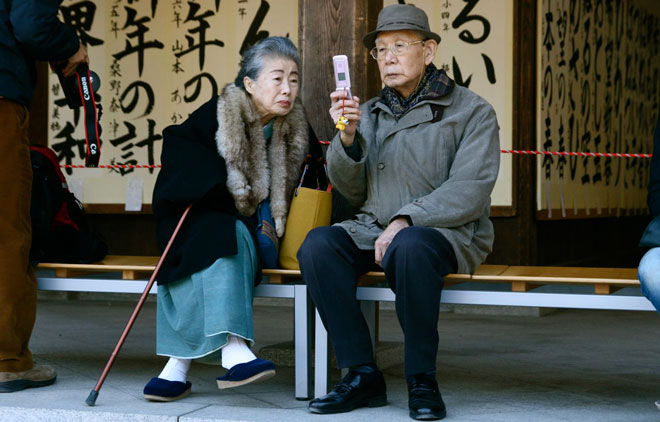
Photo by Tom Spender

If faxing works, and people know how to use it, why change it? Just like the old saying goes, if it ain’t broke, don’t fix it.

Will Japan Ever Give Up the Fax?

It’s pretty clear why the Japanese still use the fax, but less clear whether or not they’ll ever ditch it in favor of more modern tech.

More than anything, the problem isn’t technical — it’s cultural. Faxes will only be phased out in Japan once the culture around them changes. For better or worse though, cultural changes are near-impossible to predict, so it’s kind of a crap shoot to say if or when Japan will give up faxing.

Who knows? Maybe they’ll switch over to telegram.

Read more: Japan and the fax: A love affair, In Japan, fax machines remain important because of language and culture


Header photo by Yortw

  • horatiopositronic

    This article leaves out one of the biggest reasons the fax gained popularity, and retained that popularity. For a lot of Japanese people, it is much easier and quicker to write by hand than to enter text on a computer (and when the fax machine was young, nobody had computers). So when they need to send a quick note, they write it down and fax it.

  • Who

    I had unique day because of that machine…in my city there is only ONE fax who sends international faxes, for my scholarship I need to do that. What a pain.

  • vivianlostinseoul

    Love this!! Best title ever. Shame on using fax machines as it’s not friendly to the environment.
    http://vivianlostinseoul.blogspot.jp/

  • Pepper_the_Sgt

    I always had the impression that typing in a word processor was easier than hand writing Japanese. Maybe not for folks who have romaji and typing skills, but I would expect that to be lowish number by now. I’ve heard a couple of my Japanese friends talking about how they forget how to hand write some kanji because they just type everything most of the time (they could still recognize the kanji). I think this phenomenon had a name, but I’ve forgotten it.

  • Pepper_the_Sgt

    If you dial a certain number on your fax machine, you get a (never ending?) fax of nyan cat.

    http://www.tomscott.com/nyanfax/

    He’s ending his project on August 29th, so if you want this, you only have a few days to find a fax machine and someone with a landline.

  • http://www.tofugu.com/ Hashi

    It’s called “kanji amnesia.”

  • http://www.tofugu.com/ Hashi

    Oh man, if I had a fax machine and unlimited ink, I could have a week straight of Nyan cat.

  • belgand

    What I don’t understand is why so many people have them at home. In the West they were really more of a business sort of thing, not residential. I can’t really imagine why I’d even want one at home. Even compared to scanning and e-mail a document… I’ve never had any reason to do that in my personal life.

  • http://www.facebook.com/ocapehorn Ollie Capehorn

    I called a european airline’s Japanese office a week or two ago, and was asked to fax over the print out of my booking confirmation – which they had emailed to me. Couldn’t believe it!

  • 古戸ヱリカ

    And forgetting the term for it is “kanji amnesia amnesia.”

  • Tora.Silver

    Missed oppurtunity at the end to say “Just stating the fax.”

  • Erick Reilly

    I find it weird that Japan wasn’t quick to embrace the PC. And actually, there ARE butthole spraying toilet seats in America; you just need to know where to look.

  • Pepper_the_Sgt

    That’s difficult to self-diagnose.

  • http://twitter.com/SactoMan81 Raymond Chuang

    A big problem is that even with current JIS-standard keyboards, generating Japanese text on a computer can be a slow and involved process as the user has to manually determine if he or she is using the correct kanji character(s).

  • Sholum

    A lot of businesses still fax in the US as well, but I only know a couple of people who still fax.

  • Sholum

    Not particularly. Even I can see if I typed the right kanji fairly quickly if it’s a word I actually know (as opposed to one I’m looking up). I imagine it’s no worse than doing your own spell checking in any other language.

  • http://mistersanity.blogspot.com Jonadab

    I work at a small-town public library in the Midwest, and we have a public fax service, for people who need to send or receive a fax for some reason but, strangely enough, don’t happen to have a fax machine of their very own at home, go figure. Being the only such service in a city of about ten thousand people, we send about a dozen faxes a day and typically receive two or three (not counting junk faxes).

    I would estimate that about half of all faxes in the US go to government agencies, mostly ones involved with distributing benefits to people who may or may not actually be legally entitled to them (unemployment, disability, worker’s comp, etc.) These agencies require people to fill out lots of paperwork in order to get their benefits. Much of it has to be faxed (or, if you prefer, submitted in person at an office nowhere near your home town).

    The lion’s share of the private-sector faxes are related to the financial industry. The fax machines at banks and mortgage companies are constantly busy. It can take six or eight automatic retries before a fax to one of them will finally go through.

    Turning in time sheets for contract work is another fairly common use.

    Oh, and when people get themselves into legal entanglements of any kind (criminal or civil, either way) they often have to send a number of faxes. I don’t know if these faxes go to the courts or to the lawyers or some of each.

  • http://mistersanity.blogspot.com Jonadab

    > I find it weird that Japan wasn’t quick to embrace the PC.

    One word: Kanji.

    Early adoption of personal computers correlates strongly with use of alphabetic writing systems, especially the Latin alphabet.

    (Of course, early adoption _also_ correlates with the general level of technology and related infrastructure. Nigeria, for instance, was not a particularly early adopter, despite the fact that English is the primary lingua franca there. But that wasn’t the holdup for Japan. Language support was the main issue.)

    It’s easy to forget in this modern decadent era of widespread Unicode support, but decent computer support for Kanji was a relatively late development. It takes a few years after a character set is published for a lot of software to become available that takes advantage of it, and it takes a few more years after that for people to start using that software.

    The ASCII standard was published in its final form in 1963. We _still_ use it for a lot of plain text in the English-speaking world, because it contains all the characters we need. (ASCII, or a minor variant of ASCII with Microsoft’s stupid SmartQuotes added in, was used for most English-language text until rather recently; within the last decade a lot of software has come out that uses UTF-8 by default even when all of the characters are representable in ASCII.) By 1975, virtually all computer software in existence supported ASCII (that which didn’t mostly ran on EBCDIC-based mainframes — you don’t even wanna know), so anyone in the English-speaking world could get a computer and buy any software that was available for that computer and expect their native language to Just Work. Has anyone ever even needed to ask, “Does this software have support for English?” Duh. Of course it supports English. Even if it was written in Germany or Holland or someplace, it supports English. All software supports English.

    The Japanese-speaking world, on the other hand, has still in 2012 not yet quite settled on one particular encoding. It seems inevitable that Unicode will win out in the end, but there are still multiple mutually-incompatible encodings in widespread use at this time.

    Even setting the question of standardization aside, there just plain *wasn’t* a character encoding for Kanji until circa 1978 — a decade and a half after ASCII. That may seem like ancient history, but remember, it takes *years* after a character set is available for software to fully support it. (Nowhere is this more evident than in Unicode adoption rates.) Adding support for a new character set is a royal pain and a major undertaking for programmers, so it doesn’t happen overnight even when there’s good motivation to do it. Furthermore, fonts must be created, and the more characters there are the longer this takes. Syllabic writing systems (like kana) are bad enough for software to
    support, but ideographs (like kanji) are a veritable nightmare. Remember that _scalable_ screen fonts (like TrueType) were not widely adopted in the English-speaking world until the mid nineties. Previously, most screen display used bitmap fonts, meaning that each character had to be drawn separately, mostly by hand, for each size of type the font supported. Imagine a budding font artist drawing separate 6-pt, 8-pt, 10-pt, 12-pt, 14-pt, and 16-pt versions of each and every Kanji character, and you can start to get an idea of why Japanese was harder for computers to support than English. Oh, yeah, and you know how on modern computers you install a font in your computer’s operating system and all the programs can use it? Yeah, that’s also relatively new. In the eighties, I think Unix was the only major OS that had anything like that. Most personal computers ran DOS, and it was normal on that platform for each application program to need its *own* fonts (unless it just used the video card’s text mode, but that only supported 8-bit characters). So every individual piece of software had do all this work if it wanted to support Japanese.

    Thus, in the early eighties when American businesses were starting to buy desktop PCs for their accountants and several other major categories of employees, a lot of the software they were using did not support Japanese — at least, not fully. (Kana-only Japanese support was often available before Kanji, for obvious reasons.)

    Then, just about the time some of the DOS-based application software started to finally get support for Asian languages, along comes Windows with its new kind of fonts (TrueType). They’re obviously better… once they exist for your language.

    Then there’s the whole subject of input methods. An entire book could be written about the history of that.

  • http://mistersanity.blogspot.com Jonadab

    > What I don’t understand is why so many people have them at home.
    > In the
    West they were really more of a business sort of thing, not residential.

    Businesses adopt new technology sooner and keep it around longer than home users. In the West, most home users never got around to adopting fax technology because the internet came along and ate it for breakfast, and just in case that wasn’t quite enough to kill it along came cellphones next. (This is much like what happened to LS-120 SuperDisk: iOmega’s parallel-port drive stored almost as much and the disks were cheaper, plus it could be used with multiple different computers; and then CD burners became affordable, and suddenly nobody needed a floppy drive you couldn’t boot from or use without a special driver that took $50 disks that stored 120MB each. What would we want that for?)

    Businesses (especially in certain industries) still have fax machines because they had _already_ adopted the technology before the internet was generally available (in most areas).

  • belgand

    Yeah, but what’s the purpose of a home fax? As I said, I can’t think of an occasion where I’d ever want to send a document to a friend at home. Especially something I only have in hard copy to begin with.

    Even with current technology I could scan and e-mail it, but I’ve never done this because it’s not something that I’ve ever wanted to do.

    So what is Japan’s use case for faxes at home?

  • http://twitter.com/shollum Shollum

    Very interesting. I knew that official things usually have to be submitted in person or faxed (to ensure authenticity? It’s pretty easy to forge papers these days), but I didn’t think of all the things that would entail.

    Seeing as anything other than a used junker of a fax machine costs an arm and a leg, I can imagine why those who need to send faxes don’t have one.

  • MaaikeH

    My Japanese friends once told me that they mostly used their home fax machine to send other people maps with directions to their house or meeting places. Because it’s really hard to find anything in Japan with an address alone.

  • belgand

    OK, now that is enlightening. Japan’s address system pretty much fills me with terror.

  • Japanalsex

    Problem with pcs for Japanese is because keys are not in English. I know I have lots of sex with Japanese girls and they speak english?

  • Leona james

    Excellent effort to make this blog more wonderful and attractive.

    Franking deals