
Radio Calisthenics: Keeping Fit and Keeping in Line the Japanese Way

Rajio taiso (ラジオ体操), or “radio exercises” is an integral (if slightly dorky) part of Japanese culture. You’ve probably come across it even if you don’t live in Japan – it pops up all the time in anime and movies (I myself first stumbled upon it in Studio Ghibli’s Omoide poro poro (おもいでぽろぽろ) or “Only Yesterday”). Plus, I’m almost certain there was a rooftop rajio taiso scene in Heroes a few years ago… heck, it’s even in Animal Crossing!

If you haven’t heard of rajio taiso, it’s basically a set of simple calisthenics done to piano music, and it’s broadcast almost daily by the NHK. There are currently three official versions: one for men and women of all ages, one to increase physical strength, and one that can be done while seated (for differently-abled persons and the elderly). There are also at least as many parodies, such as the merci taiso in the film Megane (めがね), or “Glasses.”

A Brief History of Rajio Taiso
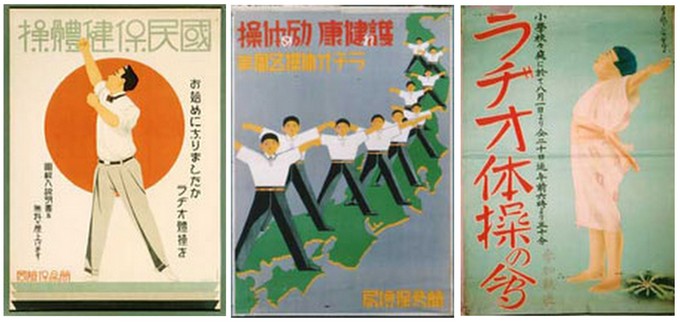
Surprisingly, despite being a Japanese cultural institution, rajio taiso is actually a foreign import.

In the early 1920s, Metlife, Inc. sponsored the broadcast of radio calisthenics by the now-defunct WGI (AM) in Massachusetts. Visiting employees from the postal life insurance division of Japan’s also now-defunct Ministry of Communications and Transportation (逓信省, teishinsyou) thought it was brilliant, and brought the idea home with them.

radio taiso old school

The first rajio taiso was broadcast in Tokyo in 1928, just in time to commemorate the coronation of Emperor Hirohito – and the rest, as they say, is history.

Rajio Taiso Today
Besides a brief period following WWII where it was banned for being too militaristic, rajio taiso is now broadcast several times a day via radio and TV throughout Japan.

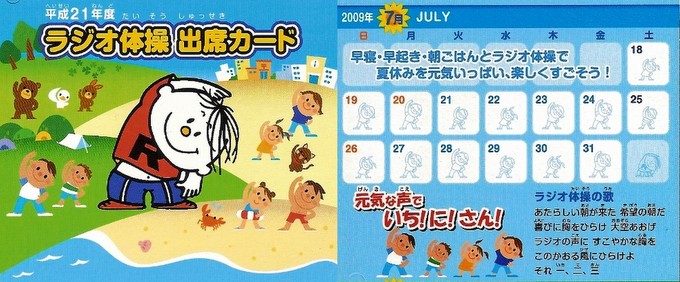
The obvious benefits of rajio taiso, namely increased flexibility, and improved general health and well-being, makes it a common sight at school sports days. It’s also practised by children during the summer holidays – all the cool kids have perfect rajio taiso attendance cards, don’t you know?

radio taiso attendance card 2009

It’s not uncommon to see rajio taiso being practised in the Japanese workplace, as it also fosters morale and instils a sense of group unity. However, there are always two sides (or more) to every story – put another way, rajio taiso can be used to affirm the importance of the group over, and at the expense of, the individual.

The Tale of Tanaka-san

Tetsuro Tanaka was once an engineer for OKI, a telecommunications equipment manufacturer. He was also a very vocal union activist who strongly objected the redundancies of 1350 of his former colleagues, and criticized OKI’s labour policies.

The following year, OKI introduced rajio taiso, to be performed before work in unpaid time. Again, Tanaka-san strongly objected and refused to participate; he felt it was a humiliating and demeaning test of loyalty to OKI. As a result, his pay was cut, and he was given the option (read: ultimatum) to transfer to a distant factory. Once again, he refused – and was summarily sacked. That was in 1981; he has been demanding an apology and a reinstatement every day since. That’s over 30 years ago.

Tanaka-san’s struggle is the subject matter of the documentary “Tanaka-san Will Not Do Callisthenics,” which lets us get some idea of the cost of individualism and non-conformity in Japanese society.

Nowadays Tanaka-san makes a living as a guitar tutor, and I daresay he’s quite good at it. Part of Tanaka-san’s protests include playing guitar and singing outside the OKI company gate daily for half an hour, and on the monthly anniversary of his dismissal, by singing the entire day.

What strikes me the most is just how lonely it can be in Japan, to be the nail that refuses to be hammered down. That, and Tanaka-san’s incredible tenacity.


Love it or hate it, it seems that rajio taiso is here to stay. It’s even practised outside of Japan, most notably in the Brazilian city of São Paulo which has a sizable population of Japanese and Japanese descendants.

So, what are your thoughts on rajio taiso? Share them with us in the comments!

Give Tanaka-san some love: Youtube channel, website


Header images from JP Insurance かんぽ生命

  • http://www.myjapanesegreentea.com/ Ricardo Caicedo

    A Japanese friend told me that in his school, a classmate had natural brown hair, even though he was Japanese too. The school always made him dye his hair black. That’s another example of how Japan prefers uniformity rather than individualism.

  • berryp

    I first saw this in Battle Royale where Kitano Takeshi exercises after the conclusion of the Battle.

  • ジョサイア

    I’ve never heard of this before?..Guess I’m a real バカ外字This is like the opposite of insanity workout! xD

  • missingno15

    awww man, you should have put cowcow’s 「当たり前体操」 for the punchline!

  • http://www.facebook.com/profile.php?id=100001535919021 Heather Stewart

    I have never ever seen or heard about this before! I learned something great today, thanks Fiona!

  • Mandarina

    It’s almost scary…

  • 古戸ヱリカ

    Oh man, 外字 are the worst 字!

  • ジョサイア

    I guess I need to fix my Character.(Yay triple pun!!)
    I’ve been striped of my identity now I’m just a foreign word D:
    That typo is worse than こんいちわ…No, maybe not…

  • http://twitter.com/jamesoneill83 James O’Neill

    Indeed there was a scene in Heroes, towards the end of the pilot episode it was shown during a montage and used to emphasise the banal conformity of the office Hiro’s office drone lifestyle (we’ll just ignore the later revelation that his dad owned the company).

  • Pepper_the_Sgt

    Tanaka-san is awesome! I’d like to watch the movie sometime, but the movie’s web site sells a copy of the DVD, but it’s $35. Maybe I can convince the local indie theater to show it.

  • fee_fi_Fiona

    Ah, wish I’d heard of cowcow before now!

  • fee_fi_Fiona

    Oh good, I was a bit worried that my memory was playing tricks on me ^-^

  • Zeldaskitten

    I love らじおたいそう。 Its like the only exercise I ever do :-P

  • fee_fi_Fiona

    I’ve made the こんいちわ typo before… -_-;

  • fee_fi_Fiona

    I’ve tried it, purely for research purposes… LOL it was a bit to whiplash-y for my liking though :p

  • fee_fi_Fiona

    Isn’t he? If I’d been in his position I think I would have cracked ages ago…

  • ジョサイア

    I bet everyone who uses a romaji keyboard has made that typo…You should see my first few lang-8 entry’s…o/’_'o

  • fee_fi_Fiona

    Wow… I can’t even think of a response, to be honest!

  • Kintaro

    It is really strange to see this actually happen in Japan because everyone does it and have been doing it for so long that they don’t think twice about it, but nobody obviously actually enjoys it any. Of course maybe that’s because the time I really saw it done it was for an office that had a late night of work ahead of them so they needed to get their juices pumping. Nothing better than swinging those arms around!

    Also, let’s not forget this lovely gem of a surprisingly and seemingly accurate example from SNL:http://www.hulu.com/watch/20337

  • averygoodgame10

    Funny, seeing as most schools are against dying hair at all. But it might have been for his own good, Japanese school children don’t have much against bullying.

  • averygoodgame10

    HA! I was going to post a link to a post waaay back in Tofugu history by Erin that was just for that. Hilarious XD

  • fee_fi_Fiona

    “It’s funny… cos it’s racist!”

    Oh my god, I laughed!

  • http://www.myjapanesegreentea.com/ Ricardo Caicedo

    Hopefully things have changed a bit, that was about 15 years ago.

  • Sjonny

    ” one to increase physical strength” I have never heard of this one which version is this?

  • fee_fi_Fiona

    The one creatively named “Radio Taiso Number 2″ ^_-

    The official line is 「体をきたえ筋力を強化することにポイントを置いて」which sort of translates to, “To forge the body and strengthen physical/muscle strength.”

    “Radio Taiso Number 1″ is for men and women of all ages, and “Everyone’s Taiso” can be done while seated.

  • Emi

    This is exactly what I was about to post! (∩_∩)

  • Jonathan Harston

    English schools are required by law to have “a daily assembly of Christian character”. When I was at school I refused to attend. They were flexible enough to let me stay in the computer room instead, doing useful programming or maintenance.

  • vivianlostinseoul

    I love those!! I don’t think they’re effective at all and make you look funny, but I get a kick out of it.

  • fee_fi_Fiona

    This is new to me! So what exactly happens at this daily assembly?

  • Vitor Eiji Justus Sakaguti

    I live in São Paulo and I have never seen people doing this or heard/seen it being brodcast around here, with the notable exception of undoukai day, of course. But then again, I’m probably just hanging out with the wrong crowd, those dirty, lazy gaijin :)

  • hikaru1412

    I was wondering if that picture used in the header has more to it that just those shown?

  • shinderu

    Fiona please take the ‘le’ out of your about section, please
    it makes you sound like some bad redditor
    Cool article, I should start rajio taiso

  • Jonathan Harston

    From what I remember:
    Stand up for the headmaster to enter. Headmaster says: Good morning. Pupils mutter g’ mr’ng. Pupils sit down.
    Headmaster gives any announcements.
    Pupils told to stand up to sing a hymn. Pupils mumble along more-or-less vaguely in tune.
    Pupils sit down. Headmaster says: Now bow your heads, and reads a short prayer.
    Pupils dismissed and wander off to first lesson of the day.

    There’s a good explanation at the Humanist Association: http://www.humanism.org.uk/education/parents/worship-your-rights

  • fee_fi_Fiona

    Yeah absolutely, those are just the first moves. If you’re interested, you can get the full sequence here: http://www.jp-life.japanpost.jp/aboutus/csr/radio/abt_csr_rdo_index.html

  • fee_fi_Fiona

    You know, you could be right!

    I’ve been to Brazil before, but only for a short while, so I think you would know more. I have to rely on what’s available online mostly, which may not always be accurate. I based that statement about rajio taiso being practised in Brazil based on these videos: http://www.youtube.com/watch?v=tDMXsInXhUI&feature=related and http://www.youtube.com/watch?v=FfJw9c-qy54

    Muito obrigado por ler meu artigo! Uns anos atrás quando eu fui ao Brasil, infelizmente nao consegui visitar São Paulo. Mas ouvi falar que tem tanto japones morando la, que tem até Japantown!

  • fee_fi_Fiona

    Ah well if the guys keep me on, I’ll get rid of the whole “Le intern!” altogether!

    (hint, hint, guys ^_-)

  • kuyaChristian

    I had saw these radio exercises while watching Detective Conan just yesterday. I probably saw the said exercise in the past before, but I couldn’t remember and Conan was the first time they actually verbally mentioned the exercises :].
    It loooks soo cool, but I understand that if it’s done everyday it becomes super repetitive and mundane.

  • http://twitter.com/bomblol rick

    I think my first exposure to this was in Norwegian Wood…. although it may have been in Battle Royale as another commentor suggested

  • Lisa

    This brought me back. When I was working in Japan my company played an exercise recording five minutes before lunch ended every day.

  • Masayuki Note

    Jame Dean’s “East of Eden” has a scene that some men exercise with the piano music. When I saw the scene, I thought that it was just like our “radio Calisthenic”. The story is in and around the World War 1.

  • fee_fi_Fiona

    Hm, I’ve never heard of this movie before! I must remember to check it out ^_^

  • xtong

    Indonesia also have the exact same phenomenon; I wonder if Japan’s occupation here has anything to do with it..

  • badhaikuman

    Lived and worked in Japan for four years. Did it twice a day in the office. Felt good, and I felt healthier. Recently, with my boss’s approval, I began inviting coworkers at my job here in the U.S. to do it with me at 3pm every day. About half of my 14 person office joins in. Some say they’re getting more flexible and more energy. Others complain that I’m trying to start a cult. Some Americans dislike any kind of group behavior that doesn’t involve guns, drugs or lottery tickets.