
How Romaji Can Ruin Your Day

When you first start learning Japanese, you most likely start out with romaji. Romaji is using an alphabet you already know to write and read Japanese.

And when you get started out, romaji is great! “Pff, I don’t need to learn kanji,” you might think, “This romaji stuff is easy!”

Slow down there, sparky! Romaji might be easy for a while, but it’s just a matter of time before romaji becomes a huge headache for you.

The Downsides Of Romaji

I hate to burst your bubble sport, but there are a lot of problems with romaji that nobody tells you about when you first start learning Japanese. Romaji definitely has its place in learning the language, but it won’t be too long before romaji starts making your life hard.

The most obvious thing is that romaji doesn’t really help you read any Japanese text, and nobody is going to turn it all into romaji for you (no matter how nicely you ask).

Even if that somehow doesn’t doesn’t deter you, it just gets worse from there. Oh, does it get worse.
You might have heard of a homonym before, words that spelled the same but mean something completely different. There are a ton of these in Japanese that are usually easy to tell apart because they’re written with different characters; but with romaji, you don’t get that same privilege.

For example, when you see the word “hashi” written out in romaji, you can’t tell what it means on its own. Does it mean bridge? Chopsticks? The stunningly handsome writer and editor extraordinaire from Tofugu? With romaji, you have no way of knowing.

And possibly the worst thing of all is – are you ready for this? – there’s more than one type of romaji.

Different Types of Romaji

As if romaji didn’t have enough problems, there are tons of different types of romanization, and there’s not really a standard way. This can be super confusing, because you’ll see Japanese words romanized in different ways.

Just take the the Japanese word 大きい – how do you write it in romaji? Oki? Ookii? Ôkî? Ōkī? All of these are pretty much equally acceptable.

In fact, there are quite a few systems of romanization: Hepburn, Kunreishiki, Nihonshiki, Waapuro, JSL . . . the list goes on. It gets even worse when people start using variants on the major systems.
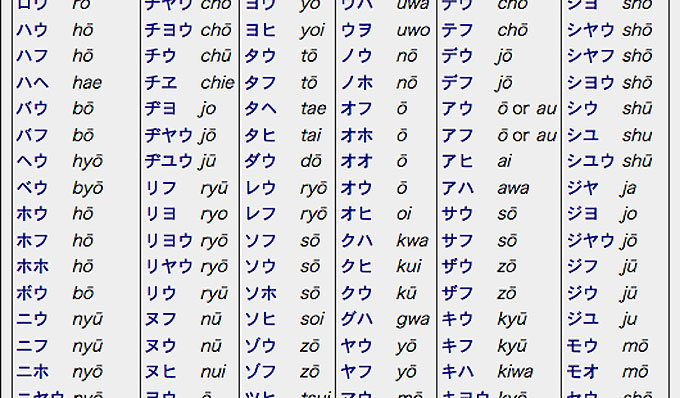
Some romanization systems use little hats (called a circumflex) on top of their vowels (lîkê thîs), but others use the lines (macrons) on top of the letter (līkē thīs). Some systems flat out disagree over what characters sound like. is romanized as “ji” in one system and “zi” in another.

The Japanese government uses on type of romaji (Hepburn), but the major standards organizations (ANSI and ISO) both recommend another type of romaji (Kunreishiki). Textbooks use pretty much whatever they want. It’s all a big mess.

Just Call The Whole Thing Off

In the end, romaji is really just a tool to help you bridge the gap between your native language and Japanese. It’s not perfect, but romaji has its purpose. Sooner or later though, the problems of romaji are going to catch up with you and you’ll have to transition over to entirely Japanese.

Fortunately, it’s easy to shed those training wheels and get on that big kid bike. Learning to read Japanese can be a lot easier than people think. Once you’ve got your basic hiragana and katakana down (which you can learn here), you’ll forget that you ever even needed romaji in the first place.

What can I say? I’m proud of you, kiddo. Just remember to wear your helmet.


Header photo by Bridget Coila

  • Kenneth Hendricks

    Oh man, yes. This is basically what I tell anyone I encounter that is beginning to learn Japanese. Romaji just puts you in the wrong mindset. Might as well get cozy to a stack of Hiragana & Katakana flashcards for a week and move on. 

  • http://zoomingjapan.com/ zoomingjapan

    Oohhh, I remember in my very early days of studying – a veeeeery long time ago, I liked Romaji much better!!! How could I?
    I can see why newbies would prefer Romaji, though.

    I can assure you that – although it might seem easier at first – you’re not getting anywhere with that.
    Yes, it’s a whole lot of work to get all thos Hiragana, Katakana and a few Kanji down, but it will be all worth it – trust me!

  • Ben

    Thank you for that, Hashi. That was certainly very handy to know! :)

  • http://twitter.com/WackoMcGoose Kimura

    The only purpose I can think of for romanji is in learning to type in Japanese, since you’re basically inputting romanji spellings and it converts it to hiragana. It is technically possible to directly type in hiragana, but it’s a highly convoluted keyboard layout to make all the characters fit on a regular English keyboard.

    And unfortunately, in Korean the latter is the only option that exists. There is no phonetic/romanized Korean input option in any IME anywhere.

  • kuyaChristian

    I didn’t like romaji to start with anyway. It’s better for me to be ambiguous and write everything in hiragana instead of writing stuff down in romaji. while still confusing, I like it better like that :]

  • http://pulse.yahoo.com/_ANRGQP3CUNXPMQLTEBUB6RRDPI TheAbsolutelyAwesomeKidofAbsol

    i started off with hiragana and katakana…i never even thought about using romaji D:

  • kuyaChristian

    Korean is very unique, I should say. Since they have more sounds [different, sounds the same to the naked ear, but differences are subtle] it’s impossible to romanize it. But then, it’s better like that for Korean learners because they don’t have the crutch of romanization and they’ll go straight to the characters and its sounds.

    Yeah, what you said earlier is basically the only way romaji can be used. IME is awesome.

  • blueshoe

    F romaji.

  • Laura whisman

    =D  Retaking Nihongo again (after five years) and I’ve been trying to chuck the romanji out of as much as possible.  It’s like word poison to me…I don’t even want to think in terms of it.  I don’t even really like it when the sensei makes us romanji out the words on the chalkboard before translating to english.

  • Followda

    hashi de ramen wo tabeta

    Contexte help, no ? -_- Of course it helps.

  • Dasding23

    Once my professor showed us a pre-Meiji translation of ‘Max und Moritz’ (probably one of the first graphic novels ever). The idea behind this was, that we students would translate it back to german to see how idioms were translated and how much the translation would differ from the original. The only problem was, that at the time the book was translated , there was a small pro-romaji movement in Japan so the whole book was completely written in romaji. In the end even our professor could not make an exact retranslation of the text. I wonder how Japanese ever could read it…

  • 古戸ヱリカ

     Hashi’s going to feed you ramen?

  • http://twitter.com/MalahkAngel Chris

    Fortunately Hangul is extremely easy to learn. With a decent effort you can learn it with in 6 hours. IME layout takes a while longer, but if you know how to make Hangul letters even that gets easy after a short period of time.

  • http://www.tofugu.com/ Hashi

    You’re absolutely right, context helps. I was just saying that the words on their own are indistinguishable from each other.

  • Followda

    I ate ramen with chopsticks …
    omg.

  • http://www.tofugu.com/ Hashi

    Wow, pre-Meiji? That must have been really interesting!

  • Michael

    “Romaji”, not “romanji”, guys.  It’s a romanisation of ローマ字: there’s no N sound in there.

  • Michael

    Of course it helps, but romaji is still the devil; stop arguing in its favour! :P

  • 古戸ヱリカ

     Add “easy to misread spelling of words” to the list of romaji’s crimes. Still better then that time I saw people spelling it “romajin” though, I guess.

  • http://www.facebook.com/profile.php?id=100000493543223 Kayla Johnson

    Don’t forget ん + あ line being confused for な line letters.

  • http://www.facebook.com/people/Shaun-Krislock/553071502 Shaun Krislock

    Much like when I learned to ride a bike (never used training wheels), I never used or learned romaji.  My first text “Japanese For Everyone” was pretty good at avoiding it.  Learning Hiragana and Katakana was so fun at the beginning.  It felt more authentic I guess.  Now 19 years later, romaji hurts my eyes and slows my reading to a snails pace (my maximum speed is a turtle’s pace…).  Boo Romaji!!

  • http://twitter.com/gaiaslastlaugh2 アレンジェー

    I think the larger argument is that no one who speaks Japanese uses ローマ字. :) If you want to immerse yourself on the Internet, Twitter, etc. and make real progress with the language, you have to learn to write it. The good news is, it’s not as painful as it first appears. Start with kana and with simple writing (kids’ books are awesome), and work your way up from there. Or use a textbook like Genki that throws you into kana and kanji right from the outset. 

    Also, beyond any utilitarian arguments, written Japanese is just absolutely beautiful. If you’re sticking with  ローマ字, you’re cheating yourself. Truly. 

  • linniea

    And after a while writing romaji by hand gets harder than writing kanji or kana. :’)

  • Jjjjjjj

    I know for some people I’ve met, they didn’t have much of a choice. Those people are now more advanced with Japanese, but began with teachers or professors (depending on the level of schooling) that could not or would not teach them the basic syllabaries until the end of their first level course. I’ve heard it argued in some places that they won’t teach it early on because they don’t want students to be “intimidated” by the syllabaries and kanji and not want to learn it (but then learning the language would somehow turn them on to wanting to study hiragana and katakana). Those people have mentioned that their reading has suffered as a result.
    That is usually one of the reasons I argue against romaji, and suggest learning the syllabaries right off the bat to new learners I encounter. They’re one of the easiest parts of the Japanese language to learn, take the least amount of time (a week or two at the most would suffice for most people), and it’s easy to retain because textbooks stop using the syllabaries after about the second or third chapter, so you progressively get used to seeing the characters on the page. After a while, you won’t even consider using romaji.

  • Jjjjjjj

    Er, stop using the romaji. I should have known there would be a typo with that block of text I had just written.

  • http://www.tofugu.com/ Hashi

    Only if asked nicely.

  • http://profile.yahoo.com/JJH7TWJZCRTCGTJUBIV2OWI3LI Juan

    ローマ人? そうですね。僕は本当にローマ字がダイキライ!
    仮名と漢字を勉強して頑張りましょう!

  • http://profile.yahoo.com/JJH7TWJZCRTCGTJUBIV2OWI3LI Juan

    So very true!

  • linguarum

    Which is an issue with the Japanese language, not romaji per se. Homophones exist in spoken Japanese, no matter what character set you write with. Sometimes context is the only way to tell what is meant.

  • Shrimp56

    No argument. Romaji is the devil. It messed me up royally my first pass at the language. Genki provides it for a while, then poof, you are on your own, naked without a crutch. Yep learn that hiragana and katakana and get on with it.

  • ジョサイア

    I never really used Romaji, The first thing I learned in Japanese was how to use ひらがな(And say こんにちは…I used to spell it こんにちわ :D).

  • http://profile.yahoo.com/JJH7TWJZCRTCGTJUBIV2OWI3LI Juan

    For: Hashi’s going to feed me Ramen it would be: Hashi-san ha, watashi ni ra-men wo tabesaseru.
    Even then, without kana or kanji is it Mr. Bridge, Mr. Chopstick, Mr. Edge, or Tofugu writer Hashi who’s feeding you Ramen. That’s why Kana and Kanji are CRITICAL!!!
    ハシさんは私にラーメンを食べさせます。

  • http://profile.yahoo.com/JJH7TWJZCRTCGTJUBIV2OWI3LI Juan

    Hangul was invented for Koreans by Koreans, it was not an imported system from another country the way that Kanji was imported from China into Japan. Also it’s an alphabetic system that follows consistency, only 28 letters, only need the shift key to add the other two. Since Korean sounds are so different, it also makes a good romanization system impossible. Best wishes to you all in your Asian language studies.

  • ジョサイア

    Question: Who has ever spelled こんにちは like こんいちは because that were trying to type fast?
    Typing んに is annoying.

  • ジョサイア

    Same here! :D

  • ジョサイア

    Check out the EDIT button…………………………………………………………………………….(∇)

  • AKBrip

     Oh man, I took over a Japanese course for a high school teacher (maternity leave) and she had students in their second year still using romanji. It’s such a crutch and their Japanese was obviously suffering. Her reasoning was the same “I don’t want to scare them off” crap that a lot of other people seem to think.
    I made those kids drop romanji the first day I was there and wouldn’t you know, by the end of the semester (8 weeks) ALL of her students could read and write in kana. Yes, kana can be intimidating to first level students, but you are doing them NO favors when you teach romanji.

  • http://www.facebook.com/Smaugi Dominik Bašelj

     This a major problem in my language, where romanization in my language is based on hepburn, but does not use it fully. There are some unique rules added. Like not writting an apostrophe after the N [ん] sound. So you have words like げんいん[原因] (geN’iN) – reason/cause げにん[下人] (geniN) low ranged person, which are both written as ‘genin’ which has noticable inpact on the meaning.
    The second major problem in our romanisation is not writting the double consonant where nattsu (nut) and natsu (summer) are both written as nacu (or for english speakers more understandable form: instead of nattsu and natsu it’s written as natsu for both words)

  • http://aelstome.tumblr.com/ メシャー・クリストファー

    There is a romanized input method on Mac OS X, although I don’t like it.

  • Saikou

    Another problem with Romaji which is really easily overlooked but incredibly debilitating is that when you read the word, you’ll still be thinking in English.

    When you see the words “tame” “nose” and “min”, what’s the first thing you think compared to when you see  ため のせ みん ? Sure, you could probably force yourself to hiraganise each pronunciation in your mind, but that takes a lot more time and energy away from learning what the actual words mean and how to use them.

    Learning hiragana, on the other hand, tells your brain “woah, this is something completely new” and as a result, you get the pronunciation rules engrained with the symbols a lot more quickly and in time becomes automatic. The idea is it’s a lot easier to learn something new (pronouncing hiragana) than it is to relearn something old (pronouncing the alphabet with all these weird rules for Japanese attached).

  • Gabe Moist

    I’d let Hashi feed me ramen on a hashi using hashi.

  • 古戸ヱリカ

     Guests can’t edit.

  • http://twitter.com/enricobianco Enrico Bianco

    One more purpose of romaji: romaji input is, as far as I can tell, still the dominant Japanese input method, even among Japanese users on Japanese layout keyboards. Kana input (using the kana directly printed on the keys) is, according to the cursory research I’ve done, more like Dvorak: people claim that you can type faster if you get used to it but the benefit isn’t so stellar that people are moving to it in droves.

    Electronic dictionaries are almost always romaji input, too.

  • http://twitter.com/shollum Shollum

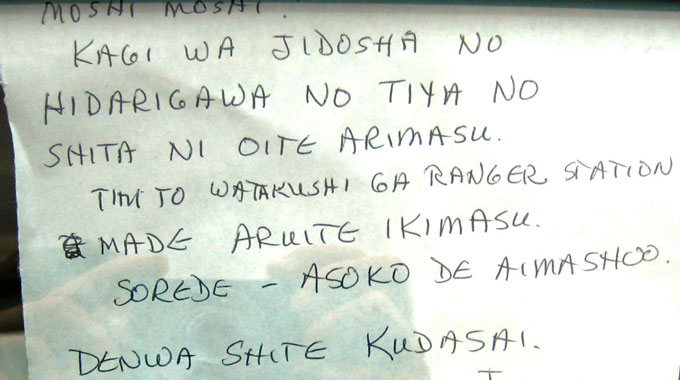
    There’s really no reason to not learn kana. It takes a couple of weeks at the most to get the characters into your head. It’s so much easier to use kana then romaji for Japanese anyway. Just looking at that paper in the picture made my head hurt trying to read it.

    Even kanji is easy once you get into the grove of it. I’m currently attempting 220 new Anki cards a day (using the lazy kanji + mod deck first) and I’m not having any problems (of course, I also have a lot of time to devote to studying). Even if I don’t get all of them done I’m accomplishing something

    Anyway, from what I’ve experienced, reading Japanese in Japanese characters is much easier than romaji, despite how romaji may seem easier.

  • http://ogijima.com/ David @ Ogijima

    “use little hats (called a circumflex)”
    Love it.
    The circumflex accent comes from French and when French kids learn how to write, they call it indeed the “little hat”, “circumflex” being difficult to pronounce for them.

    Apart from that I don’t really have an opinion on Romaji. I use them mostly to write Japanese names in French or English, although I recently decided to make the jump in using them to learn Japanese too. While I know Hiragana and most Katakana, I find it that it really slows me down in learning the language right now. I know the best way to learn it is sans Romaji, but right now I need to be able to speak, not as much write it or read it.

    Back to the “accent” thing, I like the macrons over the circumflex, while it’s harder to type, I guess I like to keep the circumflex within the French language. I really despise the extra “u” though.

  • ジョサイア

    …What?…Should I protest and take a picture of the Constitution or something? O_O?
    …何?…私は抗議し、憲法か何かの写真を撮るべきでしょうか? O_O?
    … Nani? … Watashi wa kogi shi, kenpo ka nanika no shashin o torubekideshou ka? O_O? 

  • ジョサイア

    私は知らなかった! D:

  • Albi90

    Actually some words like 橋, 箸, 端 (hashi) and 雨, 飴 (ame) are distinguished in spoken japanese by pitch accent. The one we usually learn as foreigners is the Tokyo pitch accent since it is considered the standard, but there are others that are very different like the Osaka pitch accent. And this was the 豆知識 of the day!

  • Kurone Shizuhi

    Surprisingly, I’ve gotten used to typing double Ns for ん, so no problem here (^-^)v

  • Peptron

     アイ シンク ザット ア グード アルグメント ト メイク アバウト ウジング ロマージ イン ジャパニズ イス ト サイ ザット イッチズ ライク ウジング カタカナ ト ライト エングリシュ。