
Kendo: Striving For Perfection When Perfection Is Impossible

Last week @ayabuns on Twitter bribed me with this picture to write an article about kendo. I am fairly easy to bribe. Therefore, today you are getting an article about kendo. But not just any article! We’ll talk a little bit about the martial art and sport, then delve into the philosophy as well. Fan of samurai, Zen Buddhism, and more? Kendo may be something that connects with you, then.

What Is Kendo?
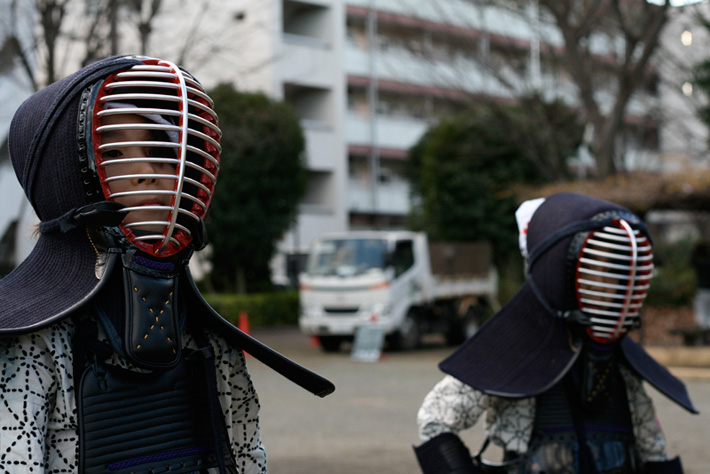
Let’s start by talking about what kendo is. Kendo/剣道 (aka “way of the sword”) is actually a fairly new martial art, in terms of how old martial arts get. It came from what was originally known as kenjutsu, which was developed in the Kamakura period (1185-1333) when samurai started showing up in bigger numbers. Because real swords were too fun to practice with, bogu (armor) and shinai (bamboo swords) were developed by the 1700s (fewer dead people, I guess). From here, we start to see modern kendo emerge.

I don’t want to talk too much about what kendo is since I want to jump into the meat of this article, but watch this documentary for a lot more info. It’s actually pretty interesting, and I think a good introduction for people who have never seen kendo before.

Okay. Got your kendo-learning fix? Let’s find out what makes kendo so interesting to me.

My Experience With Kendo

I’ve only been doing kendo for ~10 years now, and considering all the people in their 70s and 80s who have been doing kendo for their entire lives… my ten years is just a drop in the proverbial bucket. So, you’ll have to take everything I say with an “I’m-a-total-newb” grain of salt here. My thoughts on kendo philosophy ten years from now may be totally different. And it’s just like, my opinion, man.

I also have a little bit of experience in other martial arts as well… another ten years in jujitsu, as well as a few more doing judo, giving me some ability to make some comparisons. Don’t confuse anything I say with “this martial art is better than that martial art,” though. Those conversations are really dumb. I will however talk about why kendo is something that fits really well with me, personally. It’s had a huge effect on how I think about life, the universe, and everything (aka 42).

Simplicity Of Kendo
The thing that draws me to kendo the most is the simplicity of it. When kenjutsu was being developed (where kendo came from) Zen Buddhism was the big influencer in town. Kendo seems to draw a lot of influence from this (as kenjutsu did), and I think this is perhaps one of the reasons I’m drawn to it. I think this is why there are so many aspects of kendo that have to do with the simplicity of it. Here’s how I see it:

Very Few Techniques

In my experience with other martial arts, the main focus always seemed to be on learning more and more techniques. Maybe I was just going to the wrong dojos (perhaps this is American style?). I’m not sure. If you learn 100 techniques with a certain skill level, you get this colored belt. If you learn 200 techniques, you get some other belt. In kendo, you essentially get to do four techniques. That’s it, and the last one (tsuki) isn’t even something someone can try for a number of years.

They are: men (head), kote (wrist), dou (body), and tsuki (throat).
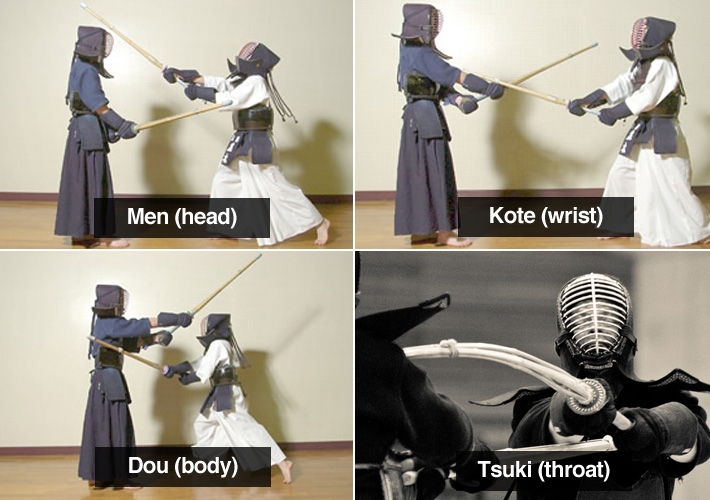
Images from web-japan and Nikopol_TO

There are variations on these techniques, of course. For example, you could hit the other side of the dou… or you hit the kote as they’re hitting your men… things like that. But, when you boil it down, it’s still only four techniques… and this turns out to be plenty. Considering how hard it is to master any one of these, four seems to be enough for me.

Real Life Application: Don’t try to do everything. Just doing a few things well is difficult enough.

No Way To Tell Rank
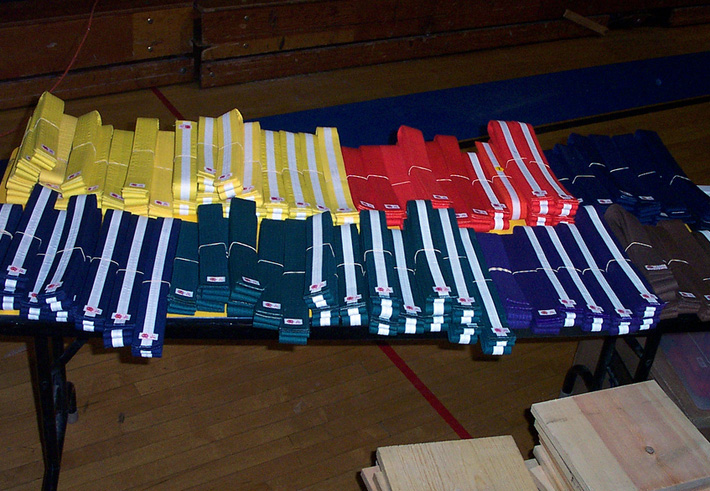
Another thing that I love about kendo is that everyone pretty much looks the same. There is rank, for sure, but if you line a bunch of people up, there’s no way to tell what someone’s rank is without them telling you (or by guessing based on how used their equipment looks, but that doesn’t always mean anything).

I like this because it puts more focus on your actions and behavior. You can tell people apart by how good their kendo is, not by what rank they are.

Real Life Application: Don’t tell the world what your status is. If you’re going to let people know, do it with your actions.

Shaving
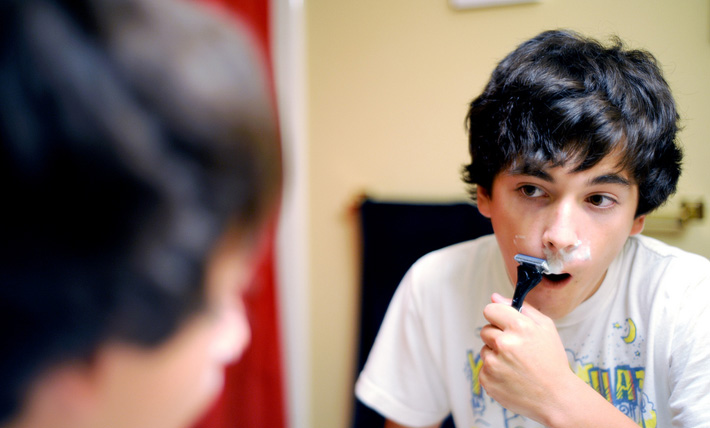
When I think about some other martial arts, all I can think about is how complicated they get. The higher your rank, the more complicated all your techniques get. Purple belt? That means you get to spin twice before kicking the target. It’s all about adding, adding, adding.

It took me a while to realize this, but in kendo I think it’s all about how much you can take away. I want to say that kyuudo and aikido are similar in this regard. When a beginner starts kendo, their swing is very complicated. They use all kinds of different muscles and make a lot of unnecessary movements. As you get better, you actually simplify your swing. You figure out how to turn off certain muscles. You make your movements more consistent. You don’t swing through your targets as much. It’s a lot like golf in terms of the consistency you need. You don’t want to swing your golf club differently every time. You want it to be like clockwork. Same goes for kendo.

The more you simplify in kendo, the better your kendo gets. One way to teach someone how to swing properly is to make them swing so many times that they have almost no strength left. When this happens, their body’s only choice is to do the simplest swing possible. This usually ends up being a correct swing, because the simplest swing is the easiest swing.

Real Life Application: Sometimes complicating things isn’t the way to go. Even though it seems like a flashier, more complicated move would make you better at kendo, it’s really the opposite that makes someone great. Simplicity is harder, sure, but taking the easy path is never the best path, ammirght?

Ridiculous Difficulty

Despite being such a “simple” martial art, simplicity isn’t an easy thing to achieve. In fact, simplicity is one of the hardest things in the world to do right. Because of this, I think, kendo is crazy difficult. Even when you’re “good” at kendo, you still have a long ways to go. Always. People who have been doing kendo for thirty years are still thinking about all the things they need to improve on and change.

Beginner Fo’Life!

The dude in this video is such a boss. And what he says is so true, too. Fifty years learning the basics seems about right, too. It depends on what dojo you end up going to, but a lot of places make you do a lot of work before even letting you touch a shinai (that’s the bamboo sword). Then, you have to swing without a partner for even longer. This is part “can you make it?” and part “get a good basics foundation.”

It’s interesting seeing people who grew up doing kendo in Japan versus doing kendo in America because of the discrepancy in fundamentals practice. The Japanese kenshi (people who do kendo) are almost always way better. Why? It’s because they spent years and years working on basics, whereas us Americans tend to be a bit more impatient. Eventually, this catches up to you and you and you can no longer catch up with everyone else.

Real Life Application: Don’t skimp on your basics. They will carry you through everything in life.

Mind Games
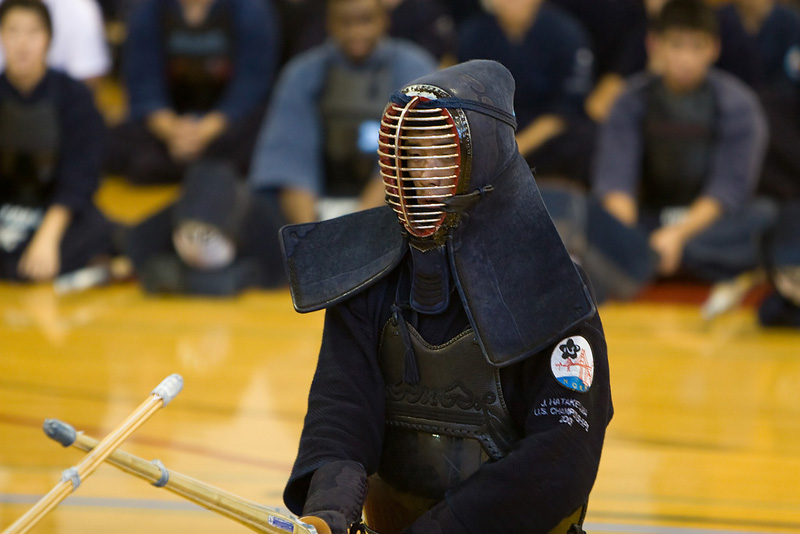
As you practice your basics (your body), you start noticing the mind games that begin developing. If your mind breaks, your body breaks as well and you die. If you can’t predict what your opponent is going to do, you die. If you can’t keep focus, you die. So much of kendo is about your mental abilities. When your body can do the basics of kendo pretty well, this becomes the thing that differentiates people who are “okay” and people who are actually good.

The “mind game” aspect is definitely one of my favorite things about kendo, though. Once you start noticing this, every single drill, match, and exercise begins to rotate around this concept too. Everything is an opportunity to make your mind stronger. In fact, a strong mind means that you’re able to push your body further, which makes your body stronger too. If you don’t have mind, you can never develop body.

Every practice you have to reach the point where you think “I can’t do this anymore.” Once you do, you have to keep doing it. That’s 100% mind, right there. When you push yourself like this, everything gets stronger. If you don’t push yourself, you’ll always stay the same, or at least progress at a much slower rate. Can I last a few more seconds? Can I stay focused longer than my opponent? Can I break my opponent’s will before he/she breaks mine? This is why short Japanese girls beat me up all the time. I have bigger and more manly muscles (maybe), but they’re sharp as tacks. Mind > Body, though both work together quite well.

Real Life Application: You have to train your brain as much as you train your body. Do you have trouble focusing? Push yourself to focus just a little bit more every time. Eventually, you too will have the focus of a short Japanese girl. All it takes is practice. Sure, it’ll be uncomfortable, but that’s the whole point, right?

8th Degree Test

Do you know what the hardest test in Japan is? Is it becoming a lawyer? Pshhhh. That’s EZPZ. No, it’s the kendo 8th dan test, which has a less than 1% pass rate.

The above documentary is one of my favorite videos to watch – it’s about the people who are trying to achieve this rank. But, it’s more than that, too. It’s so inspirational to see all these people trying again and again to pass the test. Why keep taking the test even though they keep failing? Because kendo is life, and failure is a part of that.

Real Life Application: Sometimes you fail. In fact, most times you fail. But, you have to keep trying and trying to achieve those dreams.

Living Kendo

Kendo’s definitely a way of life, I think. That’s why so many people do kendo until they die. Once you go kendo, it’ll never end-oh?

Not About The Money

A lot of martial arts dojos enjoy making lots of moneys (I guess to fill their mats?). In general, practicing kendo is very cheap. There are exceptions, I’m sure, but most of the time you just pay some dues for the facility you’re practicing in (for me, that’s $20/month) and then buy your own equipment (which lasts a long time, usually). The sensei don’t get paid for their time and they teach kendo because they love kendo.

When you go up for promotion, it’s also very cheap. If you’re going for 3rd degree (3dan) or below, which is most people, it’s around $35. If you’re going for a higher rank than that, it’s $50. Compare that to many belt-factory schools which make you pay hundreds if not thousands of dollars for a constant stream of promotions. Purple double stripe rainbow blue power belt? That’ll be $360, please…

I think the whole money issue gives kendo a very different feeling – at least that’s my experience. People are there because they care. Sometimes that means they care about improving their kendo. Other times it’s that they care about improving your kendo. Often times it’s both. Whatever it is, it’s a great environment to practice in because everyone wants to be there.

Real Life Application: You shouldn’t do everything for money. Focus on improving yourself, and surround yourself with like-minded people.

Perfection When Perfection Is Impossible

What is perfection? I have no idea. Will I ever be able to do perfect kendo? Definitely not. So, why do I keep doing kendo? I have no idea. For some reason, though, the thought that my kendo will never be perfect is awesome. It means there’s always something to improve on. Mostly, it means I’ll never be bored. When you finish a video game, you’re done. When you finish eating your dinner, you’re also done. When you finish kendo… you’re probably just dead (or you quit). Probably not the most pleasant sounding thing in the world, but to me that’s a bit comforting. If you don’t make it a part of your life, then what’s the point of doing it, right? That impossible to reach perfection makes that possible.

Real Life Application: If you’re passionate about what you do, you’ll never be able to make it perfect. You can either let that drive you insane, or you can let that drive you for your entire life. This is what people call “purpose.” If you get one, you’ll feel a lot happier.

Is Kendo For You?

Actually, no, probably not. I’ve seen a lot of beginner classes come and go at multiple dojos, and one thing is always consistent… almost everyone quits. If one person sticks it out for more than a year, then you’re lucky. I think a lot of this is because of the reasons stated above. it’s too simple, it’s too mentally draining, and it’s not what people expect. It takes so much focus and time. It just comes down to how much you’re willing to put in. Hey, it’s understandable – time is finite, and you have to use it in the way you think is right.

That being said, you should still try it. If you want to experience Japanese culture, kendo is a great way to do that. If it’s not for you it isn’t for you. I really do hope it is, though – I would love to practice with you sometime :)

So, do you do kendo? If so, what do you think? Do you do another type of martial art? What has that taught you about life?

P.S. Header art custom made by Aya Francisco. Thanks Aya!

  • http://www.tofugu.com koichi

    Rock on! Would love to practice in France / Europe. I hear you French are getting pretty good, actually! D:

  • http://www.facebook.com/jackyl3 Jacky Lee

     Ouch! You guys had no gumshield or headgear? Or you did but your partner still managed to kick your jaw? >.< Agonising when you are eating and speaking.

  • http://twitter.com/ayabuns Aya

    …The post-practice odor isn’t all that lovely when it’s coming from a girl. (whichiswhyibuyoldspicenowssshhh)

    HAHAHAHA NICE TRY BUT YOU ARE CONSIDERED SMELLY AND SWEATY SMURF MAN IN ARMOR. Unless you post pics, hehehohehehe.

  • http://twitter.com/Tany Fred

    At least we try ;) My Sensei is going to Italy for the World championship…as spectator :)

  • Clarissa

    You think kendo is bad? Try horseback riding. Horses also happen to sweat :(

  • Robin

    Great, great article. I, too have always wanted to dip my toes in kendo, but have never had any available near me. I hav, luckily, been able to study iai for the last 8 years, and it has been amazing for me in all the ways you describe. I feel like training and teaching has in turn taught me so much that I can never fully articulate it. My art makes me want to be a better person, not just a better practitioner. On top of all that, it has given me role-models and an incredibly deep connection to my peers that I very rarely see in most organizations of any kind. Finally, as a cancer survivor, it has given me a way to prove to myself that my life is my own, and that despite some physical limitations, I can still kick some ass. Sometimes, anyway…if I’m lucky. :)

  • kuyaChristian

    It was just a light spar and we weren’t even supposed to make full contact; just pulling the kicks but my partner accidentally kicked me pretty hard. So we thought we didn’t need any headgear at all. It was hard [inb4that'swhatshesaid] speaking and eating. Sucked really bad…

  • http://twitter.com/lifeyoutv Jonathan Feltham

     haha I don’t think they will let me join a group of kids doing kendo at school ^^;

  • Talktoblueberry

    i loved this writing, you said it all well, very true. you are a great writer. i hope someday we can cross our swords.

  • Guest

    Whoa, I didn’t know you were a kendoka!

    I’ve been doing kendo (and iaido, too) for ~6 months, and I love it. It’d be truly awesome to practice with you sometime.

  • boxie

    One of the things I was taught by my teacher which will hopefully always stick with me is this.
    “Good economy Budo, bad economy Budo, I’m sick Budo, I’m busy Budo, I’m hungry, worried, tired, someone died, someone was born. It doesn’t matter “you” keep going, “you” keep training.”
    Budo.
    Good luck to you on your path Koichi. All the best.

  • http://www.tofugu.com koichi

    I like that!

  • http://www.tofugu.com koichi

    For sure – let’s do it! I like visiting other dojo a lot – where you at?

  • http://www.tofugu.com koichi

    TO THE DEATH… or to ippon… whatevs :p Looking forward to it, I hope!

  • http://www.tofugu.com koichi

    That’s really awesome! I love hearing stories and experiences like this~ :D

  • http://www.tofugu.com koichi

    Pshhh, only newbs looks like smurfs.

  • http://www.tofugu.com koichi

    awww, yeah :( That’s the hardest part :(

  • http://www.tofugu.com koichi

    You should! I like having more kendoka in the world :P

  • http://www.facebook.com/jathon.thompson Jathon Thompson

    It’s interesting how I find these same things out of doing parkour…Funny how two completely different things can bring about the same inspirations once stripped down to its minimal. 

  • http://twitter.com/ayabuns Aya

    BOO, YOU’RE JUST AVOIDING KENDO PICS. I WANT TO SEE KOICHI IN A SHIAI, DAMMIT. I wonder what your kiai sounds like, LOL.

  • http://www.tofugu.com koichi

    It sounds pretty dumb, I think, but mayyybe I will. I think there’s a shiai coming up in a week from now I’m supposed to go to…

  • http://twitter.com/ayabuns Aya

    Not as dumb as mine sounds, I hope. :P YOU BETTER KICK SOME ASS NEXT WEEK.

  • Red Octob3r

    Ah! I am an American female that has been reading Tofugu for roughly 6 months now. I have been practicing Kendo for 14 months now and really enjoy it. I am happy to see this on here, especially since it was Kendo that inspired me to try so hard to learn Japanese. Kendo will get you to Japan eventuall, and I have been once now. (: Thank you for posting this!

    A common saying is: Anyone can do Kendo, but Kendo is not for everyone.

  • Amari

    Just attended my first kendo practice and I’m buying my first shinai tonight! Two hours of running around barefoot and screaming at the top of my lungs? Yes please. :’)

  • ZA다ルﻣ

    i’ve gone every now and then to a TKD dojang nearby that was run by a Korean. I was a kid then, and I don’t really remember so much of what he said, but I remember the things that he would do.

    He retired, and his head student started up his own school where I sometimes teach, though a student myself.

    I have to say, I really like practicing the basics over and over, but my kwangjang/sensei person–who was a student with me under our Korean teacher–somehow finds it more suitable to teach us twenty forms and a bunch of other throwing moves to earn black belts.

    He teaches tons and tons of forms.

    Me? I like making the kids stand on one leg with the other leg poised to kick, and making them hold it for as long as they can. Of course, I do the same thing standing in front of them, because I know more than anybody that I need the practice.

    I feel that all martial arts were once like how you described kendo. but the world is a big place, there are good teachers and bad teachers, the willing and humble, the greedy and impatient.

    anyways, great inspiring read, koichi. i love posts like these.

  • grotesk_faery

    You’re crazy, nothing smells better than a horse, even a sweaty one. I’ve actually been drawing a lot of parallels to riding with kendo from reading this article, especially with dressage. I’ve never met someone who seriously rides who will tell you that you can know all there is to know about riding and be as good as you possibly can be. There’s always something new to learn, and it comes as much from time as from different horses and trainers. I’ve been riding since before I could walk, but I’m pretty new to dressage still, and I know that I could be 75 and riding Grand Prix and still have loads to learn, which is why I really like the discipline. I love jumping and cross country as well, and I do think there’s a lot of stuff to learn for those, too, but they don’t put the same kind of stress on basics as dressage. Some days it’s kind of frustrating because I really want to be up there riding one tempis and piaffes, but I know that I could never do those well if I don’t spend enough time in the lower levels learning as much as I can about the basics.

  • AndyMeg

    Ninjutsu?

  • AndyMeg

    Thankyou very much for this post. I loved every part of what you wrote. I could feel your love for Kendo, and the philosophy behind it. I am looking for my own path. I have tried some martial artes before (Karate, Taekwondo and Ninjutsu). And the one I liked  (and still is) is Ninjutsu. Maybe is for the dojo which was really different for those places where I took Karate and Taekwondo. Maybe because of my senseis (Shidoshi and Shihan), maybe because of my sempais, maybe because I really felt I was training my hole body and not just a very little part of it… Maybe for everything, but for the first time in my life, when I started Ninjutsu, I really felt in love with a martial art. I would like to also try othe martiar arts, but I want to make Ninjutsu part of my life, part of my self. Last year I went to a Bujinkan dojo and started taking Ninjutsu clases, that was one of the best expirences in my life. For the first time I felt I was training not only my body but also my mind, my spirit. They didn`t rush me, they let me take my time to learn, to practice. There are ranks, but the ranks are not marked with a belt. Just two belts, green and red, man and  women, that was the only distintion I could notice. Well, there are also really small stars in the uniform that show the rank, but the stars almost dissapear within the uniform. One of the thinks I liked the most was that there were no official competitions for ninjutsu, no official Ninjutsu championship, and that was something I really liked about Ninjutsu, because many people see the martial part of martial arts and forget the art part. Because many people just want to win championships and combats, and I think the only combat worth winning is the one againts your own self. So I felt in love with Ninjutsu, and I want it to be part of my life, of my every day.

  • Kendogeek

    I started Kendo a year ago….I got some frustrations, however I am still going and is hoping to persevere more in the Way. It always excite me every wednesday as it my most convenient time for practice, and I always set goals, though I noticed it is still the same goal since my sensei told me to set one or two every practice.

    The main reason I join Kendo is to learn focus. Thanks for the post. I am inspired more and it is hilarious. By the way, I agree…Kendo is not for everybody. Our dojo does not recruit, and the senior members are choosy of joiners because they dont want to waste their time practicing somebody who will quit after a few sessions.

  • MystM

    I started Kendo when I was 13 and did it for just about a year. Took my first exam and got to 4th Kyu. I liked it.

    Then I got my armor. I felt really nervous and constantly kept thinking that I didn’t deserve to wear the armor and believed that I didn’t know what I was doing. Then I sparred with someone and the sensation of getting hit in the head really shook me. I showed up the next practice without my armor and awkwardly didn’t continue a conversation when one of the fellow students asked me where my armor was in a lighthearted way.

    Then I quit. Felt guilty, yet felt release at the same time.

    I’m now 21 and contemplating starting it again since I’ve developed more patience, started teaching myself the Japanese language just about a week ago, and (I’d like to think) developed more strength of character when it comes to sensitivities such as physical contact. I’m really not sure though.

  • http://pulse.yahoo.com/_TM2HGUBSDGRGZXDJ2OTVQUASPY MikeW

    Its a nice article and many valid points. Thank you for taking time to give your viewpoint on kendo. I have been doing kendo for a little while (15 years) and still feel like a beginner. I hope to continue my kendo through out life.

  • Jayson

    Great article!

  • Katie

    Hi, I have been a martial artist for the past 11 years and have always wanted to study Kendo. One of the styles I study is a Japanese style that is not well-known (Tiger System) but that focuses on perfecting yourself, not just in the dojo but in everything that you do. I love the martial arts and could not ever imagine life without training.

    Do you have any advice on how to find a great dojo, other than a google search? I have been to ‘sports’ dojo before that do not really teach or live martial arts but are only businesses, and I hate those kind of dojo because they are fake and do not teach true martial arts. I thought that maybe there is some national register for Kendo dojo that I could look in?

  • manuel

    well, i really like what you worte i have been practicing kendo for a little bit more than three years, and i just love it, We have been having the same thoughts more or less, and i think that almost every kenshi that also loves kendo feels the same,

    I also like to add that competition in kendo is very different, because the goal isn´t to beat the opponent, but to beat yourself. In our western culture, he have been said, “beat the other to show you are better” for me this is very stupid, it should be like in kendo “beat yourself in order to improve” and “show respect to your parttner(opponent) for helping you to improve” “help him to get better, because if he becomes better he will force to improve”

    In kendo both kenshi should be fighting at 100 percent always aiming to win , if you win or loose “show always respect and humility” Learn from your losses and gain confidence from your victories, and always alwasy aim to be perfect even when it is impossible.

    That is my perspective of the competition in kendo

  • Sain Kumdo

    I enjoy your philosophy on Kendo. I hope to have an opportunity to test your skill one day. My only piece of advice is to search for “Kozure O Kame” (Lone Wolf and Cub). The compilation as you are probably aware is called Shogun Assassin. The movie is a compilation of several episodes of a 1970′s Samurai Series entitled “Lone Wolf and Cub”. The use of many of these scenes will definitely improve the like-ability and sensationalism of your site.

  • denglen

    just needed to mention, grading for sandan,yodan, etc is a lot more than 50 dollars.
    In Canada its hundreds of dollars and can go as much as 8 or 9 hundred dollars IF
    you pass of coarse, fail…, you get your money back.

  • diana perne

    hi, i would like to say how wonderful this article was. i have been learning kendo for about 6months now, so you can say i am a total baby. for now my biggest problems are kirikaishi and stamina. hopefully it picks up.if you have any tips, i would love them, if not, thank you anyway.:)

  • Skywalker

    kendo is awesome and i have to agree that its very straining on the mind but thats what fun about it

    I have been doing kendo for 18 years since 12 years old

  • canyouteachmehowtokendo

    @Sain Kumdo.

    I’ve been looking for a school to study kumdo. I did quite a bunch of google searching and based on the name of a school my friend used to go to (14 years ago :[), I found some. But they’re all in New Jersey… DAMN YOU NEW JERSEY!!~! Anyway, out of morbid curiosity, I called this school in the dirty jerz, and they referred me to a place called sain kumdo…. I can’t find anything about it and was wondering if it’s an actual school? And if so where is it?!

  • canyouteachmehowtokendo

    Yea, I was kind of surprised when he listed those prices. The costs associated with kendo/kumdo around my area (NYC) are fairly expensive. Most places, even clubs that practice in churches and such, cost around $100/month. Thats not even taking into consideration the cost of gear :[

  • canyouteachmehowtokendo

    There are way too many greedy teachers.

    And our world in general is impatient.

    So sad to see traditional martial arts dying.

  • canyouteachmehowtokendo

    I was going to edit this by saying our society (america), but then I thought about it again… and that plague has probably spread around the world now.

    Can someone please teach me how to perform the dimak?!
    I saw it in a movie once, starring jean claude van damme. And even though I know its only a movie, he learned the dimak in like 45 minutes… I timed it.

    jk.

  • Mihai Dutescu

    Well said. Great article. May be we’ll practice kendo together when i’ll visit Japan. :)) Greetings!
    Mihai

  • sailsharp

    Excellent post. One of the best introductions to kendo that I’ve ever seen.