
The Right And Wrong Way To Write Your Name In Japanese

If you’re learning Japanese, one of the first things you do is learn what your name is in Japanese. It’s great because it personalizes the language and gives you an identity in Japanese.

But sometimes there’s a little confusion about how to write your name in Japanese. Let’s look at the right and wrong way to write your name in Japanese.

Right: Katakana (カタカナ)

If you don’t know a lot about Japanese, katakana is one of the Japanese alphabets, and is used for writing foreign names in Japanese.

Foreign names are typically spelled out phonetically with katakana, so Chris becomes kurisu (クリス), Sarah becomes sēra (セーラ), and Michael becomes maikeru (マイケル). It’s usually very easy and straightforward.
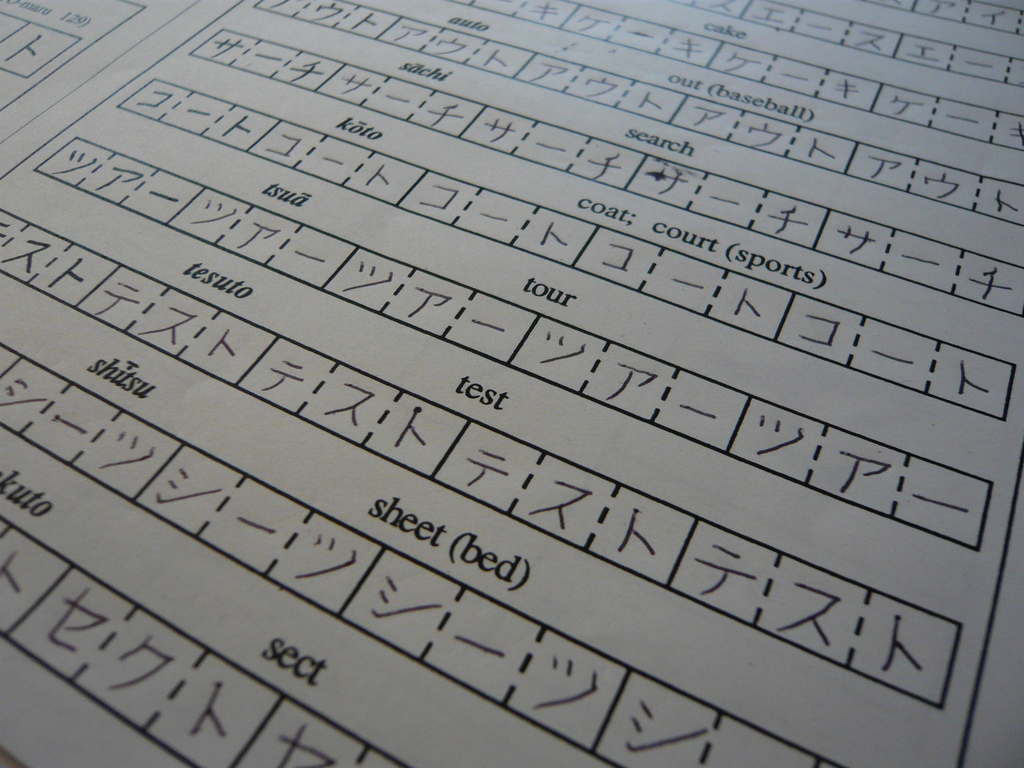
Katakana

Image sources 1, 2, 3, 4.

Writing your name in katakana is awesome! The reading is obvious and people automatically know that it’s supposed to be a foreign name. Plus, you’re probably not the first person with your name to transliterate it into Japanese, so chances are there’s a standard way of writing your name in katakana that people are familiar with.

You can even pretty easily look up these standardized names on sites like this.

But for some people, writing their names in katakana isn’t enough. They want to go further and write their names in kanji but, for a number of reasons, this is a bad idea.

Wrong: Kanji (漢字)

Kanji are Chinese characters that are frequently used in Japanese. Each character has its own, sometimes complex meaning.

After learning how to write their name in katakana, some people want to write their names in kanji. I know that we at Tofugu talk a lot about how useful and great kanji is, but when it comes to writing your name, avoid kanji like the plague.
KanjiYou might think that writing your name in kanji is super cool and extra-Japanesey, but most of the time you’re really just making things harder for yourself and more importantly, other people.

Kanji By Sound

One way people recommend writing your name in kanji is by finding kanji with the same sounds as your name in katakana, but this is a bad idea for a couple of reasons.

If you’re picking kanji based on sound alone, then the meanings of these kanji will probably be really weird and completely unrelated to your name.

For example, if Chris decides to write his name like 躯里子, it will sound like kurisu, but the kanji mean “corpse foster child” which, in case you didn’t notice, is complete gibberish (or just really morbid).

The other problem is that pretty much every kanji has multiple readings, so somebody might look at your name and either have no idea how to pronounce it, or they’ll pronounce it differently than you intended.

In other words, writing your name by constructing kanji by sound will mostly just baffle other people and really not do you any good. And the other way of writing your name in kanji ain’t a whole lot better.

Kanji By Meaning

Another way people try to flip foreign names into kanji is by meaning. Every name, no matter what the language, has some sort of etymology, or story behind it. Some people think that by recreating that meaning or story with kanji, they can distill the essence of their names and transfer it over into Japanese.

This doesn’t work well either. If you’re constructing your kanji name based on meaning, then the reading probably won’t make any damn sense. Sure, you might have conveyed that Chris means “Christian martyr and patron saint of travelers,” but the Japanese probably won’t read all that as an actual name.

But Other People Have Kanji Names!

Some foreigners can have kanji names, but those are special cases. Since the Chinese and Korean both use kanji in their languages in some way or another, some Chinese and Korean names are able to use kanji.

And it is true that foreigners who become Japanese citizens typically have kanji names, but that’s kind of unrelated. They’re not using kanji for their foreign, given names; but rather, they’re adopting a wholly Japanese name and just using the kanji for that.

Be Proud Of Your Name

Writing your name in kanji is trying to make your name into something it isn’t. Instead of spending time trying to find the perfect kanji to create a name that nobody will understand, instead spend some time looking into your own name.

What’s its etymology? Why did your parents pick that particular name? The answers to these questions are a lot more rewarding than writing your name in kanji could ever be.

[Header image sources: 1, 2.]

  • http://bridgetbeaver.blogspot.com Bridget

    This is an excellent post and something I have to explain to my students every year… I give them their Japanese names at the beginning of the semester and they are always like… I WANNA KANJI NAAAME WAAHH.

    I do have a Kanji name, but I’d never ever use it for documents or… introduce myself with it. I only use it for a stamp that I use to “sign” my sumi-e paintings with. My sumi-e sensei recommended that I create a 4-character hanko, and we selected the characters together:

    舞 bu  – dance
    莉 ri – jasmine flower (but only typically used for names)
    実 jitsu – truth/reality (was the closest sound to ジッ)
    都 to – (as in Kyo”to” 京都の「都」, where I studied sumi-e)

    Otherwise, just ブリジット is good with me!! Most people know it, too because of 「ブリジット・ジョーンズの日記」

  • HorrorChan

    Nope. xD At least I don’t think I am. Hard telling though since his last name has one n. Two brother from Germany came over, split after a feud, one added another n to the last name. 

    Oh god… I must not tell people my last name in Chicago. >.>;

  • HorrorChan

    That’s what I though about trying. Thanks. :D

  • HorrorChan

    People though my last name was a joke when the Simpsons became popular. xD I think this will be my theme song for eternity. 

  • Gigatron

     I respectfully disagree. Japanese “name culture” is really not so wildly different as you’re painting it. Lots of people in many countries share names with saints or murderers and it’s not a faux pas with them. Why would it be so with the Japanese? Are people named Mary/Maria ostracised for having the Virgin Mary’s name in the West? I HIGHLY doubt that the meaning of the kanji holds any real value in modern society any more. Just as Westerners with the name McDonnell are not asked if they are really the son of Donnell, Ethans are not assumed to be “strong and steadfast”, and Smiths are not asked if they are, in fact, smiths.

    Plus that contradicts actual Japanese law that once forced anyone taking Japanese citizenship to adopt a Japanese name. This law was changed only fairly recently, which tells me that for the longest time, they WANTED/EXPECTED you to have a Japanese name if you were going to join their society. From what I understand, they changed it to benefit the gaijin that wanted the option to keep their birth names.

    Quite the contrary, it seems incredibly more humble to me to want to cast off your original name to adopt one that ties you closer to your adopted home. To me it shows your dedication to being a part of Japanese society. Granted, this is my opinion but I’d be surprised if at least some Japanese won’t agree.

    While I agree that having a name that nobody can read (although even native Japanese sometimes have to explain how to read their names) is probably a poor idea, I see nothing wrong with adopting a normal-sounding Japanese name (for those intending to become citizens or stay long-term).

    Personally I feel that a katakana name singles me out as a foreign outsider and not part of the “group” that I intend to join. Though I agree a tourist staying a fortnight in Japan need not bother with a kanji name, I feel that a potential migrant (like myself) should not be discouraged from trying to create for him/herself an identity that links them to their home of choice.

    Apologies for TL;DR

  • ですこ

     That, or he was a robot.

  • http://twitter.com/shollum Shollum

    Well, I’d never try to get my name into a kanji meaning anyway. I don’t even want to guess how I’d get “bearer of the anointed one” into kanji.

    I’ll just stick with クリストファー 

  • Mescale

    One thing to consider is not just law but how people/companies work, it may be legal to use kana, but some companies may like to work with kanji names, or their old software only accepts kanji, they don’t have room for a kana transliteration on the form as it only accepts kanji. Staff are not trained to deal with kana. etc.

    Generally when you bring something unexpected to anyone, they are unsure what to do, so it can be a hassle for you and for the people you interact with if they have to change. 

    So having a kanji name could be useful to make it easier to deal with such situations.

    I’m thinking here of things like apartment leases, bank accounts, loans etc. So its stuff you would only experience when you’re firmly ensconced into Japan.

  • elisabel

    I actually had a student whose name on the official list appeared as 月 but she wrote “Luna” on her name card for my class. While I can’t be 100% sure that the real reading for her name was るな (I didn’t doubt it so I didn’t ask), I have since had other students named るな, but written with two kanji. It seems to be a popular name.

    I always tell students who have names that sound like things in Spanish what their names mean in Spanish. E.g. Reina (queen) and Risa (laughter). Mmm, except the time I had a girl named Rana (frog).  Ahaha…

  • elisabel

    The last heading, “Be proud of your name,” is interesting. Since I am proud of my name, I think that writing it in anything other than the letters of the Spanish alphabet automatically bastardizes it. Whether I see エリ or 絵理, I don’t think “that’s my name.” I think, “that’s what I write to make life easy for the people in whose country I live.” It’s the same with my two last names relative to Americans; I have to put a hyphen between them so people don’t think that my middle name is “Vega,” a problem I wouldn’t have in the country of my birth. When I became a naturalized American citizen I made the hyphen official across all my documents. I don’t like it, it kinda bothers me, but, well, when in Rome and all, ahaha…

  • Apryl Peredo

     Most Western last names can be handled in 3-5 katakana. Your registered name, the one you use to register with your city ward, already has to match your hanko. (And you have to have a hanko to open a Japanese bank account, etc. so most every one of us foriegners has one.) The new registration system has some perks (like a 5 year term, rather than 3) but the name matching the hanko has already been expected.

  • AKITO989

    My cert name is Sim Xi En and my chinese name is 沈希恩… 

    So… what do I call myself? 83 Is it okay if I call myself キオン? As for the surname… シムキオン?
    …My ‘En’ sounds like ‘un’ but not unko’s un… OTL So.. Yeah, it’s kinda troublesome. Japanese ‘en’ is the wrong way to pronounce my name too… D: 

    And yush, well aware of my surname’s meaning. Another trouble. D:

  • http://www.facebook.com/profile.php?id=1035678298 KianHong Khoo

    Thanks for your reply. 

    Interesting … 
    健丰 is written in simplified chinese. In traditional chinese, it should be written as 健豐 which the equivalent in Kanji is 
    健豊. And  it is pronounced at Ken Yutaka in Japanese. Am I using the right way to find my Kanji equivalent of my chinese name? I prefer to use kanji rather katakata to mimic the pronunciation of my name. 

  • http://mistersanity.blogspot.com Jonadab

    Depending on linguistic background, nine kana may not go very far.  Eastern European names for example can easily consume half a dozen kana *per syllable*.  This happens because combinations like shcht (or maybe it was tshch; something like that) are a single letter in the original language, and that letter frequently occurs in consonant clusters (blends).  So you get names that are only half a dozen letters long in the original, but in Latin script they come out looking like Kshchritshchtnya or so, which is bad enough; when you bring it over into a cluster-free syllabary like kana, not only do you have multiple consonants per consonant but then also you end up inserting about twenty extra vowels.  If you have this kind of name and need to spell your name in kana, there’s really only one way to avoid using a LOT of characters to spell it:  you can discard most or all of your original name and adopt a new name that sounds rather more like Japanese.  I suggest “Sakura” if you’re female or “Yoshi” if you’re male.

    Polish names can be interesting to transliterate as well.  I know a guy whose surname is “Olszewski”, which is pronounced (approximately) “Oh chef ski.”  (Polish uses z in digraphs in much the same way that English uses h, and w is v sort of like in Latin only backwards, among other things.  F is of course what happens to v when you devoice it for any reason.  Also, he’s a multi-generational American — his given name is Bud, no kidding — so it’s possible that this pronunciation is a few generations of drift removed from what it would have been authentically in Poland; if I had to guess I’d say that’s probably what happened to the L.)  Polish names don’t end up with as many kana as a Slavic name, but you can sure end up with kana and romaji that don’t match up according to Hepburn, which can be all kinds of fun to explain to people who don’t know anything about European languages other than English.

  • Eray Sengul

    I’m turkish and my name may not be a japanese name but it is read only one way because it has hiragana attached to it and the meaning is “great/remarkable”. My name is Eray エライ 偉い so consider me to be a very lucky exception! :D (P.S. I ROFL’ed at the corpse foster child ^^)

  • Eray Sengul

    Step 3: PROFIT :D

  • aderow

    Corpse foster child. Sounds like the title of a movie made by Tim Burton.
    I never really been that interested in trying to write my name in Kanji once. I’m pretty sure someone offered to do it before but when I told them my name, they weren’t too sure how to do it lol

  • Melissa

    Since my last name is impossible for people outside of Europe to pronounce, I’d rather just change it.

  • http://www.japaneseruleof7.com/ Ken Seeroi

    Solution:  go back to your home country, change your name to a Japanese name, and come back to Japan.

    But really, have you thought about why Japanese is so off-limits to foreigners?  When Japanese people come to the U.S., they use the English alphabet. Somehow using the Japanese writing system is only for people who look “Japanese.”  I don’t know . . .

  • http://www.tofugu.com/ Hashi

    I’m not sure that’s a really fair comparison, because there’s no English equivalent to katakana.

  • http://www.japaneseruleof7.com/ Ken Seeroi

    Now that you mention it, I’m trying to picture the U.S. with a separate writing system used only for immigrants.  Probably be a hit in Arizona.

  • http://www.facebook.com/AbigailCamarillo Cam Abi

    I’d always wanted to take the meaning of my name and find the kanji characters to go along with it. Although I did have an older Japanese lady write it out for me in kanji having no knowledge what the kanji actually means. Its probably something stupid and she laughed as she wrote it. hahaha

  • Ariana

    Time to go to work, work all night, search for underpants yay, we won’t stop till we have underpants yum tum yummy tum yay!

  • http://twitter.com/legendofleo レオ王子

    Very interesting comment. I actually met a Japanese girl named Luna a while ago and was suprised that it was a normal Japanese name.

    By the way, my name is Leo (which seems to be a common Japanese name for pets). Typically I use the katakana レオ but have often been asked what my name is in kanji, to which I reply 礼王 ;P

  • http://twitter.com/amyjeanmachine Amy-jean あいみ

    See, my last name is Mac Donald, which is unfortunately associated with that hamburger place (even though it is spelled differently!) so I tend to go with マクダ for my family name since it’s an actual Japanese family name except… in katakana?
    I have two first names which is sort of awkward in Japanese, and I don’t think エミジェーン is very pretty in Japanese so I took a Japanese first name instead: あいみ. I really hate writing it in katakana. I can let go of kanji if you’ll just let me write あいみ in hiragana, Hashi!
    I have Chinese family who call me 愛美 (ai mei) so I figured it would be okay to just use it in Japanese too since it’s practically the same reading. I think it might be a little too cheesy, though, so I was hoping for 愛海 but I guess that dream will never come true for this gaijin.
    Anyway tl;dr is hiragana a no-no too? Can I be マクダあいみ?

  • http://www.tofugu.com/ Hashi

    The hiragana might be confusing because it’s not spelled the same way as the standard, katakana way (あいみ vs. エイミー), and because it’s hiragana. I’d stick with katakana.

  • http://www.facebook.com/JadeMatrix.art Joseph Durel

    Very interesting topic.  I think it’s fine to have a kanji version of your name, but pronunciation/meaning is definitely an issue.  Personally, I use 厳子神事求, which I chose based on meaning.  I never use it alone when introducing myself, however.  Until someone’s seen it enough to recognize it as my name, I always write/type デュレールジョセフ with it.

  • raygungirl

    If you’re just talking about family names, I apologize for being off-topic…

    I’ve heard it’s kind of trendy sometimes for Japanese given names to be written in カタカナ, even when the parents and child are Japanese. My first Japanese teacher was from Osaka and her given name was written that way, and of course there’s Japanese-American Utada Hikaru, who spells it: 宇多田ヒカル. (Though Utada might be a different case seeing as how she’s got dual-citizenship and speaks/sings Japanese with an American accent.)

  • http://kiwinz.myopenid.com/ kiwinz

    I understood that shortly after WWII, the number of officially recognised Kanji was reduced. Some of the dropped characters included Kanji used in names. As a protest some parents registered their children’s names in Katakana in preference to using “approved” Kanji. My wife is Japanese-born and her name is サヤコ. Even other (younger) Japanese are surprised by the way her name is written.

  • http://goblinjapanese.wordpress.com/ Ruby

    Btw, guys, can I ask for some advice regarding this?

    I have a really easy to katakanize name but… Mainly, my first name is Ioana (pronounced I-wa-na). Since I can write it both ways, which would be best? The way my name is actually spelled (イオアナ, accurate but probably confusing)or the way it’s pronounced (イワナ…because my name has not been misspelled by enough people over the years)? 

  • http://www.japaneseruleof7.com/ Ken Seeroi

     Well said.  I agree.

  • http://www.facebook.com/naomip224 Naomi Peck

    I have an interesting case whereby my English name (Hebrew-derived) is a Japanese name. I generally write it in katakana anyway, but sometimes I just can’t resist the kanji….. ^^

  • あけみ / Dawn

    So I understand the pitfall of attempting to create a kanji name and ending up with some non-nonsensical jibberish.  (Ask anyone who has a kanji “KITCHEN” tattooed on their bicep, right?)

    My problem is that my first name is mostly a vowel sound that doesn’t exist in Japanese, and I’m just not wild about being called “doon” / ドーン.   So many of foreign exchange students (especially S. Korean, in my experience) coming into the US seem to pick us “English names”, I don’t see why it would be that strange to use a native name if I did end up living in Japan one day.    I suppose I could use my middle name instead, but if I’m using a different name anyway, why not use something that would be easy for the people around me to pronounce and recognize?    

    (If it’s simply a matter of getting lots of questions on it, I’d personally rather explain I took the name あけみ (Akemi) rather than try and coach people who don’t have an “aw” vowel sound how to pronounce Dawn.  Maybe that’s just me?)

  • Lily

    ikr my name is Lily so i know were your coming from it actually sucks having a name that sonds kinda like a baby that cant say there rs yet my name in japanese is リリー(ririi) and it dousent sond anything like my name ***sigh***

  • http://twitter.com/Livvyxo &xo;

    My name is Livvy.

    fml.

  • http://twitter.com/HiraharaPichi_ ピチ

    I know a girl whose name is Rose (ローズ) and she wrote her name 薔薇
    as well as a girl whose name is Lily who wrote her name 百合
    I like play like that :D

    Personally, I’m fond of the way English names sound in Japanese, or Japanese surnames with English given names (u_u)

    My actual name is 平原琳子, but I usually go around introducing myself as either 平原アリシア because it sounds cooler~ xD;;

    I think, while kanji may look cool to foreigners, having your own native-country’s type name probably seems cooler.

    (Another lesson!

    ① Four kanji names→ 亜莉死安 are not pretty with or without pretty kanji.
    ② Using 死 for し cos ヨロ)

  • Ericakanters

    A Japanese man wrote down the name of a friend of mine, but I can’t find it on the internet. Could this be because this person wrote it in Kanji? Maybe you can take a look at this picture and maybe you can tell me if this is the name ‘Peter’?

  • Ericakanters

     Can anyone help me!?

  • Laura whisman

    Nuuuu!!!  *crushed*  (╯°□°)╯︵ ┻━┻

  • Kate

    My common name “Kate” is pronounced “Keito” with Japanese syllables, and just so happens to actually be a fairly standard Japanese word, 毛糸, which is wool. I’d introduce myself in Japanese as “Keito” and would always be met with 2 responses, in this order:
    1. Don’t you mean “Keiko”? (a common Japanese girl’s name). No, I’m not remotely Japanese. English name for me.2. That’s a very strange word for a name.The #2 puzzled me for ages until I bothered to look it up and found that, yep, my name is a normal Japanese word. No wonder it seemed like such a weird name. “Hi, my name is wool. Nice to meet you.”I don’t use the kanji 毛糸 when writing my name, of course, but still kind of identify with it when I see it on the cover of knitting magazines.

  • Drewdeth

    My name is Drew, so would my name be “deru” (デル)?

  • Suki

    Well, this kind of reminds me of how I had a friend in high school from South Korea, and she picked the American name: “Katie” and after my friends and I got to know her, we gave her a nickname… unfortunately we were all into japanese stuff-SO she ended up getting the nickname: “Temari”, and everyone in the school ended up forgetting that her name was Katie, and even the teachers started calling her Temari! Then she stopped responding to “Katie”. LOL! It was really funny because then people insisted on calling her Temari, just cause she looked really Asian. (>__<)!

  • Daichi

    How would you read Cho Lin Shen in Japanese? Is the pronunciation the same? Because Japanese names in Chinese sound different.

  • http://www.facebook.com/profile.php?id=1434168513 Juan Fernando Castellón

    This is true! I always get asked about Takashiro, Keisuke. My Japanese name.

  • http://www.facebook.com/profile.php?id=1434168513 Juan Fernando Castellón

    There’s no standardized Romaji, Hepburn is close to being the de facto, but that would also create differences in the Kana renditions of foreign names.

  • 歌真理

    I think everyone here is forgetting about a VERY important feature of Japanese: FURIGANA! You know, the Kana that sits beside Kanji to TELL YOU HOW TO PRONOUNCE IT?! The Japanese use them all the time in text books, manga, movie subtitles, and even business cards!

    The Japanese use Furigana because, yes, Kanji have multiple readings: On-yomi (based off of the Chinese pronunciations); Kun-yomi (the originally Japanese pronunciations used in everyday words); and sometimes they have Nanori-yomi (pronunciations ONLY USED IN NAMES!). Kanji can have multiples of each of these — in fact, I once saw somewhere that there is a kanji with about 4 On-yomi, 10 kun-yomi, and 12 nanori-yomi! Thats 26 DIFFERENT readings! — and ANY of them could be the correct pronunciation!

    So don’t worry so much about the pronunciation being different or rare. I’d be more concerned about getting a proper MEANING as well as pronunciation, and an auspicious stroke count. THAT is what is going to get you!

  • Mina

    I was wondering, when you write your name in katakana, should you put your family name first and your given name last like they do in japan? or write them like you would in english separated by the dot thing? :)

  • AnadyLi

    I’m actually Chinese, but when my parents chose my name in Chinese, it actually has no meaning. It’s just a Chinese-ified version of my English name. Should I visit Japan, would 李安娜 translate somewhat well? b/c I put it in Google Translate and got a bunch of gibberish, as expected. (Try it. ctrl+c it into Google Translate and set it to Chinese => Japanese. You’ll get a kanji + katakana. >_<)

  • Hiram Aranda

    Can anyone help me learn how to spell my name. it is not a common name in english at all. My name is Hiram Aranda. It is a mix of hebrew and spanish names. I can’t find a single place that will help me translate it. :(

  • http://www.tofugu.com/ Hashi

    Your name fortunately seems to translate very well phonetically to Japanese. It’d probably just be ヒラン アランダ.