
The Right And Wrong Way To Write Your Name In Japanese

If you’re learning Japanese, one of the first things you do is learn what your name is in Japanese. It’s great because it personalizes the language and gives you an identity in Japanese.

But sometimes there’s a little confusion about how to write your name in Japanese. Let’s look at the right and wrong way to write your name in Japanese.

Right: Katakana (カタカナ)

If you don’t know a lot about Japanese, katakana is one of the Japanese alphabets, and is used for writing foreign names in Japanese.

Foreign names are typically spelled out phonetically with katakana, so Chris becomes kurisu (クリス), Sarah becomes sēra (セーラ), and Michael becomes maikeru (マイケル). It’s usually very easy and straightforward.
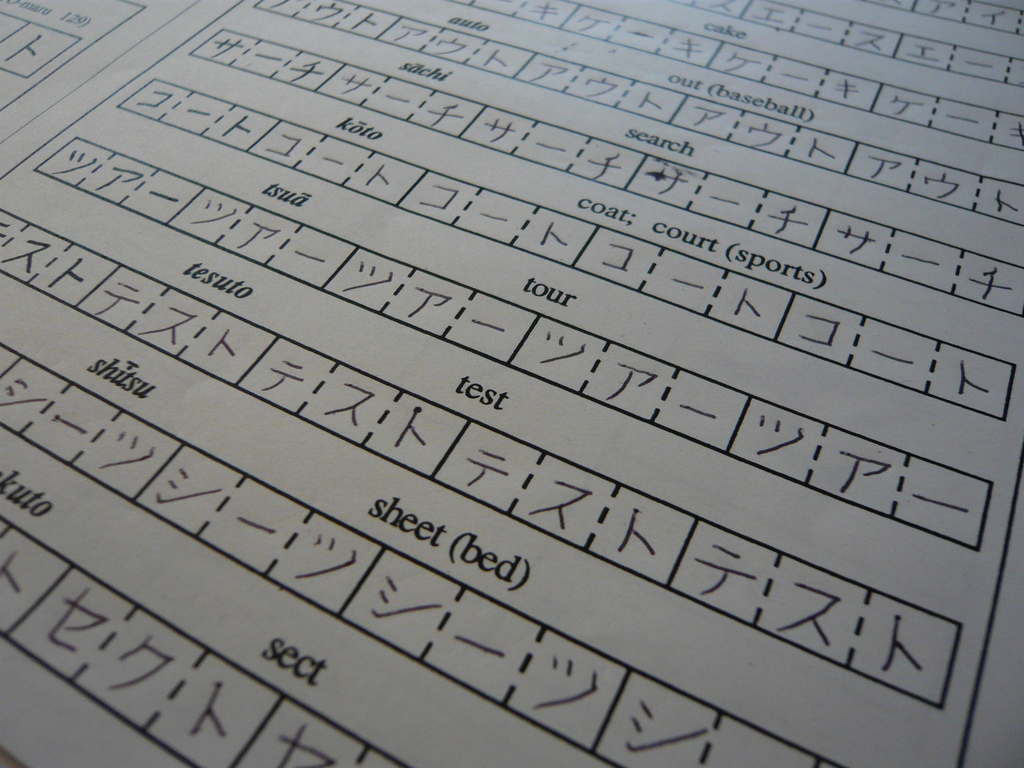
Katakana

Image sources 1, 2, 3, 4.

Writing your name in katakana is awesome! The reading is obvious and people automatically know that it’s supposed to be a foreign name. Plus, you’re probably not the first person with your name to transliterate it into Japanese, so chances are there’s a standard way of writing your name in katakana that people are familiar with.

You can even pretty easily look up these standardized names on sites like this.

But for some people, writing their names in katakana isn’t enough. They want to go further and write their names in kanji but, for a number of reasons, this is a bad idea.

Wrong: Kanji (漢字)

Kanji are Chinese characters that are frequently used in Japanese. Each character has its own, sometimes complex meaning.

After learning how to write their name in katakana, some people want to write their names in kanji. I know that we at Tofugu talk a lot about how useful and great kanji is, but when it comes to writing your name, avoid kanji like the plague.
KanjiYou might think that writing your name in kanji is super cool and extra-Japanesey, but most of the time you’re really just making things harder for yourself and more importantly, other people.

Kanji By Sound

One way people recommend writing your name in kanji is by finding kanji with the same sounds as your name in katakana, but this is a bad idea for a couple of reasons.

If you’re picking kanji based on sound alone, then the meanings of these kanji will probably be really weird and completely unrelated to your name.

For example, if Chris decides to write his name like 躯里子, it will sound like kurisu, but the kanji mean “corpse foster child” which, in case you didn’t notice, is complete gibberish (or just really morbid).

The other problem is that pretty much every kanji has multiple readings, so somebody might look at your name and either have no idea how to pronounce it, or they’ll pronounce it differently than you intended.

In other words, writing your name by constructing kanji by sound will mostly just baffle other people and really not do you any good. And the other way of writing your name in kanji ain’t a whole lot better.

Kanji By Meaning

Another way people try to flip foreign names into kanji is by meaning. Every name, no matter what the language, has some sort of etymology, or story behind it. Some people think that by recreating that meaning or story with kanji, they can distill the essence of their names and transfer it over into Japanese.

This doesn’t work well either. If you’re constructing your kanji name based on meaning, then the reading probably won’t make any damn sense. Sure, you might have conveyed that Chris means “Christian martyr and patron saint of travelers,” but the Japanese probably won’t read all that as an actual name.

But Other People Have Kanji Names!

Some foreigners can have kanji names, but those are special cases. Since the Chinese and Korean both use kanji in their languages in some way or another, some Chinese and Korean names are able to use kanji.

And it is true that foreigners who become Japanese citizens typically have kanji names, but that’s kind of unrelated. They’re not using kanji for their foreign, given names; but rather, they’re adopting a wholly Japanese name and just using the kanji for that.

Be Proud Of Your Name

Writing your name in kanji is trying to make your name into something it isn’t. Instead of spending time trying to find the perfect kanji to create a name that nobody will understand, instead spend some time looking into your own name.

What’s its etymology? Why did your parents pick that particular name? The answers to these questions are a lot more rewarding than writing your name in kanji could ever be.

[Header image sources: 1, 2.]

  • Stroopwafel

    Thank you, now I now longer need to copy the ・ from wikipedia. 
    ア・リ・ガ・ト・ウ

  • Stroopwafel

    *no longer

  • :D

    Damnit all, I really wanted my name to be 女リス . My life no longer has any joy. :/

  • Aay4

    So my Chinese name is 安栄 and my last name is written 余。Would I write my full name as 余安栄 ? Does あんえい sound like a weird name in japanese? My english name is Andre and my chinese name is pronounced on-wing.

  • ZXNova

    It makes complete sense that you shouldn’t make your kanji name by sound (I feel bad for the people that actually got tattos, and Japan doesn’t even like tattos anyway!) But as for looking up names by meaning, there are some names that could possibly be roughly translated. Like my name (Bryant – variant of Brian – lit. Noble, High) would be 高貴 (Kouki, High, Noble), but I’m not sure if that name is really normal, or a liable name that could be used in Japan. There are people named Kouki in Japan, but they have different Kanji though. (光希 – Light, Hope | 幸輝 – Happiness, Radiance). What do you think?

  • <3

    What if you simply included furigana with your chosen Kanji name, to avoid confusion? Or is that cheating? =) 

  • ZXNova

    Anei means Shadowy Gloom… So yeah weird name.

  • http://www.facebook.com/profile.php?id=100000440035746 Ikenna Ugwuegbulam

    I will admit I tried writing my name in kanji once and I absolutely hated it. My name is Nigerian and it translates to “Divine Power” or “God’s Power.” My main instinct was “Ooooh, I think 「神力」 would work!” and then I looked at the readings for each and said “Yeaaah, no.”  and stuck to my name in K-kana. Personally, I think 「イケンナ」 looks way better. :D

  • Jateku

    Haha…I’m no even going to try to write my name in Kanji (Because my name is originally Hebrew ”יאשיהו”)Lol

    Isn’t your name originally Japanese?  You can jest write 橋 :D

  • ジョシュ (恕修?)

    I put some thought into it, and came up with Josh =  ジョシュ or maybe ジョシュウ, which then becomes 恕修… would this be acceptable? 恕 is jinmeiyou at least, and I really like the meanings… or should I just stick to kana? 

  • Jateku

    And my name is Josiah so would i write it like ジョサイア ジョザイア or ジョシア?

  • Willian Pestana

    Interesting, thanks!

  • http://www.tofugu.com/ Hashi

    That’s an interesting workaround, but still doesn’t solve all the problems with a kanji name.

  • http://www.tofugu.com/ Hashi

    Probably just stick to katakana.

  • Meary Brown

    I am nisei and my American Dad named me Meary. In America everyone want to pronounce as Mary, but it is pronounce Japanese way with long e sound instead of short a sound. Thanks for interesting article! Please keep them coming!

  • モーガン、ローソン

    みなさんこにちは、ぼくのなまえはモーガンです。 Both my sensei and speech tutors (who are both native Nihonjin) said that it is ok to write your name as kanji, if the meaning suits you, and it can be read as the same sounds.  My sensei came up with this for my first name 猛頑。  I really like the meaning and connotations of the kanji.  I still write my name in katakana, cause personally i feel like writing the kanji is not only confusing for people, but also like im trying too hard to be Japanesey…  So the only time i EVER use that kanji is for signing my 書道, or any other sumi-e art i do.

  • Erick

    Increible article and some coments too! I understand why  you keep saying  that keep our names in katakana es the best way, It contains our identity, we cant change that, indeed we should be proud of that. In all the cases we could be curios, and a lot of us, go through all the way you mentions or any other, to get our name in kanji. But even if I get it, I would only have it for curiosity or to use it like a pen name!  

    I found this website that gives  your name in all the way posible, in my case tree ways of writing it in kanji and of curse katakana and hiragana. My name is Erick so got this http://goo.gl/zoaQ2

    Iam dealing with english and japanese at the same time, sorry if my english become misunderstood!! :^)

  • http://twitter.com/arleas_ Lee Rolfing

    Unfortunately for me, My name is rife with L’s and R’s and sounds that don’t translate well into Japanese.   I have a book that gives all sorts of kanji for names, and yeah, it doesn’t really work well… but I like one of the suggestions for mine:  利猪

    The book says it’s “clever boar” (I was born in the year of the boar).  Google says it’s “interest boar”  (which sounds like a mascot for a bank or something).

  • Gigatron

    Fortunately my real given name is a perfect homophone for an existing Japanese name (a fact noted to me by native speakers), so I will brazenly and unashamedly use the kanji for it. :P

    I refuse to use katakana, for my own personal reasons that will probably sounds stupid to everyone else, but are important to me.

    Plus my name likely has no etymology worth learning, and even if it did, it probably wouldn’t describe me accurately, so I have no interest in it.

  • Sgoss79

    What do you make of foreign names transcribed into Chinese then? They use characters for that, right? As long as the characters are selected with the help of a native speaker/experienced learner, I see no problem with picking a few kanji for one’s name even in Japanese (in addition to the “official” katakana transliteration). You seem to like Japanese names right, “Hashi”? 

  • purin

    I have a student with the same name (he is Brazilian-Japanese, living in Japan). He writes his name ウィリアン. All the teachers call him ウィリ. ;)

  • Taiishi

     I believe you need to have your surname in kanji, but given name can be in kana.

  • syrup16g

    You can write your “foreigner” name in Kanji. There are plenty of creative and accurate ways that work out nicely in Kanji. There are really no rules for 名乗り readings so you are free to assign whatever characters you want. Japanese has a long history of assigning kanji to words that otherwise wouldn’t use them. You can also look up how your name is usually translated in Chinese for reference, and if you have a name that would be found in the Bible or as a historical figure with a pre-determined reading that is fine too. As far as the meaning of the characters, it can also be arbitrary. If a girl’s name is 愛菜 (Aina) nobody is going to be asking her if she really loves vegetables, and if her name is 真衣 (Mai) nobody is going to ask if her clothes are real! Japanese names aren’t taken literally like that, which gives you the opportunity to play around with different characters. It was only until recently that naturalized foreigners were required to take a kanji name. For something like Michael, first you pick if you want to use Mike or Michael. For Mike you need to decide if you want to write it as mai ku or ma i ku. What is wrong with something like 舞句 or 眛紅 (Maiku)? 舞気留 Maikeru? As far as being unreadable, there are plenty of names or kanji with unusual readings that Japanese use. I don’t think it’s completely right to tell foreigners they can’t use kanji in their names, you can register a bank account and many other things with a kanji name despite your name not being Japanese.

  • syrup16g

    You can register your name in kanji, hiragana or katakana and any combination of the above. Around 10-ish years ago it absolutely had to be in kanji but the law has changed now. 

  • syrup16g

    If you have a Chinese name you can use it as it is, if the character is not regularly used in Japanese you can use the Japanese version of that character. Your FB says 健丰, this would be pronounced ケンホウ kenhou in Japanese. 

  • syrup16g

    For Japanese last names 橋 hashi is bridge :)

  • SaraWyatt

    YOU USED MY NAMEE~ < My name is SEIRA, bitches!
    Lol I'll also admit to thinking about being really ostentatious and unlikable and using the kanji for hime 姫 because hell, that's the meaning of my name. Try and stop me!  I'd be all,"My name is hime; pronounced SEIRA!" xP jk 

  • linguarum

    Which brings me to one of my pet peeves. If I want to know how to write “Johnny” in Japanese, Japanese people will say it’s ジョニー. Of course, I realize that forcing the Japanese syllabary to produce English words requires mangling the pronunciation a little, and that’s しょうがない. But since there is a “jah” sound in katakana, I would say that ジャニ actually comes closer to the original, native pronunciation. Still, many Japanese people will insist that anything other than 
    ジョニー  is wrong. Even though it’s your name, your opinion about how it should be written or pronounced doesn’t seem to matter.

    But it’s not as hard-and-fast as some people make it seem. If your name is Luke, you will be told to write ルーク, although the Apostle Luke is written ルカ, and no one tells him he’s writing it wrong. If your name is Jordan, you will be instructed to write ジョーダン (as in the Japanese word for “joke”), although it appears that the people who live in the country of ヨルダン didn’t get the memo. If the rules are that malleable, you really can’t insist that there’s only One Right Way to do katakana, IMHO.

  • ですこ

     Save more with Interest Boar! Help out that low credit score!

  • ですこ

     I don’t think you need to put quotes around names when it’s someone’s actual (half a) name.

  • Kiai Fighter

    I know many Japanese natives who have just hiragana names (first names).

    Also, one girl I know married a foreign guy and so when she took his last name, her last name became katakana. no, wait, 2 girls that I know… and yes, they are native Japanese living in Japan (not abroad).

  • Apryl Peredo

    I have friends whose last name is so long, it takes 8 katakana. You can have hanko made with up to 8 katakana…..so this will not be an issue. If you need 9 kana, then maybe you’re in dire straights.

  • http://www.facebook.com/vitor.etcheverry Vitor Etcheverry

    I used kanji meaning, but in a different fashion. I’m Vitor, wich basically means victory in latin. I got Enamdict from Jim Breen and looked there for names with kanji that could mean victory. In other words, I’ve found a real japanese name (with kanji and everything) that actually fits for me (´0ノ`*) Of course that is still strange, but its better then ヴィトル・エチェヴェヒ (or ビトル・エチェベヒ), I think. I do use katakana in official japanese papers, though.

    Btw, I’m 新屋・勝雄 (しんや・かつお) (^∇^) I also made a gibberish one, 神毅勝方(カミガワ), for personal use.

  • Mescale

    Step 2: ???

  • Mescale

    I think whatever language, you should choose something that is easy for the natives to speak. A kata-kana transliteration is easy for you to make and easy for them to read and say.

    For Japanese unless the Kanji (for names) used is common then they would quite possibly have to look up the way to pronounce it, or ask for the pronunciation if it was written. For many Japanese people talking English or to foreigners is scary enough without the insult of asking how to pronounce their name which is written in Japanese ><

    Also names can have other meanings, they may have strong community ties or historical meaning, choosing some cool Kanji may be potentially offensive. Maybe 愛苺 was a mass murderer or a saint or something, maybe a well known yakuza family! Oups faux pas!

    Also thinking from a Japanese perspective, maybe it seems presumptuous and misleading if you have a Kanji name, you are trying to be someone you are not, trying to take the identity of that name or history, with no understanding of it, you are making an assumption that you can just take a Japanese name.
    Japan society is about politeness, frequently you try to out-humble your acquaintances. Choosing to write your name simply in kata-kana shows a simple politeness, where as choosing a bunch of Kanji shows presumption and rudeness and a lack of understanding of the culture.

  • Stroopwafel

    No debt collectors at your door, if you go with interest boar.

  • Mescale

    Chinese doesn’t have a syllabary specifically for foreign words and names, japan does, so you need to transliterate a name into chinese characters if you want chinese people to be able to call you a name.

  • Noah Hicks

    A famous professor of ethnology from Minpaku in Osaka named Dr. Umesao always wrote his name in カタカナ.  But he was probably unique for Japanese.

  • Apache_Chief
  • syrup16g

    It’s up to whoever is deciding, Japanese will usually stick to creating katakana name that is closer to the romaji regardless of it’s pronunciation. There isn’t always one way because there are more sounds than can be represented easily. And actually, Japanese will probably say Johnny is ジャニー because of Johnny’s Jimusho :D

  • http://www.facebook.com/profile.php?id=1434168513 Juan Fernando Castellón

    Flayer Marian said that this name is common enought that their is a Kanji compound that is used commonly. Luna 流奈 is the code she used. Hashi, thanks for adding to my other comment! Wouldn’t the Japanese stick to hiragana for Tsuki, though? It seems that some names seem more “girlish” and are kept in Hiragana. The name 桜 Comes to mind.
    高城恵輔

  • http://www.facebook.com/profile.php?id=1434168513 Juan Fernando Castellón

    If you’re really deep into Japanese culture, you wouldn’t want nine kana, anyway! My last name in Katakana is 5 characters. カステヨン

  • http://www.tofugu.com/ Hashi

    Chinese is a different situation because, like @Mescale:disqus says, they don’t have a writing system specifically for foreign words.

    And I am quite fond of Japanese names, mostly because middle and last names are Japanese. :p

  • http://www.tofugu.com/ Hashi

    There’s joy in katakana!

  • http://www.tofugu.com/ Hashi

    NO FUN EVER

  • HUTCHINSOOOON!

    actually i would rather not be called bribe flowerpot

  • Guest

    I thought that to open some bank accounts and sign of leases, you need a name in Kanji. I’ve seen some documents where you need a Kanji regardless of whether you Japanese or a foreigner. Maybe I’m wrong. Does anyone know anything about this?

  • Bren Kulp

    My name is Brennan Kulp (コルプ ブレナン)But I was given a Japanese name, だいすけ, by my Japanese friends. Should I spell my american last name in katakana and then my Japanese first name in kanji (大介)? 

  • http://www.tofugu.com/ Hashi

    You could but if you go by the Japanese name your friends gave you, you should expect a lot of questions about your name. If you just go by your given name written in katakana, it will be a lot less of a hassle.

  • http://www.tofugu.com/ Hashi

    I’m curious about this too, I don’t have a real firm grasp on how Japanese law works when it comes to things like this.