
The Right And Wrong Way To Write Your Name In Japanese

If you’re learning Japanese, one of the first things you do is learn what your name is in Japanese. It’s great because it personalizes the language and gives you an identity in Japanese.

But sometimes there’s a little confusion about how to write your name in Japanese. Let’s look at the right and wrong way to write your name in Japanese.

Right: Katakana (カタカナ)

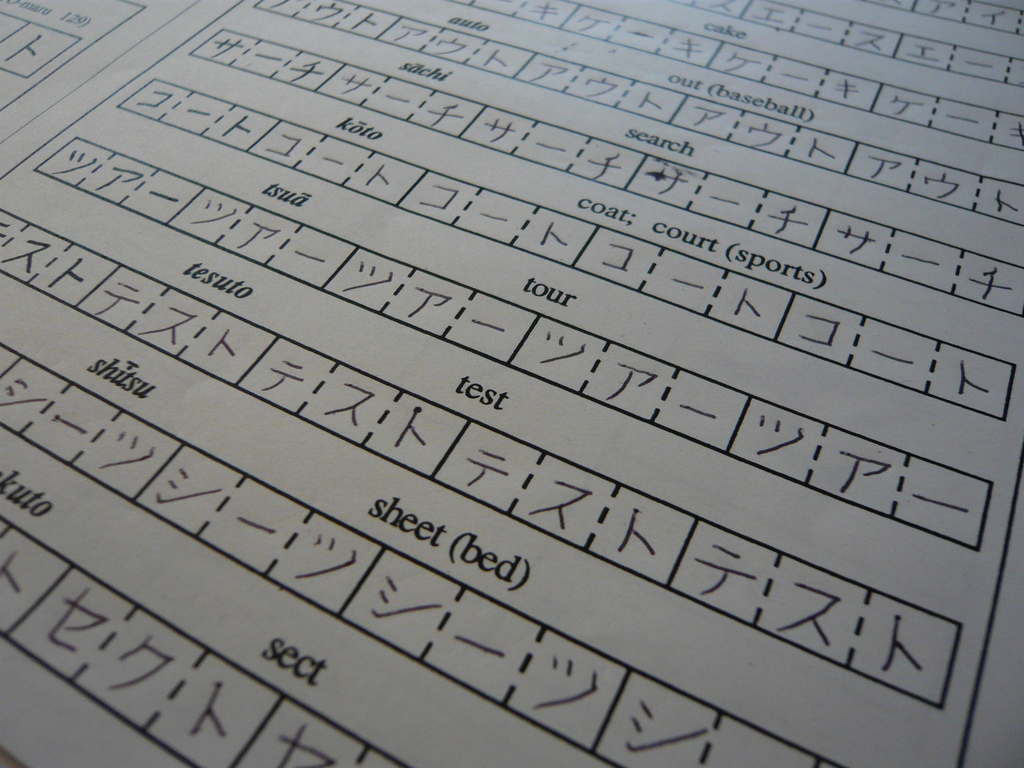
If you don’t know a lot about Japanese, katakana is one of the Japanese alphabets, and is used for writing foreign names in Japanese.

Foreign names are typically spelled out phonetically with katakana, so Chris becomes kurisu (クリス), Sarah becomes sēra (セーラ), and Michael becomes maikeru (マイケル). It’s usually very easy and straightforward.
Katakana

Image sources 1, 2, 3, 4.

Writing your name in katakana is awesome! The reading is obvious and people automatically know that it’s supposed to be a foreign name. Plus, you’re probably not the first person with your name to transliterate it into Japanese, so chances are there’s a standard way of writing your name in katakana that people are familiar with.

You can even pretty easily look up these standardized names on sites like this.

But for some people, writing their names in katakana isn’t enough. They want to go further and write their names in kanji but, for a number of reasons, this is a bad idea.

Wrong: Kanji (漢字)

Kanji are Chinese characters that are frequently used in Japanese. Each character has its own, sometimes complex meaning.

After learning how to write their name in katakana, some people want to write their names in kanji. I know that we at Tofugu talk a lot about how useful and great kanji is, but when it comes to writing your name, avoid kanji like the plague.
KanjiYou might think that writing your name in kanji is super cool and extra-Japanesey, but most of the time you’re really just making things harder for yourself and more importantly, other people.

Kanji By Sound

One way people recommend writing your name in kanji is by finding kanji with the same sounds as your name in katakana, but this is a bad idea for a couple of reasons.

If you’re picking kanji based on sound alone, then the meanings of these kanji will probably be really weird and completely unrelated to your name.

For example, if Chris decides to write his name like 躯里子, it will sound like kurisu, but the kanji mean “corpse foster child” which, in case you didn’t notice, is complete gibberish (or just really morbid).

The other problem is that pretty much every kanji has multiple readings, so somebody might look at your name and either have no idea how to pronounce it, or they’ll pronounce it differently than you intended.

In other words, writing your name by constructing kanji by sound will mostly just baffle other people and really not do you any good. And the other way of writing your name in kanji ain’t a whole lot better.

Kanji By Meaning

Another way people try to flip foreign names into kanji is by meaning. Every name, no matter what the language, has some sort of etymology, or story behind it. Some people think that by recreating that meaning or story with kanji, they can distill the essence of their names and transfer it over into Japanese.

This doesn’t work well either. If you’re constructing your kanji name based on meaning, then the reading probably won’t make any damn sense. Sure, you might have conveyed that Chris means “Christian martyr and patron saint of travelers,” but the Japanese probably won’t read all that as an actual name.

But Other People Have Kanji Names!

Some foreigners can have kanji names, but those are special cases. Since the Chinese and Korean both use kanji in their languages in some way or another, some Chinese and Korean names are able to use kanji.

And it is true that foreigners who become Japanese citizens typically have kanji names, but that’s kind of unrelated. They’re not using kanji for their foreign, given names; but rather, they’re adopting a wholly Japanese name and just using the kanji for that.

Be Proud Of Your Name

Writing your name in kanji is trying to make your name into something it isn’t. Instead of spending time trying to find the perfect kanji to create a name that nobody will understand, instead spend some time looking into your own name.

What’s its etymology? Why did your parents pick that particular name? The answers to these questions are a lot more rewarding than writing your name in kanji could ever be.

[Header image sources: 1, 2.]

  • トム ジェンセン

    Good article, cleared up that whole issue. 

  • http://www.vietamins.com Viet

    But but but… Are you telling me I can’t use 越 as my first name? Oi. I will use it and you can’t stop me. かつ!

  • Flayer Marian

    Hello Tofugu,

    I am Japanese and therefore my English is certainly not good, but oh well, I hope you can understand it. First of all it is true that it is difficult to change one’s name from the alphabet to Kanji, but with some experience there are good possibilities. Most of them are surely not the trivial Japanese name and some people find it funny, however in the other hand it could be really cool. Also note that some Japanese parents give their children western names like “Leo” with the fitting Kanji 玲央.

    Here are more examples:
    Luna 流奈
    Tom 斗夢
    Mike 舞空

    These are indeed not a common name, but it wouldn’t sound for me to alien. But maybe you should avoid Kanjis likes these (if you are going for seriousness).

    Noel 聖夜
    Chris 水晶

    ^^ I like reading Tofugu even as a Japanese. Keep it up please.

  • Yager

    Thank you for bringing this up. Friends will ask me to write their name in Japanese and when I write in it katakana they’re always dissapointed and ask me why I can’t write it in the “cool way” (in kanji). I found it hard to explain but I can use this article as a reference now. Thanks! 

  • トム (斗夢?) ジェンセン

    Heh, thanks for that one. And your English made perfect sense to me ;)

  • lightroy

    Might be actually helpful to any novice getting into this for the first time, but I personally find the kanji counterpart more interesting.
    One should look up a kanji to use as such first by possible readings, and then by meaning (as normally you’ll find many possible kanji that can be used for the same sound). 

    Also, would have expected that you pointed out the existence of name-only readings for some kanji.

  • niyoels

    When I was in Kyoto, one of the temples (I think Kinkakuji or Ryoanji) had hanko for foreigners in their gift shops. They constructed names by sound as mentioned above and were pretty much gibberish. My own name had no meaning at all (probably because it has foreign sounds) and only one of the names I looked up had an appealing kanji composition. 

    Also, my Chinese friend asked me how to read her Chinese name in Japanese but that didn’t go over well. The kanji were uncommon in Japanese, especially in names, and the only decent reading I could come up with was a boy’s name. She wasn’t happy about that. I told her she should use the original Chinese reading even in Japanese. She wasn’t happy about that either haha

  • Willian Pestana

    My name is Willian. My teacher always write my name like this: ウィリアン, however this website that translates any name into katakana showed ウィラン. I wonder which one is more correct…
    Nevertheless, I like 「ウィリアン」 the best…

  • Beautifulworld

    I thought becoming a citizen of Japan would also allow you to use a Katakana name in place of your first name. it’s true, right? You don’t HAVE to adopt a kanji name, but at least a Katakana name?

  • http://www.vietamins.com Viet

    Go with the best sounding variation or the one that you are happy with.

    I agree 「ウィリアン」sounds the best.

  • Anatanoshinigami

    Hashi, I want a name like yours.

  • Willian Pestana

    Yes, ウィリアン is more natural, I think.
    Thanks Viet!

  • HorrorChan

    Nice article. :D That should clear things up for people who want to write their names in Japanese. 
    I thought about writing my last name in katakana since I already know how to do my first. xD Since it’s Bartmann I’m totally unsure how to go about it. 

  • http://www.facebook.com/profile.php?id=1035678298 KianHong Khoo

    What if I have a Chinese name? Can I find the equivalent in Kanji? I would like to know how to pronounce my Chinese name in Japanese. ^^ 

  • hakuba_jen

    In July, though, the foreign registration system is changing and your hanko will be required to match your registered name, but katakana names are usually too long to fit. Therefore, a lot of residents are opting for a kanji names along with a registeted romaji name. It’s a bit of a しょうがない situation. :/

  • http://www.vietamins.com Viet

    Bartmann, huh? You aren’t related to The Bartmann of the Chicago Cubs controversy, are you? :P
    http://en.wikipedia.org/wiki/Steve_Bartman_incident

  • Mescale

    I broke that website, what a rubbish website, I can’t believe you linked a website that couldn’t find my name in Japanese.

    Lots of love

    メスカルです。

  • Mescale

    I still love you though.

    Lots of love

    メスカルです。

  • http://www.facebook.com/profile.php?id=100000858852501 Luna Thalmensy

    Hey Hashi, my name is Luna wich means ‘moon’ in spanish. Do you think that traslate my name in kanji as ‘月’ is a good idea or should I keep the katakana translation ‘ルナ’ ?

  • Kyah

    My question is: which is more appropriate for foreign names, surname first or given name first? I’ve seen both but Im not sure what determines which order should be used.

  • Brandon Inoue

    It always used to irk me when I watched Japanese television and saw some people were foreign born Japanese (Nikkei-Jin) and their names were always spelled with Katakana.  My parents used to always say that it was because that regardless they are “Gaijin Tarento” and always have their names spelled with Kana instead of Kanji. 

    I got used to doing it when in Japan but it almost screams “Hi, I’m a foreigner!”  I guess I kind of thought of it like it was blowing my cover (lol).  I also knew a few 3rd or 4th generation Korean people living in Japan and they always used Kanji as their cover names.  It helps them get jobs and prevent discrimination.  One girl guarded it so much that she told me that she wouldn’t tell me her real Korean name because she didn’t want others to hear it.  I was the only person outside of her community that she had ever told she was ethnic Korean.  I guess she knew I would understand.

    As for my own name…
    My mom thought my first name was a strong warrior name (not by a long shot but English is her second language).  It was also distinctively American/Western.  When in Japan, only friends who are really close call me by my middle name Nobuyoshi (I can never remember the Kanji for it).  It’s taken from my Dad and Uncles’ first names, Shinobu and Yoshi.   The meaning of the name was secondary in importance (Compassion and Believer). 

  • Rowan

    What if your name (like mine) is made entirely of easily-translatable nouns? Is it vaguely acceptable for me to go by 西 山椒 (with ウェスト ロアン as furigana on my name card)? I’ve actually been wondering about this for a while, so I’m glad you posted this.

  • Flayer Marian

    ヴィリアン is also possible.

  • Travisnamewebster

    ありがとう はしくん

  • Stroopwafel

    I think, that when you want to make it super obvious for people your name is displaying given name first you should use a dot in between you given- and surname
    Like so… ジョン・レノン (John Lennon)
    By the way, can anyone tell me how to input such a dot? 
    I’m using the japanese input system on mac os,

    Also, Hashi, is that your actual name, or is it a pen name? Does it have a kanji reading? Doesn’t Hashi mean ‘chopstick?’

  • K Takashiro

    It would be best to stay with ルナ because that is your name, I don’t know if つき is used as a girl’s name in Japan, so keep things simple. Someone I know gave me a Japanesed name based on the spiritual roots of my name. Since Jaun, means God is gracious, I am Keisuke in Japanese and use the Kanji there.恵輔

  • mkrause

     バートマン probably works best.

  • Chris Lastnamerson

    Cool, a whole article about my name! I’d never even thought to write it in kanji before, I didn’t know that was a common thing to do.

  • デス子

     I don’t know if it’s the same on a Mac, but try the / key. It makes a ・ for me.

    …I don’t know why that rhymed…

  • ですこ

    I think the obvious middle ground is to write eryone’s names in ひらがな.

  • http://www.tofugu.com/ Hashi

    My only advice would involve doing the Bartman, which is probably counterproductive

    http://www.youtube.com/watch?v=8jmhlyuxULI

  • http://www.tofugu.com/ Hashi

    What can I say Chris? You inspired me to write this whole post.

  • http://www.tofugu.com/ Hashi

    月 is sometimes used as a girls name in Japanese, but I think I’d still use ルナ. I’m not really sure to be honest but like I said, you can never go wrong with katakana!

  • http://www.tofugu.com/ Hashi

    My deepest apologies!

  • http://www.tofugu.com/ Hashi

    Thanks! I was partially inspired by your TF forum post.

  • http://www.tofugu.com/ Hashi

    Interesting, I didn’t know that! Thanks for commenting, and your English is quite good :)

  • Mescale

    Aww now I feel bad. Take that back!

  • http://www.tofugu.com/ Hashi

    Glad this could come in handy!

  • http://www.tofugu.com/ Hashi

    Honestly, I’m not sure. I do know some naturalized Japanese citizens adopt fully Japanese names, but I’m not too clear on how the process works. Sorry!

  • http://www.tofugu.com/ Hashi

    Step 1: have Japanese ancestors :P

  • http://www.tofugu.com/ Hashi

    I’d just go with katakana.

  • http://www.tofugu.com/ Hashi

    “Hashi” is the first half of my surname. The kanji is 橋, and in this case it means “bridge.”

  • http://www.tofugu.com/ Hashi

    Yup, it’s the / key on a Mac when using the Japanese IME.

  • http://www.tofugu.com/ Hashi

    しょうがない indeed 

  • Stroopwafel

    You gave me a fair advice, 
    yet when I press the ‘ / ‘, a ‘ / ‘ still arise.

  • トム [斗夢?] ジェンセン

    Heh, you read that? Well Thanks for the article it was pretty helpful :D

  • http://www.tofugu.com/ Hashi

    Interesting stories! I’ve got one related one to add:

    When I visited Japan with my family, we stayed at a hotel that put the guests’ names out in the front in kanji (since all the guests but us were Japanese). I was excited to see our name up in the front in kanji, but after one night of staying there, they erased the sign with our name on it and replaced it with a romaji spelling.

    It was both hilarious and kind of disheartening :

  • http://www.tofugu.com/ Hashi

    I’m always lurking the forums o_o

  • http://www.tofugu.com/ Hashi

    Try using the spacebar to cycle through the different options. ・is the third option for the / key.

  • Stroopwafel

    I’m sorry, I’ll quit the crappy poetry.
    When I press the / key, it give me this /. Just a longer, slightly more tilted version of /.