10 Things I Wish I Knew About Japanese Learning When I Was First Starting Out

When it comes to Japanese, I still have a long ways to go and a lot to learn. But, I’ve had lots of time to learn about learning, make mistakes, and apply plenty of learning theories of my own. Looking back now to when I was a wee lil’ lad, so naive and innocent (and incredibly good looking), I’ve come up with a list of ten things I really wish I had known during the days of my youth (and did I mention incredible good-looking-ness-ness?) that would have made my Japanese-learning life so, so much easier. But now, that information is going to be gifted to you so that your early Japanese language learning careers can be filled with unicorns and candy canes. You ready? Let’s learn about all my Japanese learning regrets (as well as ways to avoid these situations yourself).

10. Focus On Your Ability To Recall, Not Memorize

Memorization is the focus of most Japanese classes. Memorize words! Memorize kanji! Memorization is so Japanese, too. But, all that sucks, and it’s not at all how our brain learns anything. While memorization has its place in learning, it’s not the memorization that’s important, it’s the recall. So, instead of focusing on getting things into your head… focus on getting things out. It’s not as simple as you might think, too. In terms of pure recall ability, there are a lot of things you can do to make your learning much more effective.

  1. Try learning five different things at the same time (as in, one right after another). Although “different,” they should be related things as well. For example, learn a vocab word, a kanji, a grammar term, and practice with a bit of audio, all as one “set” then rinse and repeat. This is more effective than, say, learning 10 vocab words at a time, then repeating. The progress will feel slower than if you do a single subject group all at once, but your recall is going to be better if you do it this other way. Why? Because each time you rotate back around to vocab, you’re practicing recalling vocab. Each time you rotate back to learning a kanji, you’re forced to practice recalling the previous kanji. It’s forcing recall over memorization. Doing the same thing over and over just puts you into auto-pilot.
  2. After you take or read a lesson, take notes. Note the word “after,” it’s very important. Writing notes while you’re listening or reading something is pretty useless. You can use it later to memorize, I suppose, but in the end you’re not learning as much. If you take notes afterwards, your focus is on recall, not memorization, and guess what? You end up recalling more the first time.
  3. The more you struggle to recall something, the more easy it is to recall next time. So, you should actually try to make it hard to recall an item. The trick, though, is to not forget something so much that you can’t recall it at all. If you can’t recall something, you can’t make the memory and recall of that thing better either. The harder it is to recall this thing, the more effort your brain will put into recalling it better. So, try to wait as long as possible before you practice recalling an item. Try to catch it right before you’re about to forget it (this is why srs and mnemonics are so good, we’ll talk about that in a moment).

So, the next time you catch yourself trying to memorize something, remember recall that what you really need to do is practice recalling these things, because that’s what will help you out in the long run. It’s like a hard drive. You can store as much information as you want inside… but if you have no way of recalling that information, it’s pretty much useless.

9. You Ought To Focus On Weak Points
You're only as strong as your weakest point

Nobody likes to do things they aren’t  good at, but that’s what separates the pros from the not-really-good-at-anything people. The snow-ball fighting team that wins the championship didn’t ignore the things they were bad at. Olympic gold medalists don’t ignore what they aren’t good at… no, they focused on their weak points. Why? Because it makes everything else so much better.

With Japanese, I’ve learned that you have to focus on your weak points too. Weak points will only get weaker, and they will constantly hold you back. For example, if your weak point is kanji, it’s not just kanji that’s poor. Your grammar is poor too. Why? Because when you’re reading, you constantly have to stop and see what each kanji means, which means you read less stuff, which means your grammar isn’t as good. What happens when your grammar isn’t as good? Your speaking and listening don’t get better either. All this could be fixed by focusing on your weak point (in our made up world, that’s kanji). Even though working on something you aren’t good at sucks, it’ll make everything so much better in the long run. If you want to get better, it’s an absolute must.

So, what’s something you’re bad at in Japanese? You should spend most of your time working on that, until it’s no longer a weak point then choose something new that’s the new weak point (and repeat).

8. You Should Learn More Kanji, Earlier
Kanji’s one of those things that most people take forever to learn. But, just like in the example for #9, it affects a lot of other things. More than any other part of learning Japanese, kanji can help or hurt you, and I’d rather it help you. The more kanji you learn, the more effectively you can study. That’s all there is to it.

I’m not going to go into how to learn kanji more quickly right now, that’s for points farther down in this list. I will say, however, that it’s a long-term mistake to not learn as much kanji as you can now. Keep reading to figure out better ways to do that, though, because the “traditional” approach won’t let you learn very much kanji very fast.

7. Existence of SRS Learning

One thing I had no idea that existed back in the day is SRS (that’s a spaced repetition system). The SRS of choice around here tends to be Anki, but there’s plenty others as well. The idea behind it is pretty simple: SRS programs show you things based on how well you could recall them the time before (see, recall is good!). For example, if you could recall the kanji 中 very easily, it might not show you that card again for a couple months (if you’ve recalled it several times easily, anyways). But, if you had trouble recalling it or couldn’t recall it at all, it might show you 中 later that session or the next day. Basically, it’s just flashcards, but it tries to stretch out that recall time so you better memorize things. Right before you’re about to forget it something a proper SRS should show that thing to you and make you recall it, making that memory stronger every single time.

SRS might be pretty commonplace in today’s world, but when I was in school I just sat there trying to memorize one thing after another like some kind of chump. It was terrible, and most of the time I’d barely be able to get anything in my short term memory long enough to pass the test (then promptly forget everything I just “learned”). SRS solves all that. If you’re not using an SRS program, you should. It does a lot of the recall / memorization work for you (though you still gotta work a little).

6. The Existence Of The “Other” Kanji Radicals

Yep, a lot of these radical's meanings are made up, but that's because "traditional" radicals are so useless

In high school, I learned about kanji radicals in a way that would allow me to look up kanji in dictionaries. These are the radicals most Japanese teachers know about and use, but these radicals aren’t that helpful. Of course, because of this, I had to learn kanji stroke by stroke by stroke. 18-stroke kanji? That’s eighteen different things I had to remember, making learning one kanji really, really difficult.

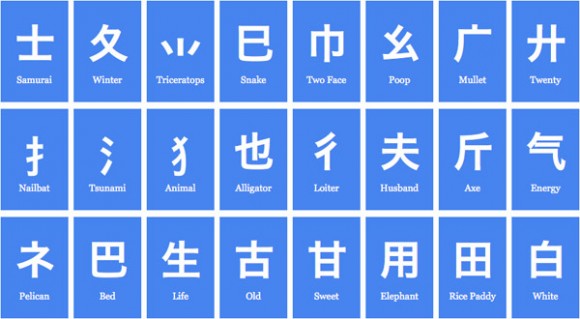
These “other” radicals, however, are different. Every kanji (and I mean every kanji) should really only be made up of three parts (aka three radicals). Basically, these radicals are parts that make up a kanji. They’re like smaller kanji (or pieces of kanji) that you can piece together to make a bigger kanji. Although there are around 200 radicals (depending on who’s list you use), learning these 200 radicals can be pretty easy if you use mnemonics and SRS to learn them. Once you know these 200-ish radicals (I know, sounds like a lot, but it’s not), all kanji can be created with three or fewer radicals. It’s sort of like the difference between putting together a puzzle with three pieces (EZPZ Lemon Squeezy), or putting together a puzzle with 20 pieces (while memorizing where each piece goes for the next time you have to put it together). Over time, this really, really adds up.

If I had known about these kinds of radicals a lot earlier, I would have known a lot more kanji a lot earlier too. Japanese school kids spend around 6 years learning their Joyo kanji. Japanese language learners spend an upwards of 10+ years learning kanji. All this can be cut down to a fraction of both of those time frames if you use radicals (and mnemonics). Learning kanji faster than a Japanese school kid? Strangely enough, it’s no problem at all. There’s various methods for learning with radicals, including Heisig’s, TextFugu, and Kanjidamage. All have their good points and bad points – I’d just recommend using the one that seems to work best for you.

5. Classrooms & Teachers Can Slow You Down (But Also Can Help A Lot Too)

A lot of my Japanese learning has been in classrooms, and I’ve learned a lot from that experience. Classes are great, because you have a teacher there to tell you what you’re doing wrong. But, classes can also slow you down. Unless you’re the slowest person in the class, the class is always going to prevent you from learning things as quickly as you actually can.

If you’re in a class, I’d always recommend studying outside the class. You could focus on your weak points (aka point #9). You could study kanji separately from everyone (because kanji helps with everything). There’s any number of things you can do. Even grabbing another resources and studying with it is good (because either it’ll fill in the gaps of things that you’re not learning in your class, or it will reinforce things you’ve learned and explain it in a different way).

Whatever you do, though, study outside the classroom is great. You shouldn’t be tricked into thinking that a classroom is all you need. Think of a classroom as just a supplement to your learning, because there’s really so much more that you can do.

4. Don’t Learn Kanji In The Order They Tell You

They’re liars! All of them! Perhaps I sound like a heretic, but I think kanji ordering is important, and the ordering they tell you is a false God ordering. There’s two ways to do ordering. One is traditional, and one is my way (and I’m sure other people have other ways that are just as good).

The traditional way has you learn like a Japanese school kid learns, aka in order of easy meaning to difficult meaning (which has nothing to do with how complicated the kanji itself is). So, for example, you’d learn 食 way before you learn 又. Although the meaning of 食 is way easier than 又 (which is why little kids with small brains learn them in this order), the kanji is not. And, I’m guessing you’re kind of old now, so the meanings aren’t really that difficult for you (but the kanji part is). So, why would you learn them in this order when meaning has nothing to do with anything?

Now, for me, I think it makes more sense to learn in order of simple to difficult kanji (not the meaning). There is a problem with this, though I think it’s a problem only short-term thinkers will worry about. The problem is that you don’t learn the most useful kanji first (which means you can’t use the kanji in real life as quickly either). You’re missing a lot of really basic kanji for a long time (like 食), and people don’t like that.

I understand why that’s rough, but the goal for me is long term, not short term. By learning in this order, you can use previous kanji to learn future kanji. You also get better at learning kanji, and you struggle less on a per kanji basis than you do the traditional approach, because you slowly get more and more difficult as you get better.

If the goal is to learn all the Joyo kanji (and I’d say this is the goal), then going in order of difficulty of the kanji itself is the way to go. You won’t be able to use the kanji as quickly (which is a bummer), but you’ll learn all the kanji way faster. So, short term you miss out on being able to apply the kanji, long term you just end up knowing all the kanji. I’ll take the long-term approach any day. Learning Japanese is a long-term thing, anyways. You have time.

3. Learning To Write Isn’t All That Useful

I'm not saying it's not beautiful, I'm just saying it's a waste of your time (right now)

I’ve written about this on Tofugu before, and I even have people take this (somewhat controversial) approach on TextFugu. Many people say this is crazy, but those people can keep their pagers and hand-pens and join the Pen15 club. Writing isn’t as important as it used to be. In fact, it’s hardly important at all (especially when we start talking kanji). Now, don’t get confused. When I say “writing,” I mean hand-writing, not typing. Typing is great. Think about it – when was the last time you wrote anything with your hand. For me, I think it was when I signed a restaurant bill (and Japanese tend to use cash anyways, so no problem there).

But I know, I know. Writing helps you to remember kanji, blah blah blah. Maybe it does help you, but I don’t think it’s necessary to learn kanji, and I think it takes up more time than it gives you. Think of it this way. You could spend an extra 5 minutes practicing writing the kanji 食. Or… you could spend that 5 minutes learning to read the next kanji on your list. What does that achieve? That makes your kanji learning twice as fast, probably faster than that if you consider how much you end up practicing writing of previous kanji later on. So, the question you have to ask yourself is “do I want to be able to write this kanji, or do I want to learn another kanji?” Over time, this adds up.

That being said, I’m not saying you absolutely shouldn’t learn to hand write. I am saying, however, that you shouldn’t learn it right now. Learn it after you learn everything else. Learn it when it isn’t keeping you from studying more important (and useful) things. I don’t know how many hours I wasted trying to write kanji back in school. The moment I realized it didn’t matter if I learned to write or not, I suddenly learned so much more. It’s amazing how much time you gain by cutting this out of your routine. Most people tell you that you should learn it because “that’s how its always been done.” I say you should think about why you’re doing something and come up with your own conclusions.

2. Mnemonics Aren’t Cheating

I didn’t know about mnemonics for a long time (which sucks). I also thought mnemonics were nothing more than parlor tricks when I first learned about them (another mistake). Now, I can’t believe I ever lived without them. Mnemonics are boss, and if you’re not using mnemonics, you’re probably hanging out in the dust.

I’m not going to go into a huge thing about mnemonics here, but here’s the quick and skinny.

Mnemonics are basically techniques that allow you to associate one thing already in your brain with something that’s outside of your brain (and needs to get in). To do this, you create hooks in your brain or you use stories that are more memorable, and add the new knowledge you want to remember to those. The goal of a mnemonic is to help you to recall an item, not necessarily to make you memorize something perfectly the first time.

Think of it this way. Your brain is full of memories. Each of those memories have little arms that can grab onto things. If you use a mnemonic, the thing you’re trying to memorize will latch on to one of those hands. To remember the new memory, you just have to remember the thing already in your brain (which is way easier to do), and then use that to get to the new memory you want to recall. Do this enough and you’ll eventually be able to recall that new memory without using the old one (and then it’s memorized).

Now, if you try to memorize something without a mnemonic, it’s like you’re throwing that item into a dark hole in your brain. It tries to catch on to something, but there’s no hands to clasp on to. It keeps sliding off the side of your brain, falling out. Eventually, it might stick, but there’ll be nothing connected to it. When you try to retrieve it, your brain doesn’t have any good way of getting there, so you just can’t recall it very easily. If you do this enough, sure, it’ll end up working… but how much time have you wasted?

Connecting a new memory to an old one is essentially what mnemonics do for you. It’s how your brain works, and it will help you to remember a lot. Most commonly in Japanese, people use mnemonics to memorize kanji, though I think there’s other ways to use mnemonics as well that haven’t been explored as much. Just last week we started adding mnemonics to vocab on TextFugu, which I’m pretty excited about. Vocab is a really abstract thing to learn, and mnemonics help a ton.

1. I Should Have made More Mistakes

See? Won't be making this mistake, again.

The number one thing I wish I had known about a long, long time ago, was mistakes. Seems simple enough, but when you think about it, we’re wired to try to avoid making mistakes. It’s embarrassing. It’s painful. Yadah yadah yadah. Mistakes aren’t things that we as humans like to make, probably mistakes usually meant death for us, but what if I told you that mistakes made you learn way, way faster (and you won’t die, too, because saber tooth cats don’t exist anymore)?

There’s a few reasons for this.

  1. If you’re not making mistakes, you’re not pushing boundaries. If you’re not pushing boundaries, you’re going to end up learning at a slower pace.
  2. If you’re afraid of making mistakes, you won’t try to learn new things. To learn new things, you have to make a lot of mistakes.
  3. If you make a mistake, you can learn what you did wrong. Going back and learning why you did something wrong gives you better insight into the thing you’re learning. If you’re not doing this, you’re just skimming the surface.
  4. If you’re not willing to make mistakes, you’re probably not willing to practice conversation with people. Practicing conversation is really important. It helps you to practice recalling things you’ve learned in new and different situations. Remember how important recalling information is for learning?
  5. Mistakes mean you’re trying. If you’re trying… well, that means you’re trying. You should try more.

The list actually goes on and on. No matter who you are, you can strive to make more mistakes. The important thing, however, is learning from them. That’s why I wrote this post in fact, so you can learn from my own mistakes. Just remember, though, if you don’t learn from your mistakes, you’re wasting time by making the same mistakes over and over again.

So, the question is (and this is going to be gold mine of info), what mistakes did you make? What would you change about your Japanese learning past if you could? Let the younglings know what they ought to be doing in the comments below.

Hope at least one of these things have helped you, too!

P.S. Hit us up on Twitter, Facebook, or Google+ if you have any questions (or post them in the comments below)!

  • bparks

    Thank you!  Great information Koichi!

  • Anon

    One thing in favor of language classes: practicing a conversation with yourself makes you feel a little insane.

    There are other ways to get communication experience, but the time (and money) you’ve invested in a class ensures that you have opportunity to practice speaking and thinking of responses to questions that you wouldn’t get from a book, flashcards, or a website.

  • Anon

    Language groups, skype chats, or studying abroad would defiantly help in those areas, but they each have their own shortcomings.

  • Anonymous

    Very good post. One of the best I’d say. I’ll give my 2cents re: writing the 漢字. I think people get caught up in writing them ‘perfectly,’ which is where the time is wasted. But anyone who has written 20-30-40-etc kanji knows that by a certain point your hand muscles just start adapting to how to write a stroke, and you really don’t need to spend all day getting 漢字 down perfectly. I think it’s misleading to say or have people think that writing it is a waste of time. It is if you are spending all day trying to write 願 perfectly.

    But I also agree with you, Koichi, in that having the mindset of ‘I need to write it to know it’ is not a good mindset to have, either. One thing most people that do spend time writing 漢字 will surely find out, is that after you know every radical or ‘element’ possible, you will pretty much know how to write a 漢字 based on the simple fact that you’ll understand the ordering of radicals or ‘elements.’

    Everyone has their mind made up when it comes to this topic. All I’d say is that, if it’s helping you then keep going, but if you are wasting all day trying to write a 漢字 perfectly, then stop wasting your time, writing perfect 漢字 is not important in this day in time.

  • http://twitter.com/ineray Yareni Villarreal

    loved the post!… About the mistakes part, it is really hard to overcome a mistake sometimes. I met a japanese guy and after a few hours of conversation I finally dared to say something in japanese out of the normal sentences, I don’t remember what it was, the thing is the sentence didn’t come very well and he told me, “Make sure you learn more before you dare to speak in japanese, I don’t take it bad because I know you mean well, but you shouldn’t say something you don’t know”… it made me feel horrible… that was the last time I tried making a sentence out of  the standard sentences I learn on books.

  • Afoofoo

    Thank you for sharing your experiences! I can relate. I do agree that recalling is important; I keep a diary that I write in in Japanese for some odd reason, and I get kanji amnesia more often than I would like. It’s horrible :/
    I actually don’t have any regrets with my Japanese learning, except for stupidly spending more time memorizing kanji readings instead of learning words using that kanji (usage). And those dumb ungrammatical gaijin comments on my favourite actor’s blog… *shoots self*Also, I love writing manually, so I don’t like to neglect that aspect =)

  • Michael

    Have to disagree with not learning to write Japanese (though it’s just an opinion).  Not writing kanji/vocab as they come up on flash cards makes the review sessions faster, yes, but if it takes you more reviews to be able to recall the item successfully; surely that’s much slower in the long run.

    Say writing down a word as you review it makes it take 2 reviews before you can say “I remembered that! WIN!”.  Now say not writing down the word (not engaging your motor memory) makes it take 4 reviews before you get it right.  In this made-up example, that’s taking twice as many reviews to “learn” the item, even though each time you review it without writing takes about 2 seconds shorter than if you took the time to write it out too…
    You have to take into account the time spent learning how to write, but that’s like a one-off time expenditure – you’ll more than make up for it with the time saved later on (like solar panels on your roof, but the profit in learning Japanese comes much sooner).

    Does that even make sense? :D  Still some good points you make.  I’m way past the complete n00b stage now, but this would definitely help a lot of people taking their first few steps :)

  • Savvywoza

    I really agree with #10.3. I don’t think I’ll ever forget the word 偶然 because I remember this one time, I tried so, so hard to recall it, and after about 10 minutes, I got it. From that moment on, I could always recall it. I used to have a theory, that if I -almost- forgot a word or phrase, but then managed to pull it out of nowhere, I’d always remember it. And mostly, that actually does work. And it’s so, so satisfying, too.

    Two of the funniest mistakes I think I’ve made…
    It was the night before my flight for a short vacation back to America, and since this was my first time traveling from home to destination all by myself, I was very anxious. I really hate the cartoon character Moguro Fukusou. I think he’s extremely creepy. But my boyfriend does a really good impression of him. And I was freaking out about all the things I had to do, last minute, before my flight, running through my laundry-list of tasks in my head. And he starts doing that creepy laugh of Moguro Fukuzou. And I ended up saying “No! モリゾーがんぐろが大っ嫌い!!” And he busts out laughing, saying “What the hell is a モリゾーがんぐろ?” Imagine a fried woodland creature. Not exactly a grammar mistake, but hilarious.

    My other one involved a young student of mine. She’s in first grade, and her younger brother is in kindergarten. I asked her where he was, and she said he was on a trip, or something. I wanted to ask if it was something involving his class. So I asked, 「洋介くんの遊園地?」 She looked at me, puzzled, and asked, 「幼稚園?」 I got pwned by a 6-year-old. I felt stupid. But it was kinda funny.

  • Willian Pestana

    I tried to learn to write kanji stroke by stroke too. Then, in a beautiful summer day, I finally acknowledged the radicals existence. And I thought (crying at the same time): “I’m so stupid, why I didn’t realize that earlier??”  Then, a new “Kanji-Learning-Era” appeared before me.

  • Dana Atnb

    very nice post.  I totally agree that hand writing is less effective… but depending on learners.. for those who just want to recognize characters not to write. and there is also another way which im doing constantly as a part of practice is “thinking” about my everyday staff in target language instead of mother/first language. it really helps to speed up recalling and speaking.

  • Anonymous

    I second the thinking in L2 not L1 exercise, I do often myself.

  • Elmonc84

    Hey Koichi thanks a lot for that information,  I have been learning Japanese for almost a year now, and it’s becoming more difficult every time, let’s see if some of the things that you mention would help my learning…. Thanks

  • http://www.facebook.com/profile.php?id=100000307999786 Pedro Campos

    very nice post, i’m starting my Japanese course this year :)

  • http://pulse.yahoo.com/_QU27YBKOVHWO7H3Q65A6AZEKOM foozlesprite

    I found a few gems here that I’m going to incorporate, but don’t they spend more than 6 years learning the kanji?  I’m pretty sure the 6 years are for the kyoiku kanji, which cover approximately half of the standard jouyou kanji.

    And I think writing the kanji varies in usefulness from person to person.  I use Skritter to write mine, which incorporates an SRS and saves a bunch of trees.  For me, writing seems to help with recall (not memorization!) since I only write each of them a few times to learn their radical arrangements (and possibly come up with a radical related mnemonic).

  • Anonymous

    Wow, thanks for the tips!!! The recall method actually give me brain aches lol.

  • http://twitter.com/shollum Shollum

    I put off kanji for far too long. So now I’m going through Heisig’s RTK so I can get on to some more fun stuff (like reading).

    I do write the kanji though. I don’t do it to learn how to write, but to dissect each kanji into it’s parts (radicals and such) while thinking it’s meaning. For now I’ve decided that I’ll try doing this for several (the goal is twenty) kanji a day. The next day, I’ll look over the kanji I wrote and see which ones I can recall. If I can’t recall them, I write it a couple more times, then move on.

    I really like Anki, but I wish it had a way to make cards for learning and not just recall. Every deck I’ve tried is almost impossible to learn from without doing normal study first and I don’t have the patience to make my own. I also can’t take it with me everywhere.
    On top of that, my computer is more of a play space than a study space, so I get tempted to do something else when I study.

    I think people could do their own basic SRS style flash cards without having to take things with them everywhere. Perhaps have your deck of cards and each time you look at one, you judge (kind of like in Anki) how well you recalled it between one and five, then place that card in a stack for that number. After you do so many (depending on your preference) you go through the ones you did the worst on and put the best ones away for later.

  • Anonymous

    Regarding Kanji: if you’re going through RTK, writing it seems to be the best bet, but no need to write the character over and over again, and no need to write it perfectly, as long as you get the radicals arranged correctly. I see Koichi’s point here, but (at least for me) writing the character out, then showing the answer in an SRS doesn’t let me slide by saying ‘oh yeah I got that right’ when it’s not correct on the piece of paper ;) At the very least, when I’m feeling exceptionally lazy but make myself do my review for the day… I’ll sketch it out with my finger on the desk.

    RTK is a completely different beast however, as it isn’t teaching the readings or combination kanji, but simply recollection of the characters individually themselves.

    If you’re using textfugu, there are a few more pieces to wedge into your brain at the same time as you’re also learning the readings and vocab with it.

  • Anonymous

    Wow, that’s a rough but valuable experience!! I kinda consider speaking in Japanese with native speakers I meet all the time but, I don’t want to risk it. Even though I do understand them when they’re speaking in Japanese with their friends and stuff.

  • Kai_sin

    I like these tips, they are very good to nihon-newbies :3 of course, I dont have those problems :D

  • Miyeon

    I agree with point No.4 so much. I discovered that the hard way lol.

  • http://profiles.yahoo.com/u/DYMQ74VK55RPNRARHMDV5UNFEE V2Blast

    This is partly a result of Japanese culture. “Not looking bad”, or “saving face”, is paramount in Japanese culture.

    Of course, classrooms and other “friendly” environments are much more conducive to learning.

  • http://japan-australia.blogspot.com/ Japan Australia

    Some great information and very useful for the Japanese language learner!

  • Rashmi

    I agree with you on point  #4 (and other points as well, but specifically that one). I feel it’s a lot easier to learn kanji by stroke count, going from one-stroke kanji to 2-stroke etc etc.  

  • Anonononono

    That guy was just a dick. A normal person (in any culture) would have been more polite about an error and given you a tip on what you did wrong. As you try, you’ll meet some good people and some dicks. You’ll just have to take the risks and grow a thicker skin. When they are rude, don’t let it reflect on you, let it reflect on them.

  • http://www.dandandin.it/ Dandandin

    Actually the Titanic disaster did not teach anything, see for example the recent Costa Concordia shipwreck where the captain waited 2 hours before starting the evacuation

  • Tell ‘em, Steve-dave!

    Doubleplusgood awesome! I’m hopelessly addicted to mnemonics ever since I used it to conquer 2000+ kanjis like a boss. I’m dying to know how you will use it to teach japanese vocabulary. I mean literally dying! Seriously, someone call an ambulance!

  • Michael

    “…would *defiantly* help…” – what is there to defy here? :S

  • Dh

    Koichi post = instant awesomeness assumed. Then I start reading.
    I started to learn japanese from a hungarian book made in the 80′s. When I reached about lesson 7, they (the writer) dumped approx. 40 kanjis on me like “okay, memorize these stroke by stroke and we can proceed”. Then I gave up and my learning process consists of 2 things:

    - Heisig’s RTK books – i’m about at the 1100th kanji now. Making flash cards, having android apps (thx to KanjiQuiz;), having a poster up on the wall to stare at, or just closing my eyes, tapping my finger on a random place, opening my eyes and trying to recall the kanji (and eventually getting quite angry when I fail:)

    - watching Lots of weird japanese (non-anime, non-hentai, non-horror) movies, with english subtitles, but paying close attention to pronunciation.

    Is that anything good? I will switch to vocab+grammar later at the same time, after i’m through the RTK books 1 and 3 (goal is to know about 3000 kanjis as good friends.. I might be autistic in some way, as I particularly enjoy storing and recalling these wiggly little scripts, more than flowing into conversational japanese.. maybe even planning on switching to Hanzis later.. who knows? i’m a sucker for writing systems:)

  • Dh

    (i was nagz and i effin’ hate this submit form which “corrects” my nickname:)

  • Dh

    (i was nagz and i effin’ hate this submit form which “corrects” my nickname:)

  • Tschaa

    I’d like to join to the kanji writing party. … but I’m not writing too much. As Michael said, writing applies to motor memory… or whatever memory it is, but it helps the radicals to settle down in my brain… But it’s not about writing the same kanji X times. Every morning I start with Anki and a piece of paper. Make a list of the kanji readings I had in the session, then turn off the Anki and rewrite the readings back to kanji…
    Maybe this is more about recalling then writing…

    And one more think… What do you think about learning a whole word made of kanji 「日本放送協会」instead of learning onyomi and kunyomi to every single kanji?… Whole words rule for me. 

  • Tschaa

    And I forgot to say that writing kanji produces looooots of nice kanji-decorated paper ^_^

  • http://www.facebook.com/profile.php?id=1774168512 Roentgen Del Mundo

    maybe you just have the guts to say that writing is not that important because you know how to write already, but for beginners isn’t that essential in way?… good post thou I learn a lot! :)

  • Anonymous

    Whole word(s) made of Kanji… completely agree!

  • Anonymous

    Oh great wise Koichidamus, you bless us with your wisdom!
    Seriously though, it was a great read and motivation.  I really like insightful posts like this.  This will definitely help me in the future for studying not only in Japanese but other classes as well.

  • http://mypandahero.wordpress.com/ Cat

    One thing I know is a mistake is that schools here in Sweden tend to focus on teaching students things that actually don’t matter at all in the future (like all our previous kings’s names, wives, adventures, birthdays, pets’ names, favourite food…etc.) just to fill up school time. What I think is important is to teach the students -how- to actually study. That’s something you’ll figure out by yourself at the end of your university years, and most people don’t even go to university thanks to that. Not realizing this sooner is definitely a mistake for me, and I’m now spending over 8 hours a day catching up with things I never learned. The thing is, I’m actually enjoying it. Once you figure out how to do it, everything becomes more simple. Thanks for making this helpful list, though I enjoy writing kanji by hand so I think I’ll continue doing that anyway ;3

  • http://www.facebook.com/nature.of.reality Uli Juli

    Go to Japanese chat rooms! This helps you practice everything, it’s free, and is especially helpful if your not in Japan and don’t have the chance to practice with native speakers.

  • http://www.facebook.com/nature.of.reality Uli Juli

    In my experience most people aren’t this way, especially if you get to know them.

  • Kwok Leuih

    Thanks Koichi. I might add that your comment on going out of one’s way to make mistakes is particularly important after achieving some level of proficiency. Hilarious photo caption by the way. Anyway, there comes a point when people can begin circumlocuting a lot when they don’t know a certain word or phrase. That’s a really bad habit worth breaking!

  • Annonyynonnynon000

    I live in Japan and am really sick of not being able to talk to my co-workers well or express my feelings to them, so I’ve been spending everyday this week after work “researching” study methods (hopefully the actual study will commence next week).

    I’m still soooo confused about kanji study methods (back in uni they attempted to teach us the Japanese grade school way) -.-.  I would like to start with the radicals but I don’t get it… different places call them different things (Heisig, websites, etc).  Do they actually mean those things or is it just a silly name the place came up with to remember that radical?  Not knowing distracts me so much I can’t remember anything..

    Thanks for the great blog as always.  I’ve been reading tofugu at work (shhh ^^) for a few months now.  I always try and review the learn Japanese/kanji posts.  I hope I can read it enough times until I understand how to study kanji -_-;.

  • Anonymous

    I personally found this post both inspirational and full of great advice. I’m definitely planning on taking it all and adapting it so it fits the kind of learner I am. I’ve actually begun linking to this article to my other friends who want to or are learning Japanese. I’m hoping it helps them as well!

  • Kyo

    Writing 漢字 or not is a very 微妙 matter, but it will help certain people, and it will only slow down certain others. In my case it does help, even only learning the first few grades (say, 500 漢字). Being able to write means you can imagine it and also, your mind will remember the stroke order if you write over and over and thus, you will be able to distinguish look-a-likes more easily. Only being able to read a 漢字 when you see it, means you’ll only see a blur in your mind when you try to recognize it from others.

  • Joseph Goforth

    i think writing really depends on the person and how you ‘learn’ things.  outside of language courses, for me, the act of writing my own notes (not word for word renditions of) during college lectures enhanced my memorization of what was being said. Being a visual person, my memory is much more tied into that (also being a visual artist is probably part of it too).  An example of how it applies to kanji for me has been in doing RTK.  I’d come upon a kanji in the books, follow the drawing and as i’m repeating it a bit i’m also thinking up the story to go along with it.  so the act of writing the kanji is imprinted along with the story meaning for me which doubles up the relation in my brain with image and meaning.  So…TLDR: Understand how you learn things best.  You should know from your years in school what works and what doesn’t on an individual basis (not all students learn the same way) and build your japanese study methods around what has worked for you.

  • http://twitter.com/9DaysOld 9DaysOld

    I’ve lived in Japan for a total of 9 years (3 in the early 90s, 6 since 2006), and I’ve never heard anyone in Japan saying anything like that. My guess is that his English (was he communicating with you in English?) ability was poor and he didn’t communicate what he was trying to say well. Looking at what he said, I believe that he had some kind of problem with the content of what you said. Perhaps it was on a topic he was sensitive about. It was probably something completely different, but topics such as critical comments regarding Japanese culture/behavior/politics/business/etc. or even the atomic bomb/WWII history could trigger a reaction. 

    I’ve been here 9 years (my Japanese still sucks–I’m working in an all-English environment) and I regularly mangle the Japanese language, but I’ve never had anyone criticize my horrible language abilities.  Even on the very few instances where someone tried to help me out by correcting my Japanese, the Japanese person always seemed very hesitant, embarrassed and apologetic for having to do so. 

    If “the sentence didn’t come very well,” it could very well be that he also might have misinterpreted what you meant to say. Either way, don’t worry about it; there are plenty of nicer, more polite and understanding people to hang out with in the world. 

    Good luck and please make many more Japanese sentences!

  • Kanalet

    Wow. Nice list! I will definitely keep this in mind. Though I do disagree, to a certain extent, with the thing about writing.  I write quite a lot myself so I don’t think I would abandon it with Japanese. It wouldn’t be my main focus, but I wouldn’t stop on learning about it all together.

  • Anonymous

    Question: what if my weak point is actually practicing Japanese? That seems to be my problem, and I’ve had enormous difficulty just trying to overcome it.

  • http://www.facebook.com/profile.php?id=1800174516 Spook MrsSpooky

    I started my Japanese lessons using Pimsleur method.  I got 2/3 of the way through unit 3 when I realised, I wasn’t so much learning the language as learning how to say things.  I don’t consider it a waste of time though, because I do remember what I learned, the vocabulary especially AND some of the conjugations and sentence structure.  Plus they’re right when they say you MUST say these things out loud.  Each lesson begins with a dialog with vocab and concepts from the previous classes plus some new things.  Once that’s done, the English voice says “Do you remember how to say ?”  Then you have to recall it then say it.

    Right now I’m using Japanesepod101.com for the vocab, grammar and kanji, along with a buttload of apps on my iPhone.  I’m very interested in finding a method of learning kanji that will work for me and which kanji I should start with.  I have the ‘Kanji de Manga’ series and the 2 volume ’250 Essential Japanese Kanji Characters’ and both volumes of Heisig’s ‘Remembering the Kanji’.

    I just found your site and I love it a lot!  I’m going to be going through it more to see how things work here.  I’ll find a method and hopefully someone to talk to in Japanese too! :)

  • http://twitter.com/GoodPeopleJapan Jason Ball

    You rock mate, really.

  • Tim

    IMHO there are two major reasons
    1) You have not got your mind around the word order reversal, so practice hurts, and to this the only solution is practice, and pain
    2) You are like we all are, terrified of jumping into a meaning system that means nothing to you. Humans hate unmeaning. When you first speak Japanese, and until someone nods or answers, you might as well be speaking gibberish – i.e. it feels like you are speaking pure un-meaning. There may be a way of overcoming this by actually trying to speak gibberish. One you can speak gibberish — and it is surprisingly hard despite the lack of rules — then Japanese may be easy. Here is Sid Ceasar, the master at work.
    http://www.youtube.com/watch?v=_dlr8fj4Y00
    Please let me know if that helps at all.

  • http://nihonbunka.com/ Tim

    Another Kanji book worth thinking about, because it analyses “the other” radicals (or all the parts is) De Roo’s 2001 Kanji. It is out of print now but there is one second hand book going. I was greateful of his explanations for  all the parts (and not only trad radicals). The biggest problem is the layout which is awful, typwritten so don’t be disappointed.
    http://www.amazon.com/2001-kanji-Structure-association-referenced/dp/B0007B6HXG