
When it comes to Japanese, I still have a long ways to go and a lot to learn. But, I've had lots of time to learn about learning, make mistakes, and apply plenty of learning theories of my own. Looking back now to when I was a wee lil' lad, so naive and innocent (and incredibly good looking), I've come up with a list of ten things I really wish I had known during the days of my youth (and did I mention incredible good-looking-ness-ness?) that would have made my Japanese-learning life so, so much easier. But now, that information is going to be gifted to you so that your early Japanese language learning careers can be filled with unicorns and candy canes. You ready? Let's learn about all my Japanese learning regrets (as well as ways to avoid these situations yourself).
10. Focus On Your Ability To Recall, Not Memorize

Memorization is the focus of most Japanese classes. Memorize words! Memorize kanji! Memorization is so Japanese, too. But, all that sucks, and it's not at all how our brain learns anything. While memorization has its place in learning, it's not the memorization that's important, it's the recall. So, instead of focusing on getting things into your head… focus on getting things out. It's not as simple as you might think, too. In terms of pure recall ability, there are a lot of things you can do to make your learning much more effective.
- Try learning five different things at the same time (as in, one right after another). Although "different," they should be related things as well. For example, learn a vocab word, a kanji, a grammar term, and practice with a bit of audio, all as one "set" then rinse and repeat. This is more effective than, say, learning 10 vocab words at a time, then repeating. The progress will feel slower than if you do a single subject group all at once, but your recall is going to be better if you do it this other way. Why? Because each time you rotate back around to vocab, you're practicing recalling vocab. Each time you rotate back to learning a kanji, you're forced to practice recalling the previous kanji. It's forcing recall over memorization. Doing the same thing over and over just puts you into auto-pilot.
- After you take or read a lesson, take notes. Note the word "after," it's very important. Writing notes while you're listening or reading something is pretty useless. You can use it later to memorize, I suppose, but in the end you're not learning as much. If you take notes afterwards, your focus is on recall, not memorization, and guess what? You end up recalling more the first time.
- The more you struggle to recall something, the more easy it is to recall next time. So, you should actually try to make it hard to recall an item. The trick, though, is to not forget something so much that you can't recall it at all. If you can't recall something, you can't make the memory and recall of that thing better either. The harder it is to recall this thing, the more effort your brain will put into recalling it better. So, try to wait as long as possible before you practice recalling an item. Try to catch it right before you're about to forget it (this is why srs and mnemonics are so good, we'll talk about that in a moment). So, the next time you catch yourself trying to memorize something, remember recall that what you really need to do is practice recalling these things, because that's what will help you out in the long run. It's like a hard drive. You can store as much information as you want inside… but if you have no way of recalling that information, it's pretty much useless.
9. You Ought To Focus On Weak Points
Nobody likes to do things they aren't good at, but that's what separates the pros from the just "okay." The snow-ball fighting team that wins the championship didn't ignore the things they were bad at. Olympic gold medalists don't ignore what they aren't good at… no, they focused on their weak points. Why? Because it makes everything else so much better.
With Japanese, I've learned that you have to focus on your weak points too. Weak points will only get weaker, and they will constantly hold you back. For example, if your weak point is kanji, it's not just kanji that's poor. Your grammar is poor too. Why? Because when you're reading, you constantly have to stop and see what each kanji means, which means you read less stuff, which means your grammar isn't as good. What happens when your grammar isn't as good? Your speaking and listening don't get better either. All this could be fixed by focusing on your weak point (in our made up world, that's kanji). Even though working on something you aren't good at sucks, it'll make everything so much better in the long run. If you want to get better, it's an absolute must.
So, what's something you're bad at in Japanese? You should spend most of your time working on that, until it's no longer a weak point then choose something new that's the new weak point (and repeat).
8. You Should Learn More Kanji, Earlier
Kanji's one of those things that most people take forever to learn. But, just like in the example for #9, it affects a lot of other things. More than any other part of learning Japanese, kanji can help or hurt you, and I'd rather it help you. The more kanji you learn, the more effectively you can study. That's all there is to it.
I'm not going to go into how to learn kanji more quickly right now, that's for points farther down in this list. I will say, however, that it's a long-term mistake to not learn as much kanji as you can now. Keep reading to figure out better ways to do that, though, because the "traditional" approach won't let you learn very much kanji very fast.
7. Existence of SRS Learning
One thing I had no idea that existed back in the day is SRS (that's a spaced repetition system). The SRS of choice around here tends to be Anki, but there's plenty others as well. The idea behind it is pretty simple: SRS programs show you things based on how well you could recall them the time before (see, recall is good!). For example, if you could recall the kanji 中 very easily, it might not show you that card again for a couple months (if you've recalled it several times easily, anyways). But, if you had trouble recalling it or couldn't recall it at all, it might show you 中 later that session or the next day. Basically, it's just flashcards, but it tries to stretch out that recall time so you better memorize things. Right before you're about to forget it something a proper SRS should show that thing to you and make you recall it, making that memory stronger every single time.
SRS might be pretty commonplace in today's world, but when I was in school I just sat there trying to memorize one thing after another like some kind of chump. It was terrible, and most of the time I'd barely be able to get anything in my short term memory long enough to pass the test (then promptly forget everything I just "learned"). SRS solves all that. If you're not using an SRS program, you should. It does a lot of the recall / memorization work for you (though you still gotta work a little).
6. The Existence Of The "Other" Kanji Radicals
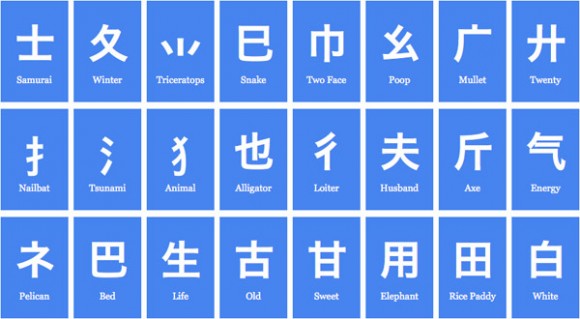
Yep, a lot of these radical's meanings are made up, but that's because "traditional" radicals are so useless In high school, I learned about kanji radicals in a way that would allow me to look up kanji in dictionaries. These are the radicals most Japanese teachers know about and use, but these radicals aren't that helpful. Of course, because of this, I had to learn kanji stroke by stroke by stroke. 18-stroke kanji? That's eighteen different things I had to remember, making learning one kanji really, really difficult.
These "other" radicals, however, are different. Every kanji (and I mean every kanji) should really only be made up of three parts (aka three radicals). Basically, these radicals are parts that make up a kanji. They're like smaller kanji (or pieces of kanji) that you can piece together to make a bigger kanji. Although there are around 200 radicals (depending on who's list you use), learning these 200 radicals can be pretty easy if you use mnemonics and SRS to learn them. Once you know these 200-ish radicals (I know, sounds like a lot, but it's not), all kanji can be created with three or fewer radicals. It's sort of like the difference between putting together a puzzle with three pieces (EZPZ Lemon Squeezy), or putting together a puzzle with 20 pieces (while memorizing where each piece goes for the next time you have to put it together). Over time, this really, really adds up.
If I had known about these kinds of radicals a lot earlier, I would have known a lot more kanji a lot earlier too. Japanese school kids spend around 6 years learning their Joyo kanji. Japanese language learners spend an upwards of 10+ years learning kanji. All this can be cut down to a fraction of both of those time frames if you use radicals (and mnemonics). Learning kanji faster than a Japanese school kid? Strangely enough, it's no problem at all. There's various methods for learning with radicals, including Heisig's, TextFugu, and Kanjidamage. All have their good points and bad points – I'd just recommend using the one that seems to work best for you.
5. Classrooms & Teachers Can Slow You Down (But Also Can Help A Lot Too)
A lot of my Japanese learning has been in classrooms, and I've learned a lot from that experience. Classes are great, because you have a teacher there to tell you what you're doing wrong. But, classes can also slow you down. Unless you're the slowest person in the class, the class is always going to prevent you from learning things as quickly as you actually can.
If you're in a class, I'd always recommend studying outside the class. You could focus on your weak points (aka point #9). You could study kanji separately from everyone (because kanji helps with everything). There's any number of things you can do. Even grabbing another resources and studying with it is good (because either it'll fill in the gaps of things that you're not learning in your class, or it will reinforce things you've learned and explain it in a different way).
Whatever you do, though, study outside the classroom is great. You shouldn't be tricked into thinking that a classroom is all you need. Think of a classroom as just a supplement to your learning, because there's really so much more that you can do.
4. Don't Learn Kanji In The Order They Tell You
They're liars! All of them! Perhaps I sound like a heretic, but I think kanji ordering is important, and the ordering they tell you is a false ordering. There's two ways to do ordering. One is traditional, and one is my way (and I'm sure other people have other ways that are just as good).
The traditional way has you learn like a Japanese school kid learns, aka in order of easy meaning to difficult meaning (which has nothing to do with how complicated the kanji itself is). So, for example, you'd learn 食 way before you learn 又. Although the meaning of 食 is way easier than 又 (which is why little kids with small brains learn them in this order), the kanji is not. And, I'm guessing you're kind of old now, so the meanings aren't really that difficult for you (but the kanji part is). So, why would you learn them in this order when meaning has nothing to do with anything?
Now, for me, I think it makes more sense to learn in order of simple to difficult kanji (not the meaning). There is a problem with this, though I think it's a problem only short-term thinkers will worry about. The problem is that you don't learn the most useful kanji first (which means you can't use the kanji in real life as quickly either). You're missing a lot of really basic kanji for a long time (like 食), and people don't like that.
I understand why that's rough, but the goal for me is long term, not short term. By learning in this order, you can use previous kanji to learn future kanji. You also get better at learning kanji, and you struggle less on a per kanji basis than you do the traditional approach, because you slowly get more and more difficult as you get better.
If the goal is to learn all the Joyo kanji (and I'd say this is the goal), then going in order of difficulty of the kanji itself is the way to go. You won't be able to use the kanji as quickly (which is a bummer), but you'll learn all the kanji way faster. So, short term you miss out on being able to apply the kanji, long term you just end up knowing all the kanji. I'll take the long-term approach any day. Learning Japanese is a long-term thing, anyways. You have time.
3. Learning To Write Isn't All That Useful

I'm not saying it's not beautiful, I'm just saying it's a waste of your time (right now) I've written about this on Tofugu before, and I even have people take this (somewhat controversial) approach on TextFugu. Many people say this is crazy, but those people can keep their pagers and hand-pens and join the Pen15 club. Writing isn't as important as it used to be. In fact, it's hardly important at all (especially when we start talking kanji). Now, don't get confused. When I say "writing," I mean hand-writing, not typing. Typing is great. Think about it – when was the last time you wrote anything with your hand. For me, I think it was when I signed a restaurant bill (and Japanese tend to use cash anyways, so no problem there).
But I know, I know. Writing helps you to remember kanji, blah blah blah. Maybe it does help you, but I don't think it's necessary to learn kanji, and I think it takes up more time than it gives you. Think of it this way. You could spend an extra 5 minutes practicing writing the kanji 食. Or… you could spend that 5 minutes learning to read the next kanji on your list. What does that achieve? That makes your kanji learning twice as fast, probably faster than that if you consider how much you end up practicing writing of previous kanji later on. So, the question you have to ask yourself is "do I want to be able to write this kanji, or do I want to learn another kanji?" Over time, this adds up.
That being said, I'm not saying you absolutely shouldn't learn to hand write. I am saying, however, that you shouldn't learn it right now. Learn it after you learn everything else. Learn it when it isn't keeping you from studying more important (and useful) things. I don't know how many hours I wasted trying to write kanji back in school. The moment I realized it didn't matter if I learned to write or not, I suddenly learned so much more. It's amazing how much time you gain by cutting this out of your routine. Most people tell you that you should learn it because "that's how its always been done." I say you should think about why you're doing something and come up with your own conclusions.
2. Mnemonics Aren't Cheating
I didn't know about mnemonics for a long time (which sucks). I also thought mnemonics were nothing more than parlor tricks when I first learned about them (another mistake). Now, I can't believe I ever lived without them. Mnemonics are boss, and if you're not using mnemonics, you're probably hanging out in the dust.
I'm not going to go into a huge thing about mnemonics here (but I did here), but here's the quick and skinny.
Mnemonics are basically techniques that allow you to associate one thing already in your brain with something that's outside of your brain (and needs to get in). To do this, you create hooks in your brain or you use stories that are more memorable, and add the new knowledge you want to remember to those. The goal of a mnemonic is to help you to recall an item, not necessarily to make you memorize something perfectly the first time.
Think of it this way. Your brain is full of memories. Each of those memories have little arms that can grab onto things. If you use a mnemonic, the thing you're trying to memorize will latch on to one of those hands. To remember the new memory, you just have to remember the thing already in your brain (which is way easier to do), and then use that to get to the new memory you want to recall. Do this enough and you'll eventually be able to recall that new memory without using the old one (and then it's memorized).
Now, if you try to memorize something without a mnemonic, it's like you're throwing that item into a dark hole in your brain. It tries to catch on to something, but there's no hands to clasp on to. It keeps sliding off the side of your brain, falling out. Eventually, it might stick, but there'll be nothing connected to it. When you try to retrieve it, your brain doesn't have any good way of getting there, so you just can't recall it very easily. If you do this enough, sure, it'll end up working… but how much time have you wasted?
Connecting a new memory to an old one is essentially what mnemonics do for you. It's how your brain works, and it will help you to remember a lot. Most commonly in Japanese, people use mnemonics to memorize kanji, though I think there's other ways to use mnemonics as well that haven't been explored as much. Just last week we started adding mnemonics to vocab on TextFugu, which I'm pretty excited about. Vocab is a really abstract thing to learn, and mnemonics help a ton.
1. I Should Have made More Mistakes

See? Won't be making this mistake, again. The number one thing I wish I had known about a long, long time ago, was mistakes. Seems simple enough, but when you think about it, we're wired to try to avoid making mistakes. It's embarrassing. It's painful. Yadah yadah yadah. Mistakes aren't things that we as humans like to make, probably mistakes usually meant death for us, but what if I told you that mistakes made you learn way, way faster (and you won't die, too, because saber tooth cats don't exist anymore)?
There's a few reasons for this.
- If you're not making mistakes, you're not pushing boundaries. If you're not pushing boundaries, you're going to end up learning at a slower pace.
- If you're afraid of making mistakes, you won't try to learn new things. To learn new things, you have to make a lot of mistakes.
- If you make a mistake, you can learn what you did wrong. Going back and learning why you did something wrong gives you better insight into the thing you're learning. If you're not doing this, you're just skimming the surface.
- If you're not willing to make mistakes, you're probably not willing to practice conversation with people. Practicing conversation is really important. It helps you to practice recalling things you've learned in new and different situations. Remember how important recalling information is for learning?
- Mistakes mean you're trying. If you're trying… well, that means you're trying. You should try more. The list actually goes on and on. No matter who you are, you can strive to make more mistakes. The important thing, however, is learning from them. That's why I wrote this post in fact, so you can learn from my own mistakes. Just remember, though, if you don't learn from your mistakes, you're wasting time by making the same mistakes over and over again.
So, the question is (and this is going to be gold mine of info), what mistakes did you make? What would you change about your Japanese learning past if you could? Let the younglings know what they ought to be doing in the comments below.
Hope at least one of these things have helped you, too!