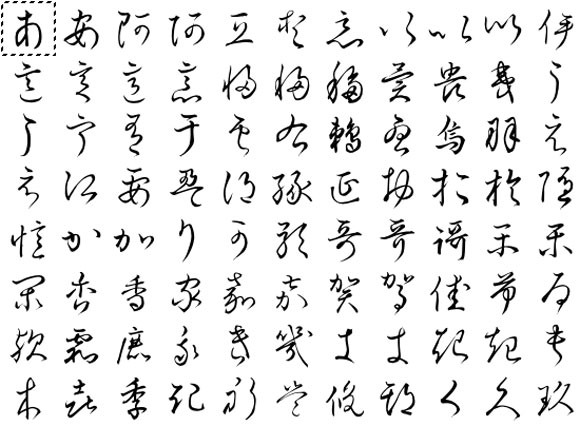
How Japanese Went From Illegible To Legible In 100 Years

Most languages have different ways of writing letters and characters. In English, there’s not only printed script, but cursive, and a million different fonts and variants thereof, and people are constantly churning out new and different ways of expressing the English language.
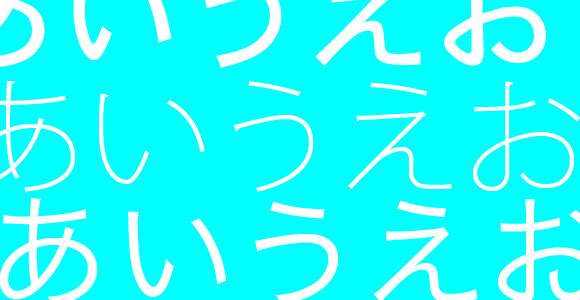
Japanese is no different. There are tons and tons of ways to write the same hiragana, katakana, and kanji. You may have heard of “kawaii” handwriting that swept Japan by storm in the 70s, but Japanese goes so much farther than that.

But have you ever seen written Japanese that just looks like a bunch of scribbles (more so than usual)? Let me introduce you to hentaigana and kuzushiji.

Hentaigana
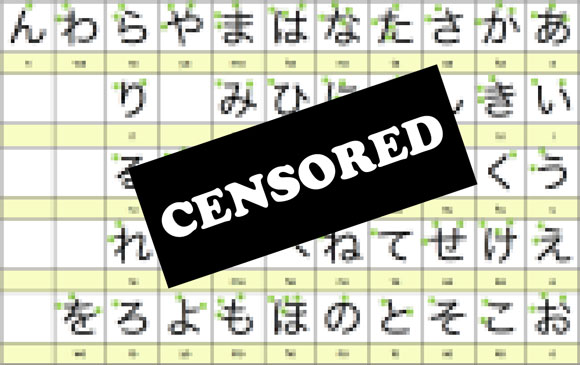
At the core of Japanese there’s hiragana, the basic Japanese alphabet (or syllabary, if you want to be pedantic about it). But it wasn’t until pretty recently that hiragana was standardized. Until the 20th century, people could basically write hiragana however they wanted to.

Those different ways of writing hiragana were called hentaigana (変体仮名). No, not that kind of hentai. In this case, hentai translates to “variant” instead of “pervert,” so hentaigana is “variant kana.” (As far as I know, perverts don’t have their own, special alphabet.)

Can you read this hentaigana? Me neither.

These hentaigana looked like if somebody told you to make hiragana as sloppy and unreadable as humanly possible. They all roughly look like standard hiragana, but if somebody was having a stroke in the middle of writing them.

Fortunately, Japanese went through tons of changes in the early 20th century to streamline and simplify the language to make it more accessible. Since then, hentaigana has fallen out of favor with pretty much everybody. The only real exception are soba shops that want to look all fancy and old-timey.

Kuzushiji

Another way people used to write Japanese was kuzushiji (崩し字 ), which was basically cursive characters. Like hentaigana, kuzushiji looks like what my handwriting would look like if I lost all motor control, but kuzushiji includes more than just hiragana – kanji gets thrown into the mix too.

Interestingly with kuzushiji, the more common a character is, the worse it looks. The logic is that if the character is used often enough, you should be able to recognize it anyway because a lot of people would be writing it this way. Right? Well, maybe not.
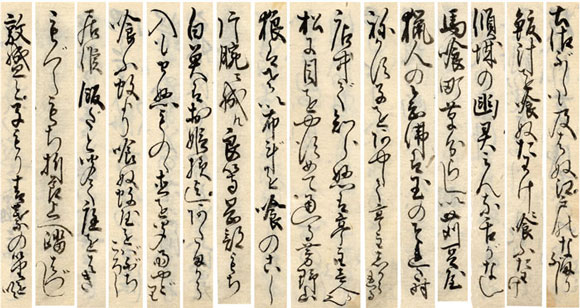
So how do you read kuzushiji if you’re not, say, a 18th-century Japanese elite? Fortunately for us there are dictionaries for kuzushiji, along with books that print original literature written in kuzushiji alongside the same text written in standard Japanese.

Handy stuff, especially if you’re a Japanese literature nerd. But if you are familiar with Japanese, then you know how useful context can be in understanding things you don’t know.

For more on kuzushiji, check out this great introduction to kuzushiji.

Kanji Amnesia

It shouldn’t be a surprise that you might not recognize kuzushiji or hentaigana. After all, handwriting has been on a slow and steady decline ever since the invention of the printing press.

If you’re like me, most of the writing you do is either on the computer or cell phone. And in Japan, some people are worried that all this technology is causing people to forget how to write kanji by hand.
This phenomenon of people forgetting how to write kanji is called kanji amnesia or character amnesia, and Koichi wrote about it more in-depth a few years back (and even talked about it on the BBC at about 39:20 in).

What It All Means

Is it a good or bad thing that we don’t have things like hentaigana and kuzushiji around anymore? Well, on one hand you could argue that handwriting is less expressive and individual than it used to be back in the day. Characters have become more standardized and arguably, more boring.

On the other hand, those standardized characters and ways of writing mean that we can actually read what people write instead of having to guess. I’d say that because handwriting is no longer a huge distinguishing part of writing, content becomes more important.

P.S. Twitter
P.P.S. Facebook Google+

  • Brandon Inoue

    Writing, like language, must evolve with its environment.  I don’t think it’s necessarily good or bad but we’re lucky these days that we have hard drives, airplanes, and books instead of stone slabs to help us interpret languages.  How we write language is merely a consequence of how we communicate.  I don’t know a heck of a lot of people who use shorthand but it was popular at a certain time in our past. 

    However, at heart I’m a bit of a traditionalist (just a bit).  I can write Japanese better than I can write English in print.  My cursive is lovely but nobody uses that anymore either.  http://www.humordairy.com/mr-troll-strikes-again-cursive/

    I think I’ll be writing cursive until the day I die.  It’s faster for me and people can read my handwriting that way (provided that they know how to read cursive).  Also, it’s like hidden code for my Japanese coworkers (they can’t read it) and I’m sure I’ll be using it to stage an awesome plot of discovery for my detective grandchildren who will find my writing and use the version of the internet to research what the scribbles on the paper mean. 

  • ZXNova

    Isn’t another word for hentaigana (or kuzushii) sosho style writing? Sosho is basically the weird sloppy kinda of writing Japanese.

  • ZA다ルﻣ

    cool, cool! i have to check out BBC’ing Koichi–sounds big-time! (though, i have a feeling it wasn’t, seeing it’s been about a year and a half already)

    the article layout was great this time. not too long, each section just enticing enough to read it to the finish, and with links for further reading for the curious. the net is vast, isn’t it?

    i like to think that the way someone writes says a lot about them. it might not, but making fun of the way someone writes is, for me, great fun.

    for learning the few kanji I know, it really helped me to write them out. when i have free time or nothing to do, or if the professor is boring and makes me feel like i have better things to do, i’ll whip out my pen and write away. writing them out instead of typing them gives the kanji a sense of realism, something that can’t be achieved with a simple ctrl+v. and that helps me learn them, too.

  • Cat

    I absolutely love the way you write. It’s fun and informative at the same time. Great!

  • MilkyChocoxD

    Hentaigana looks harder to write then Hiragana O.O

  • Kiriain

    So wait… Wouldn’t Kawaii handwriting be like l33t5p34k?

  • Anonymous

    I had my name written in Japanese hiragana (I believe) and wanted an opinion on if it was close to hentaigana or not.

    Btw, my name is Jordan and they tried writing that.

  • http://www.tofugu.com/ Hashi

    Something like that, but for school girls in the 70s.

  • http://www.tofugu.com/ Hashi

    Thank you, much appreciated

  • http://www.tofugu.com/ Hashi

    To be honest, I’m not sure what the difference is between kuzushiji and sosho.

  • http://www.tofugu.com/ Hashi

    Yeah, that’s hiragana. I wouldn’t say that it’s hentaigana, because it looks close enough to standard hiragana characters, rather than crazy variants.

  • http://www.tofugu.com/ Hashi

    I’m glad you liked the layout of the article! I hope I’m getting better at that kinda thing. And I agree that writing out kanji gives you a difference experience from typing.

  • http://www.tofugu.com/ Hashi

    I’m jealous that your cursive is so good. I remember learning it in one grade in elementary school, then never using it for anything ever again except for my signature. Maybe one day I’ll revisit cursive so my handwriting doesn’t look so childish.

  • http://twitter.com/shollum Shollum

    I can’t read cursive English very well! How am I supposed to read kuzushiji?!

    I’m sorry about my nitpicking, but in paragraph 6 (I think) you have this:
    “but if somebody was having a stroke in the middle of writing them.”
    It should have ‘as’ after ‘but’.

  • http://profiles.google.com/jonadab.theunsightlyone Jonadab the Unsightly One

    You know what would make Japanese more legible?  Pervasive furigana.  

    Unicode really missed the boat, IMO, in failing to treat furigana (and other forms of ruby text) as diacritics, which they really are.  They help the reader know how to read (pronounce) the text, just like vowel points for Semetic languages or accent marks on European languages.  If Unicode had included “combining furigana” characters from the get-go, software would all support it by now, so at least people writing Japanese on a computer would have the *option* of including furigana in a convenient fashion, as part of the main text stream, without a lot of fooling around and messing around trying to figure out how to position those glyphs up there.

  • http://www.tofugu.com/ Hashi

    Why isn’t Ruby a good substitute?

  • http://twitter.com/Camemberu Catherine Ling

    I’m sorry but I see it as beautiful calligraphy!

  • Sarah

    I am a huge advocite for learning cursive (mostly because I spent over 6 years of my life learning the stuff and I’ll be damned if I’m not going to get some work out of it or make my future children suffer the same fate).
    I can understand streamlining public writing, just like not everyone can read cursive (I still have trouble), so books or things like that should have some level of standard.
    Handwriting is very useful for revealing certain traits; patience, attention to detail, general personality (hyper, quiet, etc.) My handwriting is a combination of cursive and print, I press with medium pressure (a fairly level personality) and blurr words together or write too fast and it looks sloppy (lack of patience and attention to detail).

  • カイエン

    I read that hentaigana Wikipedia page you link a whole ago.

    Hentaigana is more than just differently written hiragana characters. When the system of using a character for its pronunciation rather than meaning started, there was a handful of different characters with the same reading that could be used for any syllable. And then on top of that is the super cursivization you write about. But the main thing that makes hentaigana different from their standard equivalents is that they are often based on different kanji.

  • http://twitter.com/0LovelyMadness0 Emily

    I keep staring at the pictures like I’ll be able to decipher the kanji just by looking at them….

  • Koichinist

    We need a koichigana.