
The Kana, They Are A-Changin’

Bob Dylan, esteemed Japanese linguist

Languages are always changing. The English that you and I speak today is almost completely different than that English people spoke a hundred years ago, and it’s even a little different than the English people spoke in the 90s. (Who says “tubular” anymore?) Japanese is the exact same way, but some people don’t really realize how much Japanese has changed.

Reform!

Why does language change? Some of it is a natural progression, with words and phrases going in and out of style, eventually becoming phased out of a language. But sometimes language is changed very deliberately and carefully. Probably the best example of this is the Academy of the Hebrew Language, located in Israel, which studies and regulates Hebrew. The Academy figures out how to fit new words and concepts like “Twitter” into the Hebrew language while staying true to tradition.

There isn’t really an organization in Japan equivalent to the Academy of the Hebrew Language, but over the years there have been efforts by the Japanese government to curate the Japanese language.

Post-War Changes

In 1946, right after WWII, the Japanese were open to all sorts of big change. Like, huge changes. Since most of Japan had been bombed into oblivion, the country was rebuilding literally from the ground up, and lots of people thought it was the perfect time to change Japanese society.

Dammit MacArthur, what’d I say about using romaji?!

Some Japanese wanted to adopt another language altogether. Novelist Naoya Shiga thought French sounded good and wanted the Japanese to adopt it as Japan’s national language. Needless to say, people weren’t enthusiastic about it.

Lots of people were fine with Japanese, but wanted to streamline the language a bit more. The American Occupation wanted to eliminate kana altogether and make Japanese all romaji, which didn’t go over well (surprise!).

When the whole romaji thing didn’t pan out, the Occupation tried other ways to simplify Japanese. They attempted to cut down on the number of kanji in Japanese by creating a standardized list of kanji for everybody to learn. So yes, you can blame/thank the American Occupation for the Jouyou Kanij.

But it wasn’t just kanji that was changed after the war. Even hiragana, one of the most basic written elements of Japanese, was changed to what we know as gendai kanazukai (modern kana usage). I like to think of gendai kanazukai like a huge patch for the Japanese language with bug fixes and balance changes.

The Kana You Never Learned
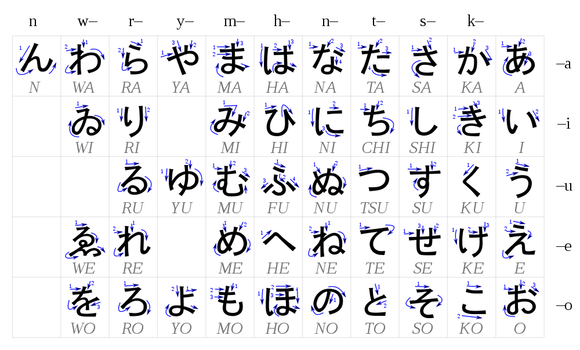
As part of these language reforms, the Japanese cabinet removed both wi and we from official usage. The kana wi (ゐ in hiragana or ヰ in katakana) and we (ゑ in hiragana or ヱ in katakana) were once part of hiragana as much as あ or ん, but wi and we were phased out because, quite frankly, they weren’t really needed. You can make roughly the same sounds with ui (うぃ) and ue (うぇ), and by that time most people had pretty much abandoned wi and we anyway in favor of i and e.

Today, some people still use wi and we occasionally (just to be super cool and ironic, I’m sure), but you really won’t see them around too much. Both are very much on their way out of the Japanese language, and will soon be to the Japanese language what “ð” is to the English language.

Another change that was made with gendai kanazukai was yotsugana (四つ仮名), or “four characters.” Before gendai kanazukai, four characters (じ, ぢ, ず, and づ) had really confusing and different pronunciations. Nobody could agree on how to pronounce the characters. With gendai kanazukai, the yotsugana were given two official pronunciations: じ and ぢcan be pronounced as ji or zi, and ず and づ can be pronounced as zu.

But that’s not even mentioning the nicest change that came with gendai kanazukai. There didn’t used to be small kana, so if you saw a word like りよう, you’d basically just have to guess if it was pronounced riyou or ryou. Given, you could often guess from context, but anything that gives clarity can’t be bad, right? After gendai kanazukai, you have りよう for riyou and りょう for ryou.

[hr]

Wish you could have been on the committee that changed Japanese language as we know it? What would you have done? Let me know in the comments.

P.S. Glad Japanese isn’t all romaji? Follow us on Twitter.
P.P.S. Do you wish a little that you didn’t have to learn all that kanji? Like us on Facebook.


[Header Image]

  • http://ogijima.com David @ Ogijima

    Great post. I love history of languages (and I have yet to learn most of the Japanese one).
    Oh by the way, this Naoya Shiga was a genius, Japan should have followed his idea.

  • http://pulse.yahoo.com/_VUB25XU2HNXKINDGV3U6RS3GNU Roddy

    Check out cans of Ebisu beer the next time you are in the konbini

  • Rashmi

    I really enjoy these history lessons. Hope there’s more coming:))))

  • http://www.tofugu.com/ Hashi

    I can’t imagine how different the course of Japanese history would have been if Japan adopted French.

  • Mark Weber

    Japanese in all romaji would make it pretty simple :D

  • http://www.tofugu.com/ Hashi

    Oh, interesting. I don’t think I’ve ever seen an Ebisu beer can, but I assume that they probably use the old kana to show how much of an “old school” brewery they are.

  • http://www.facebook.com/profile.php?id=100002881734672 Lyon Kuralapnik

    As an Israeli, a little sparkle has appeared in my eye reading about the Hebrew academy ^_^
    Awesome post!

    P.S. – Ditch French. Let’s all speak good ol’ Hebrew.
    אהבתי!

  • http://www.tofugu.com/ Hashi

    Always! :D

  • http://www.tofugu.com/ Hashi

    In some ways it would be a lot easier for westerners to read, but it would be a nightmare to read in a lot of other ways. Kanji, as big a pain as it is to learn, helps a lot with readability and breaking up sentences.

  • http://www.tofugu.com/ Hashi

    Glad you appreciated the reference! The Hebrew Academy is just so interesting to me because in the United States, language is very much a free-for-all. The idea of one organization curating language so carefully is just such a different concept to me.

  • http://www.facebook.com/profile.php?id=100002881734672 Lyon Kuralapnik

    There is actually a lot of criticism against the Hebrew Academy for being useless, making odd-sounding words that no one uses. 
    Who’d want to call facebook partsuf-sefer and twitter metzayetz? Not me :)
    Although earlier they were very important ever since the language was reborn and needed a lot of changes.

  • Carolinerobinson1456

    I just showed this to my Japanese professor along with the article on Babigo and she loved it! She thought it was very insightful and she might use it in class tomorrow. Great job tofugu! :]

  • http://www.tofugu.com/ Hashi

    Awesome! That just made my week! :D

  • J.Paul

    I can’t be the only person who noticed that Nichijou mangaka Keiichi Arawi’s name is usually spelled あらゐけいいち.

  • http://www.callistospatches.com Callisto

    The headline frightened me. I shook my fist to the heavens and cried out in agony.

    But I’m cool now. It’s cool. It’s all good.

    Also, anyone else think ゑ is really freaking pretty?

  • Hailey

    Ah I have that chart with “we” and “wi” (I printed that one because it showed stroke order), and I’ve always wondered why those two hiragana were on there even though I had never seen them before.

  • http://www.tofugu.com/ Hashi

    Yeah, I guess that the headline’s a bit misleading :p It should be “The Kana, They Changed,” but I don’t think that was a Bob Dylan song.

    Weirdest part about ゑ? It’s all ONE STROKE.

  • http://www.facebook.com/people/Jeffrey-Ngare/733548073 Jeffrey Ngare

    I can appreciate the difference between びよういん (beauty salon) and びょういん (hospital) due to gendai kanazukai. My sensei was very careful to differentiate the two (for good reason).

  • glitterpillz

    i’d bring back the “wi” and “we” they look fun to write :P

  • http://www.tofugu.com/ Hashi

    Ooh, that’s a much better example of that than what I had. Good call!

  • http://www.tofugu.com/ Hashi

    Very loopy!

  • http://www.tofugu.com/ Hashi

    Yeah, I’m not sure why they’re still included on hiragana charts. I’m not sure if I’ve ever seen we or wi in real life.

  • Anonymous

    I could never figure out the difference between wo or we, cause though I recognize their shapes I couldn’t tell which was which because I had never had to use it before. =/.

    Nicely written post! Very informative. Not too long, not too short. Just perfect~ Well done!

  • Falconfree

    Yeah, the headline scared me too! =P

  • http://www.tofugu.com/ Hashi

    Thank you, glad you enjoyed my post!

  • John
  • Eri

    Does this mean that in the future English isn’t going to have the letter ‘c’ because it makes the same sounds as ‘s’ and ‘k’, and ‘x’ will be abolished because it sounds like ‘ks’? Hrrrmmm…

    Everything in Romaji wouldn’t be so bad as long as they spaced it out like we do with words in English. If it was all stringed together you’d never figure it out :/

  • http://twitter.com/WilliamBurgett1 William Burgett

    That’s pretty interesting, now it makes sense why the w sounds were cut down.

  • http://twitter.com/WilliamBurgett1 William Burgett

    That’s pretty interesting, now it makes sense why the w sounds were cut down.

  • http://profiles.google.com/bangalterdaft Thomas Guy-man Bangalter Chris

    Nver knew the occupataion did such thing. Maybe they missed to give a maximum of 2 meanings for each kanji some of them have way too much meanings.

  • Tiffany Harvey

    They are a pain to learn, but I’d rather have the Kanji. There are so many new words that you can guess the meaning of from the Kanji, but from Romaji I’d be clueless.

    There are also a ton of words with the same reading, and when you have a few in the same sentence it’s not to so easy to guess from context. I’ve had difficulties trying to translate children’s books written in all Hiragana (I think there might have even been spacing!).

  • http://www.callistospatches.com Callisto

     It’s not necessarily misleading. In a couple hundred years’ time, it’s probable the kana will morph at least a teensy bit, right? Or by then we’ll be communicating via a computer chip in our brain and won’t need to write anything. Hopefully the chip will have endless streams of Mameshiba videos.

  • Guest

    if the Japanese was all in romaji i wouldn’t even consider it “Japanese”
     im a beginner and i struggle, just like any other :p
    but i like Japanese the way it is now.. that’s what makes japan so interesting on my own opinion though..
    nice post!

  • Guest

    if the Japanese was all in romaji i wouldn’t even consider it “Japanese”
     im a beginner and i struggle, just like any other :p
    but i like Japanese the way it is now.. that’s what makes japan so interesting on my own opinion though..
    nice post!

  • Anonymous

    if the Japanese was all in romaji i wouldn’t even consider it “Japanese”
     im a beginner and i struggle, just like any other :p
    but i like Japanese the way it is now.. that’s what makes japan so interesting on my own opinion though..
    nice post!

  • 39

    Only for short words. Anytime I try to read something in romaji that’s more than three or four characters, it just looks like a jumbled mess of letters. Spreading out the sound into multiple, variable width characters makes it hard to read.

  • 39

    ゑ looks like る hitched a ride on a poorly drawn bird. You go, little る! ら, り, れ, and ろ are all proud of you.

  • aneiyo

    What the heck is this “ð”? I need to know.  A six and an x had sex?

  • Hinoema

    With no spaces, somewhat random punctuation and a limited number of sounds to represent thousands of words? It would be a nightmare. Kanji can immediately indicate a meaning (or a few potential meanings, and the addition of context usually makes the intended meaning pretty obvious). It is a challenge to learn a semanto-phonetic script if you’ve been raised with an alphabetic language, but the alternative would be an undefinable mess of similar sounds and limited romaji syllables. 

  • Hinoema

    With no spaces, somewhat random punctuation and a limited number of sounds to represent thousands of words? It would be a nightmare. Kanji can immediately indicate a meaning (or a few potential meanings, and the addition of context usually makes the intended meaning pretty obvious). It is a challenge to learn a semanto-phonetic script if you’ve been raised with an alphabetic language, but the alternative would be an undefinable mess of similar sounds and limited romaji syllables. 

  • http://profiles.google.com/shahiirosan shahiir mizune

    ヱ is used to write the title of anime called evangelion

  • http://www.tofugu.com/ Hashi

    Nobody knows :o

  • タカヤ・ノリコ

    ヱヴァンゲリヲン, to be exact. It’s got a ヱ and a ヲ for no reason. But only in
    the new movie versions. Maybe Hideaki Anno just really loves them, they
    also appeared in ヱクセリヲン and ヱルトリウム, the spaceships from GunBuster.

  • http://www.callistospatches.com Callisto

     Okay that was just cute.

  • Murtaza Syed

    i started investigating the Japanese through wikipedia. then i got so interested, and now i’m starting my second year.

    but wikipedia still shows those obselete kana, and ゑ was definitely my favorite. i’ll never forget that little guy.

  • 80sGeek

    I still say tubular… Lol.

  • Madbeanman

    If they had have adopted French it would have made my Degree easier (Japanese and French) but also a little less relevant. 

    I personally think they should speak Irish. When they come over to my Uni and learned Irish they really caught on very quickly, far better than we do. 

    Also this post blew my mind.  Fair play Mr Bridge or is it Mr Chopsticks????????????????????

  • http://www.tofugu.com/ Hashi

    Mr. 橋 :)

  • http://www.facebook.com/profile.php?id=1550596562 Alexa VanDemark

    This is so interesting. I doubt my teacher would have ever mentioned this – makes me want to take Japanese history classes!

  • Everybody Know

    It’s Eth