
To learn hiragana is to create a foundation for the rest of your Japanese. By learning hiragana, you will learn the basics of Japanese pronunciation. It will also open doors in terms of the Japanese resources you can use. There are no (good) Japanese textbooks or learning resources that don't require you to know hiragana. In essence, it's the first step to learn Japanese.
Many classes and individuals spend months learning hiragana. This is too long. You should be able to learn everything in a couple days. A week, tops. Some people have reported back that they could read all the hiragana after a few hours, using this method. How long it takes depends on you, but if you follow the steps laid out below, you'll come out the other side with the ability to read hiragana.
To make this possible, you will employ a few important methods.
-
Mnemonics: Due to hiragana's relative simplicity (at least compared to kanji), image-based mnemonics are a perfect method for memorization. Each hiragana character has a memorable illustration that goes along with it. For a long time I believed that mnemonics were a waste of time. If this is you, I recommend you give it a serious try. It's amazing what you are able to memorize when using a mnemonic method.
-
No Writing: "WHAT? NO WRITING!?" you scream. I know what you're thinking. But, think about it for a moment. When's the last time you actually wrote something by hand? Probably the last time you had to sign your name on a receipt at a restaurant. The need to write by hand is going down. Most of your written communication comes in the form of typing. Learning to read can be done very quickly and is very useful. Learning to write doubles or triples how long it takes to learn hiragana, with very little real-life benefit. It will be important to learn eventually, but for now you have more important fish to fry.
-
Exercises: After studying each column of hiragana, there are exercises for you to go through to review what you've just learned. They also happen to be very well thought out, too. If you do them, and you don't cheat (yourself), you will learn hiragana. In these exercises, you should do your best to force yourself recall items, even when you don't think you can come up with the answer. The more effort and strain you put into recalling something, the stronger of a memory your brain will end up building (as long as you actually recall it, that is).
For the most part, if you follow along and do everything that this hiragana guide says, you will learn the hiragana. It will be difficult not to.
Tofugu's Learn Hiragana Book
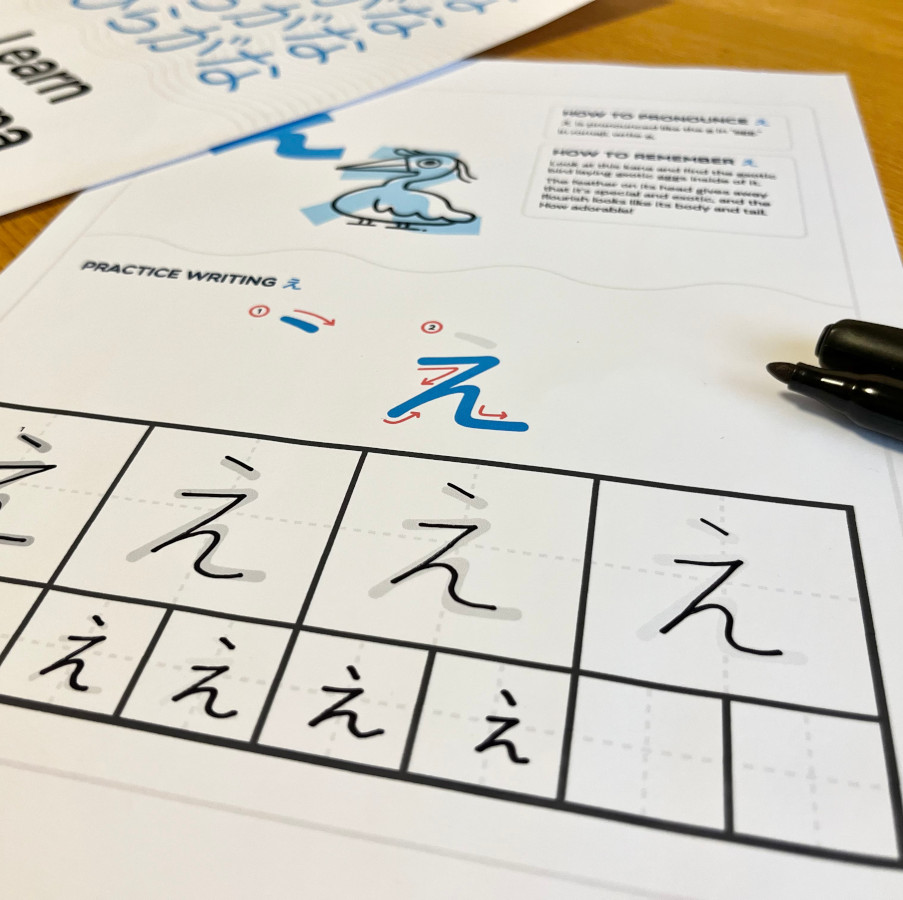
Before getting to it, I wanted to let you know that we also have Learn Hiragana Book — a PDF version of this Learn Hiragana content you can print or use on your tablet.
Although I would still focus on "being able to read hiragana" first, moving your hands to handwrite as well as to trace over the characters will help you associate the shape with the sound.
If hands-on practice sounds like your kind of studying method (or if you simply prefer going analogue), check out the book. It comes with extra practice on handwriting.
Tofugu's Hiragana Charts
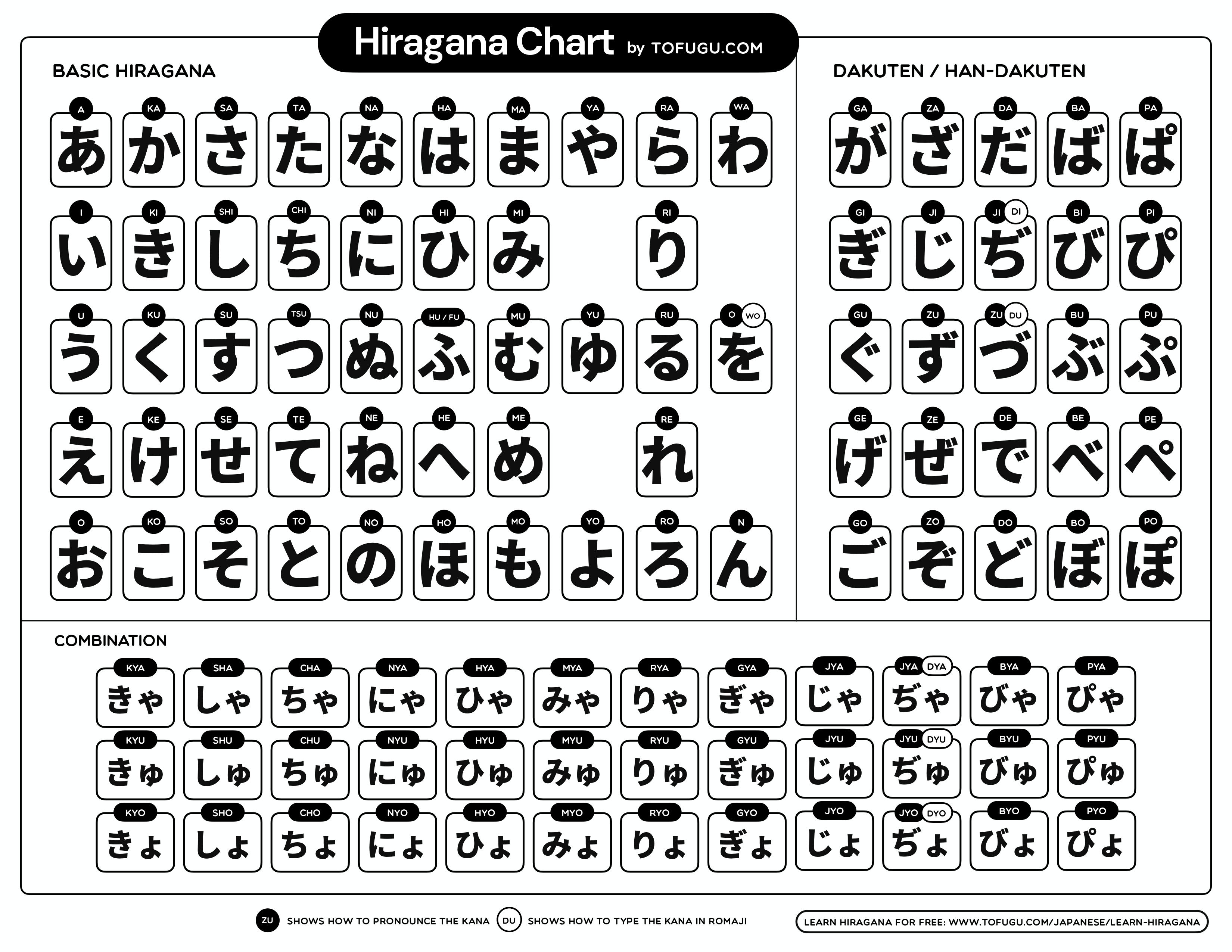
As the first step, download this hiragana chart. It shows all the hiragana (including "variation" hiragana) you will be learning on this page. If you have a printer, print it out. If not, you can follow along digitally too.
Optionally, download the hiragana "mnemonic" chart. It's a handy chart that shows basic hiragana along their mnemonic images, which we'll be using on this page to help you remember the hiragana. Temporarily or not, it'll make a good replacement for the "Live, Laugh, Love" poster on your bathroom wall.
Hiragana Pronunciation
Next, learn how to pronounce the hiragana. Since hiragana pronunciation is such a listening and speaking thing, we made a video to cover this topic. Follow along.
When you can pronounce the five "vowel sounds" of hiragana, move on to the next section, where you'll learn to read them.
あ い う え お
This is the first (and most important!) column in hiragana. It sets the pronunciation of every other column coming after it, because every other column is basically just the a-i-u-e-o column with consonants attached to them. The same basic sound repeats over and over and over, with a consonant plus these five vowel sounds, so make sure you have the right pronunciation for these five right from the start.
Shall we? No, that's okay, after you.
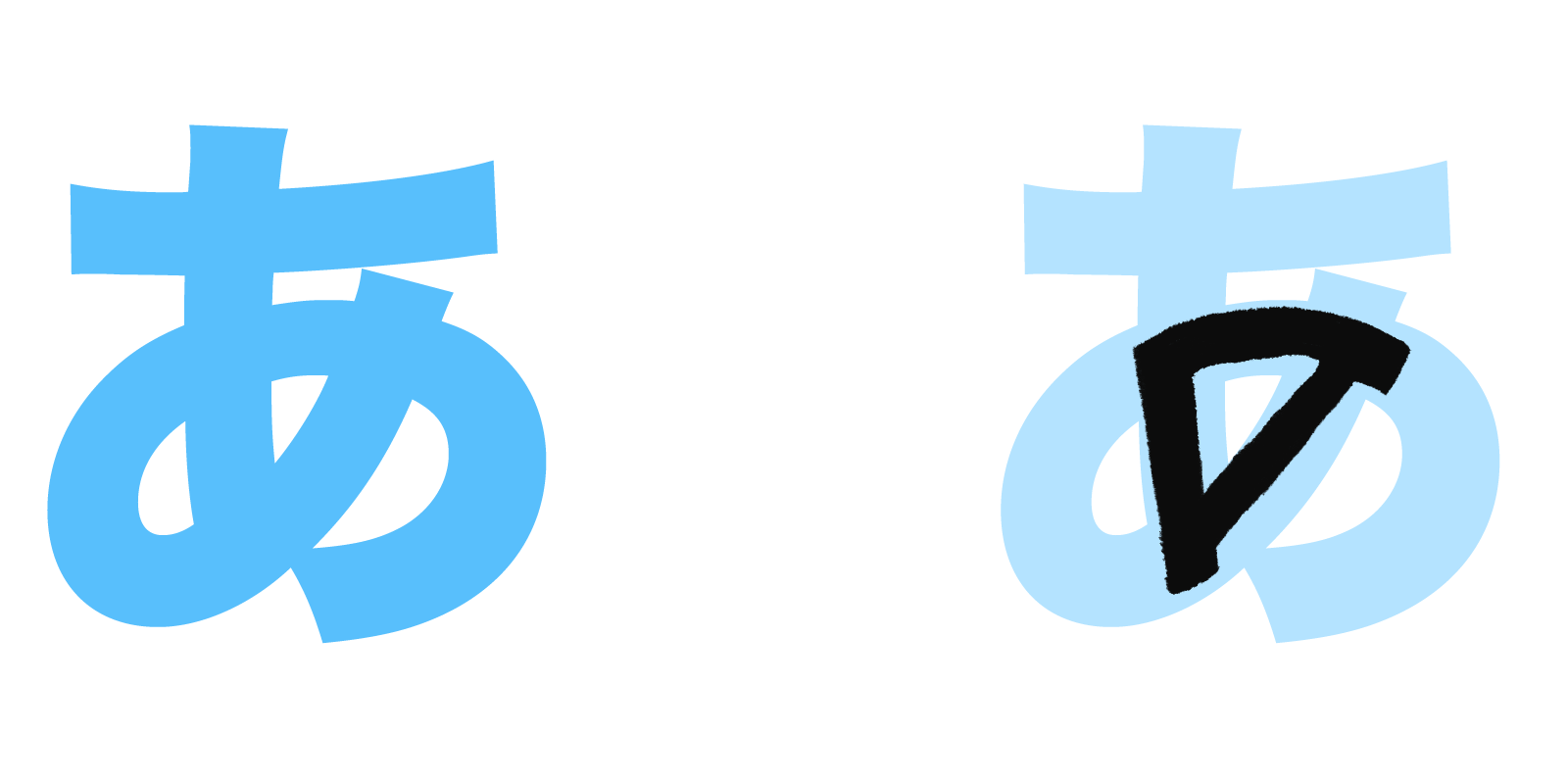
あ is pronounced like "ah!" like when you come to a realization. It also sounds like the a in "car."
- あ
- A
To remember this kana, find the capital A inside of it. This "A" will tell you that this kana is also "a" aka あ. There is another similar kana, お, but that one doesn't have an "A" in it, which is how you can differentiate them.
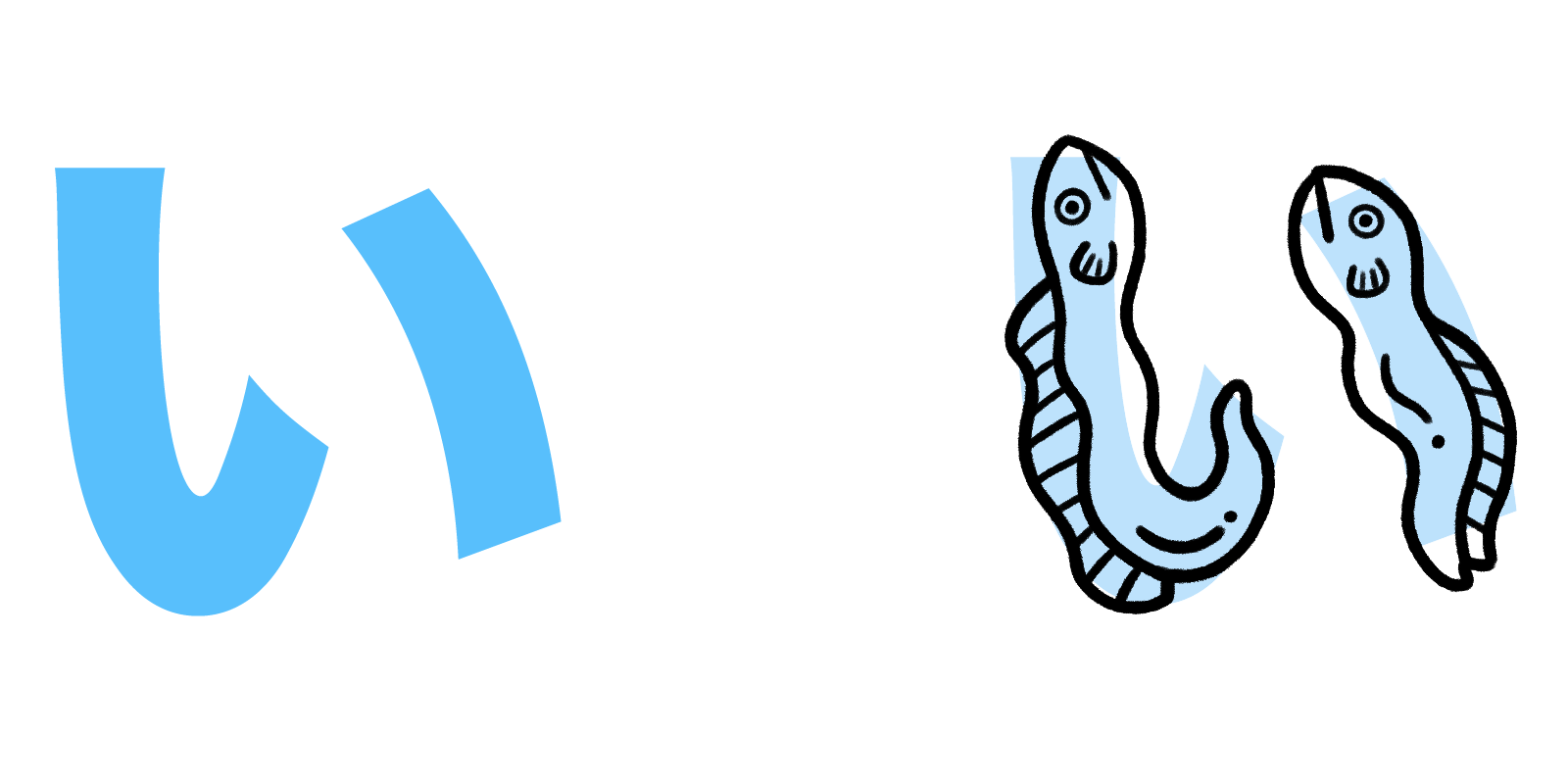
い is pronounced like the ee in "eel."
- い
- I
To remember this kana, just think of a couple of <u>ee</u>ls hanging out. They're upright because they're trying to mimic the letter "i" which also stands upright and also happens to be the way you spell out this character in romaji1.
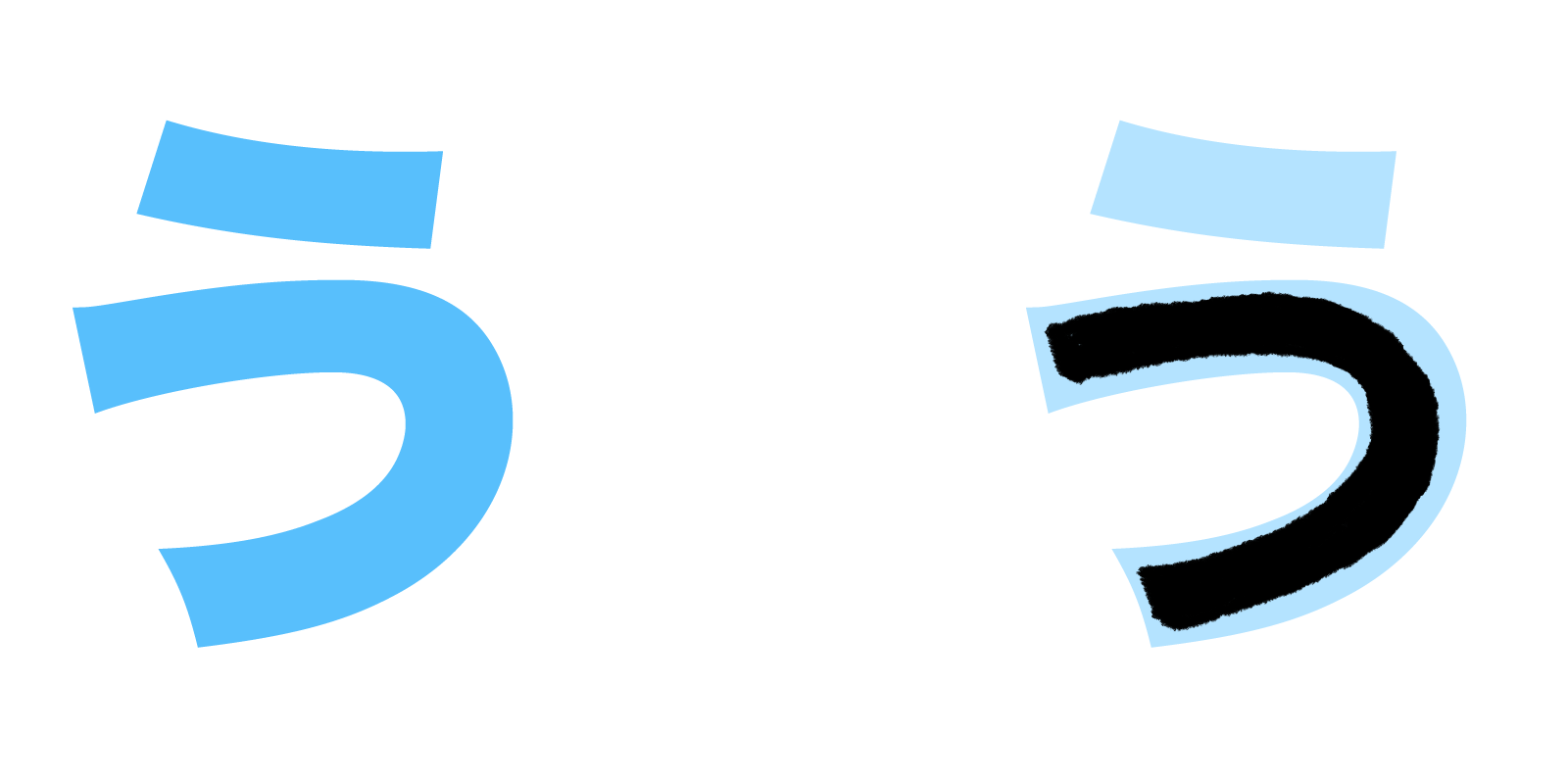
う is pronounced like the oo in "ooh… ahhh!" when you're watching fireworks. In other words, it sounds like u in "UNO," the card game, or the number one in Spanish.
- う
- U
To remember this kana, notice the U shape right in it! It's sideways but it's there, telling you what this kana is. Be careful, there's another similar hiragana, つ, but that one isn't wearing a hat like U (you) are. Ooh, ahh, what a nifty hat!
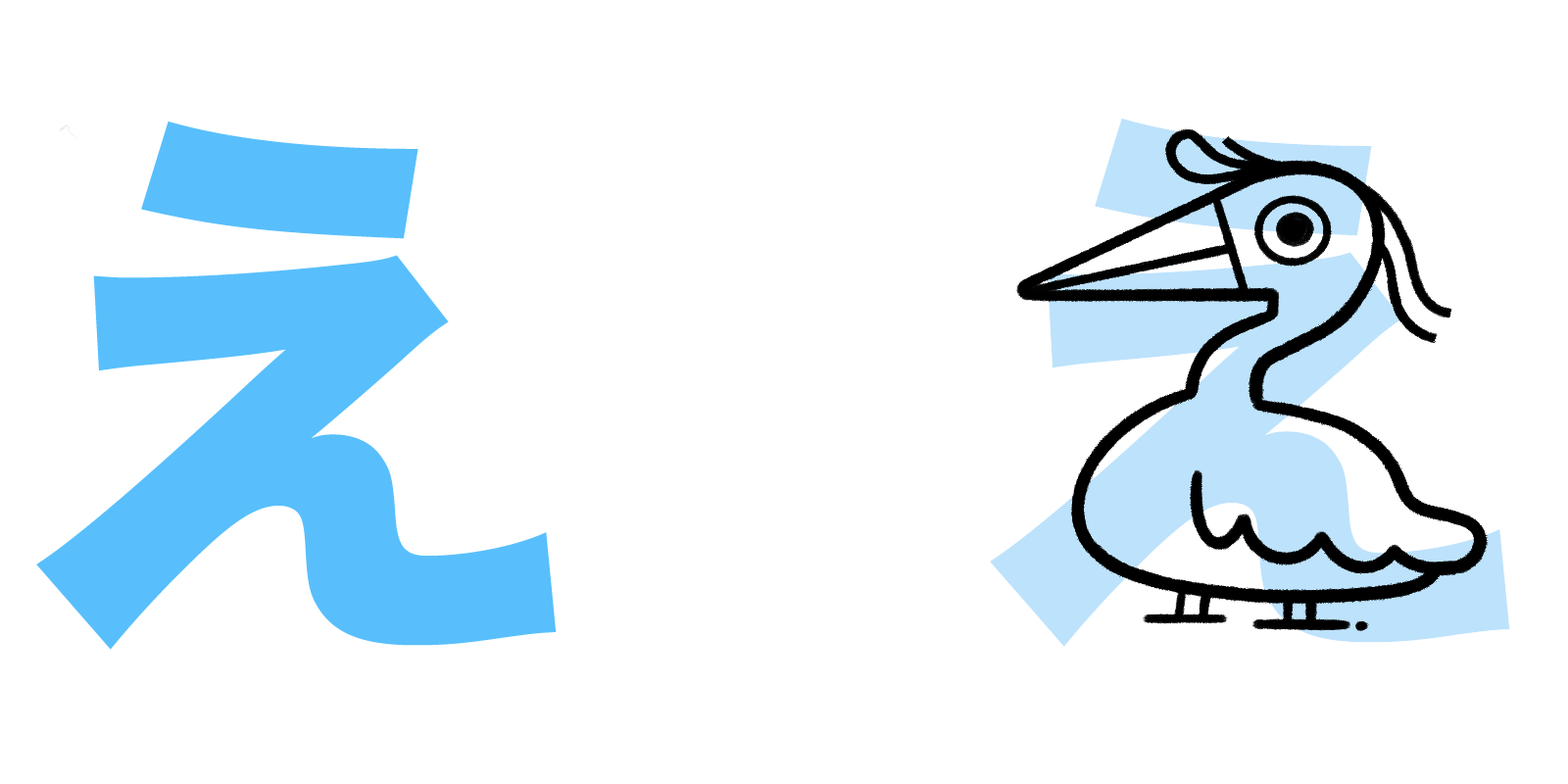
え is pronounced like the e in "egg."
- え
- E
To remember this kana, think of it like an <u>e</u>xotic bird. The feathery thing on its head gives it away that it's exotic and not normal. It also lays <u>e</u>xotic <u>e</u>ggs, because it's an exotic bird, after all.
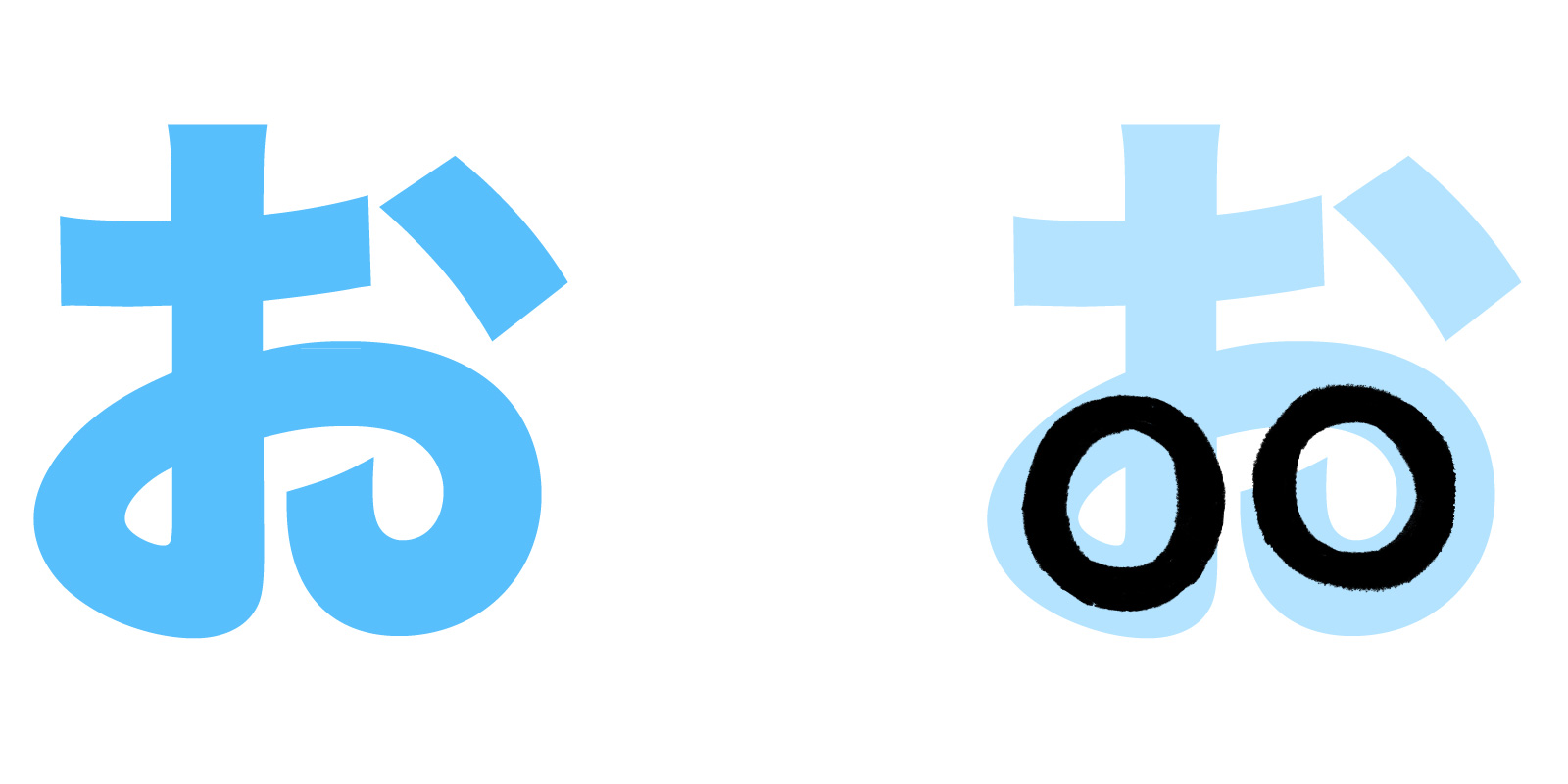
お is pronounced like you're saying "oh." It also sounds like the o in "origami."
- お
- O
Can you see the letter o in here, two times? This one looks similar to あ, except for its one key difference: there are two letter "o" symbols visible in there. Make sure you use this to differentiate this kana (お) and that similar kana (あ). This is one area of hiragana where a lot of people trip up, but by using this mnemonic you will be able to figure them out every time.
あいうえお Tasks
Now that you've put these kana into your brain (at least somewhat shakily) it's time to pull them out. Recall is the foundation of memory, and you're going to start doing just that. For each "tasks" section make sure you follow along perfectly. Skipping these steps may cause you to fail later on in the future. Having a strong base to build off of is important with each section.
- Head over to Tofugu's Learn Hiragana Quiz. Select only the
あ/abox under the "Main Kana" list, then hit "Start Quiz!" and keep practicing until you can get them all right. - Print out, copy, or download this worksheet. You'll need to go through it, filling in the boxes with the romaji for the kana. Try your best not to cheat – even if you spend a while trying to remember a kana it will be beneficial to your memory (as long as you're able to recall it on your own). Looking up the answer doesn't help your memory at all, but struggle (with accomplishment) tells your brain that this is a thing worth remembering. Try using the mnemonics when you need to recall something you can't figure out right away. This should be fairly easy with only five kana (and maybe a little boring too), but when you're done move on to the next five hiragana.
か き く け こ
The next set of hiragana is from the "k-column." This is just the K sound plus the vowel sounds you learned above, making it ka-ki-ku-ke-ko. There are no weird exceptions in this column either, so enjoy it while you can.
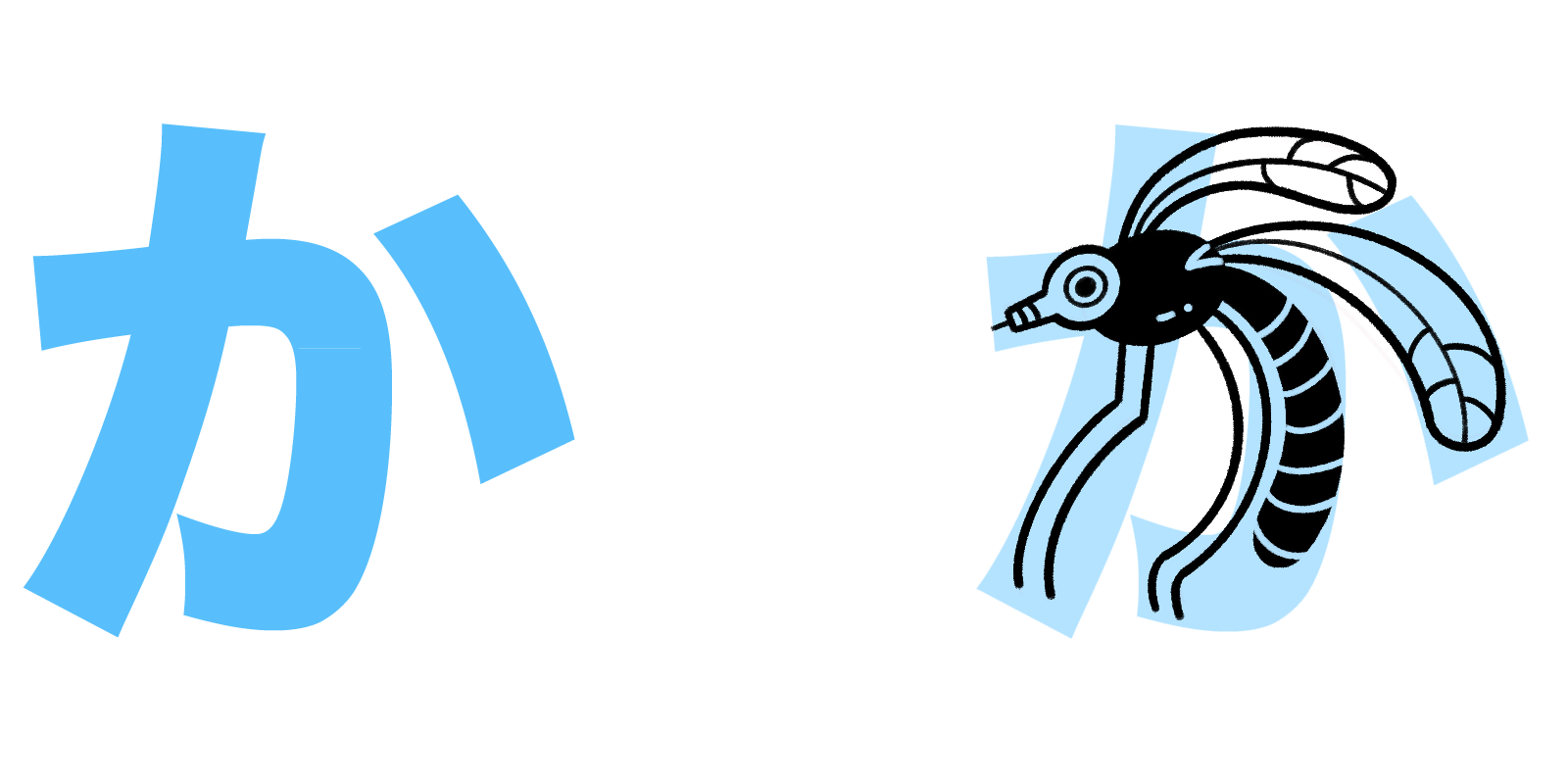
か is just the K sound plus あ, making a ka sound. It's pronounced like ka in "karma."
- か
- KA
See how this kana looks like a mosquito? What a convenient coincidence. Mosquitos happen to be called か (<u>ka</u>) in Japanese. You also say "<u>cu</u>t it out, darn mosquito!" when they try to suck your blood, so that should be easy to remember.
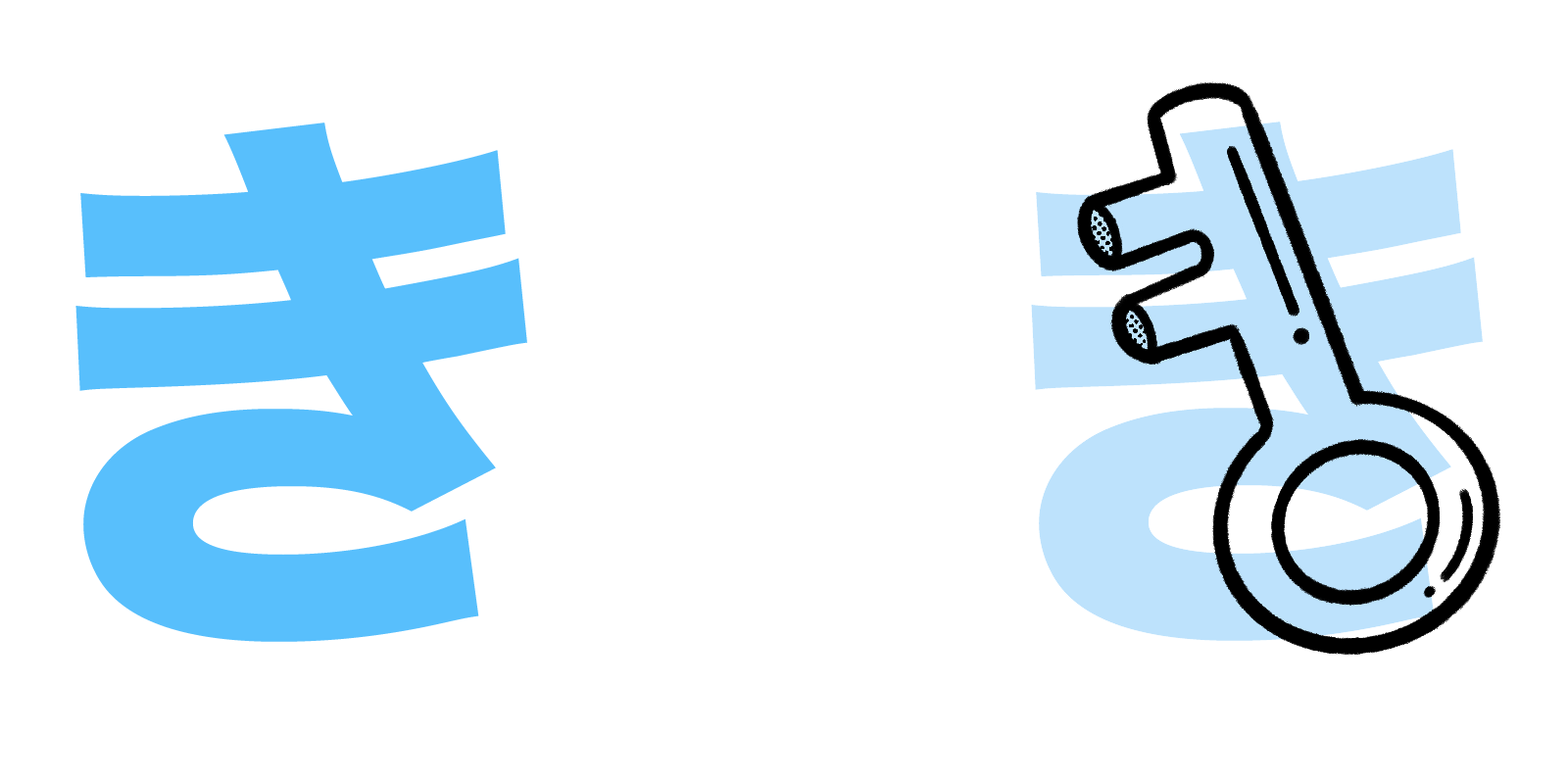
き is just the K sound plus い, making a ki sound.
In fact, it sounds just like the word "key" which is the mnemonic we end up using.
- き
- KI
To remember this, notice how much it resembles a <u>key</u>.
Note: In some fonts, the bottom part is detached from the main part. For example: <span class="ki-and-sa">き</span>. The pronunciation is still "ki" though!
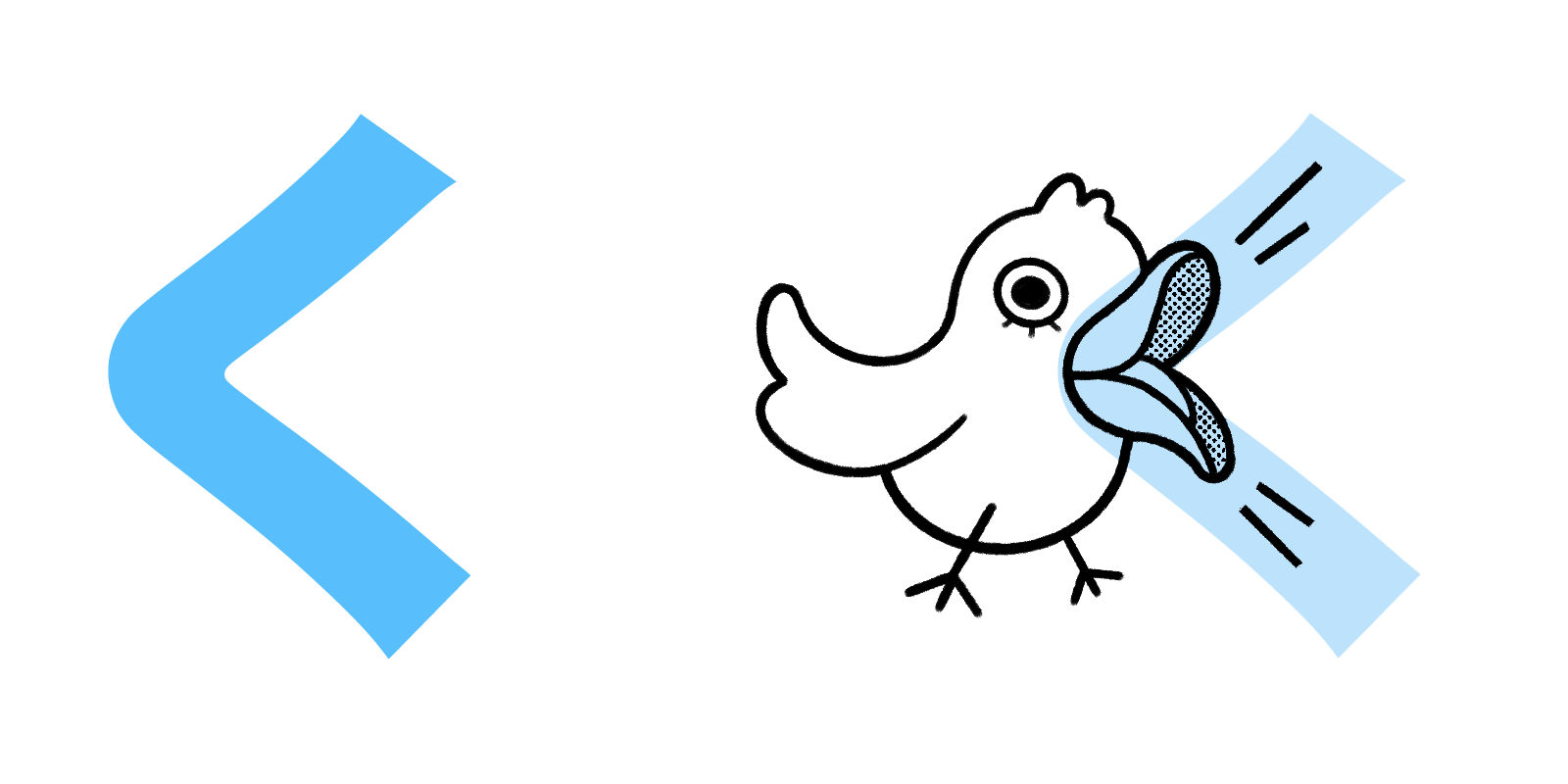
く is just the K sound plus う, making a ku sound. It's pronounced "coo," like both syllables of the word "cuckoo" (or just the first syllable, depending on your variety of English).
- く
- KU
To remember this, think of this kana being the mouth of a <u>coo</u>-coo / <u>cu</u>ckoo bird popping out saying "ku ku, ku ku!"
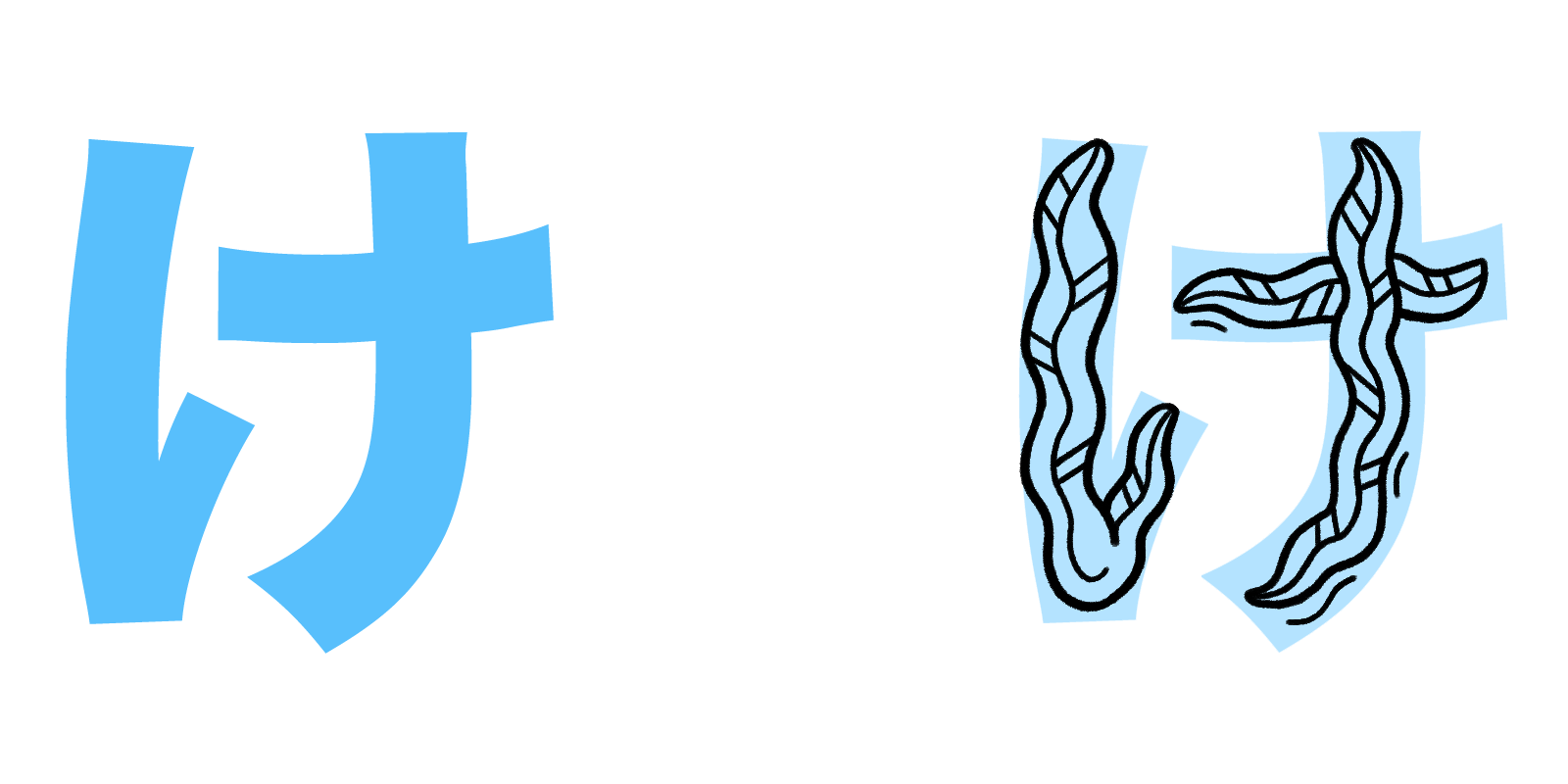
け is just the K sound plus え, making a ke sound. It's pronounced like ke in "kelp."
- け
- KE
See how this kana resembles some wiggly <u>ke</u>lp?
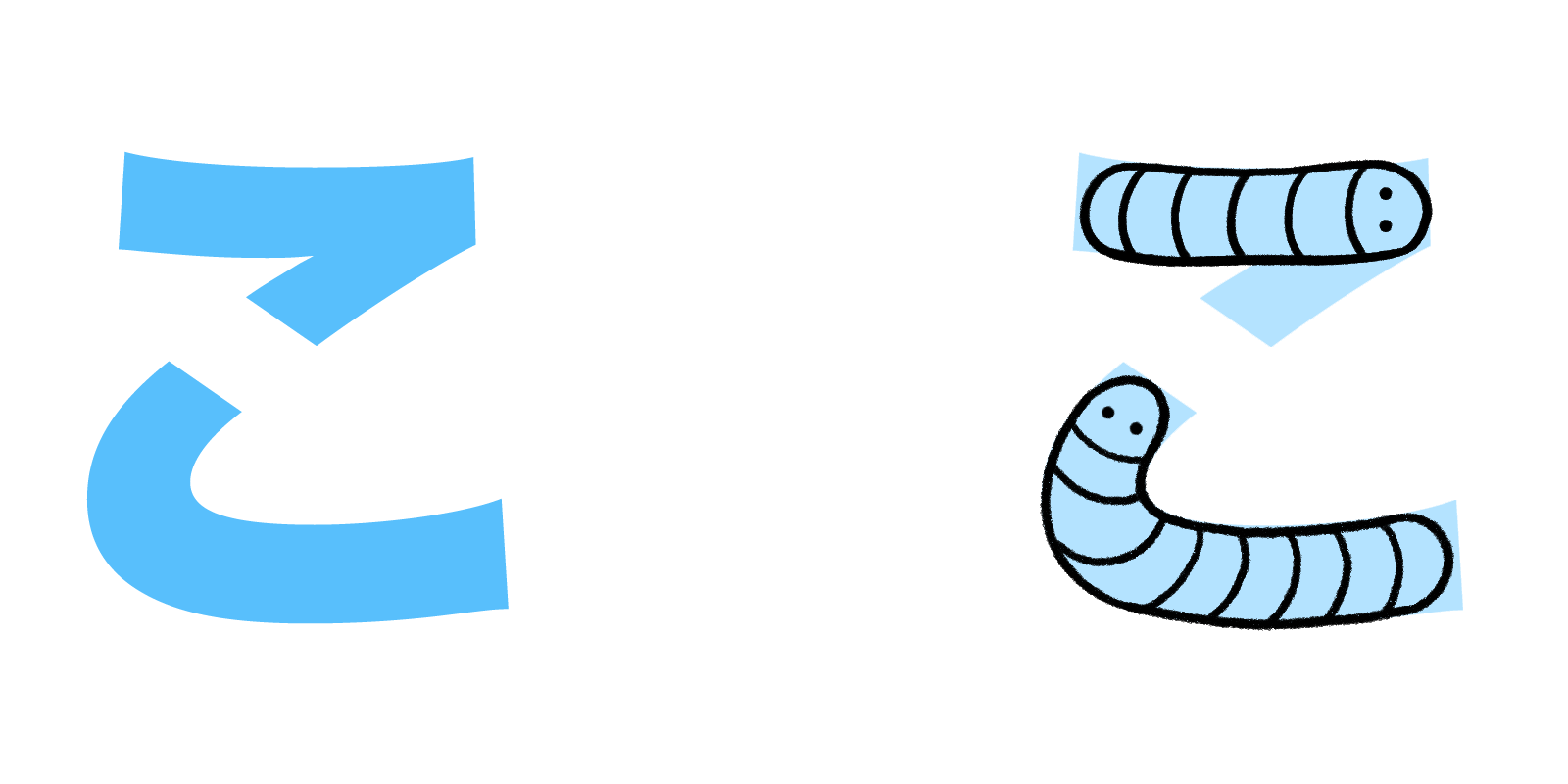
こ is just the K sound plus お, making a ko sound. It's pronounced like co in "cohabitating." In British English, it is more like co in "coin."
- こ
- KO
こ is a couple of <u>co</u>-habitation worms. They're so happy together, co-habitating the same area! Alternatively, you could imagine a couple of short <u>co</u>rds laying on the ground next to each other.
かきくけこ Tasks
More tasks! This time we'll include the あいうえお column along with this "K-column" you just learned.
- Using Tofugu's Learn Hiragana Quiz, select the
あ/aandか/kaboxes, and quiz yourself on those cards. How quickly can you identify and answer these ten hiragana characters? When you've completed this task at least five times, move on to the next step. - Print out, copy, or download this worksheet. Complete it by filling in the blanks with the romaji for each of the kana. This time it will be both of the columns that you've learned (so far) so it should be a little more interesting (and half familiar).
Once again, when you get stuck just think back to the mnemonic before you cheat. When you're done you can move on to the next group.
さ し す せ そ
Now that you have the "K-column" under your belt it's time for the "S-column." There is one weird exception in this column, and that's for "si" aka "shi." It's pronounced just like the word "she" in English, and doesn't quite follow the pattern you've seen up until now. You'll want to use "sa-shi-su-se-so" for this column.
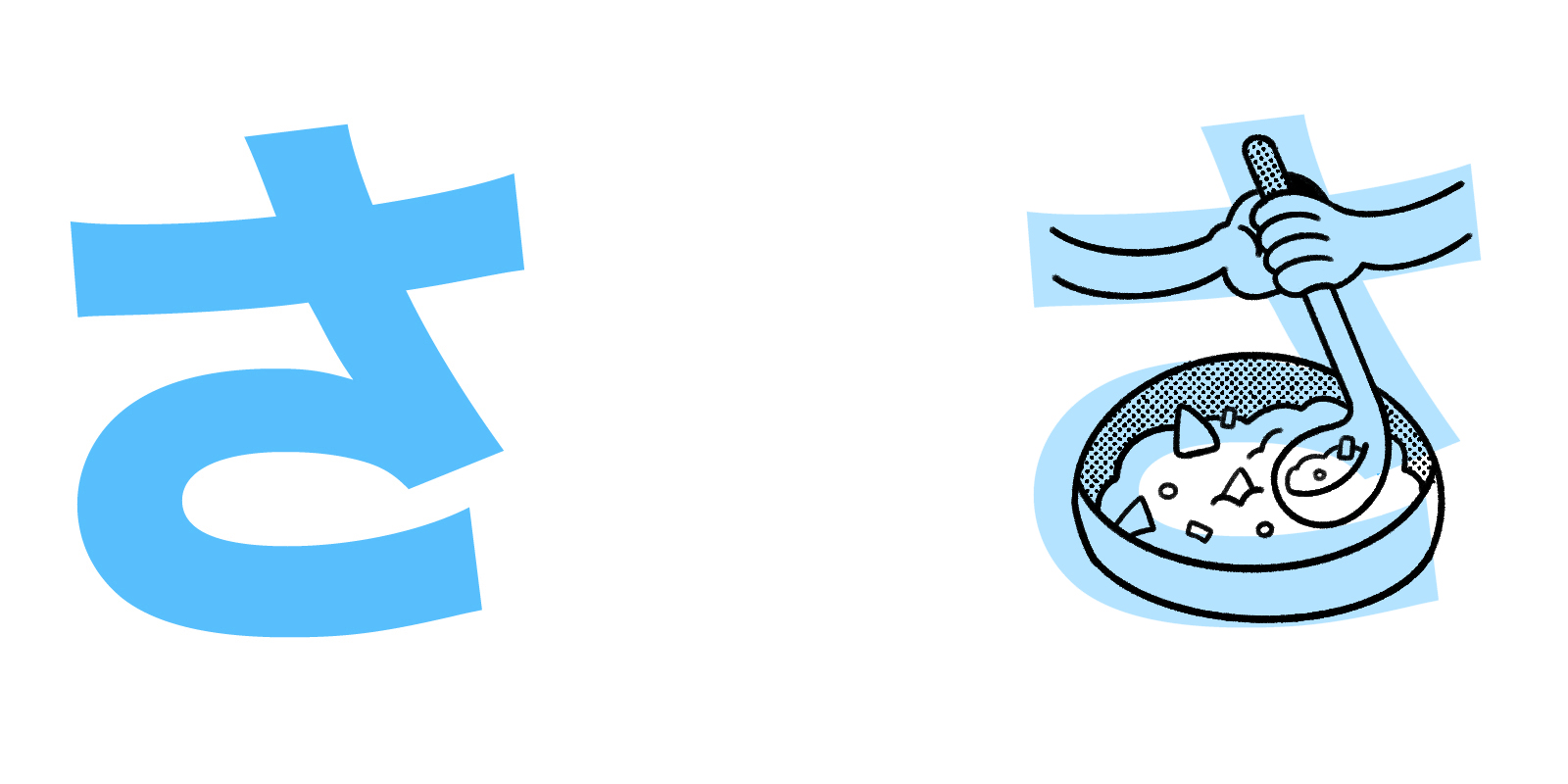
さ is just the S sound plus あ, making a sa sound. It's pronounced like sa in "salsa."
- さ
- SA
Notice how this kana looks like two hands stirring a bowl of <u>sa</u>lsa. This salsa is so chunky and thick, you need two hands just to stir it!
Note: Like き, the bottom part of さ is detached from the main part in some fonts. For example: <span class="ki-and-sa">さ</span>.

し is just the SH sound plus い, making a shi sound. It's pronounced like shee in "sheep."
Take note that this is the first "exception" kana where it doesn't follow the patterns that show up everywhere else. Instead of being "si" it's "shi" (though you will see it written both ways when dealing with romaji. One more reason why you ought to just learn hiragana already).
- し
- SHI
This kana looks like a giant shepherd's crook used to herd <u>shee</u>p. Baaaa… get in that corral, sheep!
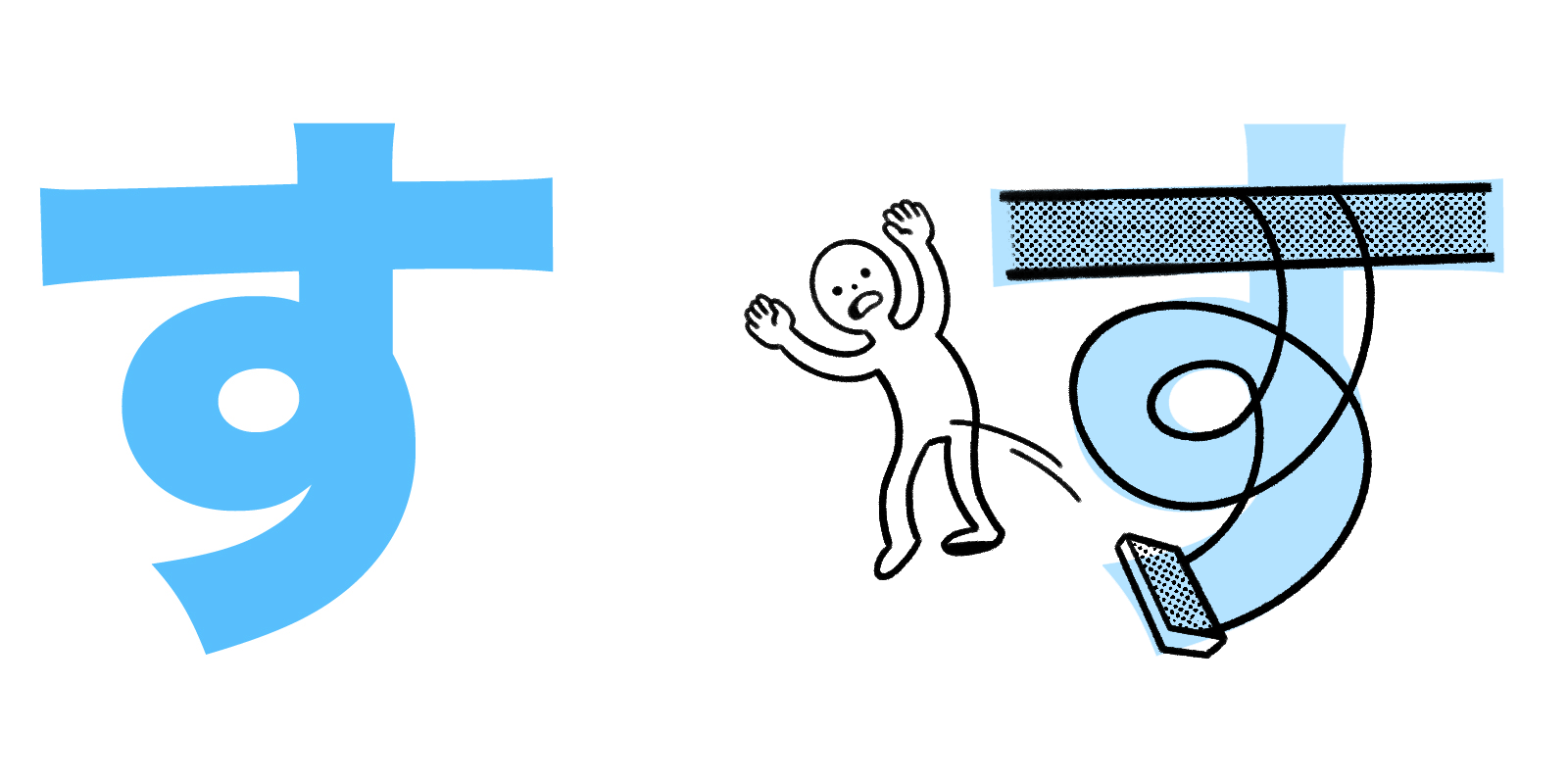
す is just the S sound plus う, making a su sound. It's pronounced like the word "sue," or su in "suit."
- す
- SU
See the <u>s</u>wing doing a loop-dee-loop throwing that poor kid off of it? Imagine him screaming "I'M GONNA SUE SOMEBODY FOR THIIIIIiiiissss" as he flies off into the distance.
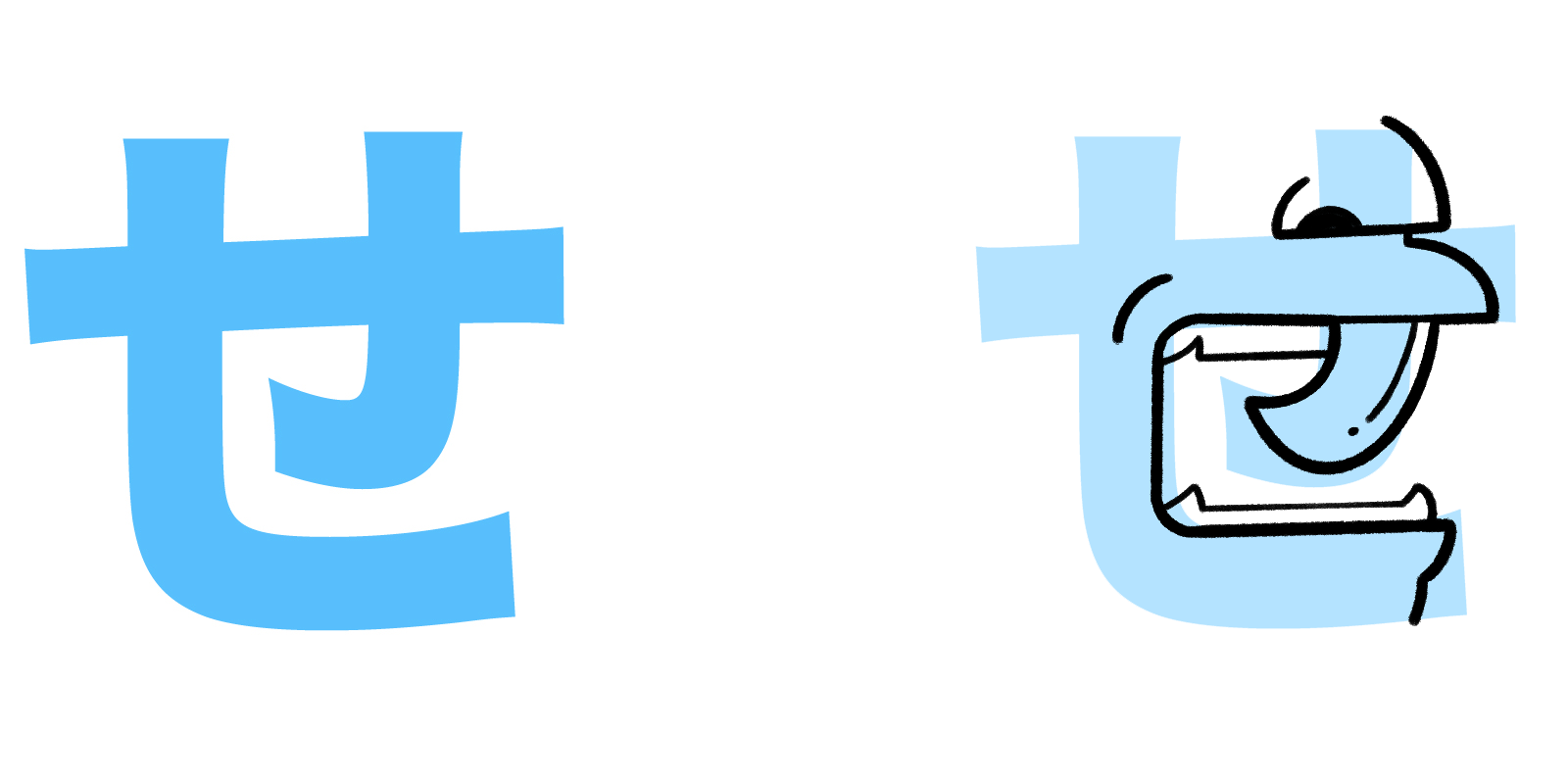
せ is just the S sound plus え, making a se sound. It's pronounced like se in "sell."
- せ
- SE
This kana looks like a mouth with a big vampire fang in it. Someone's trying to <u>se</u>ll you a <u>se</u>t of vampire teeth because they are just so <u>se</u>xy! Oh Dracula, always trying to make a quick buck.
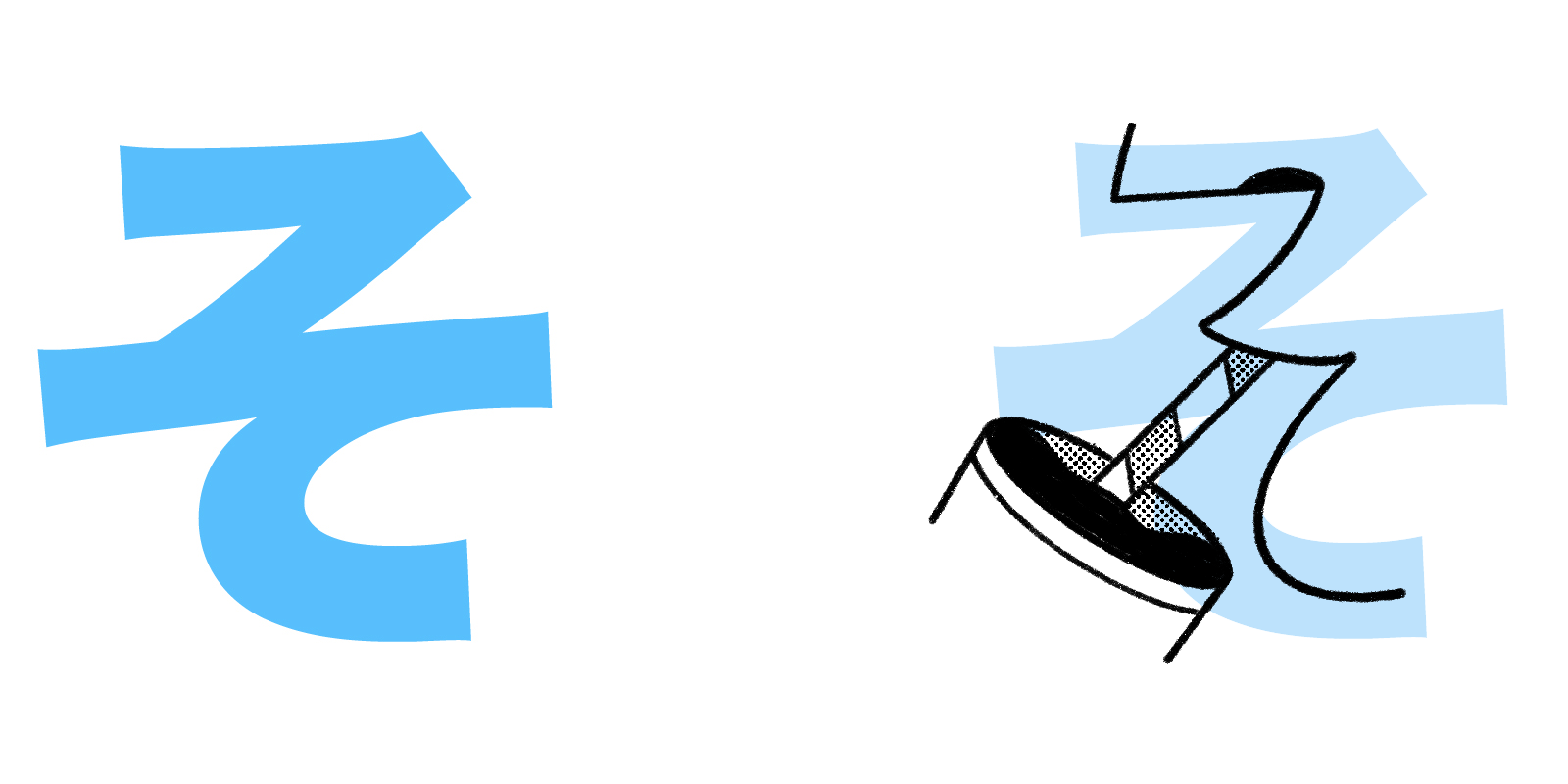
そ is just the S sound plus お, making a so sound. It's pronounced like so in "soda." In British English, it's more like so in "song."
- そ
- SO
See how this kana looks like a mouth slurping <u>so</u>da?
さしすせそ Exercises
Now that we've done three sets of five, it's time for exercises! As usual, these exercises will help you to practice kana you've previously learned plus the ones you just learned.
- Back to Tofugu's Learn Hiragana Quiz. Select the あ, か, and さ boxes and quiz them. Do this five times. Once you've done this, move on.
- Using this worksheet, print out, copy, or download it and fill out the boxes with the correct romaji. If you can't remember something try to think back to the mnemonic first before cheating.
When you're able to do these two tasks move on to the next five kana.
P.S. Have you noticed how in the worksheets you're being asked to wait 5 minutes then 10 minutes? Waiting is actually an important part of building memory. By waiting and then recalling something as it's fading away, you're telling your mind that it shouldn't forget that item. But, if you keep bringing it up over and over again in a short period of time your brain will just keep it in its short term memory, meaning you probably won't remember it later. Don't skip the waiting periods! In fact, if you think you can wait longer without forgetting much that's even better!
た ち つ て と
Time for the fourth column, the "T-column." Now you have a lot to remember! Hopefully mnemonics and the reasons for using them are starting to make sense now. If not, that should happen soon.
Like the さ column, you'll find an exception in the た column. In fact, you'll find two exceptions, them being ち (chi) and つ (tsu). So, for this column we'll have "ta, chi, tsu, te, to."
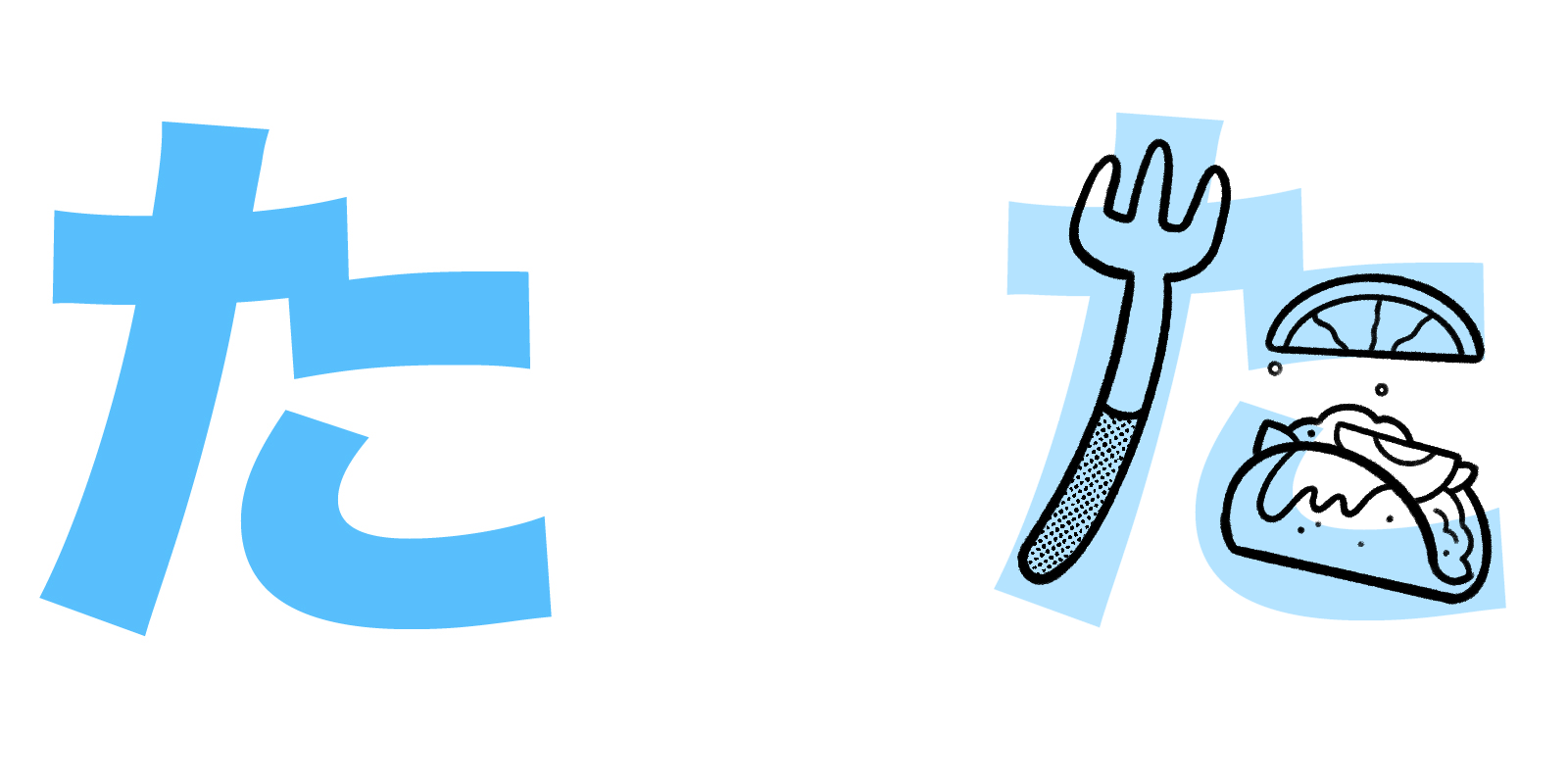
た is just the T sound plus あ, making a ta sound. It's pronounced like ta in "taco."
- た
- TA
Use your imagination and see this kana as a fork, <u>ta</u>co, and lime garnish for your taco. Wait… you're eating a taco with a fork? That's a bit weird, but you do you, pal.
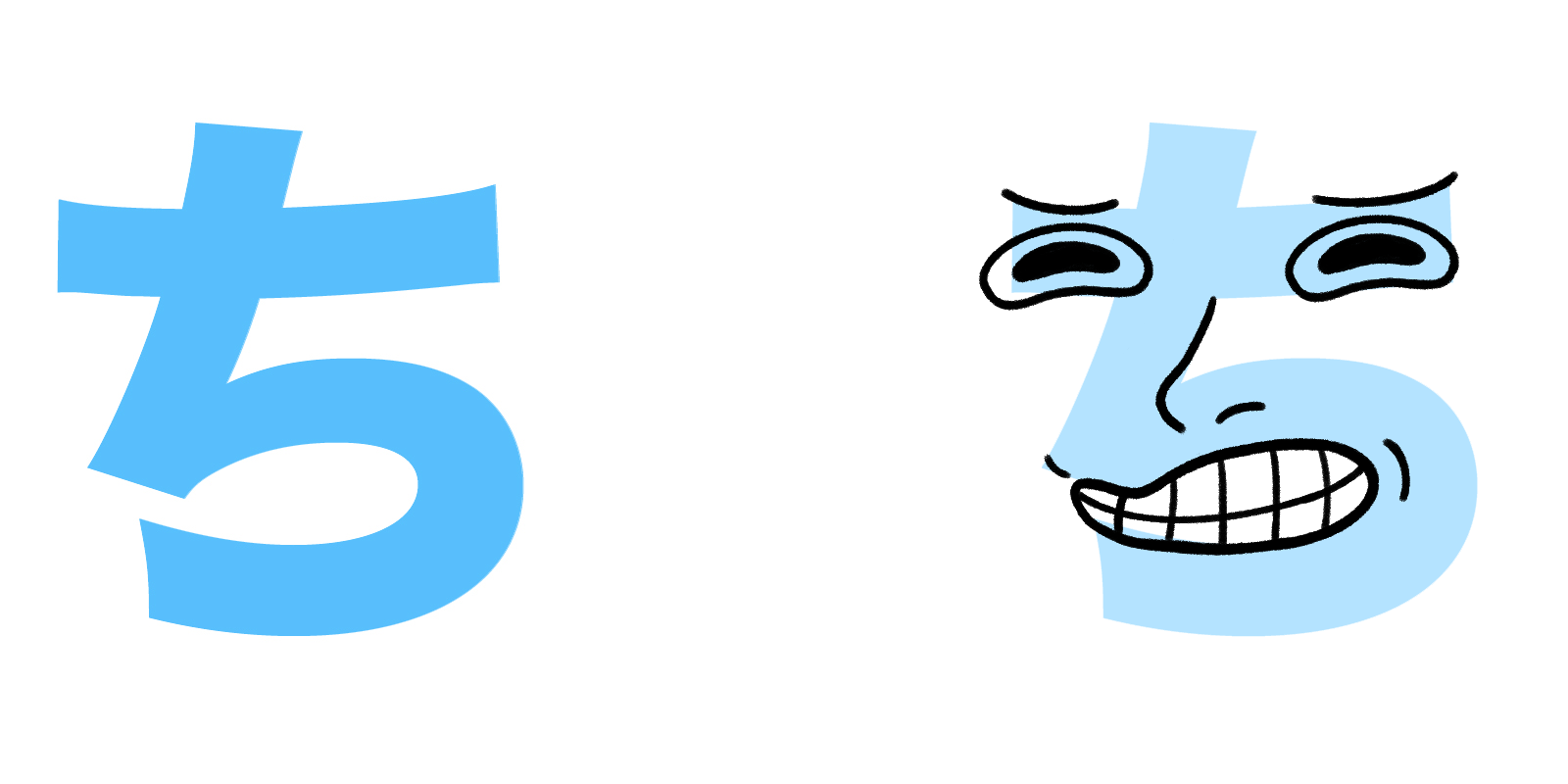
ち is just the CH sound plus い, making a chi sound. It's pronounced like chee in "cheese."
This is the second "exception" hiragana. Instead of a "ti" sound, it's a "chi" sound. Try not to forget this.
- ち
- CHI
You know when someone tells you to say "<u>chee</u>se" when taking a picture of you? This kana looks like that forced smile you have to make every time you're in a group photo.
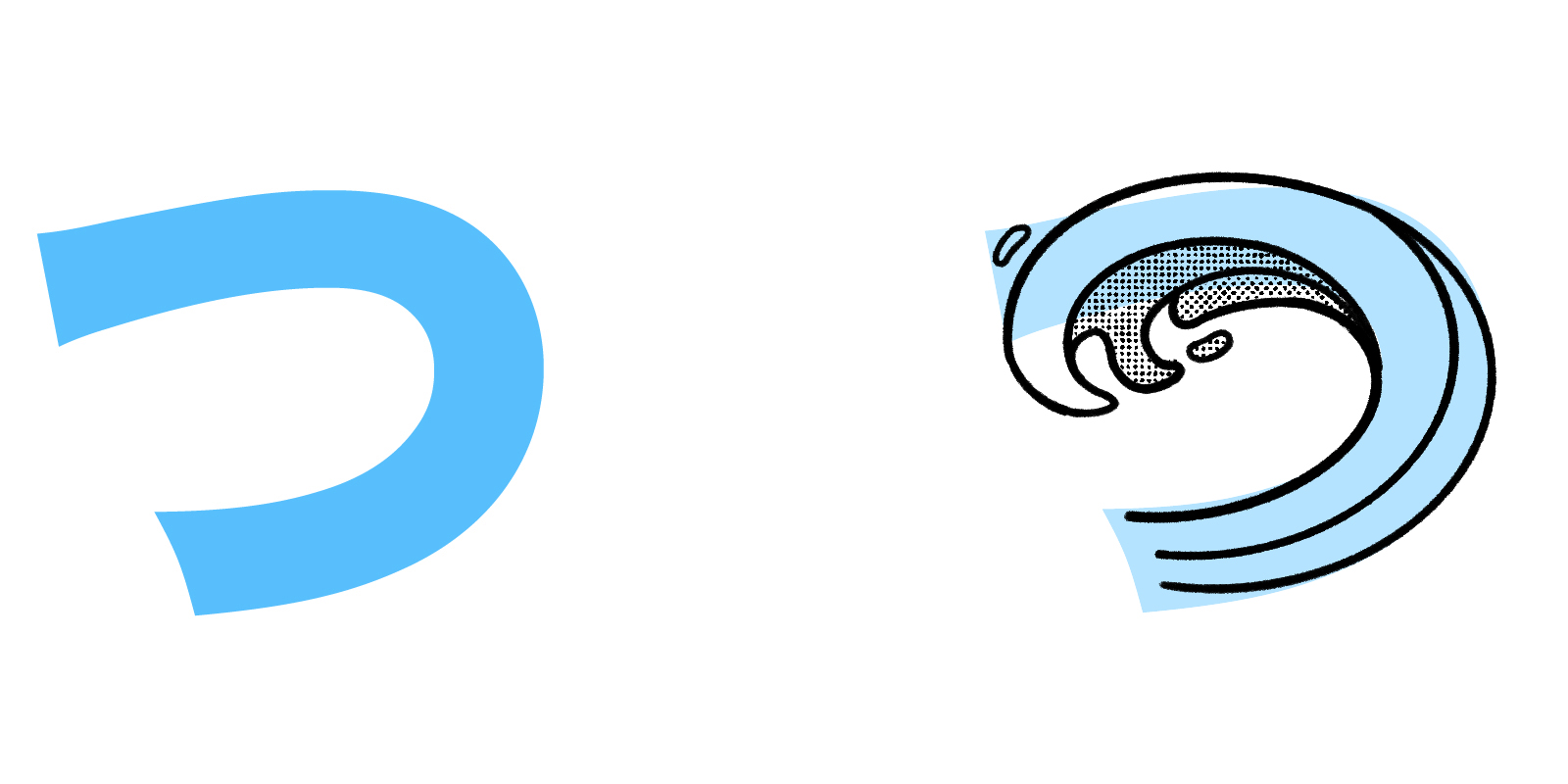
つ is just the TS sound plus う, making a tsu sound. It's pronounced like tsu in "tsunami."
- つ
- TSU
This is another "exception" hiragana. Instead of saying "tu" you say "tsu."
Look at the swoosh of this hiragana. Doesn't it look like a big wave, or <u>tsu</u>nami?
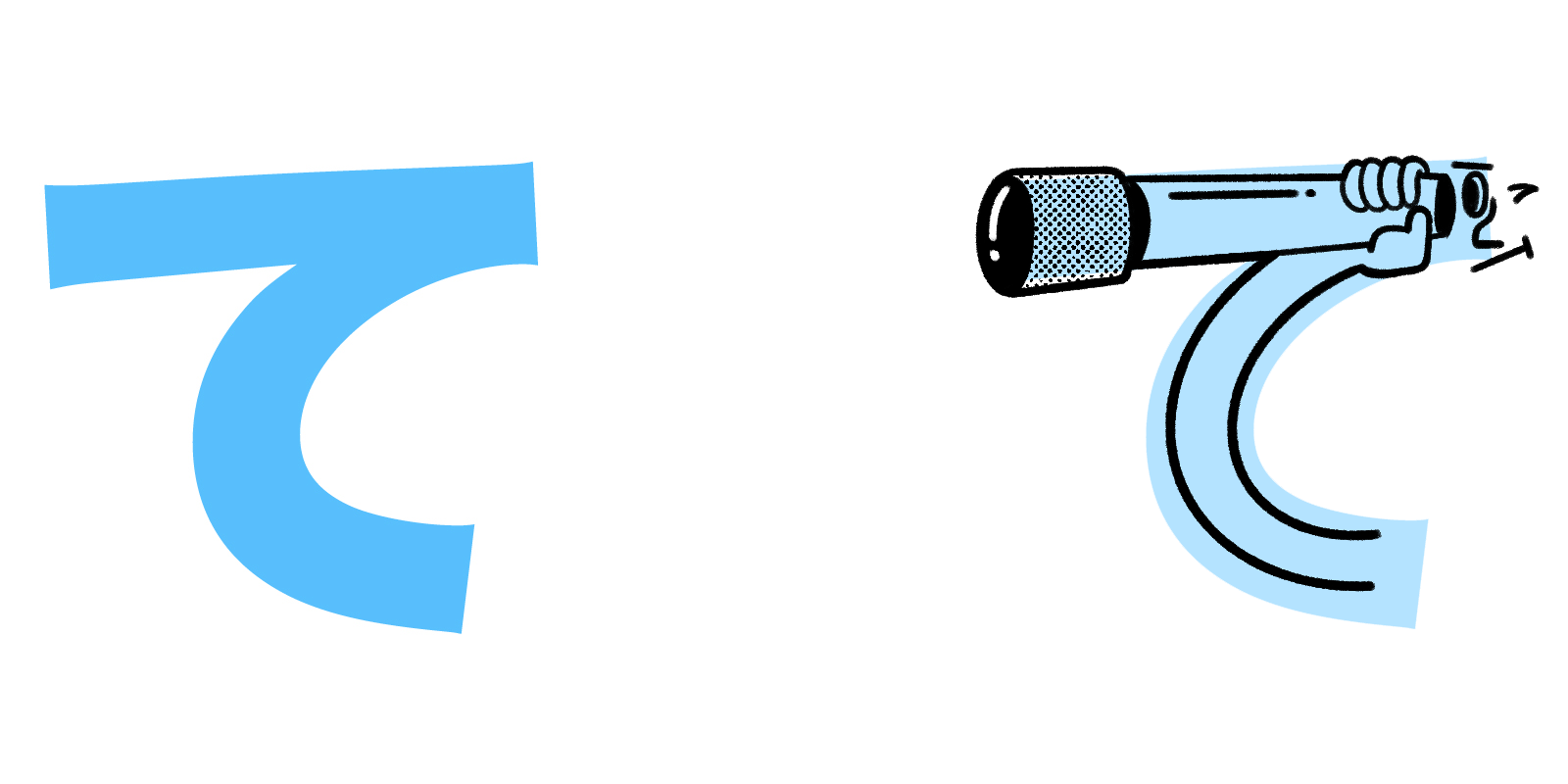
て is just the T sound plus え, making a te sound. It's pronounced like te in "telescope."
- て
- TE
Can you see a good ol' <u>te</u>lescope? It's a hand-held one! In Japanese, "hand" is て (<u>te</u>). That should help you remember that this kana looks like an old-school hand(te)-held telescope.
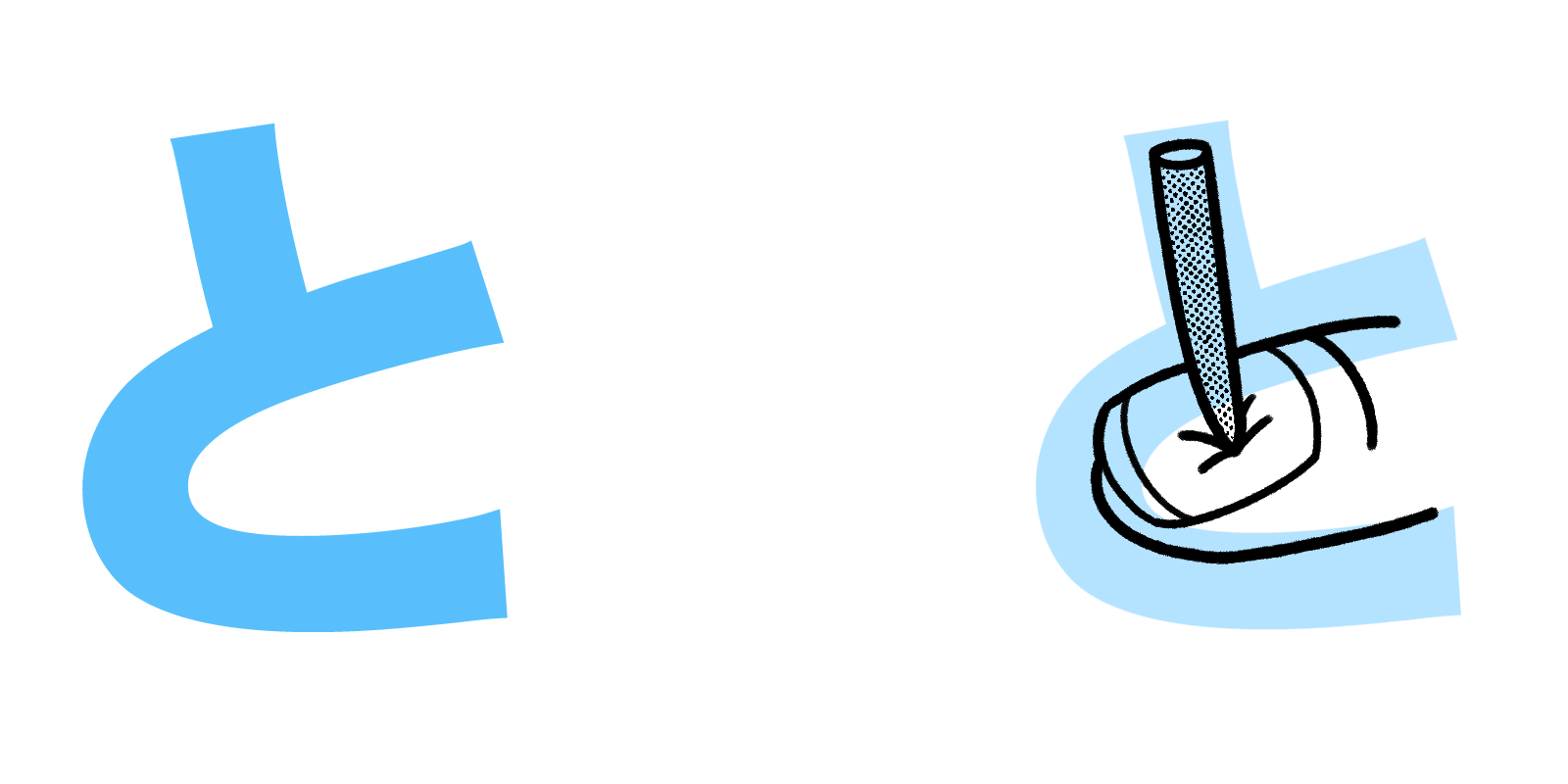
と is just the T sound plus お, making a to sound. It's pronounced like to in "toe." In British English, it sounds like "to" in "top."
- と
- TO
This kana looks just like someone's <u>to</u>e with a little nail or splinter in it. Imagine how much this would hurt if it was your toe!
たちつてと Exercises
Now that we have a few kana under our belt we'll be adding a third resource to our arsenal. Still, we'll start with something familiar. Just follow along.
- With Tofugu's Learn Hiragana Quiz, quiz yourself on the four columns that you know (あ, か, さ, た). When you've done it five times, move on to the next step.
- Copy, download, or print out this worksheet. Fill in all the blanks with romaji. Pay special attention to "exception" kana, like し, ち, and つ and write them out the way I showed you above to make sure that you know the proper reading. Not all romaji-styles will write these kana like this (you'll see "si, ti, and tu" too), but for now write "shi, chi, and tsu" just for the sake of associating the correct pronunciation with each of these particular kana.
When you've completed everything and feel like you can recall all 20 of these kana, move on to the next section. Now it's time to try ten at a time. You're getting better at this, after all!
な に ぬ ね の
This is your first "more than five things to learn" group. In fact, it's a whole ten things! But you'll be just fine. You're getting better at learning the hiragana with all this practice. Too bad there's not 150 hiragana for you to practice on.
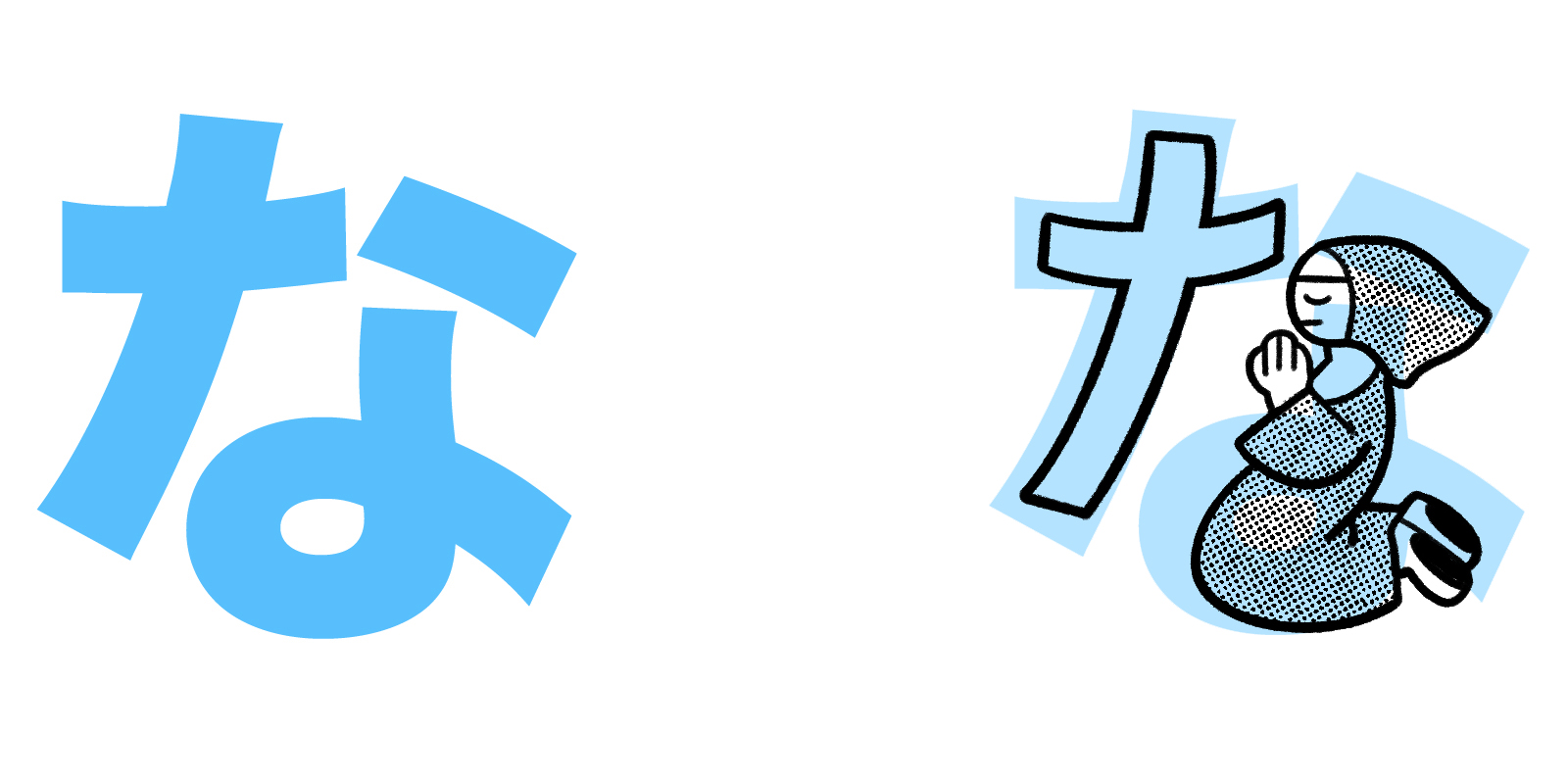
な is just the N sound plus あ, making a na sound. It's pronounced like na in "nachos."
- な
- NA
The <u>nu</u>n is praying in front of the cross asking for <u>na</u>chos, because she's craving a delicious snack. The cross up in the air should be the main giveaway that this is な.
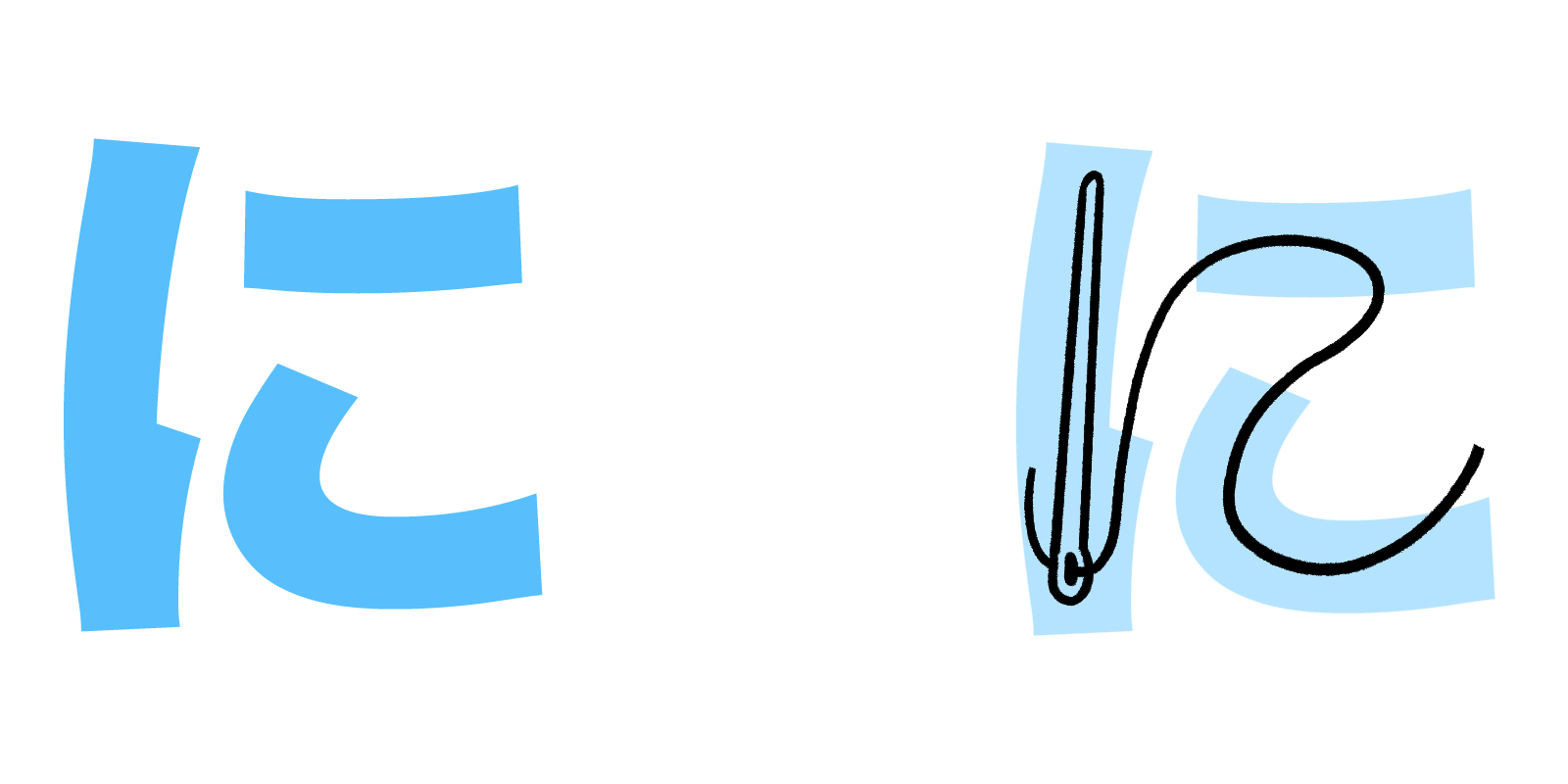
に is just the N sound plus い, making a ni sound. It's pronounced like nee in "needle."
- に
- NI
Do you see the <u>nee</u>dle pulling the thread?
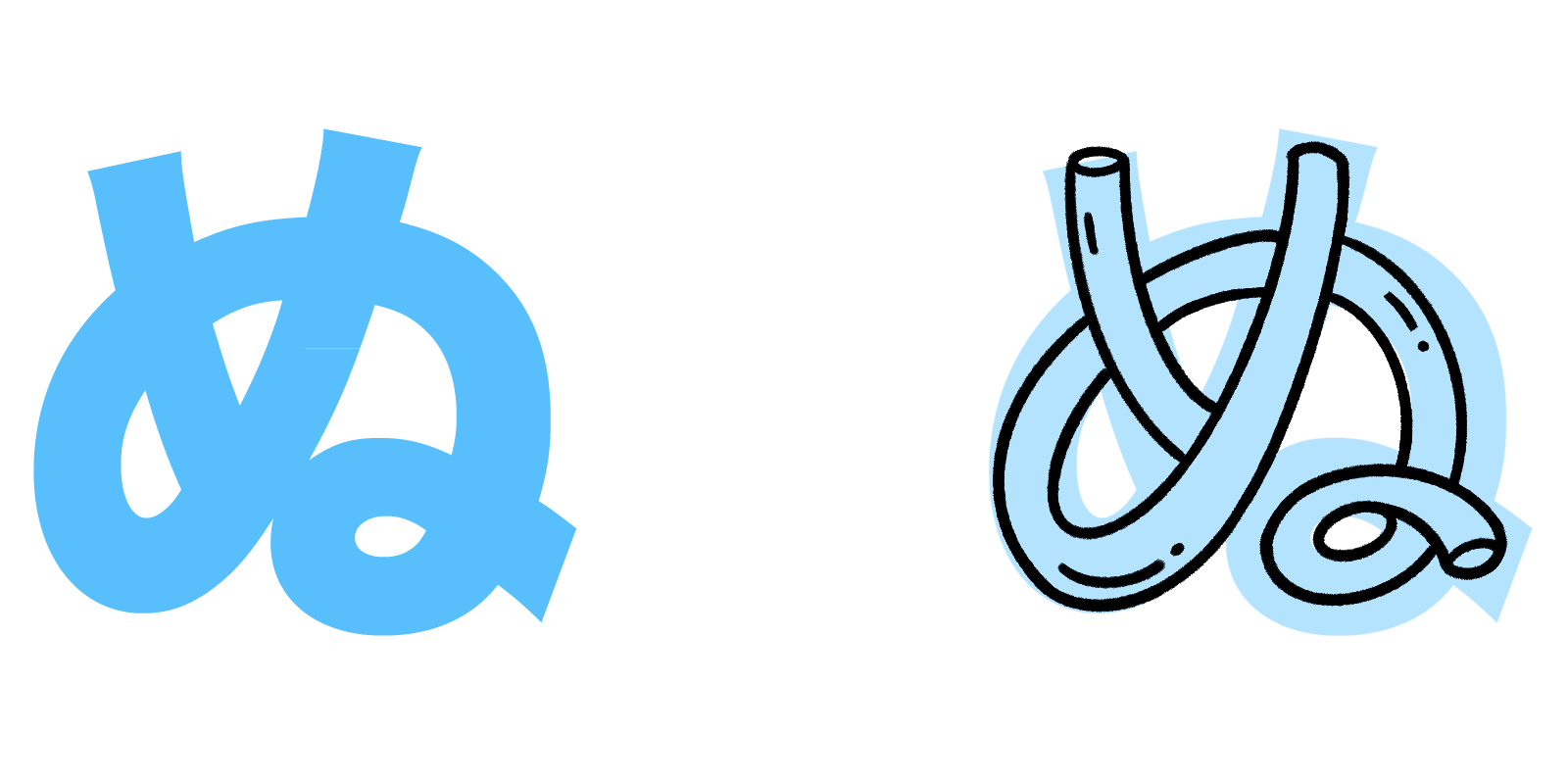
ぬ is just the N sound plus う, making a nu sound. It's pronounced like noo in "noodle."
- ぬ
- NU
This kana looks like some <u>noo</u>dles. There are several other kana that are similar to this one (れ, め, ね, わ), but you know this one is noodles because there are no sharp angles in it. It's 100% smooth and bendable, like noodles! It even has an extra loop at the bottom, because it is a noodle.
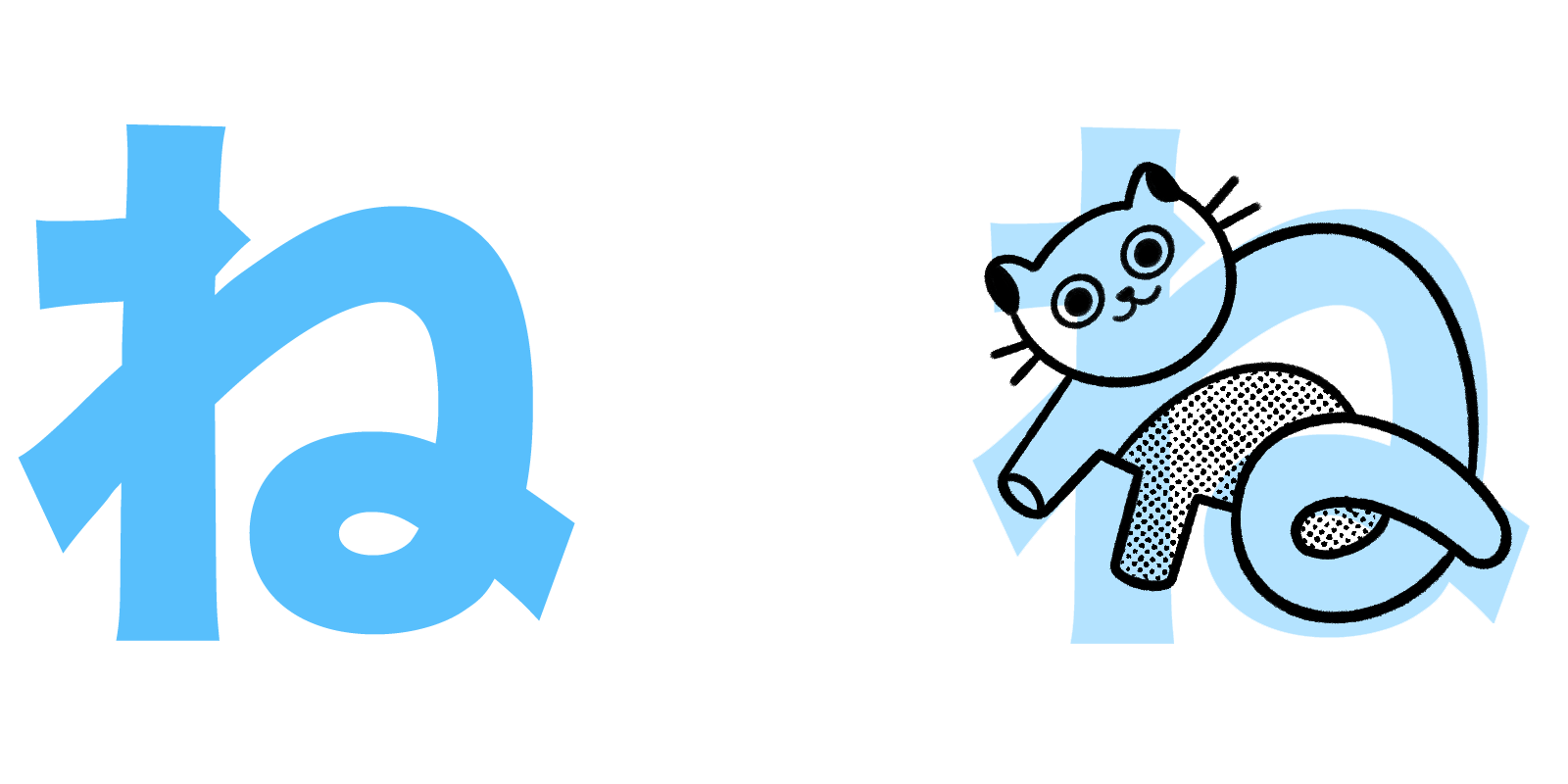
ね is just the N sound plus え, making a ne sound. It's pronounced like ne in "Nelly."
- ね
- NE
This is <u>Ne</u>lly the cat. There are other kana very similar to this one (ぬ, れ, め, わ), but you know this is different. Why? Because it has a loop at the end for the tail, and it's not super bendable like ぬ (noodles) is — see those sharp corners on the left?
To top things off, Nelly is a <u>ne</u>cromancer. Why? I have no idea, you'll have to ask her. It must have something to do with the undead cat army she's creating.
Also, if you know the word <u>ne</u>ko (Japanese for "cat"), you can use that too. This is a ねこ.
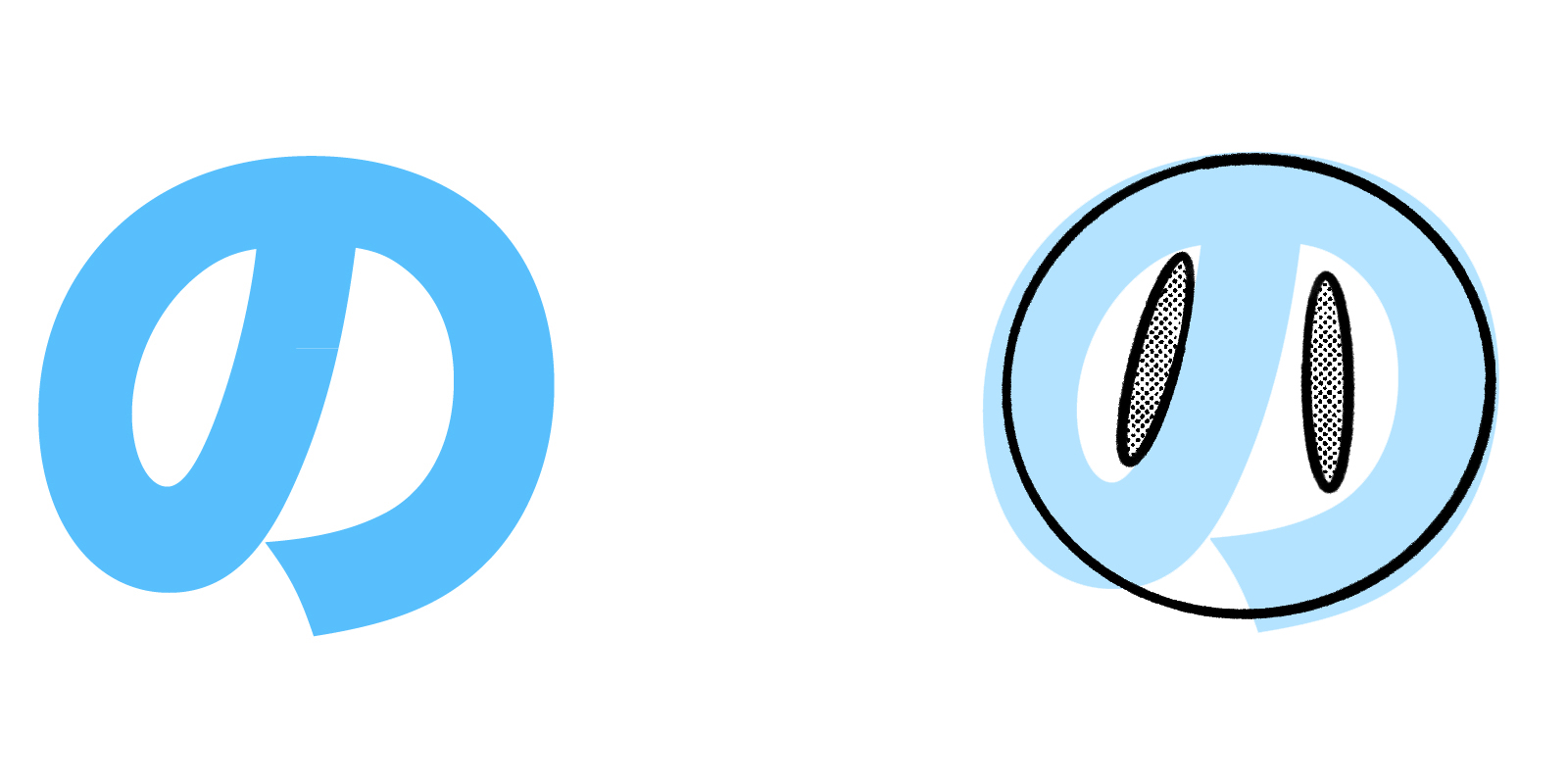
の is just the N sound plus お, making a no sound. It's pronounced like no in "nose" or "nori."
- の
- NO
See the big pig <u>no</u>se there? You can also think of this as a "<u>No</u> Smoking" sign (the ones with the cigarette and the big red circle and slash through it). Pick the one that sticks with you the best.
は ひ ふ へ ほ
Now let's look at the next five in this set. If you're feeling really shaky you can jump over to Tofugu's Learn Hiragana Quiz to practice, but you don't have to (yet)!
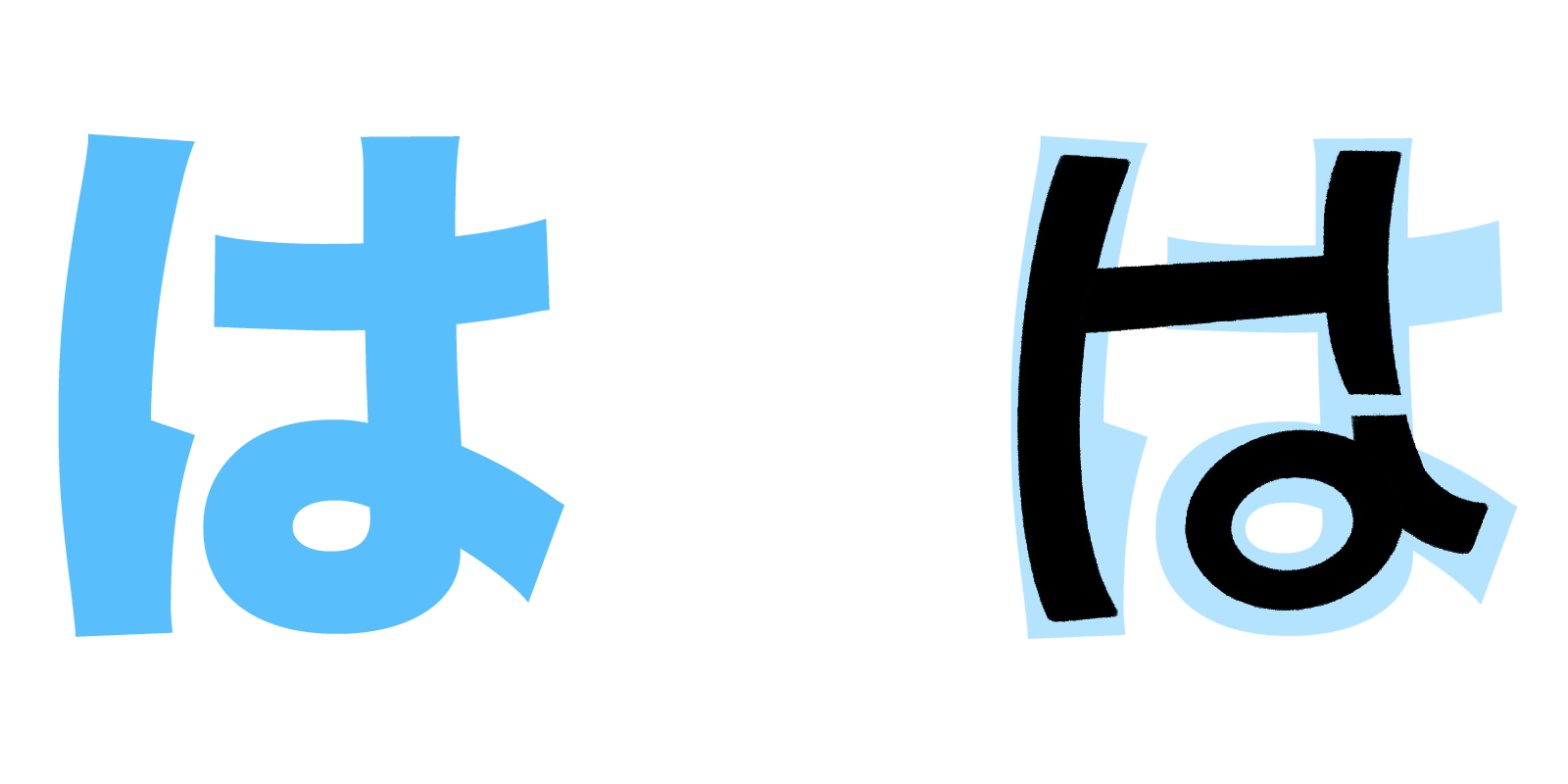
は is just the H sound plus あ, making a ha sound. It's pronounced like ha in "haha" (like laughing!).
- は
- HA
This kana looks like an uppercase letter H plus a lowercase letter a.
What does that spell? "<u>Ha</u>!"
Why are you laughing? Stop that. Make sure you can see the H + a in the kana.
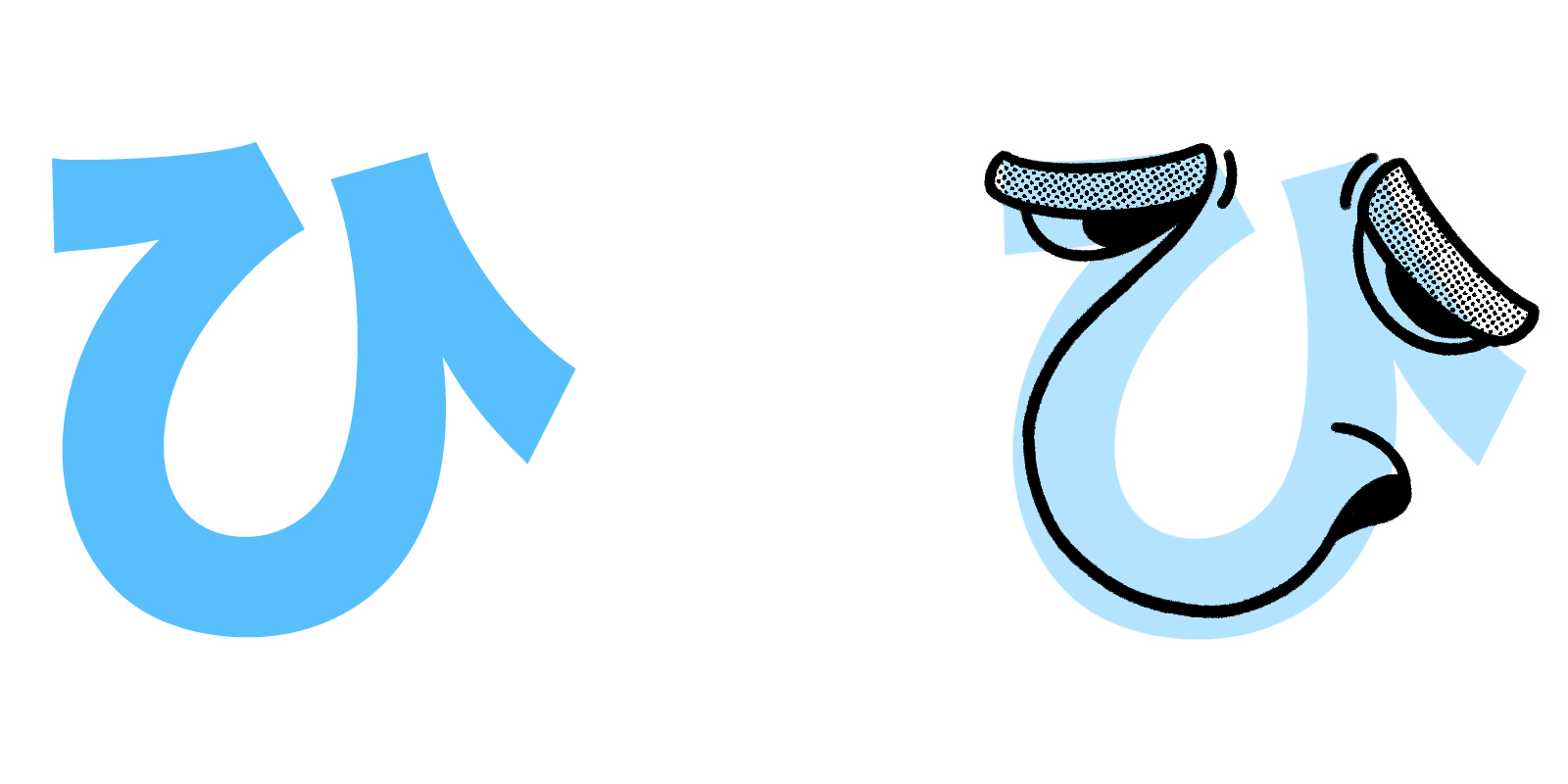
ひ is just the H sound plus い, making a hi sound. It's like the English pronoun "he." In other words, it sounds like he in "heat."
- ひ
- HI
<u>He</u> has a big nose. See that big nose? Now say it out loud. "<u>He</u> has a big nose."
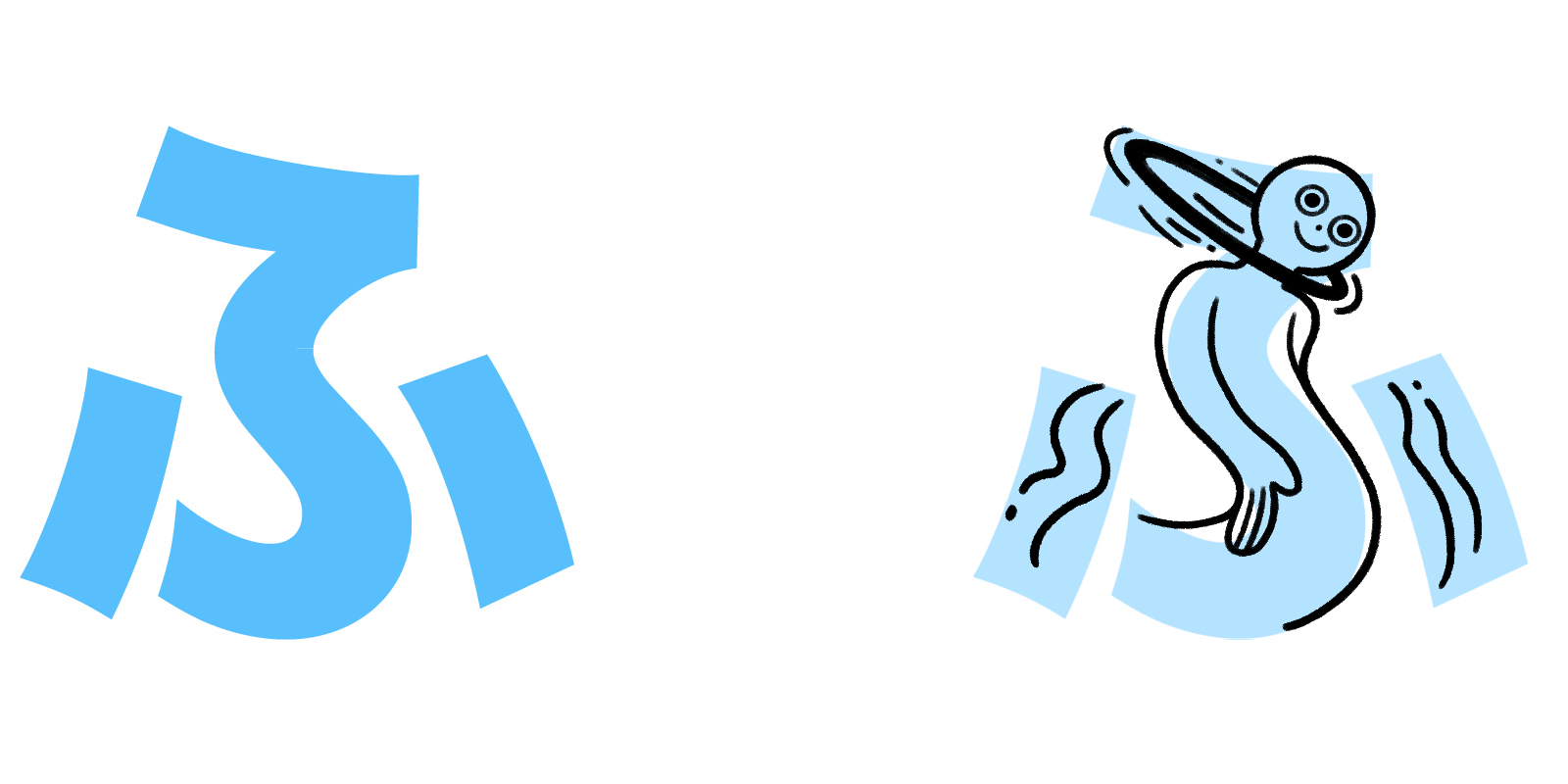
ふ is halfway between the F and H sounds, plus う, making a fu / hu sound. It's pronounced like a softly blown-out version of foo in "fool," or sometimes hoo in "hoop."
- ふ
- FU
Someone is over there dancing like a <u>foo</u>l. What's that around their neck? …Oh, that's a <u>hu</u>la <u>hoo</u>p! That's why they're twisting their body so hard.
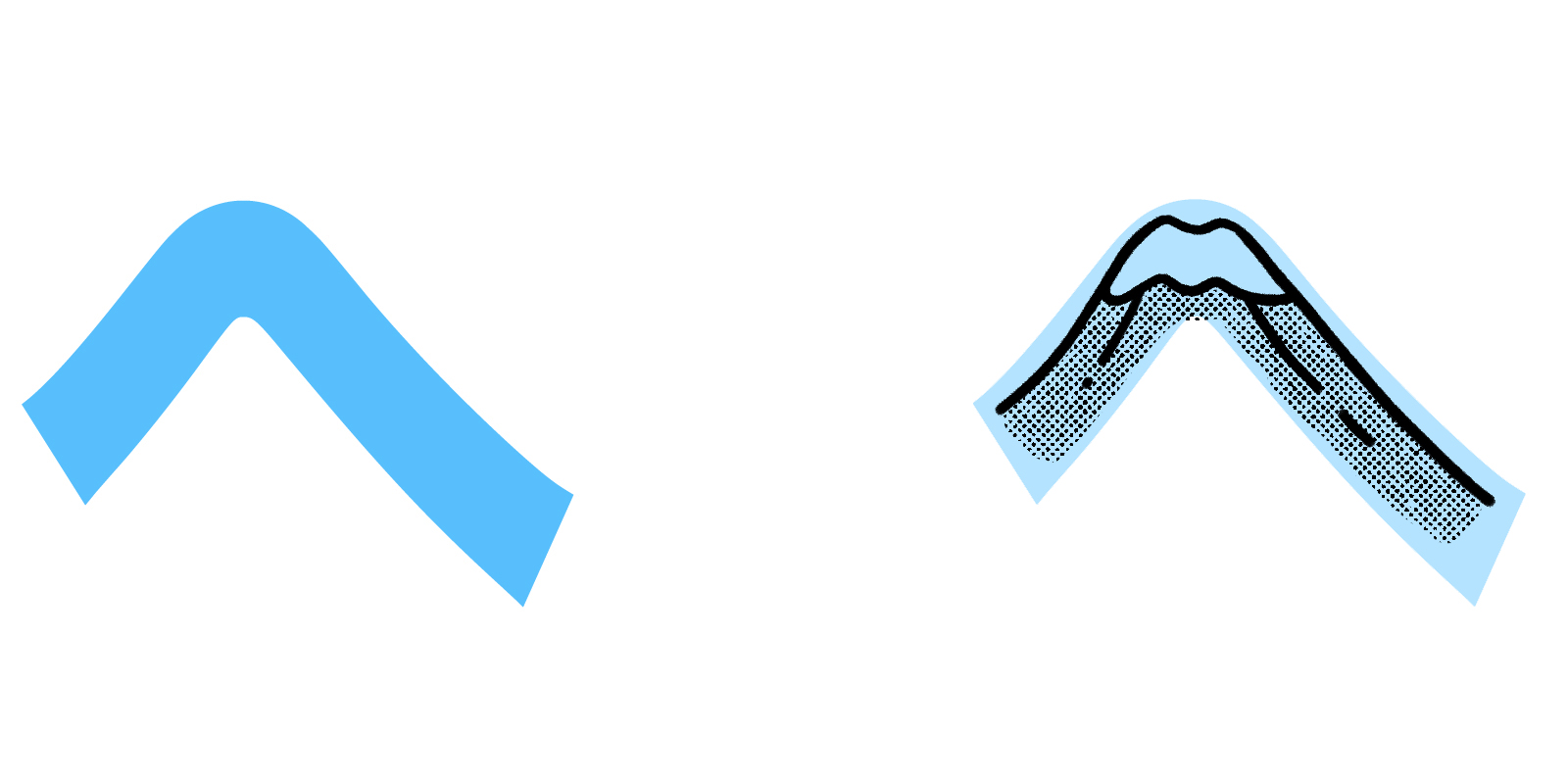
へ is just the H sound plus え, making a he sound. It's pronounced like he in "help," or "Helens.
- へ
- HE
Do you know the famous mountain Mt. Saint <u>He</u>lens? This kana isn't totally flat like Helens is, but it's pretty squat looking. That's why this one is Helens.
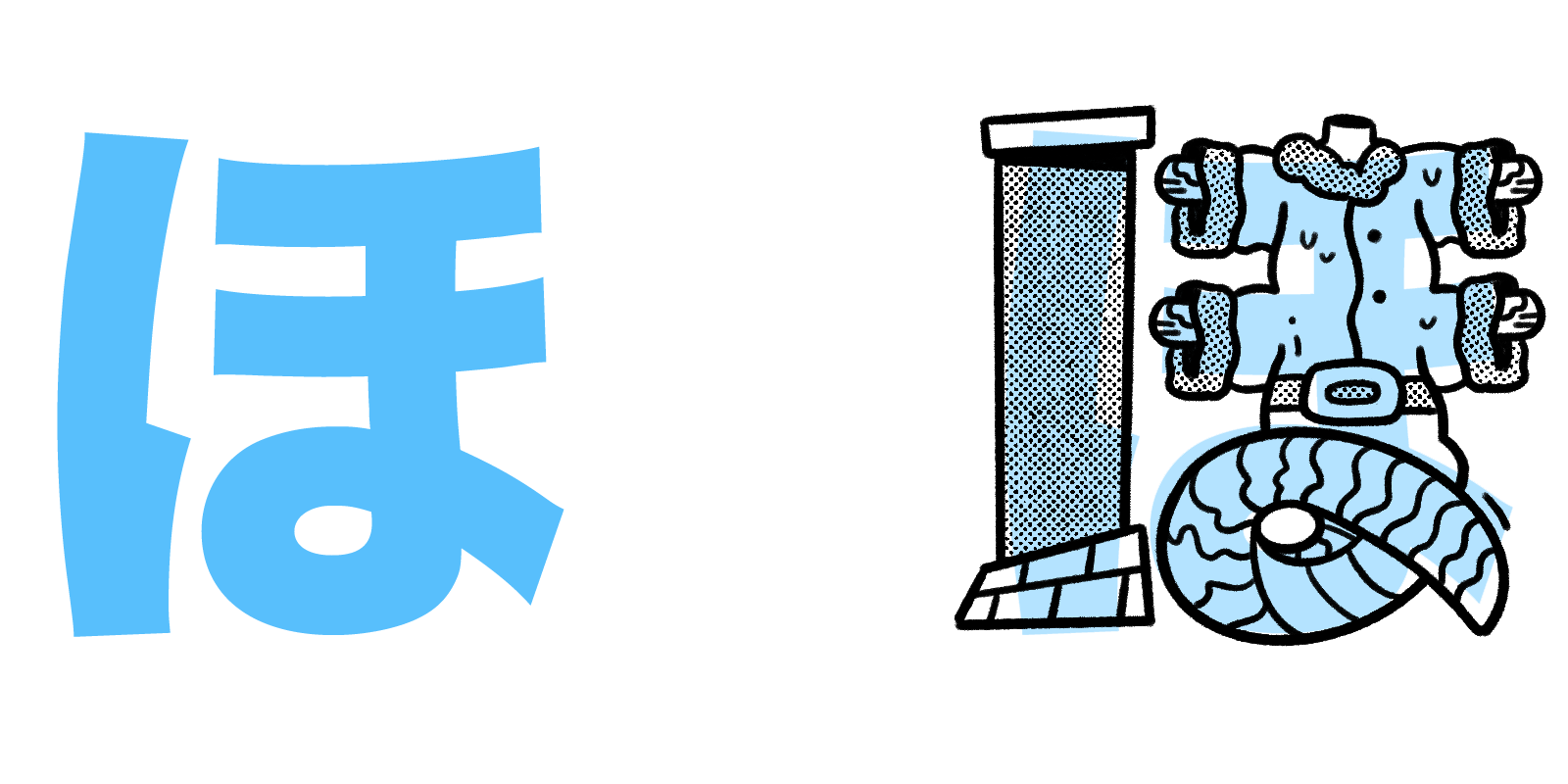
ほ is just the H sound plus お, making a ho sound. It's pronounced like ho in "hoe" or "ho ho ho!" In British English, it sounds more like ho in "hot."
- ほ
- HO
The line on the left is a chimney. The right side is a mutated Santa Claus. He has four arms, a snake tail, and no head. Out of his neck he's uttering "<u>ho</u> ho ho… ho ho ho…"
Hopefully he doesn't come down your chimney.
なにぬねのはひふへほ Exercises
Time to practice ten at a time! It's a lot, but you're getting better at learning these things, right?
- Using Tofugu's Learn Hiragana Quiz, quiz yourself on the hiragana from the あ, か, さ, た, な, and は columns. When you've completed this five times, move on to the next task.
- Copy, print out, or download this worksheet and fill in all the boxes. As always, use the mnemonics and try not to cheat. If this is starting to feel easy, try to time yourself to see how long it takes to complete each section and try to beat yourself each time.
When you are done with these exercises it's time to move on to the next set of hiragana.
ま み む め も
Not quite ten in this set (before the exercises), but close enough. Let's start with the "M-column."
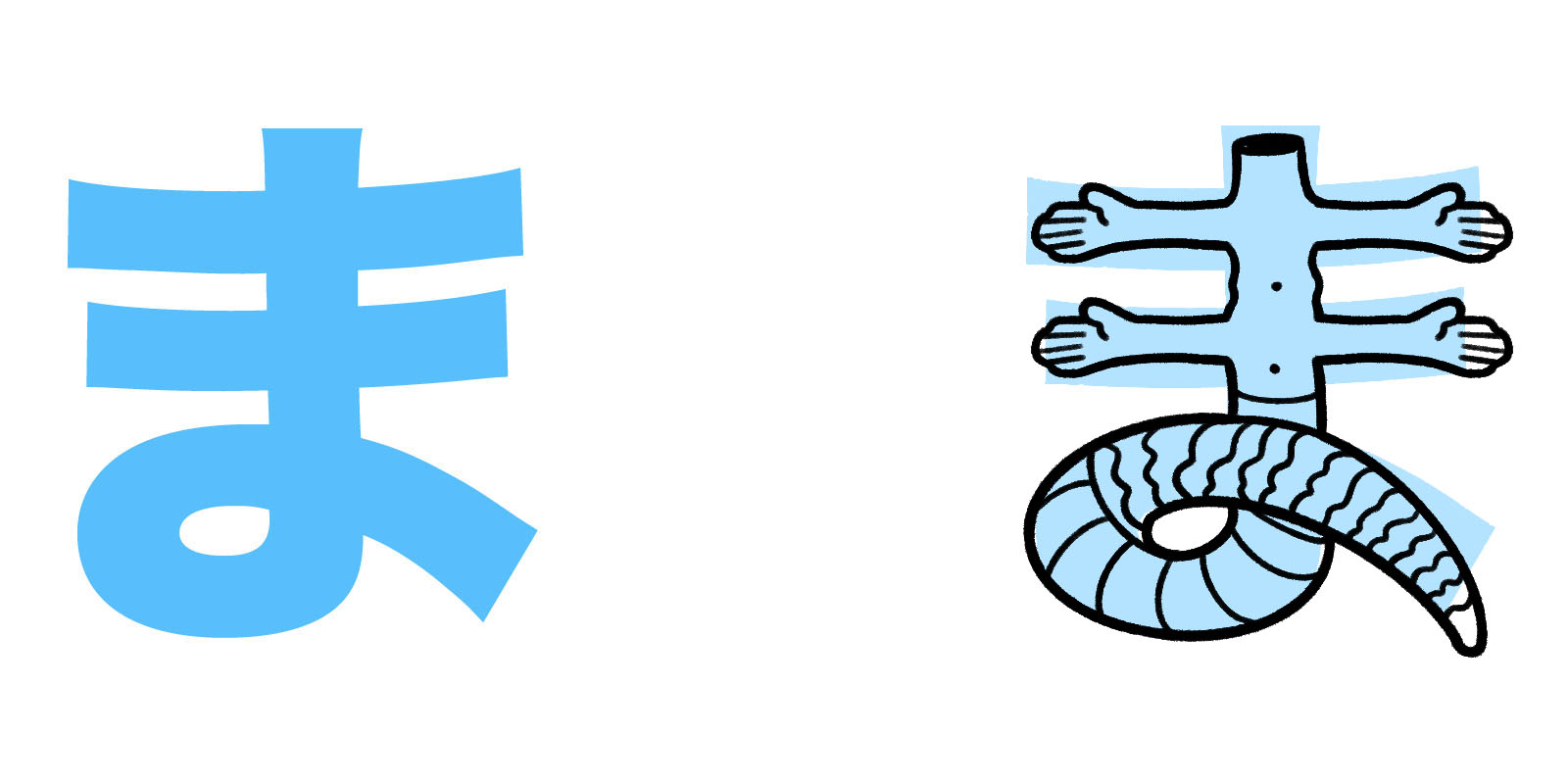
ま is just the M sound plus あ, making a ma sound. It's pronounced like the English word "ma" (meaning "mother"). In other words, it sounds like ma in "mark."
- ま
- MA
Removing your head? Doubling your hands and arms? What sort of evil <u>ma</u>gic is this? What makes it weirder is that your <u>ma</u>ma is the one doing this magic. Imagine your <u>ma</u> looking like this. Aghh!
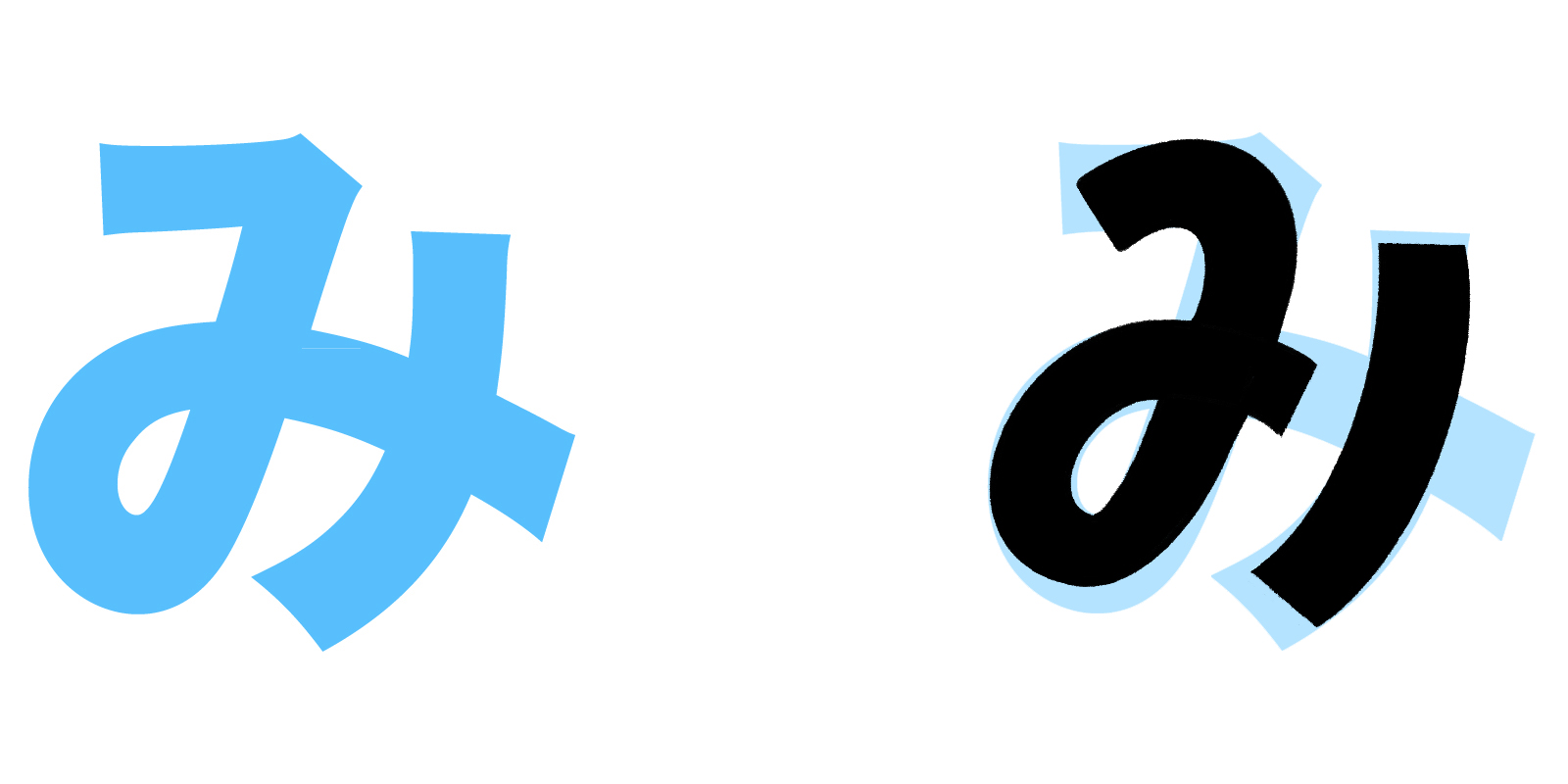
み is just the M sound plus い, making a mi sound. It's pronounced like the English word "me." In other words, it sounds like mee in "meet."
- み
- MI
Looks like lucky number 21. Who just hit the blackjack? <u>Me</u>! Who just turned 21 as well? <u>Me</u>!!
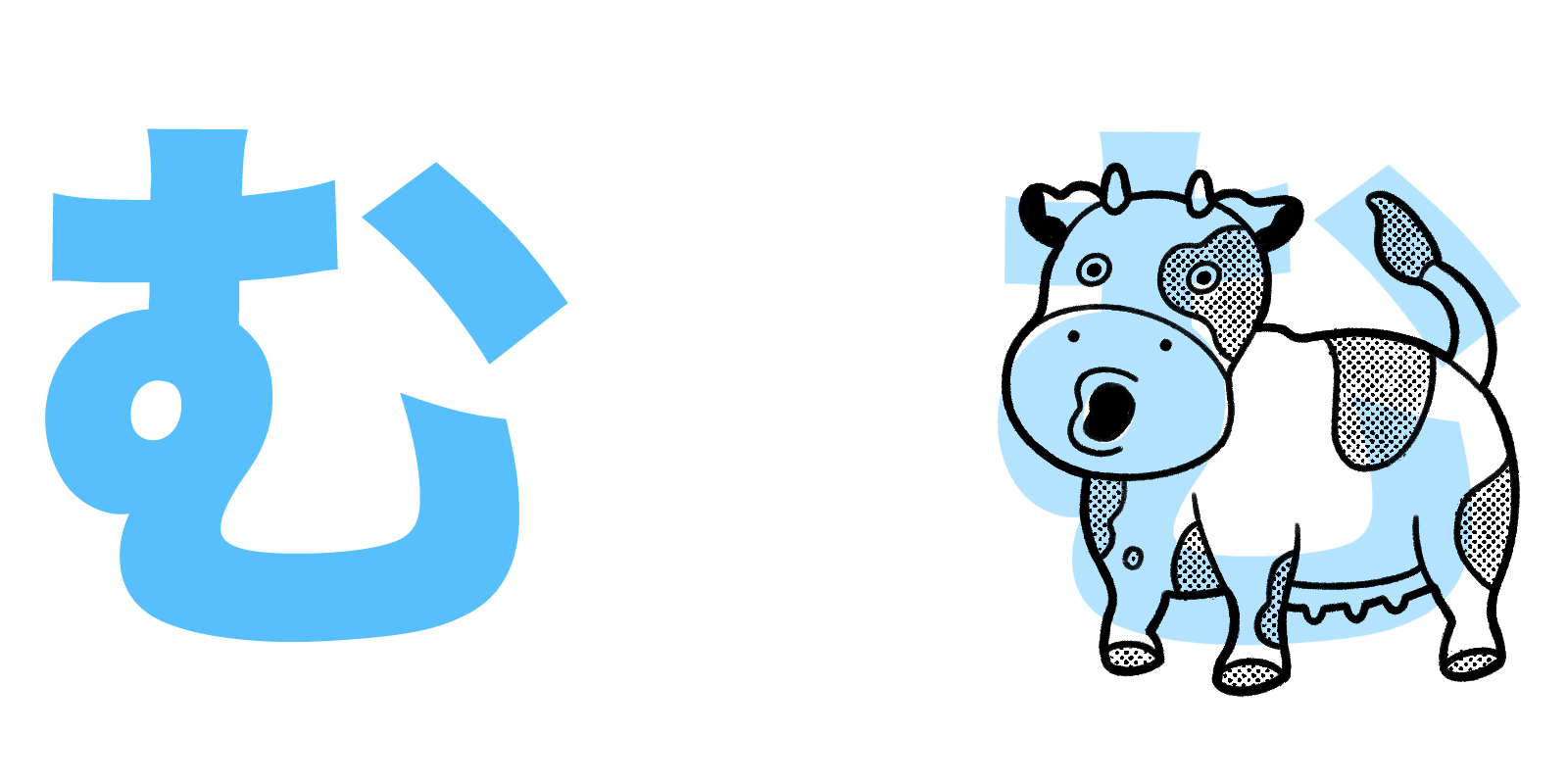
む is just the M sound plus う, making a mu sound. It's pronounced like what cows say in English: "moo." In other words, it sounds like moo in "mood."
- む
- MU
"<u>Moo</u>oooo", says the cow. "<u>MOO</u>OOOOO."
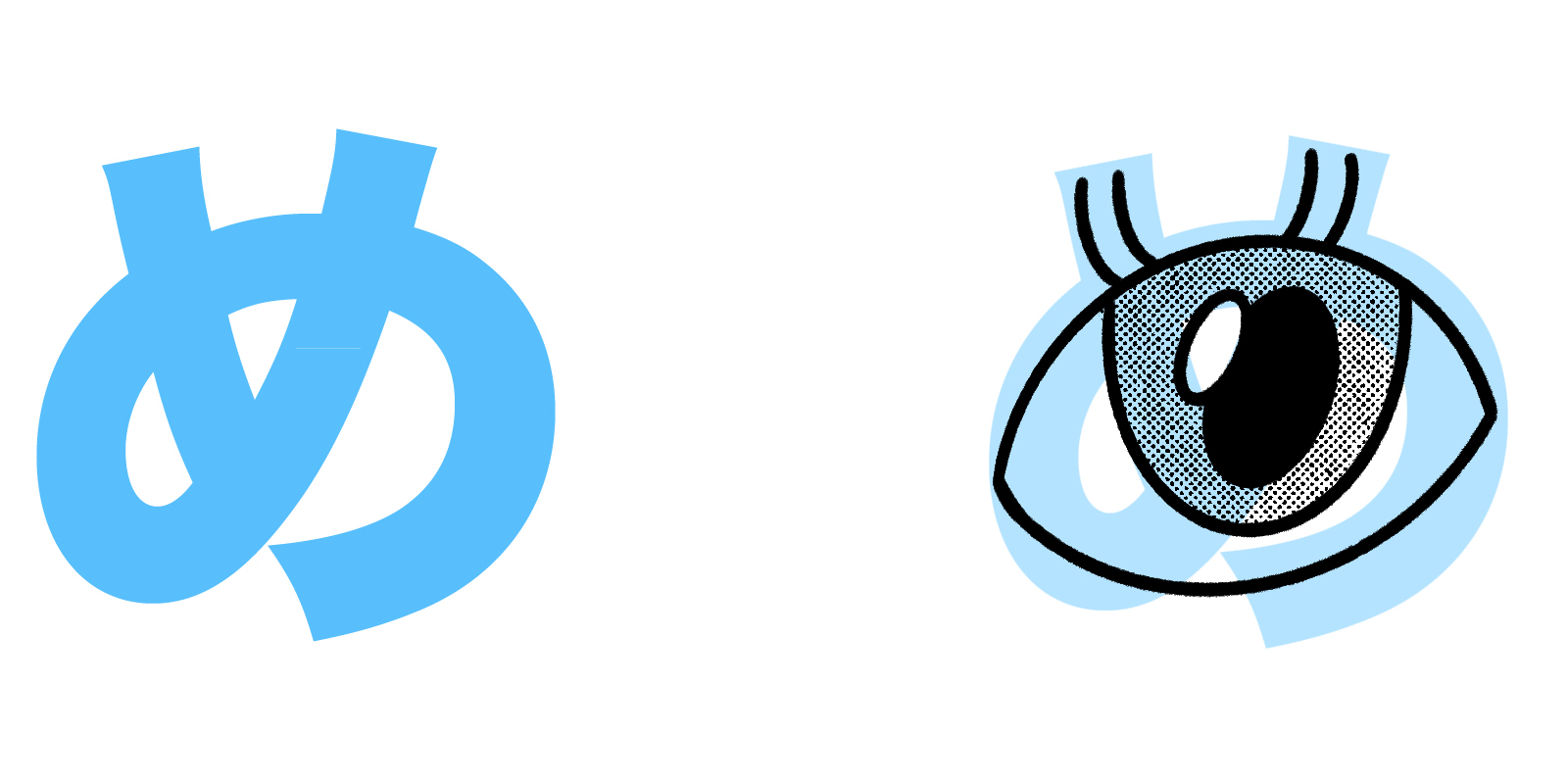
め is just the M sound plus え, making a me sound. It's pronounced like me in "mess.
- め
- ME
Look at that beautiful eye! It's so beautiful because of the <u>ma</u>keup on it. Gotta look pretty in the eyes, or else your ensemble will just be "<u>me</u>h."
If you also happen to know the word for "eye" in Japanese, that will help too. The word for "eye" in Japanese is just め (<u>me</u>).
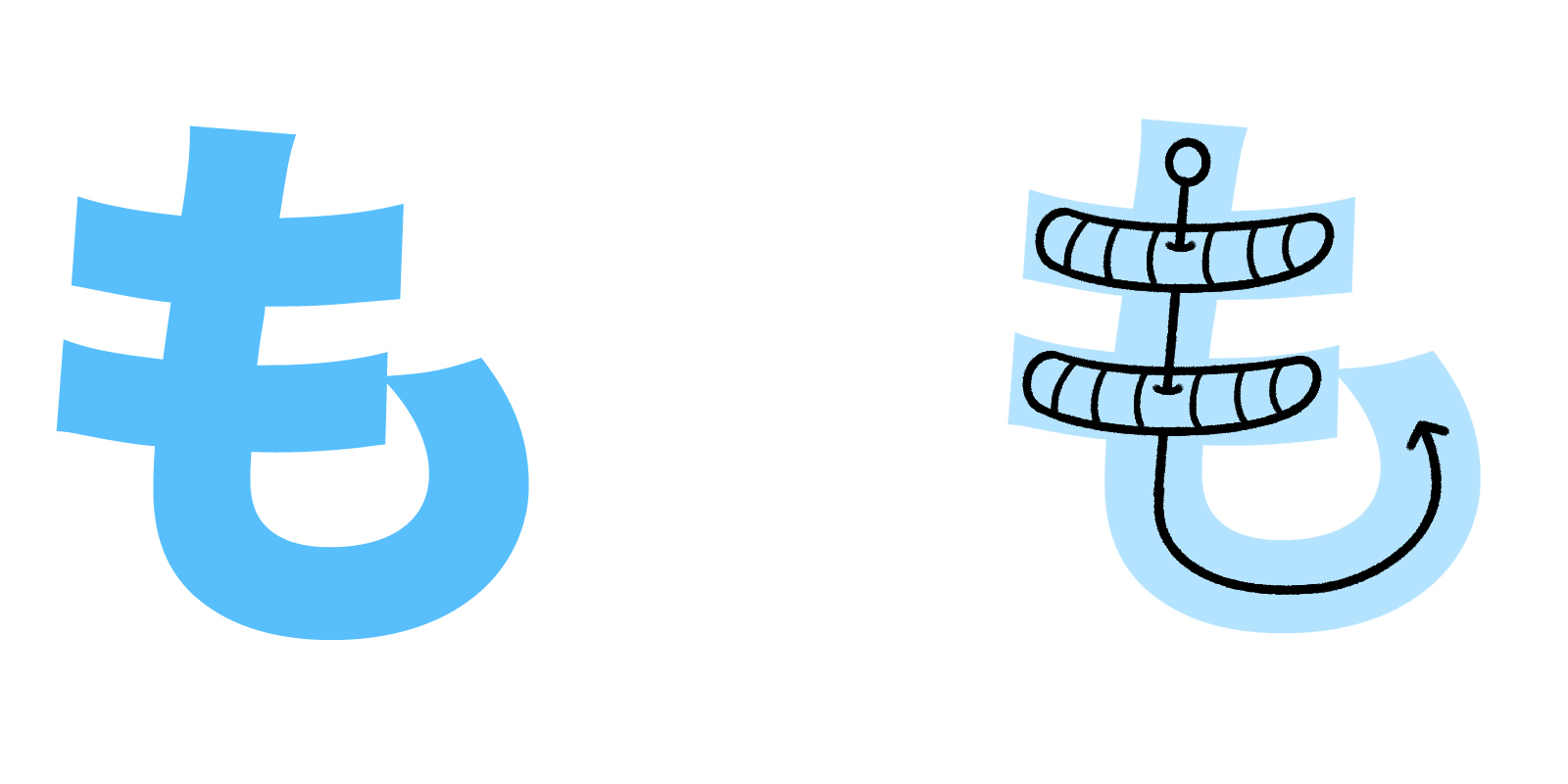
も is just the M sound plus お, making a mo sound. It's pronounced like mo in "more."
- も
- MO
You want to catch <u>mo</u>re so you add <u>mo</u>re worms to your hook.
や ゆ よ
This column is a little strange. There are only three items in here, and "ye" and "yi" are seemingly missing. Actually, they used to exist but now they don't (instead people use い or え, because it sounds pretty similar). Because of that, you only have to learn three kana for this section!

や is just the Y sound plus あ, making a ya sound. It's pronounced like ya in "yacht." In British English, it sounds more like ya in "yak."
- や
- YA
See how this kana looks like a <u>ya</u>cht with an anchor going down? It's even got a little flag on the rear… how cute.
Alternatively, you can
think of や as the face
of a <u>ya</u>k too.
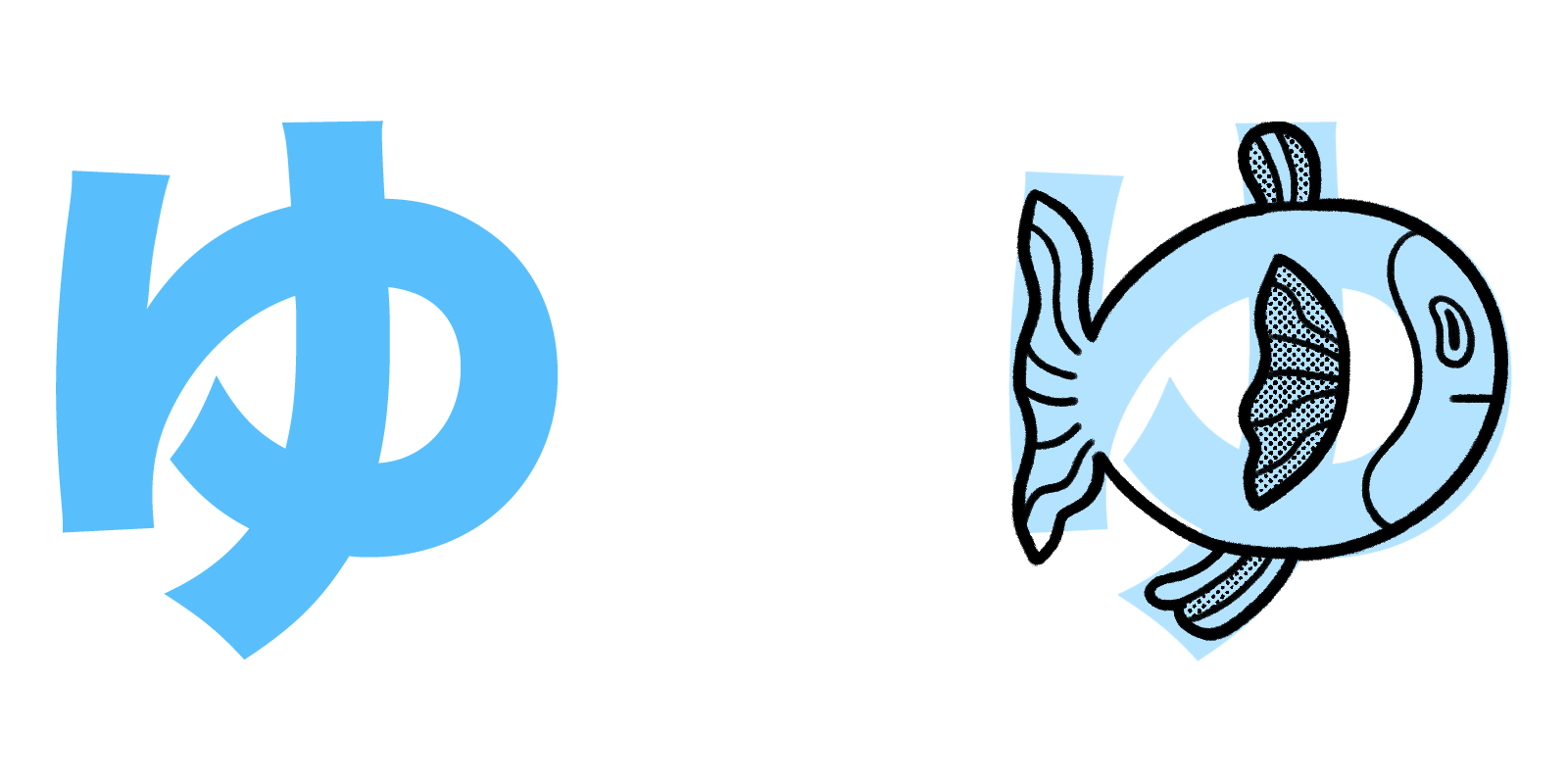
ゆ is just the Y sound plus う, making a yu sound. It's pronounced like the English word "you."
- ゆ
- YU
This kana is a very <u>u</u>nique looking fish! It looks like a big eyeball swimming in the water. What's it looking at? <u>You</u>, you big goofball! Isn't it weird how fish always look like they're staring at you?
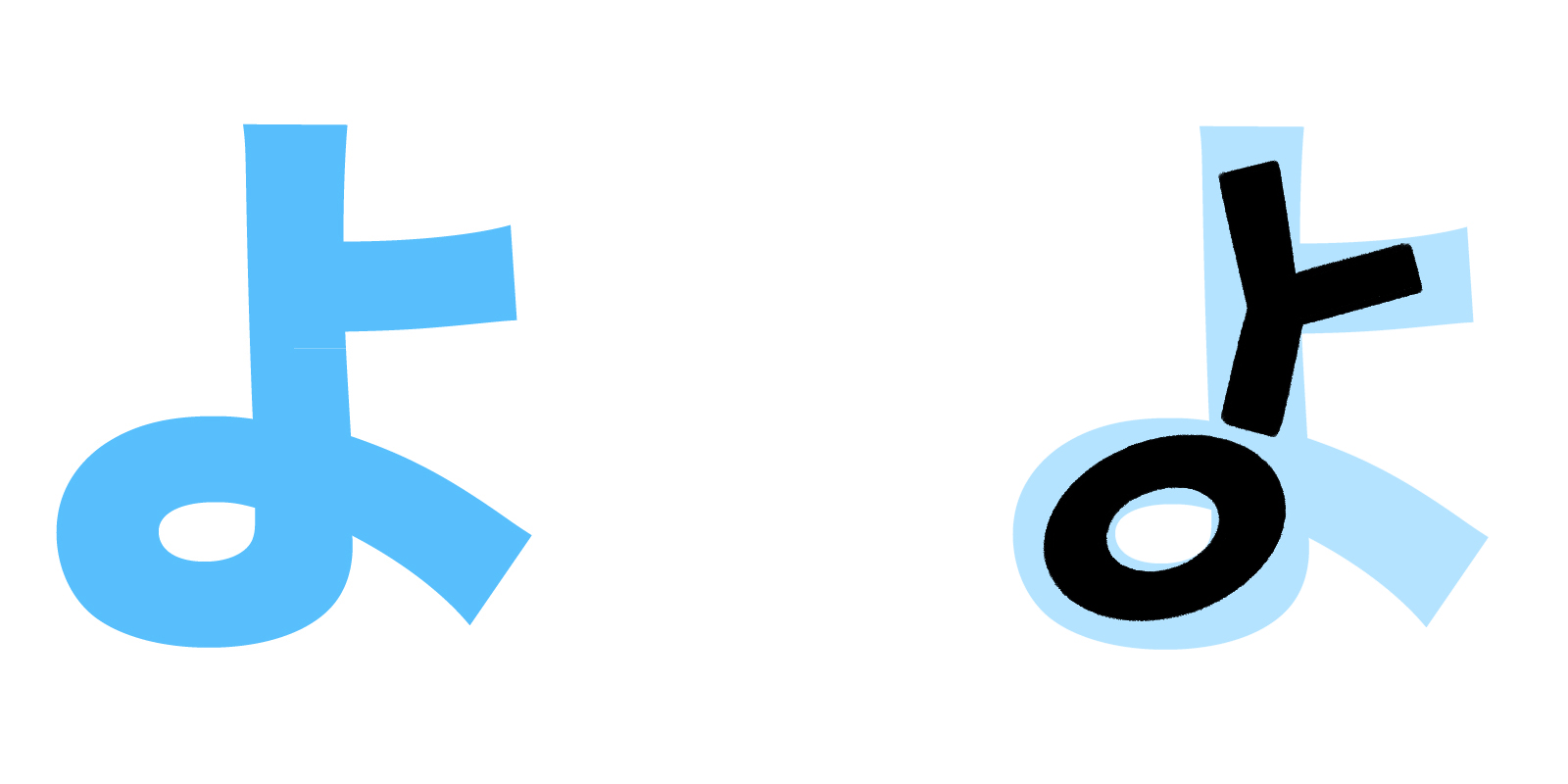
よ is just the Y sound plus お, making a yo sound. It's pronounced like yo in "yo-yo." In British English, it's more like yo in "yonder."
- よ
- YO
<u>Yo</u>, this kana looks like the letters Y & O! And look, you can even play <u>yo</u>-yo with it. Look at it slide down and back up again… it's mesmerizing, yo.
まみむめもやゆよ Exercises
Time to practice these eight hiragana (and the previous ones as well). Once again, go through the steps to make sure you know everything well!
- Using Tofugu's Learn Hiragana Quiz, quiz yourself on the あ, か, さ, た, な, は, ま, and や columns. Once you've done this three times, move on to step two.
- Using this worksheet, copy, print out, or download it and write in all the boxes.
When you're all done, it's time to tackle the last "main hiragana" section. You're almost there! Not so hard, right?
ら り る れ ろ
Welcome to the last main set! It's only eight characters just like the last set, so hopefully it's not too bad. It does include the infamous ra-ri-ru-re-ro column though, which does tend to give some people trouble pronunciation-wise. Please be sure to check out our "how to pronounce the Japanese R" article for more information on this.
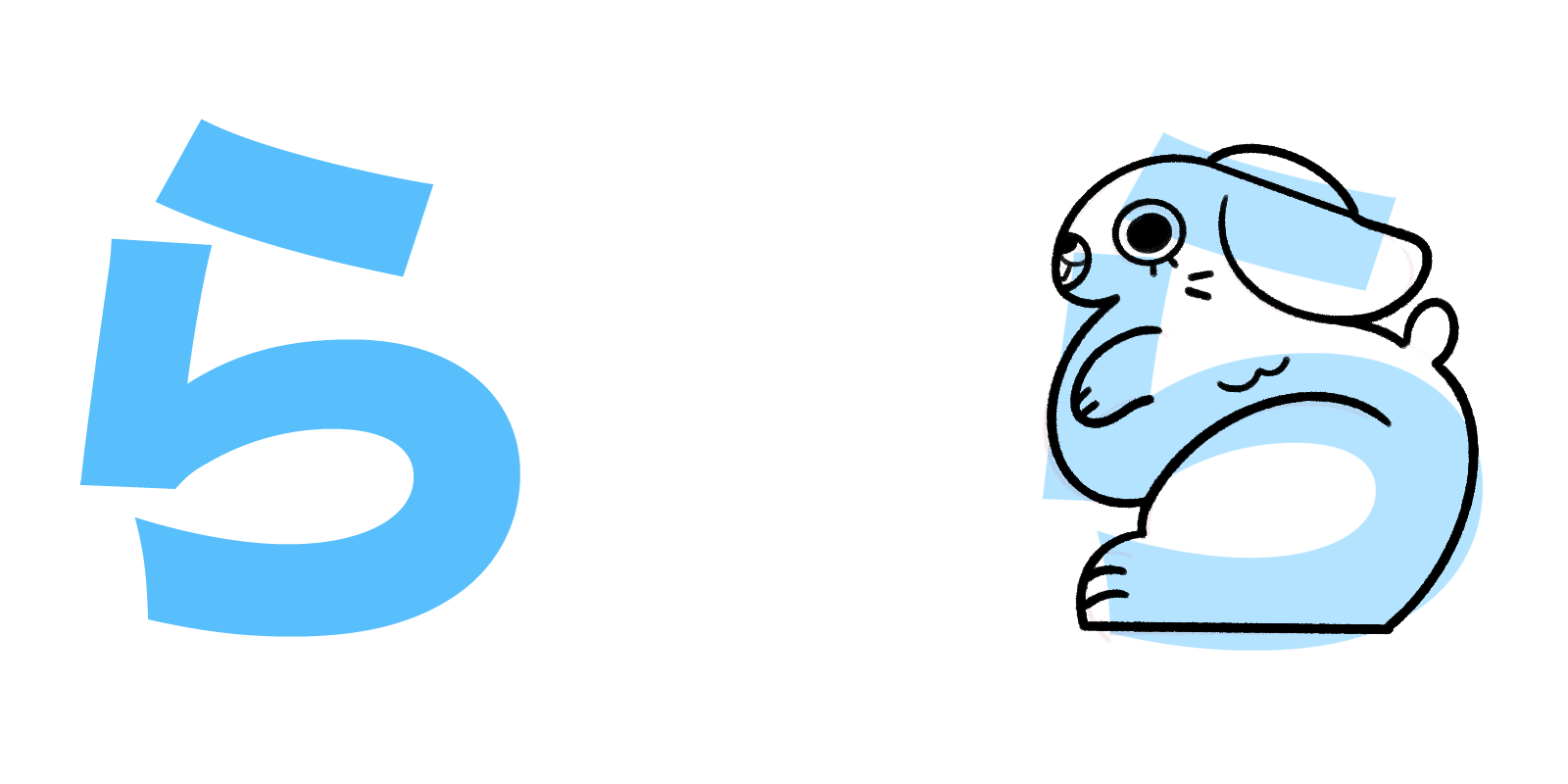
ら is just the R / L sound plus あ, making a ra / la sound. It's pronounced like a combination of "rah rah" (like cheering) and "la la la" (like singing!). To type or write it in romaji, use "r" and write "ra." The same goes for the rest of the R column. Use "r" when writing in romaji!
- ら
- RA
ら looks like a <u>ra</u>bbit that's standing and facing left. Look at its big droopy ears. So cute!
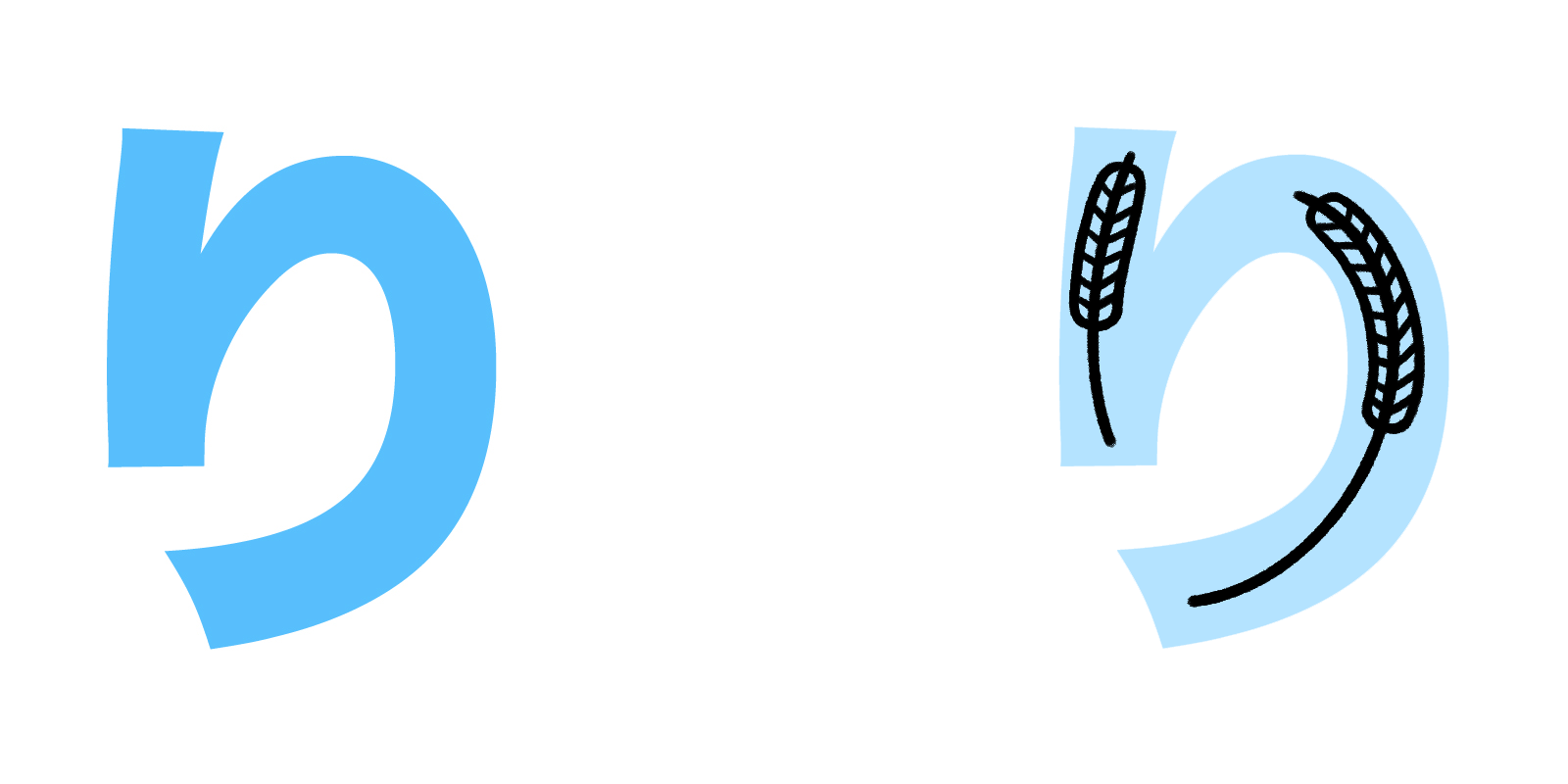
り is just the R /L sound plus い, making a ri / li sound. It's pronounced like a combination of ree in "reed" and lee in "leek."
- り
- RI
The <u>ree</u>ds are swaying in the wind.
This kana can also be written without the connection in the middle, too, which makes it more reedlike in that case (I wanted to present the more difficult of the two versions here, though).
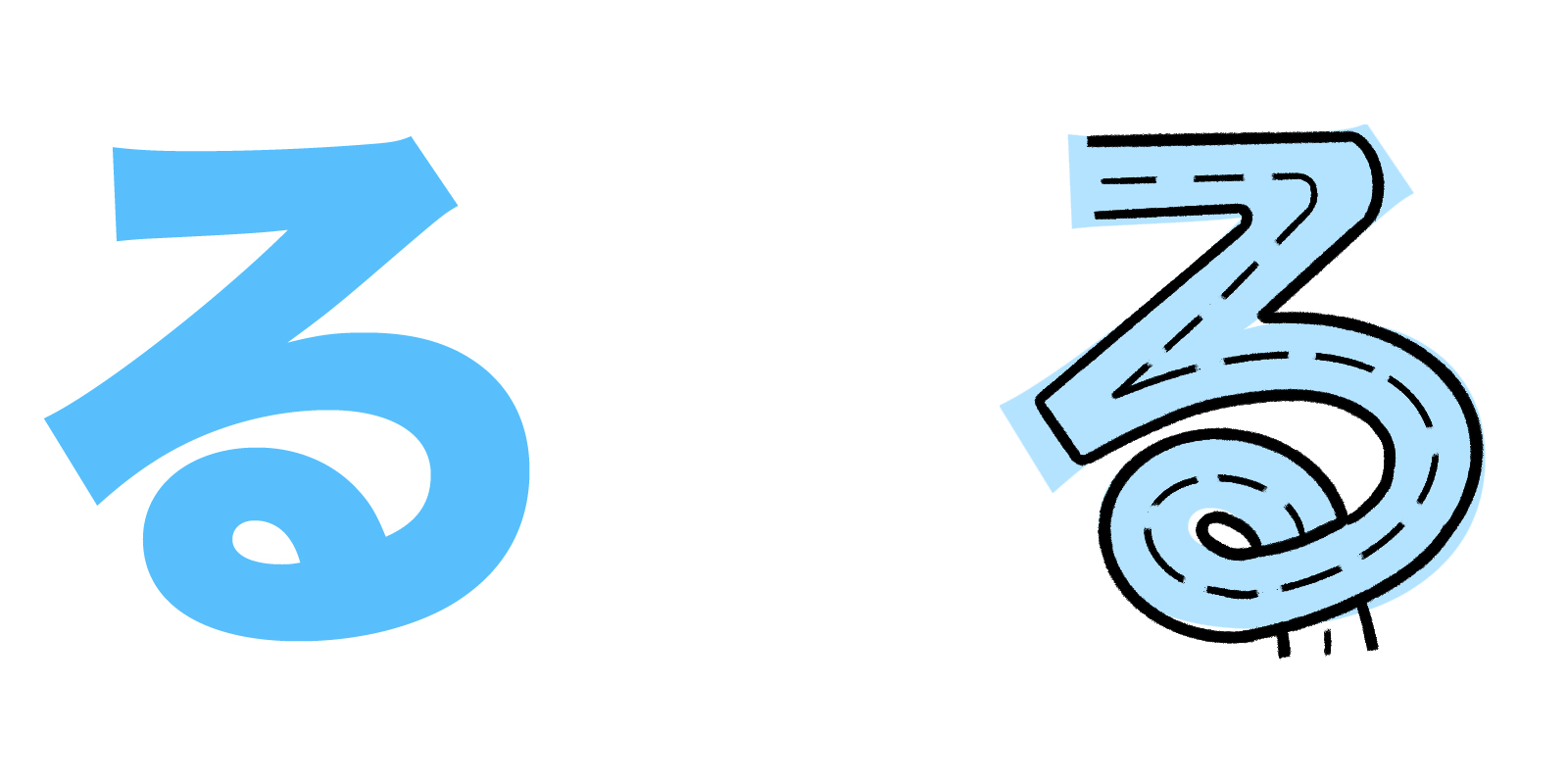
る is just the R / L sound plus う, making a ru / lu sound. It's pronounced like a combination of ru in "rule" or "route" and loo in "loop."
- る
- RU
The is like ろ (you'll learn it in a second) except it has a loop at the end. る is a crazier <u>rou</u>te. There is a <u>loo</u>p at the end. Are there no rules on this road?
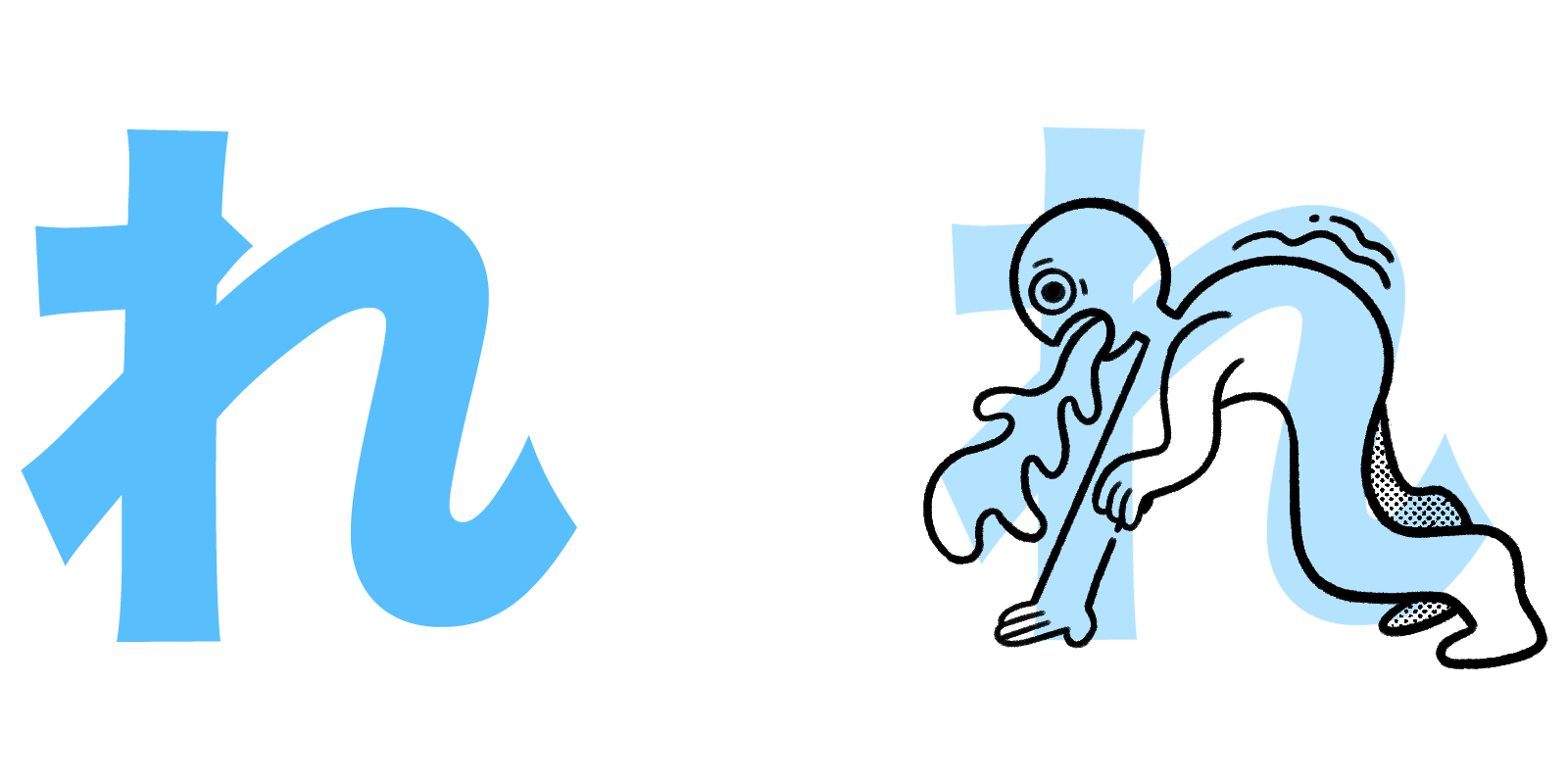
れ is just the R /L sound plus え, making a re / le sound. It's pronounced like a combination of re in "retch" and le in "led."
- れ
- RE
This looks like a guy kneeling on the ground, <u>re</u>tching up his dinner.
This kana is similar to め, わ, ぬ, and ね. What makes this one different is the curve at the back. You can identify this as the guy's knees bending, which makes it clear that he's keeled over retching his guts out.
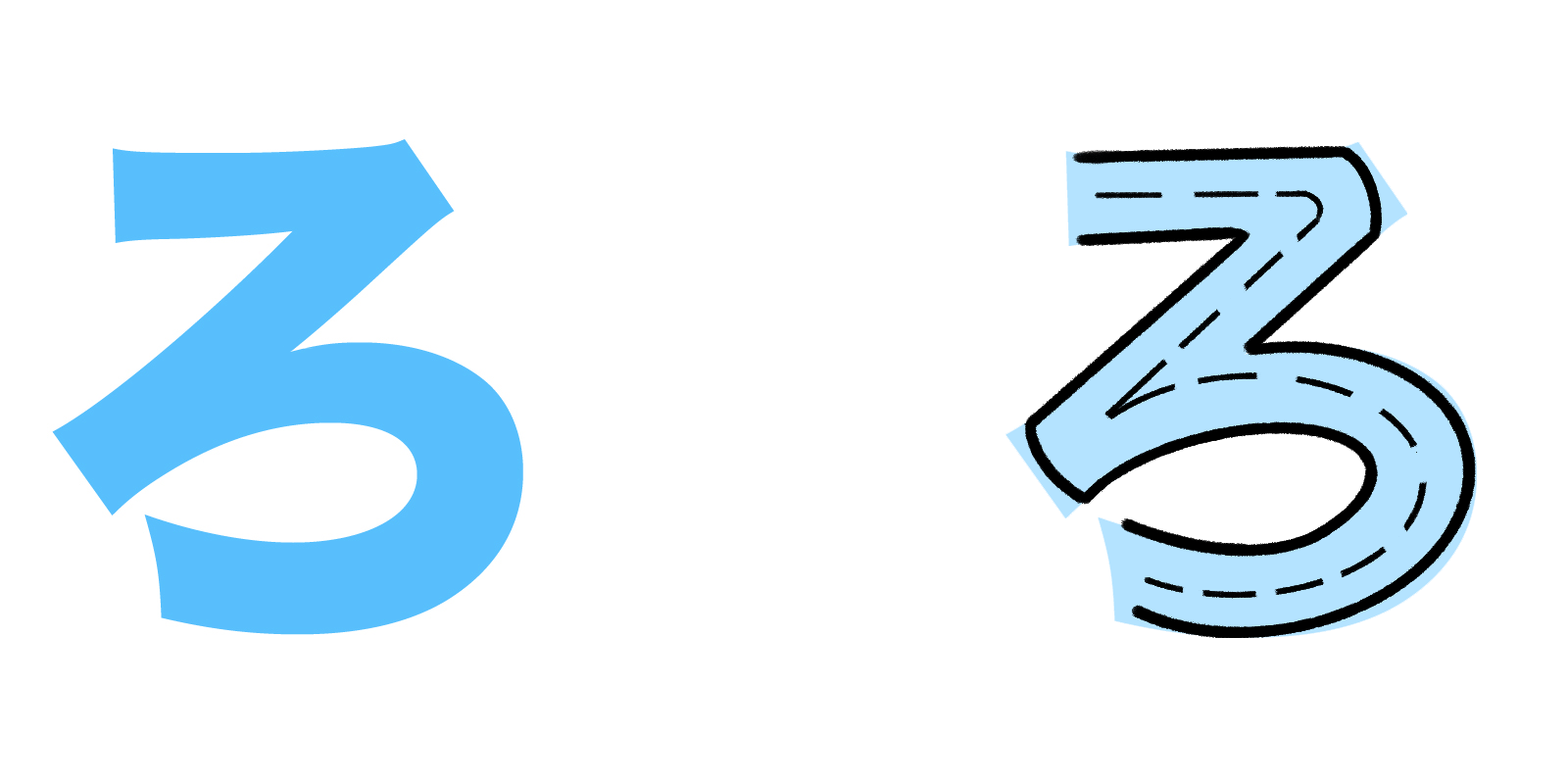
ろ is just the R / L sound plus お, making a ro / lo sound. It's pronounced like a combination of ro in "road" and lo in "load." In British English, it's more like ro in "rot" or lo in "long."
- ろ
- RO
This is the counterpart to る, except this one doesn't have a loop at the end. So this kana is just a plain old <u>ro</u>ad.
わ を ん
And finally, the last group. This is a weird one. It includes わ (which is quite normal), を (which is pronounced just like お, but is primarily used as a particle), and ん (which is the only consonant-only character in all the kanaa). Let's go through them one by one.

わ is just the W sound plus あ, making a wa sound. It's pronounced like wa in "wasabi."
- わ
- WA
This kana looks like a <u>wa</u>sp flying straight up.
It looks similar to れ, ぬ, ね, and め. And it looks especially similar to ね. You know ね is Nelly the cat because of the curl of the tail on the end. So you can imagine the cat chasing this wasp, which is why it's flying straight up to get away. Its butt is also a straight, sharp line. This is its stinger!
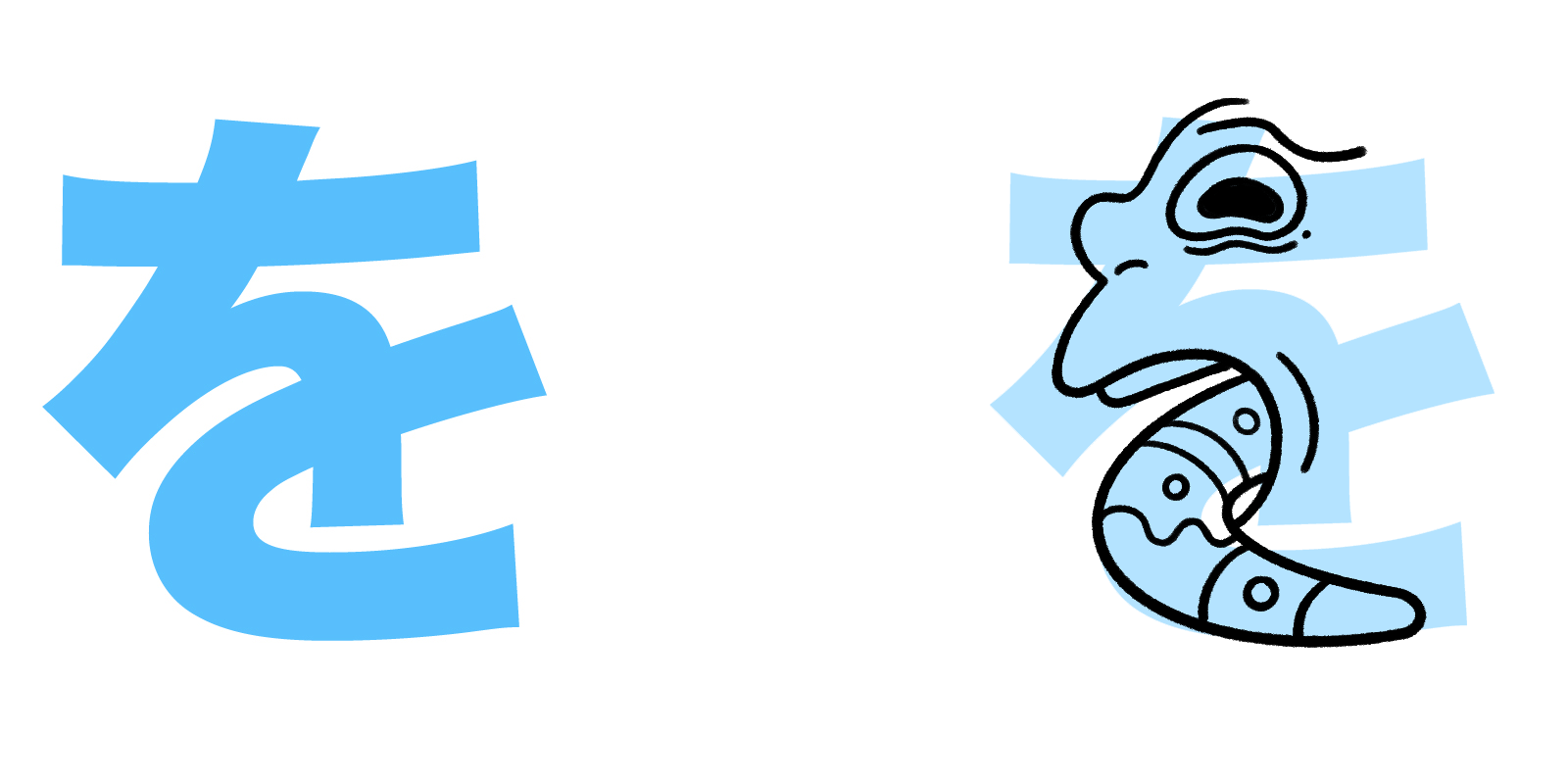
を is pronounced like o in "origami" — just like the vowel お. It used to be pronounced like "wo," but now it sounds exactly like お. Why two kana for the o sound, you wonder? Unlike お, を is primarily used as a grammar element called a "particle." It marks the object of a sentence.
In romaji, both "o" or "wo" are used for を. To type it, write "wo."
- を
- WO
"<u>Who</u>a!" yells the guy with no chin. Someone threw a boomerang into his mouth! That's pretty "<u>who</u>a"-worthy, I think.
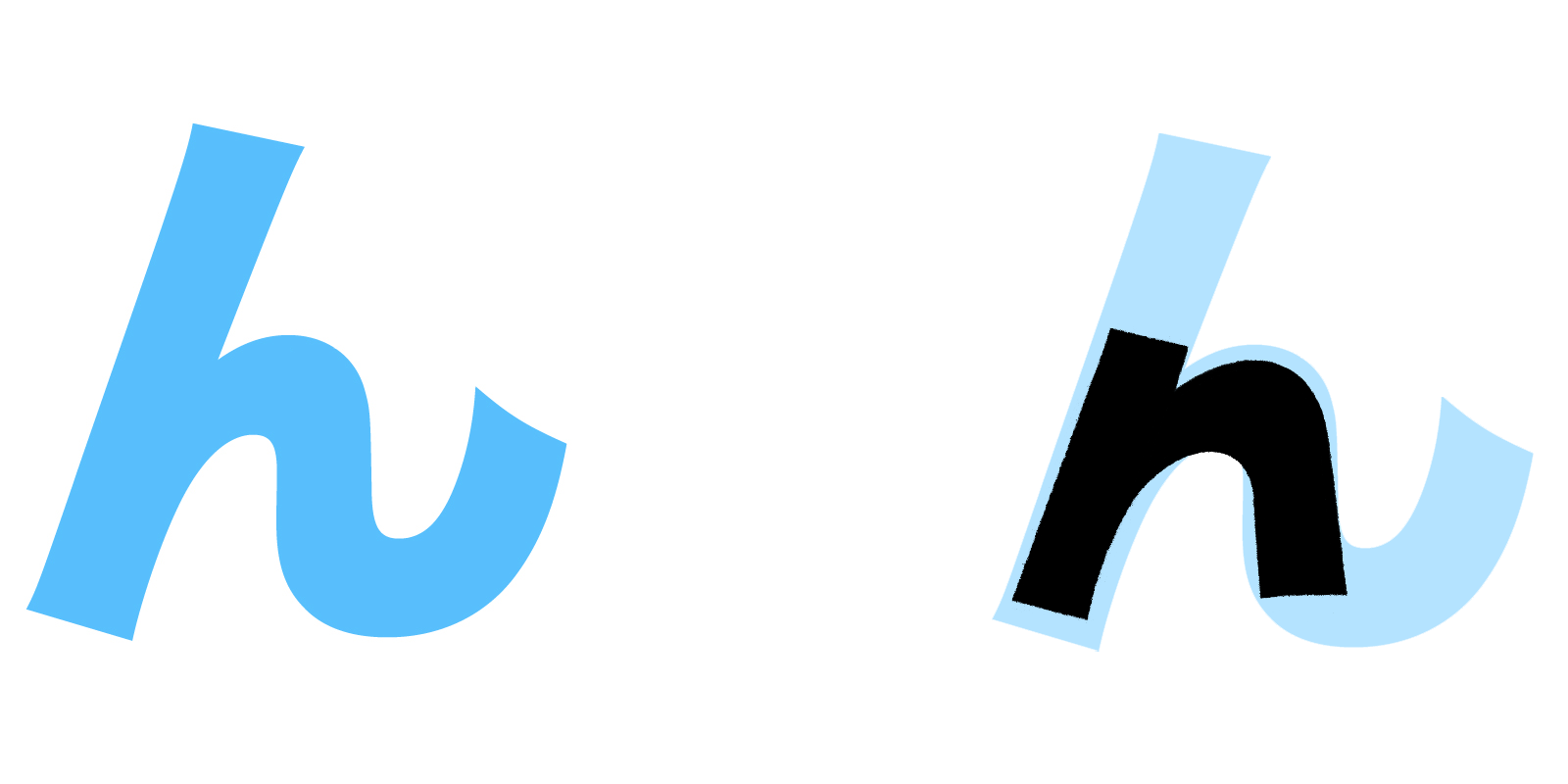
ん is just the N sound, that's it. It's the only kana that consists of a single consonant. It's pronounced like the ending n sound in "pen."
In romaji, write "n." To type it, you sometimes have to type "nn." Type double "n"s, especially before vowels and y, so that it won't turn into another kana that starts with n.
- ん
- N
This kana looks just like the lowercase n in English. They happen to be the same sounds, as well. How convenient! nnnんんん.
らりるれろわをん Exercises
This is the last of the main hiragana. The exercises will now cover quite a bit (you know quite a bit!), so make sure you understand and know everything before moving on.
- Using Tofugu's Learn Hiragana Quiz, quiz yourself on all of the main hiragana. Try to do it as quickly as you can.
- Using this worksheet, fill in all the blanks. You know the drill!
That will finish out all the main hiragana. From here on out it's just combinations of kana or variations on kana you already know, which makes things both easier and harder. Let's start with the "variation hiragana," also known as…
Dakuten & Han-Dakuten
Dakuten is a symbol that looks like this → ゛. Looks like a double quotation mark, right?
This dakuten symbol marks hiragana from certain consonant columns and changes their pronunciation. It turns the consonant into a "voiced" or "vibrating" sound, which just means your vocal cords vibrate when the sound is made. Let's take a closer look at each so that you know what I mean by that!
が ざ だ ば ぱ
Luckily for you, there are only five rows of dakuten kana to learn, and all you have to learn is what the sound changes to (since you know the kana already). Let's go over each of those dakuten transformations.
か → が
Every kana in the か column can have dakuten. When this happens, the K sound becomes a G sound.
か → が (ga)
- が
- GA
き → ぎ (gi)
- ぎ
- GI
く → ぐ (gu)
- ぐ
- GU
け → げ (ge)
- げ
- GE
こ → ご (go)
- ご
- GO
Because you know the か column already, all you really need to remember is that K → G. Think of it this way:
The <u>ca</u>r (か) runs into the <u>gua</u>rd (が) rail.
さ → ざ
When something from the さ column gets dakuten, it changes to a Z sound, with the exception of し (which is already an exception, so this makes sense!). Although じ sounds more like "JI" than "ZI," keep in mind both spellings work when you type. The same goes for other combination hiragana that use じ — You can either use J or Z for typing characters like じゅ, for example.
さ → ざ (za)
- ざ
- ZA
し → じ (ji)
- じ
- JI
す → ず (zu)
- ず
- ZU
せ → ぜ (ze)
- ぜ
- ZE
そ → ぞ (zo)
- ぞ
- ZO
All you have to remember is that S → Z, except in the case of し, which goes to じ. Exceptions will breed exceptions, so make sure you keep this in mind. To remember the S → Z part, though, consider the following mnemonic:
My <u>sa</u>w (さ) just <u>za</u>pped (ざ) me when I tried to use it. (imagine yourself trying to use a saw/さ and getting zapped/ざ).
Do you remember what the K-column converts to? Do you remember what the S-column converts to? What is the exception in the S-column? When you're able to answer all that, move on to the next dakuten set.
た → だ
The T-column kana change to D sounds, except for the exceptions (which are ち and づ). Remember: Exception breeds exception!
た → だ (da)
- だ
- DA
ち → ぢ (ji)
Note: If you're typing, write "di."
- ぢ
- JI
つ → づ (zu)
Note: If you're typing, write "du."
- づ
- ZU
て → で (de)
- で
- DE
と → ど (do)
- ど
- DO
Take a look at ぢ and づ again. Although they used to be pronounced differently (more like "dzi" and "dzu"), nowadays, ぢ and づ are pronounced exactly like じ and ず. However, in written form, they're still used for sounds that originated from ち and つ. So bear in mind that if you want to type ぢ and づ, you'll need to type "di" and "du" — not "zi" and "zu."
To remember that the た column changes to become the だ column, think of it this way:
Changing these kana to the dakuten versions is a bit like magic… "<u>TADA</u>!" (た & だ)
Do you remember what the K-column changes to? Do you remember what the S-column changes to? What about the T-column? Do you remember the three exceptions we've run into so far? If you can answer all of those questions it's time to move on to the last dakuten set, which is really two sets in one.
は → ば, ぱ
The H-column is a bit strange. It has two different kinds of symbols that can be applied to it. One is the regular dakuten — that "quotes" symbol you've seen so far. The other is called han-dakuten, a little circle like this → ゜. This han-dakuten makes phonetically voiceless sounds: unlike voiced sounds (dakuten sounds), your vocal cords don't vibrate when you make them. Han-dakuten only applies to H sounds and turn them into P sounds so it should be easy to remember, though.
は → ば (ba), ぱ (pa)
- ば
- BA
- ぱ
- PA
ひ → び (bi), ぴ (pi)
- び
- BI
- ぴ
- PI
ふ → ぶ (bu), ぷ (pu)
- ぶ
- BU
- ぷ
- PU
へ → べ (be), ぺ (pe)
- べ
- BE
- ぺ
- PE
ほ → ぼ (bo), ぽ (po)
- ぼ
- BO
- ぽ
- PO
You have to remember that the H-column goes to both a B and a P sound. What a pain. Think of it this way:
You're saying "<u>ha</u>haha (は)" at the <u>ba</u>r (ば), because you've been drinking too much.
You say "<u>ha</u>haha (は)" so much at the bar that somebody <u>pu</u>nches (ぱ) you.
Imagine through that story with you being the one saying "hahaha" (i.e. you're laughing) a couple of times, trying to get the details as vivid as possible (especially the details that have to do with laughing, the bar, and getting punched).
To help you a little more, you can remember that the P-column is the one that uses the little circle. Why? Because that little circle is like a little fist that's about to punch you.
Before moving on, try to recall the mnemonics we used for the following (and remember what each converts to):
か →
さ →
た →
は →
は →
When you're able to do and recall everything, it's time to practice and see how good you really are!
Dakuten Practice
This practice will mainly focus on dakuten but also include all the kana you've learned up until this point.
- Using Tofugu's Learn Hiragana Quiz, select only the dakuten hiragana and drill those for 5-10 minutes until you feel somewhat comfortable.
- Now, add in all the other kana, mixed in with the dakuten kana.
- Using this worksheet, fill in all the blanks.
When you're all done with that you should know all the kana fairly well, some better than others. I imagine there will be a few nagging "difficult" kana for you (it will depend on each individual which kana these are), but over time as you use hiragana and read more everything will get easier and easier. The whole point of this guide is to help you to get you reading, making it so you can use various other resources to continue your Japanese study.
Combination Hiragana
There's only one more section to complete. You're not really learning much that's new here, but you are going to learn how to combine different types of kana together to make some new sounds. Mainly, we're going to focus on what small ゃ, ゅ, and ょ can do to kana from the い row (that includes き, し, じ, に, etc). In other words, what we are combining are these two elements:
-
Kana from the い (I) row.
This also means kana that end with an I-sound when written in romaji, which are:
き (ki) - し (shi) - ち (chi) - に (ni) - ひ (hi) - み (mi) - り (ri) - ぎ (gi) - じ (ji) - ぢ (di) - び (bi) - ぴ (pi)
Note the vowel い itself won't apply here! -
The small ゃ - ゅ - ょ
The small versions of や (ya) - ゆ (yu) - よ (yo).
Look closely to see how they're almost half the size of the regular kana:
やゃ
ゆゅ
よょ
Now you know what to combine, here's how to combine them. What's important in this process is you drop the I-sound that comes from the い-row kana. For example:
き + ゃ → KIYA → KYA
じ + ょ → JIYO → JYO
See how the "i" gets dropped and it just becomes one syllable of sound? Here's a list of them all:
きゃ、きゅ、きょ → KYA, KYU, KYO
- きゃ
- KYA
- きゅ
- KYU
- きょ
- KYO
ぎゃ、ぎゅ、ぎょ → GYA, GYU, GYO
- ぎゃ
- GYA
- ぎゅ
- GYU
- ぎょ
- GYO
しゃ、しゅ、しょ → SHA, SHU, SHO
- しゃ
- SHA
- しゅ
- SHU
- しょ
- SHO
じゃ、じゅ、じょ → JYA, JYU, JYO (or JA, JU, JO)
- じゃ
- JYA
- じゅ
- JYU
- じょ
- JYO
ちゃ、ちゅ、ちょ → CHA, CHU, CHO
- ちゃ
- CHA
- ちゅ
- CHU
- ちょ
- CHO
にゃ、にゅ、にょ → NYA, NYU, NYO
- にゃ
- NYA
- にゅ
- NYU
- にょ
- NYO
ひゃ、ひゅ、ひょ → HYA, HYU, HYO
- ひゃ
- HYA
- ひゅ
- HYU
- ひょ
- HYO
びゃ、びゅ、びょ → BYA, BYU, BYO
- びゃ
- BYA
- びゅ
- BYU
- びょ
- BYO
ぴゃ、ぴゅ、ぴょ → PYA, PYU, PYO
- ぴゃ
- PYA
- ぴゅ
- PYU
- ぴょ
- PYO
みゃ、みゅ、みょ → MYA, MYU, MYO
- みゃ
- MYA
- みゅ
- MYU
- みょ
- MYO
りゃ、りゅ、りょ → RYA, RYU, RYO
- りゃ
- RYA
- りゅ
- RYU
- りょ
- RYO
Combination Hiragana Practice
With this knowledge it's time to practice. I've made a worksheet that covers these combination kana. Go through it and fill in all the blanks.
When you're done, you should be able to read almost everything that hiragana throws at you. Everything except one little thing…
Small Tsu (っ)
The small tsu is a weird little thing but we'll make sense of it. This kana doesn't have a sound. Instead, it adds a quick little pause before a consonant sound in a word. The easiest way to think of it is to call it a "double consonant." That is because the consonant after a small っ is written twice when writing in romaji. Let's take a look at how the following hiragana converts to romaji.
したい → shitai
- したい
- SHITAI
しったい → shit_tai
- しったい
- SHITTAI
かこ → kako
- かこ
- KAKO
かっこ → kak_ko
- かっこ
- KAKKO
いた → ita
- いた
- ITA
いった → it_ta
- いった
- ITTA
See how that worked? したい is just plain "shitai" without the small っ. But when you add it in, it becomes shittai. The small っ that comes before the "ta" causes the consonant to double, making it "shit_tai." Make sure you understand how that works with kako/kakko too.
In terms of pronunciation, did you hear that small pause where the small っ exists? Let's take a look at another example:
いしょ → isho
- いしょ
- ISHO
いっしょ → ish_sho
- いっしょ
- ISSHO
You will hear both of the consonants as separate sounds. One that ends the first part of the word, and one that starts the second half (with the small っ) showing you where that half point is.
For a while it will probably be difficult to distinguish a small っ and a large つ, especially in handwriting. After you get more experience and read a lot more you'll be able to make this distinction quite easily.
Additional Practice
Although you could probably go out into the real world and practice hiragana on your own, I thought I'd provide for you some ways to practice your newfound skills. I wouldn't recommend doing everything here all at once but instead spread it out over the course of a couple weeks. Spacing your practice is very important if you want to get better at something more quickly. Doing all this at one time won't be all that effective. Luckily you can always start working on other parts of Japanese in the meantime while you continue to practice hiragana.
Worksheets
We made a couple more worksheets for you to download/copy/print out. They're a little different from before though. This time they're real sentences and we're not keeping track of what kana we're using, so it's a bit more like real life. You'll still want to put the romaji above the kana and read each kana out loud. Don't worry too much about meaning, that's not what we're learning right now and it will definitely be way above your ability level.
When you finish those, I bet you'll be feeling pretty special, like some kind of hiragana master. If you don't, there's always more ways to practice.
Apps & Other Programs
There are plenty of apps and resources out there to help you drill as well. Some of them you've seen already because of this guide, others you have not.
- Tofugu's Learn Hiragana Quiz
- RealKana
- Anki (you'll need to download a hiragana deck)
- Dr. Moku's Hiragana Mnemonics (in case our mnemonics aren't doing it for you)
I'm sure there are plenty of other resources out there as well, but this should be good enough to get you to that level where you can start using the hiragana with other resources.
"Real Life" Practice
Of course, if you'd like to practice more there are plenty of "real life" ways to practice hiragana. Just go to any Japanese website and read all the hiragana that you can find. If anything it will teach you to differentiate between kanji, katakana, and hiragana, which is a nice skill to have. Try the NHK NEWS WEB EASY, or any of these graded readers.
Moving On Practice
After learning hiragana to a moderately slow level, you don't have to keep drilling it until it's fast. In fact, you can just move on to something else. Hiragana will keep popping up just about everywhere, so by learning something new you're actually reviewing the hiragana at the same time!
What Next?
Hiragana is only the start of things to come. You have so much more to do and hiragana will help you to get there. Although the answer to the question "what's next" is going to be somewhat vague / dependent on the individual, here are some suggestions to move you along your way.
Kanji
I do highly recommend that you get started on kanji right away. A lot of people think they should wait until they have a higher level of Japanese but that is usually a terrible idea. Being good at kanji speeds up just about every other facet of learning the Japanese language, from grammar to reading to speaking to listening. If you're weak at kanji you'll be weaker at everything else. Many people think kanji is difficult, but we made WaniKani to show that it's not as hard as people think.
Katakana
At the same time as kanji it's worth learning katakana. Katakana won't come up nearly as much especially at a really early stage of Japanese, but it's not rare enough to ignore. If you liked this guide to hiragana, check out our guide for learning katakana. It's just as stellar.
Grammar
Along with kanji or after you have a foundation in kanji, it's time to learn some Japanese grammar. There are many resources to help you to do this. There are sites like Tae Kim's Guide To Japanese as well as textbooks (we like the Genki series). We also have a collection of our own grammar references on this Tofugu website as well.
—
I hope this guide helped you to learn hiragana effectively and quickly! Keep working hard and you'll continue to get better and better. With hiragana you have the tools to start your Japanese studies no matter what resource or textbook you end up choosing, so try a lot of things and see what works for you. Feel free to check out some of our reviews on Japanese resources!
P.S. We're working on adding videos to this guide, so check back occasionally if you're having trouble with pronunciation (because videos will help a lot with that!).
-
A system that transliterates Japanese into English letters. ↩