The 5 Biggest Mistakes People Make When Learning Kanji

The Japanese learning industry has, for all intents and purposes, failed you. It’s not your fault that learning kanji is like hitting your face on a curb, it’s the industry as a whole. Sure, there are pockets here and there that are pretty smart about it, but they tend to be small and nobody really knows about them. Most likely, you know what your teachers says about kanji, or what Rosetta Stone Japanese (doesn’t) say about kanji, or what your textbook throws at you… But, here’s the problem, though: You’re learning kanji from native Japanese speakers, and they have no idea what it’s like to learn kanji anymore (and even if they do, they just emulate the way Japanese school children learn kanji), which really just doesn’t work.

The Japanese learning industry, on a whole, has failed us when it comes to kanji learning. But, you can learn from their mistakes, and in doing so, learn how to fix the way you learn kanji.

FAILURE #1: You Learn Kanji Stroke By Stroke By Stroke…

Sure, there’s something to be said about learning correct stroke order. I’m all for that, but the problem is that it ends up putting emphasis on learning kanji stroke by stroke by stroke. When kanji is simple, it’s easy to learn this way. Three strokes? Only three things to learn. Huzzah! But, when you start out learning kanji like this (i.e. when you think of kanji as a bunch of strokes), you keep learning kanji like this. That’s why in most Japanese classes, when the kanji homework goes out, people automatically see how many strokes a kanji has. “I know a 20-stroke kanji, I’m impressive!” people think. No. You’re stupid. Thinking of kanji as a bunch of strokes just forces you to try and remember more. A 20-stroke kanji = 20+ different things you have to remember. If you think of a kanji as individual strokes making up the whole, then you’ve already failed. So how should you think of kanji, then?

FAILURE #2: You Don’t Learn Your Kanji Radicals

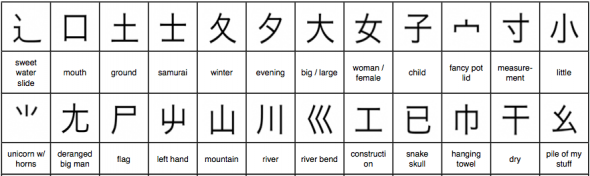
Oh sure, you might learn a few radicals here and there, like the water radical (just a few little strokes next to a kanji). “If you see this,” the kanji resource says, “you’ll know that this kanji probably has something to do with water.” For the most part, though, radicals are a distant afterthought in the kanji-learning world, and this is an absolutely huge mistake. Most people teach radicals (if they teach them at all) as pieces of a kanji that help you figure out the meaning of the kanji if you don’t know it. Although this works sometimes, why not just learn the meaning of the kanji in the first place?

Instead, learning radicals should be treated like building blocks. Remember how I said kanji should not be learned stroke-by-stroke? More complicated kanji should be put together radical-by-radical. If you take the time to learn the 200-250 kanji radicals (it may seem like a lot, but it’s really a pretty quick process), you can put a fairly complicated kanji together in 3, maybe 4 steps. Think of radicals like the ABCs of English. You can’t put together the word FAILURE if you don’t know the letters F-A-I-L-U-R-E, right? By learning radicals first you’re setting yourself up for kanji success. You cut down on the memorization required for every single kanji by 300-800%. Here’s an example:

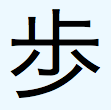
Now, this kanji isn’t particularly difficult, but you get the drift. Learning this kanji stroke-by-stroke would set you back eight steps (because there are eight strokes). Instead, let’s take a look at the radicals that make this kanji up. If you learn all the kanji radicals (or, at least the ones I recommend), putting this particular kanji together can be done in a mere 3 steps, depending on which radicals you would use. That’s a 260% less to learn which means you’re saving valuable time and brain-space.
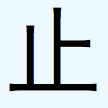
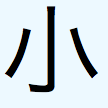
As you can see, these three “radicals” can be put together (like letters in a word) to create the kanji above. The first one (止) makes up the top portion, the second one (小) takes up the bottom, and the third (ノ) rounds it out. The best part is that you associate these radicals with names and concepts, which means you can come up with some kind of mnemonic device to help you remember what goes where (more on mnemonics below).

In summary, everyone should learn their radicals before even thinking about learning kanji. If you don’t, it’s like building a highrise with no foundation.

Failure #3: You Memorize Instead of Learn

Good things can be said about repetition and “memorization.” I think they’re a necessary part of kanji learning, but everything has it’s limits (and you can use all the help you can get when it comes to kanji). One of the problems I have with the “normal” way people have you learn kanji is that they give you 10-20 kanji, sit you down with a kanji worksheet, and have you write the kanji over and over again (and of course, the focus is on the number of strokes, right?). The problem, though, is with our brains. First of all, there’s only so much information (or so many steps) we can fit in our short term memory. That means as soon as you move on to the next kanji, there’s a good chance you’re already forgetting the one before it. Another problem is that with too much repetition, our brains switch to autopilot. At that point you aren’t learning any more, you’re just going through the motions. To solve this, there are a couple of solutions.

SOLUTION A) First of all, don’t think of the kanji as strokes, think of them as particles. This will help you learn more effectively (and get the information in your long term memory more quickly). When you’re practicing, think of the individual radicals that you’re writing, and how they go together to form the whole kanji. The more you do this, the faster you’ll be able to learn kanji.

SOLUTION B) Don’t write a single kanji more than three times in a row. If you have multiple kanji to practice, switch back and forth and go back to previous ones. Come up with some kind of pattern. I would recommend something like this. Each letter represents a kanji, and each time it shows up it should be written for practice: A, A, A, B, B, B, A, B, C, C, C, A, B, C, D, D, D, A, B, C, D, E, E, E… etc. When you run out of space for “A” kanji, you would just start at “B” the next time around. This way you are forcing your brain to actually think and process the information, instead of hitting autopilot the moment you’ve written a kanji for the 4th or 5th time.

SOLUTION C) Apply some kind of mnemonic strategy to your kanji. Mnemonics help you remember things. They basically leave hints in your brain that when seen trigger another memory, which really helps you to remember things more effectively. One way to do this is to come up with “stories” for your kanji. If you’ve learned the kanji radicals, it is pretty easy to do. If you take the example above (歩), we can use the three radicals to come up with a story to help us remember whatever it is we want to remember. The radical examples below are ones I’ve given meaning to. You can come up with your own meanings if you want to, or use a set that someone else has developed.

  • 止 is a radical that means STOP
  • 小 is a radical that means SMALL
  • ノ is a radical that means SLIDE

So, we can use these three concepts / words and put them together in a way that helps us remember that the kanji 歩 means “walk.” Here’s one: “Stop! It’s a small slide. We will walk from here” (you know, because zombies hang around slides). As long as you know the radicals already, the hints to trigger this little “story” will be right in the kanji, every time you see it. Of course, we could get even more in depth with it and start associating emotion as well as our senses. This gets into the concept of creating “flashbulb memories” for yourself (these are memories your brain produces during traumatic or incredible events, that’s why you remember where you were, say, when you learned about 9/11). By imagining the emotion you felt when you saw the small slide, or the smell of the aluminum, or perhaps even the shock you felt when you saw how small it was, you can make this memory a lot stronger by tricking your brain into thinking it was really important. The more senses or emotions you associate with it (you really have to imagine they’re happening, though!), the more likely you are to remember. This may seem like a lot of work at first, but it actually gets quite quick and easy as you practice.

You can even take this a step further and learn the pronunciation of the kanji like this as well. Once you know the meaning of the kanji, you can learn the pronunciation using a similar strategy. For the kanji 歩, the most common on-yomi for this kanji is ほ (ho). When you know this, you can come up with another story that uses “ho” in it. Maybe something like: “When you walk around, be careful about stepping on a hoe (ほ). Since we know the meaning of the kanji from the previous story, we can use that as our hint to figure out what the pronunciation of it is as well. Beyond that, though, I’d recommend also learning the common words that use that kanji, since there are often plenty of different ways to pronounce the same kanji, and learning through example is the best way, I think.

FAILURE #4: You Learn Kanji Like Japanese School Children (i.e. In The Wrong Order)

When Japanese school children learn kanji, they go from simpler kanji meanings to more complicated kanji meanings. Sometimes, a simple kanji will have a simple meaning, but sometimes it won’t. Take a look at these kanji, for example. These are learned in secondary school (i.e. they are “higher level” kanji), but if you look at them, you’ll notice they’re really, really simple to write. Two or three strokes each.

乙 了 丈 勺

Even though these kanji are simple to write, the meanings aren’t as simple, which is why Japanese school children don’t learn them until  later in their education. On the other hand, take a look at these kanji, which have very simple meanings associated with them, yet consist of many, many more strokes. These are learned by second graders in elementary school. We’re talking tiny little kids, with tiny little brains.

曜 線 鳴 算

The problem with a lot of Japanese learning resources is that they emulate this Japanese school children method of learning kanji. The thing they seem to have totally forgotten is that you, as someone who is learning Japanese as a second (or third, or fourth) language, probably are not a child (not to mention a Japanese child, in Japan), which means it really doesn’t matter if you learn kanji with difficult meanings earlier. You already understand the meanings behind the words, because you’ve learned them all in English. The difficult part is the actual kanji itself (and how to write / read them), not the meaning associated with that kanji. Because many resources forget this, you are introduced to more difficult kanji early on just because the meaning of the kanji is easier.

Instead, everyone should learn kanji based on the simplicity of the kanji itself. Who cares about the meaning. Start with 1-stroke kanji and work your way up. There are approximately 2,000 kanji you have to learn no matter what, so you might as well put them in an order that makes a lot more sense. By starting simply and moving your way up, you are able to build one kanji upon another. You’ll find that more complicated kanji are really just made up of less complicated kanji (or radicals). But, if you learn kanji the way Japanese school children learn them, it feels random, overwhelming, and just plain confusing. Learning kanji isn’t the same as learning vocabulary in Spanish, German, or whatever. It’s its own monster, and should be treated that way.

FAILURE #5: You Don’t Use The Best Tools Out There

I’m pretty sure most teachers today don’t say “okay, when you go home, I want you to go through your Smart.fm/Anki deck and practice your kanji.” No, it’s more like “okay, when you get home write this kanji a gazillion times in this kanji sheet until you feel tired and lethargic.” Now, you don’t need fancy tools to do anything. Tiger Woods could pick up a crappy golf club and still beat you every time. But, when it comes to language learning, it certainly doesn’t hurt, especially when the best tools out there are free.

Smart.fm and Anki are “intelligent” flash cards (i.e. they know when to bring back certain cards and know what’s giving you trouble so that it can help you learn more effectively). Even if you like the feeling of paper in your hands, these services will beat your handmade set almost every time (though Rainbowhill has a pretty good method if you do like using physical flash cards). These services will tell you what to study and when to study them (and in general, they’re usually right), which really helps take the pain out of flashcard learning, and will be your best friend when it comes to learning kanji.

P.S. If you just had a kanji epiphany, you should subscribe to the Tofugu Newsletter.

P.S. If you wish this article was a lot shorter, you should follow Tofugu on Twitter.

  • http://twitter.com/paulkrause88 Paul Krause

    Tofugu, you forgot the biggest mistake of them all: learning shapes, not words.

  • http://twitter.com/EdreesesPieces Edrees Hatef

    WOW THIS IS ALL SO TRUE. AMAZING ARTICLE! I employ a lot of the techniques here when I learn (such as, not thinking about strokes, but radicals).

    I actually ignores strokes because I'm left handed and the strokes are made for right handed people, and it ended up making it easier to learn the kanjis because I was paying attention to the radicals instead. I'm gonna try the technique.

    The one thing that did bug me is learning the kanji's like Japanese school children. It bugged me that we learned the Kanji for time (ji/toki) when it was all complicated, then the next year I learned the Kanji for person/people (hito/jin) and it was 40 times easier to remember.

    I disagree with the learning tools though. I tried using those learning tools, and it doesn't help me much. My brain only remembers something if I approach it in a different way each time, otherwise I just memorize it short term. For example, when learning Kanji, sometimes I use white printer paper, sometimes notebook paper, sometimes I'll do it in the bathroom, sometimes outside, sometimes on a desk. I just have to mix it up and I start learning rather than memorizing. I find that when I use those online tools, I'm simply memorizing, because the scenario of presentation is always the exact same, so I become comfortable. I know how I learn, and anything resembling flashcards online or offline, only makes me put stuff into my short term memory. I hate flash card concepts of any sort. Instead I like to write out all the definitions that I can remember off the top of my head. I do think tools like smart.fm can help a lot of people, but everyone learns best in their own way, it's not for everyone.

  • http://sushihamkaas.blogspot.com/ basak

    This is an excellent and informative post! Thank you so much for this series. So far I've been using smart.fm to go through my vocabulary in kana. Will be checking out Anki for sure. Since I could avoid learning Kanji (not being in Japan) I've been stupidly doing so. I'm very intrigued by the idea of learning by radicals, it makes a lot of sense. Even if it results in writing the actual kanji skewed and out of proportion, it sure would beat any other method I've come across so far in remembering them. Mnemonics used with radicals is a genius idea! Can't wait for the upcoming posts.

  • jrabernethy

    Koichi! But what is the best way to learn all the radicals? Is there a list out there that is good to use?

    I admit to committing all five of these mistakes in my kanji learning. No wonder I hate kanji and can't remember any of them it seems.

  • Neil

    This basically describes the Heisig Method more effectively than Heisig explains his own method in Remembering the Kanji. As such, I approve.

  • d03smith

    Thanks Tofugu. Simply put it makes sense. I am learning now (just beginning) and every book teaches stroke order. I'm going to revise my approach to learning this…..

    It's very true…zombies LOVE slides!!

  • http://www.tofugu.com koichi

    Well, I lay out the entire process over at TextFugu, but this cheatsheet can get you started.

    http://www.tofugu.com/wp-content/uploads/2010/0

    It has all the radicals on it, and if you start at the beginning and work your way through you can achieve a similar result. Just remember that more complicated radicals are made up of the less complicated radicals (thus making the more complicated radicals less complicated)!

    Also a list on Smart.fm to help you learn them, though it needs some rejiggering because png's don't show up too well on Smart.fm. If you use the “drill” mode, though, it should work okay.

    http://smart.fm/goals/198872

  • http://www.tofugu.com koichi

    No reason for kanji to be skewed, you just make them smaller / bigger depending on where they're being used.

  • http://www.tofugu.com koichi

    Yep, definitely some inspiration from there. I do feel like Heisig isn't 100% complete, though (pretty darn close, I suppose) and could use some tweaking, but yeah, Heisig provided a great start!

  • http://www.tofugu.com koichi

    “wheee!”

  • kekoax

    I love the Anki SRS tool for learning mostly because there's an app for it on the iphone. So I can study my kanji when ever I have a free moment. And then when I get home I can sync to the server and then study on my computer.

  • http://sushihamkaas.blogspot.com/ basak

    Good that I follow comments, otherwise I would've missed out on this cheatsheet! I hope everyone diligently reads through the comments ;-)

  • http://www.tofugu.com koichi

    test test, does this work?

  • http://sushihamkaas.blogspot.com/ basak

    Easier said than done this one. When you learn the radicals all the same size, and then you have to reproduce the kanji, there's a high chance that you'll write should-be-small ones larger and vice versa. I still think it serves superbly for recognition and overcoming fear-factor issues.

  • jrabernethy

    which app are you talking about? Do you mean the one where you have to jailbreak your phone for?

  • http://bridgetbeaver.blogspot.com bridgetbeaver

    大賛成!! Great post!!

  • sumi

    It would be great if there was a dictionary of radicals with their sounds and meanings, just for the purpose of learning radicals.
    Do you know if there is one?

  • http://twitter.com/vaneea Vania Sofiandi

    i wished somebody would have told me this earlier. I quit learning Kanji years ago. I think it's because I didn't learn correctly. Who knows, maybe I will take it up again :)

  • http://www.tofugu.com koichi

    In terms of “official” radicals, there might be, but “official” radicals are fairly useless when used this way. That's why people create their own sets.

    Also, no sounds associated with radicals, as they're just a means of remembering and putting together kanji.

  • http://smart.fm/users/zefster Kendra

    I'm happy knowing that I'm not making any of these mistakes. :D

    Thanks for this great post!

  • kekoax

    Sorry yes the one I meant was the Jailbroken app.

  • SK

    Nice article… well written out. Definitely of good use.
    I did Japanese as a third language while working. Imagine the number of things I had to process in a day. The mental stress … However I had an advantage is that I know mandarin, thus I also understand the formation of radicals in writing Kanji or mandarin characters. For me, it wasn't so much about the writing but the reading of the word, as I need to “shut off” the mandarin reader in the head.

    And a note, there is not much use if you were to learn all the radicals, in my opinion, best to learn it as you go along, as this is to prevent over-loading. And the writing of kanji, no more than 3 in row, I think it does work, as this was how I was taught by my mandarin tutorial teacher in the past and if I recalled correctly, no more than 6 characters in a session. And the stroke sequence is only useful as this creates the flow of the character. That's all. Don't memorise it…

  • http://rhinospike.com/ Thomas (rhinospike.com)

    Another thing that has helped me a lot with kanji is learning the *names* of the radicals/parts. My electronic dictionary let's me look up kanji by 「部品読み」, so I can look up a kanji like 「躙」 by typing in 「あし&もん&ふるとり」. Or I can look up 「藻」 by typing 「さんずい&くさ&ひん&き」

    Typing is way faster than arrowing through the big list of radicals (plus the 「部品」 doesn't have to be a radical, it can just be a reading for a smaller kanji within the kanji).

    If you have a denshi-jisho, see if the kanji lookup has this feature. Great for finding readings when you are reading from text instead of a computer screen (and faster too).

  • Darin

    About Failure #4, the kanji with simpler meanings are most likely used more often. There's something to be said about learning them first, because we will need to learn them to understand basic sentences and meanings. Learning 勺 isn't very important if you will never even see it written, or use it for yourself.

  • Mashimaro

    I don't know how it is for you guys,but for me,readings are super simple,you just learn one reading at first and look it up if you see it in a different word you don't know or something!Like 上手 And お手洗い.If you know the words that kanji is in,readings come naturally…

  • kanji_learner

    Nice article, every time I think about learning 2000 odd kanji, it feels pretty daunting, but this breaks it down nicely. My only question would be how do you know how to break the kanji into its composite radicals? You divide 'walk' into 'stop', 'slow' and 'slide'. All well and good, but how do you know those are the radicals for this kanji? Couldn't it just be as easily be 3 or more completely different radicals?

  • http://blog.rainbowhill.com.au/ Rainbowhill

    There are a couple of books, like Hadamitzky and Spahn's “The Learners Kanji Dictionary” That do a good job of presenting and classifying radicals. Some elementary school kanji dictionaries for Japanese children also do a similar thing, but often use far more radicals than the 79 in “The Learners Kanji Dictionary”.

  • http://blog.rainbowhill.com.au/ Rainbowhill

    Some good rules of thumb here, allow the flow of the character to come from the strokes, but don't rely on them by memory. This is why writing is such an important part of kanji study, and this is best done slowly and with care.

  • Fen

    I have a bigger problem with kanji. I end up knowing their meanings, and maybe kun readings, but often forget their other readings. I find it very frustrating as I see a kanji, I know it, but can't read it. Not to meantion having to replace words in hiragana with kanji(dring our last test, I couldn't find a way to write いけばな for the life of me. Any advice on this?

  • http://www.chrisnitkin.com/ Chris Nitkin

    Actually, there's also an app if your iPhone isn't jailbroken called iAnki (http://ichi2.net/anki/wiki/iAnki). It's a plugin for Anki and works very well. Alternatively, if you have internet access when you're out, you can use the site http://anki.ichi2.net/account/login if you sync your Anki deck online.

  • 张振轩

    when i've started to learn japanese, i learn the words word by word, and not kanji by kanji , it is a bit more useful :D the senses of each kanji come day after day :)

  • Pingback: Question: How Should You Learn Kanji?

  • sumi

    I think it's useful to see all the radicals since many of them are actual kanjis by themselves.
    There is also the problem of radicals having different shapes according to their placement in kanjis.
    Sometimes, they are hard to identify.

  • Pingback: Café da tarde - Semana de 26 de março de 2010 | Vivendocidade

  • Franzeska

    Yeah, in some cases it could. It's something you have to get a feeling for over time. If you use the WWWJDIC's multi-radical lookup page, there's a box at the bottom that lets you paste in a character and get a list of all of the radicals it contains. Sometimes, it spits out one or two obvious ones. Other times, it will show some bigass radical plus the two radicals that make that one up. That and using dictionaries with radical lookup in general (mostly WWWJDIC and the New Nelson) are what did it for me.

  • Franzeska

    When I took Mandarin, one of our first assignments was reading Learn to Write Chinese Characters (Yale Language Series) by Johan Bjorksten. It's this short little book that basically just talks about the general theory of characters. It doesn't list every radical, but it does lay out some of the most common pretty clearly, and it talks about general principles of stroke order and direction, how you make the different radicals look balanced in a handwritten character, etc. It's not a list to be memorized either, so I found that the information actually stuck. It's about Chinese, not Japanese, but aside from a couple of Chinese radical names, pretty much everything is equally applicable to Japanese. (Also, you can get it for a couple of bucks from half.com or somewhere, so it's not exactly a huge investment.)

    I recommend this so often I sound like a shill, but I can't help it: it's just that good. Having used it in Chinese class really helped when I started Japanese.

    Also, if you get pretty advanced, there are dozens of DS games and thousands of books aimed at Japanese people with sucky handwriting. Learning radicals is actually a good first step towards good handwriting (it's way better than just thinking of characters as 20 strokes) even if it takes a while to figure out exactly how each radical gets squashed in each position. But I'd learn to read first and worry about crappy handwriting later.

  • http://blog.rainbowhill.com.au/ Rainbowhill

    The DS is an awesome way to learn Kanji, and cuts down on the waste of messy ink and reams of paper. It's also possible to study on the bus and not worry about making too many mistakes. I'm probably picking up some bad writing habits, but my need to crush kanji reps for the sake recognition outweighs my concern for writing style.

  • http://twitter.com/Landorien Lan'dorien

    I don't have a DS, but I can recommend Kanji LS Touch on the iPhone for the same purpose. I do prefer the feel of pen on paper though … really I ought to get a brush and ink and practise with that :)

  • http://www.tofugu.com koichi

    I think you just need more practice with vocabulary, from the sounds of it. By learning and using vocabulary that use various kanji (especially words that use the on-yomi, for you), you'll learn the readings pretty quickly along with vocab.

  • http://twitter.com/MeganeShoujo Sun Wei Liang

    Well this is totally true,i learn radicals when i was a kid and now it helps me alot in learning japanese.I can guess a word without knowing the meaning.When playing galge which is more easy because the female is speaking and it's more easy to learn.

  • Isi

    First, I totally agree with your method of making up a story to help you learn Kanji…I did that a lot, too :D

    But there's also another method which I used for a long time myself and it helped a lot…I don't know if you think it's stupid but I thought it was worth mentioning, especially to people who just started learning Kanji.

    What I did was…I took a Kanji, let's say 水 and I wrote that on my water bottle. After that, everytime I bought a water bottle or something else with water in it, I instantly wrote the Kanji on there…no matter where I was. It helped me remember the Kanji but I also started associating something with a Kanji :D
    You can do this with every object although there aren't that many objects which have a useful Kanji in your every day life…you could try though :D
    I also used post-it's to stick them to things that remind me of a Kanji…I wrote 本 on them and put that on my school books for example…

    Don't know if this is helpful but yeah :D

  • tomususan

    You've convinced me to start learning kanji by radicals.
    But where I can find this scary bunch of those ?

  • http://scalesoflibra.wordpress.com/ scalesoflibra

    I started doing the radical thing a bit naturally as I started learning more kanji. I learned the kanji 歩 after I had learned 止 and 少, so when it came time to learn 歩 I thought of it as “stop a little.” When I thought about it, that's sort of what walking is, isn't it? LOL

    I must challenge the whole “the learning industry has failed you” mentality though. Don't you think a learner has some amount of responsibility in their education? Even though my homework assignments for Japanese class were precisely what you described, a worksheet that required I write each kanji about 5-9 times, nothing prevented me from thinking on my own and noticing the patterns in kanji. To me, it was logical. For example, after writing itohen so many times, even before I knew it was this radical called “itohen,” it was a logical progression to think of it as a single thing rather than six separate strokes.

    In other words, if we say “X method is crap, use Y method” instead of “if you feel yourself not learning doing things one way, examine what it is you need to learn and try to come up with a way that makes YOU learn it.” That's using critical thinking to further one's education. Someone who can't do that will never really learn, no matter how great a method you make for them, because they aren't taking responsibility for their own education.

  • warwick

    I've really got to disagree with you about #4 being a mistake. I've been learning my kanji in the kyouiku/kanken order and I'd say that I'm pretty happy with it. I'm up almost to the kanken 4級 mark at the moment.

    For starters:

    1. Learning it in the kanken order gives me some nice milestones to aim for when I clear a level.
    2. There is a nice number of resources out there for those learning in this order.
    3. I think that it gives a nice perspective as to what actual practical level of vocabulary I'm up to.

    As for your examples I don't have a clue why you picked 曜 and 線. You're pretty much contradicting yourself and what you said about the radicals being what's important and not the individual strokes.

    曜 for starters is a very commonly occuring kanji which means that children should be coming across it often enough to help memorise it, and then it's made up of the radicals sun and bird with wings. The sun radical is simple and uber-common so that's no problem, which leaves the bird with wings, and since the bird radical is actual quite common as well and pretty much required learning as far as radicals go… About the only uncommon here is the wings.

    As for 線… The radicals it's made of are three basic kanji – 糸, 白 and 水 – that those second graders oh so randomly learnt back in first grade. You don't really get many kanji much simpler than that.

    And the only reason that I can think that you put 鳴 down as opposed to 鳥 is that you wanted the kanji to seem as complicated as possible to emphasise your point. Never mind that once you learn 鳥 (which surprise surprise you also learn in grade 2) it's not hassle at all to learn 鳴 since all you have to do is add the 口 radical. Basically it's a two-for-one kanji.

    And if you want to talk about how random school learnt kanji is then we can go and look at your previous example of 歩 which is made up of 止 and 少. Surprisingly you learn all of those kanji in second grade (which 小 being learnt in grade one). What a fluke!

    “it feels random, overwhelming, and just plain confusing” is how I would describe it if I wasn't learning kanji in the order that they learn it in school. The school order may not be totally perfect but it's nowhere near as bad as you're trying to make it out to be.

    While I'm at it I should probably point out that there's a perfectly good reason to teach 算 in second grade as 算数 happens to be one of the subjects they're learning at the time (数 also being a kanji they learn in second grade). If they can't learn that kanji then obviously they're not looking at the cover of their maths textbooks enough. It might not overly help people who aren't Japanese school kids to learn it (though when learning I do personally like having compounds that I can put my kanji into) but it is another example of non-randomness in the school learnt order.

  • warwick

    Error during editting. Please ignore this double post.

  • warwick

    Apparently the 止 kanji was originally meant to represent a footprint (before it got simplified and stylized). So, the way I look at it the foot is either there doing nothing i.e. stopped, or it's there moving a little i.e. walking.

    It kind of reminds me of the pedrestrian lights that we have here (I don't know about where you are) with the red guy just standing there meaning stop and the green guy with his leg forward meaning walk. Of course maybe I just have a vivid imagination. What the actual story behind the 歩 kanji is I don't really know. :)

  • warwick

    I've really got to disagree with you about #4 being a mistake. I've been learning my kanji in the kyouiku/kanken order and I'd say that I'm pretty happy with it. I'm up almost to the kanken 4級 mark at the moment.

    For starters:

    1. Learning it in the kanken order gives me some nice milestones to aim for when I clear a level.
    2. There is a nice number of resources out there for those learning in this order.
    3. I think that it gives a nice perspective as to what actual practical level of vocabulary I'm up to.

    As for your examples I don't have a clue why you picked 曜 and 線. You're pretty much contradicting yourself and what you said about the radicals being what's important and not the individual strokes.

    曜 for starters is a very commonly occuring kanji which means that children should be coming across it often enough to help memorise it, and then it's made up of the radicals sun and bird with wings. The sun radical is simple and uber-common so that's no problem, which leaves the bird with wings, and since the bird radical is actual quite common as well and pretty much required learning as far as radicals go… About the only uncommon here is the wings.

    As for 線… The radicals it's made of are three basic kanji – 糸, 白 and 水 – that those second graders oh so randomly learnt back in first grade. You don't really get many kanji much simpler than that.

    And the only reason that I can think that you put 鳴 down as opposed to 鳥 is that you wanted the kanji to seem as complicated as possible to emphasise your point. Never mind that once you learn 鳥 (which surprise surprise you also learn in grade 2) it's not hassle at all to learn 鳴 since all you have to do is add the 口 radical. Basically it's a two-for-one kanji.

    And if you want to talk about how random school learnt kanji is then we can go and look at your previous example of 歩 which is made up of 止 and 少. Surprisingly you learn all of those kanji in second grade (which 小 being learnt in grade one). What a fluke!

    “it feels random, overwhelming, and just plain confusing” is how I would describe it if I wasn't learning kanji in the order that they learn it in school. The school order may not be totally perfect but it's nowhere near as bad as you're trying to make it out to be.

    While I'm at it I should probably point out that there's a perfectly good reason to teach 算 in second grade as 算数 happens to be one of the subjects they're learning at the time (数 also being a kanji they learn in second grade). If they can't learn that kanji then obviously they're not looking at the cover of their maths textbooks enough. It might not overly help people who aren't Japanese school kids to learn it (though when learning I do personally like having compounds that I can put my kanji into) but it is another example of non-randomness in the school learnt order.

  • warwick

    Error during editting. Please ignore this double post.

  • warwick

    Apparently the 止 kanji was originally meant to represent a footprint (before it got simplified and stylized). So, the way I look at it the foot is either there doing nothing i.e. stopped, or it's there moving a little i.e. walking.

    It kind of reminds me of the pedrestrian lights that we have here (I don't know about where you are) with the red guy just standing there meaning stop and the green guy with his leg forward meaning walk. Of course maybe I just have a vivid imagination. What the actual story behind the 歩 kanji is I don't really know. :)

  • xvfassfczx

    ======= http://www.ccshoper.com ========

    free shipping
    competitive price
    any size available
    accept the paypal

    Air jordan(1-24)shoes $33

    Nike shox(R4,NZ,OZ,TL1,TL2,TL3) $35
    Handbags(Coach lv fendi d&g) $35
    Tshirts (ed hardy,lacoste) $16
    Jean(True Religion,ed hardy,coogi) $30
    Sunglasses(Oakey,coach,gucci,Armaini) $16
    New era cap $15

    Bikini (Ed hardy) $25

    ======= http://www.ccshoper.com ========