

The History Of Kanji

To start Shark… er… Kanji Week off, I thought it would be important to tell you a bit about kanji history (i.e. where kanji originally came from). Kanji’s history is a bit muddled and goes back a long ways, but that hasn’t stopped anyone from coming up with some pretty solid theories on how it all went down in Chinatown.

Where It All Begins (Turtles Had It Rough)

Now, this is just a theory (though people seem to like it), but way back in the day in China (we’re talking 2000BC-ish, that’s around 4000 years ago) people needed to ask questions to the heavens. How did they ask questions? Not by shouting at the sky. Instead, they’d take turtle shells or animal bones and burn them.

Now, when a turtle shell or animal bone gets burned, cracks form. From there, they’d analyze these cracks and write them down (i.e. copy them down), pulling meaning from them by comparing the cracks to real life things (i.e. if the cracks looked like something, they’d attribute some meaning to it). By killing lots of turtles, you could figure out if it was going to rain, if there’d be a disaster, or whatever you want (heck, you’re pulling meaning from burnt turtle shells here).

After a while, since the scribes kept a record of all these cracked turtle shells and animal bones, they would start to replicate these “symbols” back onto not-burnt turtle shells. My guess is they thought the burnt cracks were a message from the Gods, and by replicating them and “sending them back” they could ask for the things they want (after they figured out what the cracks meant in the first place). This is why there are a good number of turtle shells with Chinese characters written on them from around this era. Poor turtles. Here, you can take a look at tortoiseshell writing, and get an idea how it evolved over time:
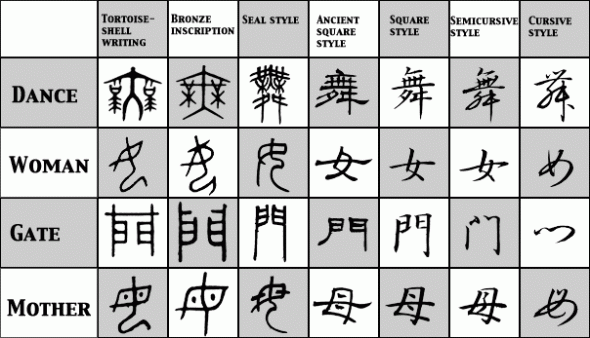
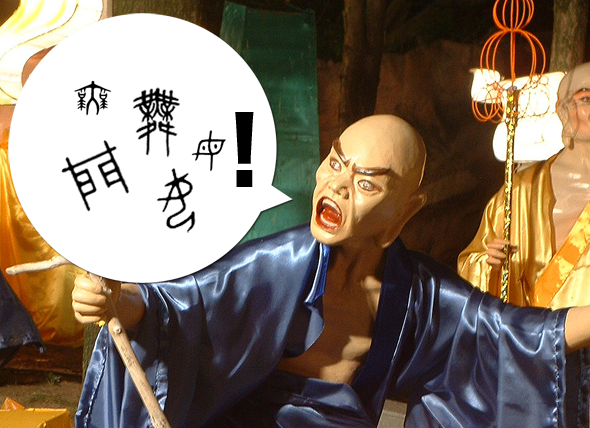
I’m pretty sure they misread the “Dance” symbol for “B51 Bomber dropping fish for great China glory.”

Where It Becomes “Writing”

The above turtle-shell burnings were the base and foundation of the Chinese writing system, but it wasn’t until the Zhou Dynasty (after the previous turtle-shell burning Shang Dynasty) that things started getting interesting. The Shang Dynasty disappeared, and the Zhou Dynasty found all these turtle shells and were like “dang, this could be a kind of writing system.” From there, they started documenting events, cool people, and the like using these turtle-shell characters. However, scribes of this dynasty never really took the time to study the originals, so they started making things up. If they didn’t know a character, they’d come up with an approximation, which of course lead to a lot of kanji being born (as well as a lot of inconsistency in the writing). There were multiple kingdoms and multiple ways to write, and I imagine reading was a big confusing since nobody followed the originals 100%. Confucius even complained about this apparently, which isn’t that surprising, because Confucius was a big whiner. Somebody call the Whaambulance… Whaaa, whaaa.
It wasn’t until the Qin Dynasty (that’s like 221 BC) that China was united under one kingdom, and the writing system was united as well. LiSu (the Prime Minister) writes an index of all the required characters scholars should learn, which contains 3,300 different kanji. That means everyone finally did kanji the same way, and Kanji finally got useful (and ready to make its way to Japan). Just a quick aside: sadly, this 3,300 kanji list doesn’t last. Smart people learn 10,000+ kanji in China, and up to 8,000 kanji in Japan (where kanji is, thankfully, not used in absolutely everything). Luckily, you can get by really comfortably with around 2,000.

How Kanji Came To Japan
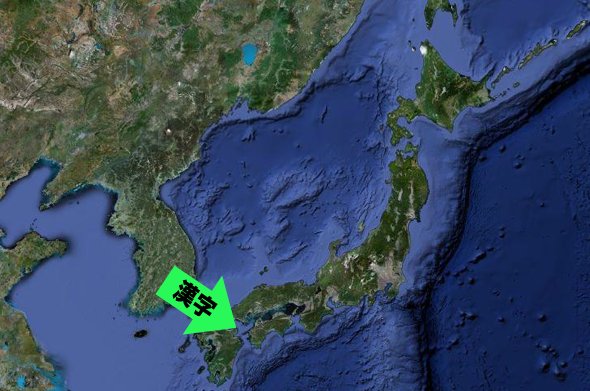
Of course, if you’ve been reading up until now, you can probably guess that kanji came from China to Japan, probably via the Korean Peninsula (it’s super close to Japan). At this point in history, Japan didn’t have its own writing system (which means they probably talked a lot, blah blah blah blah), and although nobody is quite sure when Japan started using the Chinese script, it was probably Chinese immigrants who first started using it and then it caught on from there. Sometime around 500 AD we know that groups called Fuhito were formed to read Classical Chinese, which probably means it started getting wider acceptance around that time.

Of course, the Chinese and Japanese languages were (and are) quite different, which means adoption of kanji couldn’t have been easy. Lots of modifications and changes to the pronunciation and way of writing had to happen in order to fit Kanji to the Japanese language, which is why you see On’Yomi, Kun’Yomi, and funny phonetic alphabets like hiragana appearing soon after. We’ll talk about these in a later article, so make sure you stick around for Kanji Week (and follow the Kanji Week Tag)!

P.S. If you think Kanji is bogus, you should join the Tofugu Newsletter.

P.P.S. If you think kanji should be 140 characters or less, you should follow Tofugu on Twitter.

Update: Thanks to @lianaleslie on Twitter, here’s another “explanation” on the origin of kanji. Not only does this dude have four eyes, but he has EIGHT pupils as well. How cool is that?

Cangjie is a very important figure in ancient China (c. 2650 BC), claimed to be an official historian of the Yellow Emperor and the inventor of Chinese characters.Legend has it that he had four eyes and eight pupils, and that when he invented the characters, the deities and ghosts cried and the sky rained millet. [Read More about this wicked sweet Chinese dude]

  • Anonymous

    Do you think the sheer volume of kanji created was to separate classes? As in, people who had time to laze around and learn 10,000 kanji could hold that over people of lower classes that couldn’t invest time to learn that many? Just a thought. Great article!!

  • http://www.twitter.com/christaran Chris Taran

    Kanji can only be viewed as the devils work.

    Down with kanji!!
    Kana for life <3

  • SarahXin

    Forget Textfugu – can you write a history textbook? School would be way more fun if my reading assignments said stuff like “Confucious should call the whaaambulence”… Just sayin.

    Tsumari (my new favorite word), good article. :]

  • 漢字が大好きな人

    Well, that’s not a particularly positive attitude you’ve got towards them poor kanjis. I’ve got nothing better to do, so I’ll take a moment to stand up for the little buggers. I know you’re being all tounge-in-cheek and all, I just can’t help myself.

    First off, Japanese simply isn’t written without kanji. Meaning cannot be reliably inferred from kana or romaji alone due to the limited number of sounds – and consequently the amount of homophones – which the language contains. I believe there was a number of attempts to romanize the language, but they never did catch on. Go figure.

    Furthermore, learning kanji isn’t hard as in nigh impossible, it’s “hard” as in “takes a long time”. Aslong as you do it systematically, you will probably get forward one way or another. They may look like a mess of squiggly lines at first, but as you learn a couple of hundred or so, you will start to see the patterns, making it alot easier to both retain what you’ve already learned aswell as learn new ones. It’s an accelerating process, if you will.

    Lastly, when you know the characters, they often very logically fit together to form words. This makes learning vocabulary a lot easier, and sometimes you don’t even have to look up a would-be unknown word. See what I’m saying? The kanji make the language make sense. If you tell a Japanese person a word he doesn’t know he’ll ask which kanji makes it up. It permeates society.

    Oh, and they are absolutely beautiful and it feels great to be able to read and write them.

    Addendum: If you ever want to learn Japanese, let’s face it: you will have to learn them kanjis, and that takes a lot of friggin’ time and effort. That doesn’t mean it’s boring, but it’s only as fun as you make it, so get out there and try to enjoy the ride – I did. And it was totally worth it in the end.

    …Hey, at least you’re not learning Chinese.

  • Je suis 頭が悪い

    '' …Hey, at least you're not learning Chinese. '' lool

    @ 漢字が大好きな人

    How long did it take to learn japanese as much as you know now ?

  • http://kellydolljapan.blogspot.com/ KellyDoll

    The picture for this article is priceless

  • http://www.21tiger.com/ Mike

    Bottom line, many years ago everyone was Chinese. When the Countries declared independence from the Empire, smarter heads prevailed and both Korea and Japan got Alphabets. Good move. It also means they needed to drop the tonal speech.

    Chinese could never have an alphabet until they drop the damn tones. Until then these evil Characters (sigh…Start at 5,000…. Geek out at 50,000+) must be learned.

    Meanwhile, the Koreans took the Chinese language, rejigged the Grammar for a more Confuscian Subject-Object-Verb (often no “I” needed, like Japanese) and just turned the tonal words into non tonal…

    Eg. 정통 (jeon tong)= 传统 (chuan2tong3) = Tradition/Traditional

    Guess which one is easier to read? The former has about 14 letters in their alphabet… the latter..*facepalm..

    On the other hand, the former has about 40million people (80 if you count the North), the latter is spoken by about 2 billion people worldwide. So guess which one is going to land you that next job?

  • Pingback: The Types Of Kanji In Japanese: On’Yomi vs. Kun’Yomi

  • ivyyue

    Thx to ur interesting artical about history of kanji^^ I am a chinese and now learning jp. To tell the truth this is the first time I got to know Cangjie~ Looking forward to ur next one about kanji!

  • http://www.tofugu.com koichi

    Unless you're planning on going in the TV manufacturing biz…

    Awesome addition in your comment there, especially about Confuscian injected grammar. Had no idea about that, but now it kind of makes sense when I think about it. Very interesting stuff, and you can't beat the word “rejig” or “rejigger,” either.

  • gec

    What history of the development of Korean and Japanese is this? As far as I know there's no consensus that either of them is at all closely linked to Chinese. Hence the vast differences.

  • kirk_n

    Absolutely loved the opening picture, good stuff! I haven't studied Kanji in many years, I figure if I wait long enough a shorter, simpler system may come along ; )

  • kirk_n

    Absolutely loved the opening picture, good stuff! I haven't studied Kanji in many years, I figure if I wait long enough a shorter, simpler system may come along ; )

  • hhoihoi51

    check this out
    Chinese characters (Kanji) and Bible
    this is really interesting
    http://www.youtube.com/watch?v=hxgDBFJQlY8&feat
    http://www.youtube.com/watch?v=ACznYP1aegQ&feat

  • HussainJ

    I love Kanji I think it makes Japanese that much more interesting. Interesting article =)

  • hhoihoi51

    check this out
    Chinese characters (Kanji) and Bible
    this is really interesting
    http://www.youtube.com/watch?v=hxgDBFJQlY8&feat
    http://www.youtube.com/watch?v=ACznYP1aegQ&feat

  • HussainJ

    I love Kanji I think it makes Japanese that much more interesting. Interesting article =)

  • http://www.nike-air-force-one.com air force one shoes

    Well , the view of the passage is totally correct ,your details is really reasonable and you guy give us valuable informative post, I totally agree the standpoint of upstairs. I often surfing on this forum when I m free and I find there are so much good information we can learn in this forum!

  • http://www.discount-nike-dunk-shoes.com nike dunk

    I totally agree the standpoint of upstairs, and I believe this will be a trend. I often come this forum , rom here I learn much and know the newest tide! the content here constantly update shoe and I love it! Another I know some websites which often update their contents, you guys should browse if you are free. http://inin-from.com

  • http://www.louis-vuitton-outlet-store.com discount louis vuitton

    I like writing, hurriedly, not that you are not
    http://www.always-11.net

  • mbt

    Well , the view of the passage is totally correct ,your details is really reasonable and you guy give us valuable informative post, I totally agree the standpoint of upstairs. I often surfing on this forum when I m free and I find there are so much good information we can learn in this forum!
    http://www.mbt-outlet-store.com/mbt-women-shoes

  • http://www.handbags-club.com/ Designerhandbags

    I like writing, hurriedly, not that you are not

  • http://www.handbags-club.com/ Designerhandbags

    I like writing, hurriedly, not that you are not

  • Pingback: The Types Of Kanji In Japanese: On'Yomi vs. Kun'Yomi

  • http://www.louisvuittonbagmall.com/ louis

    As far as I know there’s no consensus that either of them is at all closely linked to Chinese. Hence the vast differences.

  • http://mxdtr.com/ drivers

    I am glad that I finally came here! thanks for this nice article.

  • Anonymous

    “The History Of Kanji “It’s very Funny…
     

  • Anonymous

    I’m very agree with you ,kanji it’s very interesting …..

  • Anonymous

    Kanji
    en I think it’s very funny HAHA…
    thank you tell me it’s history!!!
     

  • Anonymous

     Kanji I think it’s very interesting HAHA funnny…!!

  • Karma

    I burst out laughing when I saw the opening picture