
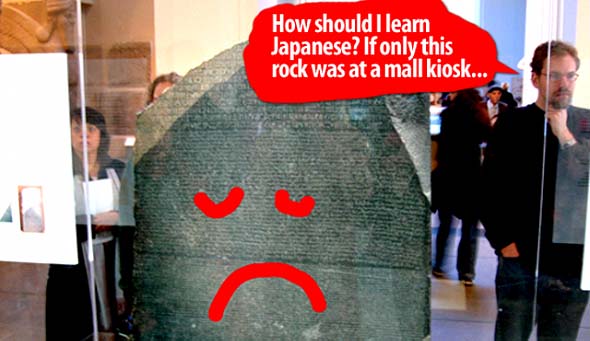
Alternatives to Rosetta Stone Japanese (i.e. Should I buy Rosetta Stone?)

One of the most common e-mail questions I get is “Should I buy Rosetta Stone Japanese?” It’s time to put an end to this e-mail silliness. From now on, I get to link to this post and video. Hopefully you, whoever “you” are (tell me in the comments), can get something out of this post as well.

P.S. Want even more Japanese language resources? Check out Tofugu’s Japanese Resources Page!

Here’s the itinerary:

  1. Should I buy Rosetta Stone Japanese?
  2. What makes Rosetta Stone “good”?
  3. Alternatives to Rosetta Stone Japanese
  4. Getting Your Opinion

Should I buy Rosetta Stone Japanese?

The nice and quick answer would be a nice and quick “no, probably not.” I’m not saying that Rosetta Stone is bad, necessarily. They put a ton of money into it, so of course they came up with something that’s decent. I’d give them a C+ or so – some parents wouldn’t accept a “C” grade, but on the other hand some parents would be super happy because they’re used to you getting F’s all the time (you know who you are). When it comes down to it though, if you’re going to buy Rosetta Stone, in terms of value versus what you can actually get out of it, you better be really damn rich. I imagine a Rosetta Stone customer looks something like this:

rosetta-stone-customer

or maybe this…

scrooge-mcduck

Rosetta Stone is fine, it probably works for some people, but it’s also a huge waste of money. Please, if you were planning on buying Rosetta Stone, stumbled upon this article, and changed your mind, send me the extra $1000 so I can buy a monocle, pocket watch, and top hat. I’ve always wanted to look like a rich Rosetta Stone Customer. Nya!

What Makes Rosetta Stone “Good”?

There’s a couple different versions of Rosetta Stone Japanese that you could buy. There’s the normal software package, which is around $500. Or, you can go with their TotalE program, which is all online and adds the benefit of having a live online Japanese teacher once a month, for a mere $1200 a year (they’ve lowered they’re prices, good for them – $20/month now) . The Rosetta Stone software is really spiffy, it’s pretty glitch-free, and if you go with TotalE the pictures are a lot less corny. All-in-all, it looks nice, which might be important to some of you when making a decision, but it still doesn’t change how expensive it is, and how you could be doing a lot better than Rosetta Stone.

Here are the things that they like about themselves, though.

Rosetta Stone Loves Their Marketing Budget

They spend a ridiculous amount of money on all that advertising / marketing / mall kiosk-ing stuff. The actual number eludes me at the moment, but I remember having myself a little heart attack when I heard it. But it makes sense – they are the big sleeping bear of language learning. Everyone knows who they are, and when you think “language learning” you probably think, at least for a couple of seconds, about Rosetta Stone as an option. This is great for them, of course, because it makes them look like they’re the best way to learn a new language. This is far from true, of course, but it’s all about how you present yourself, right? They do a great job of it. At the very least, even if you are hooked by their marketing department, try sleeping on the decision at least one night, or keep reading and try out the alternatives I’ve laid out below.

Rosetta Stone “Immerses” You Into the Language (Japanese)

baby

One thing Rosetta Stone likes about themselves is the idea that they teach you Japanese just like a baby in Japan would learn it. No grammar, no explanation, just practice and context. First of all, you’re not a baby in Japan (and if you are, you’re probably in good shape on the learning Japanese front), and secondly you aren’t spending 24 hours a day in front of Rosetta Stone (most likely) so it’s not anywhere near immersion (see immersion section down below for more info). At the most, you’re probably spending an hour or two doing the Rosetta Stone thing, which definitely isn’t enough if you want to take this approach. Either do it all the way, or don’t do it at all. Japanese babies don’t have 2 hours of Japanese “immersion” and then 22 hours of English. If they did, they’d all speak English, not Japanese, and that’s not the goal you’re trying to head towards here.

So is Rosetta Stone Japanese Good?

It’s okay, I’ll give them that, and probably not worth the money it costs (you’re paying a ton extra to fill their marketing budgets I imagine). Unfortunately for them, there are way better (and cheaper / free-er) alternatives out there that blow Rosetta’s socks off. The only problem is these alternatives don’t have marketing budgets like Rosetta, which means you’ve never heard of them before (that’s why I’m here!).

Alternatives to Rosetta Stone Japanese

So this is the part you might have been waiting for – here are the alternatives to Rosetta Stone Japanese. Sure, it is a big list of resources, but when used all together, you’ll find that your Japanese learning speed will go way up (compared to Rosetta Stone), you’ll spend a lot less money, and in the end probably have a lot more fun doing it. All these resources do a good job doing what they do, and Rosetta Stone just does a mediocre job doing all of these things. Much better to find a hip doctor that’s really good at hips, rather than one that’s mediocre at hips, hearts, elbows, golfing, and boob jobs. Am I right right, Dude, or am I right? (name that reference)

Immersion

We’ve already established that Rosetta Stone doesn’t cut it when it comes to immersion. AJATT kind of pioneers this method, and he’s a smart frood. Here are some great resources to help immerse yourself in Japanese for more than an hour or two a day, like Rosetta Stone.

itunesFavorite Choice: iTunes Japanese Podcasts
A lot of people have iPods, and even more people have computers, CD Players, and the like. It’s really easy to get Japanese podcasts for free and listen to them 24/7 (or whenever you have a chance, even at work I’m sure). All you have to do is change your location settings on iTunes to Japan, and suddenly you have access to every free Japanese podcast on there. You have to do a bit of a work-around to have access to things that cost money, but anything that’s free is good to go for you.

Choice 2: JapanesePod101 – JapanesePod101 is just what it sounds like: a website full of Japanese podcasts. In this case, their podcasts are designed to help people learn Japanese, and they do a pretty good job at it. There are paid programs, which get you things like PDFs and other study materials, but a lot is also available for free.

Choice 3: YouTube: YouTube has a ton of Japanese content you can sit and listen to, or put on in the background, and it can be a lot more interesting because you get the visuals with it. Just try and avoid subtitles, because that’s not doing you much good unless you really actively compare and contrast as you’re watching.

More Alternatives: Vimeo | NicoNicoVideo | CrunchyRoll (and of course, several “illegal” options as well, which I won’t be listing – sorry!)

Choice 4: Become a Japanese Hobo – They have pretty sweet hobo-houses. One-way tickets to Japan aren’t as much as round trip tickets? Perfect immersion strategy for the person who’s strapped for cash. Not sure how green cards work in this situation – I imagine you’d just become a fugitive?

TotalE Teacher Alternatives

One of the things you get with the TotalE program is a live online teacher. I called Rosetta Stone and got some details on this. You get one class a month (which you can repeat if you still don’t get things after taking it, but it’s the same lesson over and over), which changes every month as you progress. You go over the stuff you went over in the online app, which helps solidify things.

I think this is a bit of garbage – it’s a nice attempt at offering a good “teacher” solution to help guide you along, but you could still spend the $120 a month you’re spending somewhere else, and get a lot more out of it.

small-edufire-logo2Favorite Choice: eduFire for Live Online Classes
When it comes to finding an online Japanese teacher, eduFire is the way to go. There are alternatives to eduFire in the live online education space (which will be listed below), but they aren’t as good for Japanese just because their listings are a bit lacking (and the pricing can be pretty steep). eduFire has free online classes as well as a subscription program (a mere $29 a month for unlimited Japanese classes with live online teachers). Especially with the recent study that came out from the U.S. Dept. of Education which shows online learning as being more effective, I think it’s a no brainer (oh, and to be fair, I should probably mention I’m an employee here, but promise, not being bias. Research it for yourself if you want). Alternatives to eduFire: WizIQ | Myngle

Choice 2: CraigslistCraigslist is mostly in America, but I imagine there are “alternatives to Craigslist” in other countries as well. It’s a good way to find affordable local teachers, just be careful not to accidentally join a sex or drug ring.

Choice 3: TeachStreetTeachStreet is aiming to become the leader when it comes to teacher listings, online or local. Like Craigslist, they are only in certain locations, but if you’re in a fairly big city in the U.S. you might be in luck and be able to find some great Japanese classes as well.

Rosetta Stone Clones
cloned-sheep

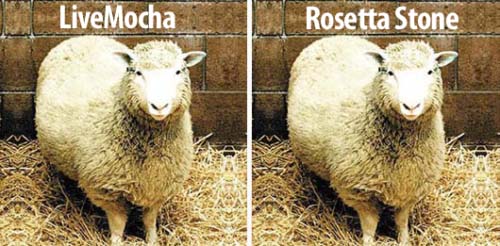
There have even been some Rosetta Stone clones popping up. Complete alternatives to Rosetta Stone, and the cool thing is that they’re pretty much all free. There are some programs out there that don’t have Japanese (yet) as well, that I’m keeping my eye on, but here’s what’s available right now.

Favorite Choice – LiveMocha: Two things about LiveMocha. First of all, I’m not sure how they’re going to make money, because basically they’re offering what Rosetta Stone offers, except it’s free, and secondly, I’m not sure what Rosetta Stone is going to do once more people figure out about LiveMocha, because it’s basically Rosetta Stone (with a lot of its pitfalls as well, but hey, it’s free!).

Japanese Vocabulary Learning Alternatives:

At Rosetta Stone, because of the whole “baby immersion thing” you don’t really learn vocab in the traditional sense. Here are some great vocab resources for you to use instead:

Favorite Choice – Smart.fm: Smart.fm does an amazing job with flashcards. It’s like they can read your brain in a way that helps you learn more vocab and kanji at a nice and speedy rate. Just spend a little bit of time every day, and you’ll be a vocab expert in no time. Couple this with some of the other resources, and you have yourself a powerhouse. Alternative: Anki is a lot like Smart.fm, and has it’s own cult following. Maybe you’ll like it more than Smart.fm, but it’s not for me.

Second Choice – NihongoUp: NihongoUp is a little game you can play on your computer or iPod Touch / iPhone. Definitely takes some of the monotony out of vocab learning, and can help solidify a lot of things for you. You can trial run it for quite a while, and the paid version is too cheap to pass up (and the particle practice mode is gold).

Japanese Grammar Learning Alternatives:

grammar

Another thing that Rosetta Stone doesn’t really do is “Grammar.” I’m a big fan of grammar learning + actual usage + some of that immersion stuff to make it all meld together. Boo on you, Rosetta.

Favorite Choice – guidetojapanese.org: Tae Kim does a good job explaining grammar, and takes you all the way from basic to advanced. He does a good job simplifying things, and of course, everything over there is free, so indulge yourself!

Second Choice – Genki Textbooks: When it comes to textbooks, I think Genki is the best I’ve come across so far. Definitely not perfect by any means (and costs $30-$40, which really isn’t that bad for a textbook), but gets the job done. You can even use Smart.fm to practice the vocab from the textbook series.

Third Choice – Jgram.org: Jgram is a wiki of Japanese grammar. Sometimes their explanations are better than the top two, and sometimes they’re not. Either way, it’s a good resource to keep a hold of.

Japanese Language Exchange:

language-exchange

Language exchange is something that Rosetta Stone can’t really shake a stick at. Learning a language with a native speaker of that language is an awesome way to have fun, meet new people, and keep up with all the things the cool kids say.

Favorite Choice – Lang-8: Lang-8 is all about language exchange, which isn’t necessarily a new idea, but it’s an idea Lang-8 has taken and done good things with. At Lang-8, you write in the language you are learning (Japanese?), and then native speakers of that language (i.e. Japanese people) correct your entries in a way that makes it easy to see your mistakes so you don’t make them again. Everything’s free, though they have a premium plan that gets you more features and fewer ads.

Second Choice Skype Forums: I haven’t actually made my way to the Skype forums, so I can’t confirm this, but from what I hear you can find people to talk with that will help you learn Japanese (and then they’ll help you). Over at Lang-8, as well, you can see who has added a Skype account and talk to them that way too.

So What’s Your Opinion?

Oof, that’s a lot of writing, and my fingers hurt.

I bet some of you have used Rosetta Stone in the past (or are currently using Rosetta Stone… your rich bastard you). What do you think? What resources am I missing that you couldn’t live without (and totally beat down “The stone”?).

Anyways, so there you have it. That’s my opinion on Rosetta Stone. Decent / Okay / Mediocre, but not worth the money. It’s one of those situations where because they’ve made it so expensive, people automatically think it’s valuable, which isn’t always the case.

Either way, no matter what you decide to do, now is the best time to start learning Japanese. You don’t want to look back six months from now and wish you were six months into things. That always sucks big time. Go, figure out what your next actionable step is and start learning today. To find more cool Japanese resources, be sure to check out “Tofugu’s Top Ten Free Online Japanese Resources.”

Another Alternative

Update (2/01/10) – Since writing this article, I have started my own Online Japanese Textbook for Japanese learning called TextFugu. It’s designed specifically for those self-teaching themselves Japanese, which means it dives much deeper into self-teaching strategy and focuses on keeping you motivated to learn. Be sure to check it out and see if TextFugu is right for you and your learning style.

[yframe url='http://www.youtube.com/watch?v=2SO8yx2Y7yo']

This video includes an attempt at a British Accent. Ouch.

Video Transcript

Minutes 0:00-1:00

Minna-san konnnichi wa, koichi de gozaimasu. [meow sound]  When I’m checking my email inbox, I notice a couple of things.  First, I get a lot of emails.  Please don’t email me.  Second, a lot of them are about Rosetta Stone.  And, of course, the question is always the same.

Dear Koichi … that’s me.  What is your opinion of Rosetta Stone?  I would like to know your opinion before I spend $1,000 buying Rosetta Stone.  That guy’s a robot.

To all of you who have nice and short Youtube attention spans, the quick answer is, “No, you probably shouldn’t buy Rosetta Stone.”  It’s not because Rosetta Stone is bad, per se.  I’d give them a C+ or so.  You know, some parents wouldn’t be too happy.  Some would be happy because they’re used to you failing.

Now, let’s get that big white elephant gift out of the room.  Rosetta Stone is expensive.  It’s like $400 to $500 for the software pack.  And it’s like $1200 for their TotalE program.

If you’re going to buy Rosetta Stone, you probably have like a top hat, a monocle and a pocket watch, maybe a British accent as well…

Minutes 1:01-2:00

Oh, look at me [speaks in Japanese and words on screen say:  British accents sound intelligent to me.  Bad representative on my part.]  If you’re going to spend all that money on Rosetta Stone, don’t do it, stop, get off the ledge, go over to tofugu.com, check out all the resources that I’ve laid out for you that are great alternatives to Rosetta Stone and then send that extra money to me because I spend all my money on cat shirts or they have eye patches and I’m hungry, no food.  [meow sound]

Now, before I go on and list off a ton of resources that that make up that sinewy concert of alternatives to Rosetta Stone, let me tell you what Rosetta Stone has going for it or at least what they think they have going for them.  First of all, they spend a ridiculous amount on advertising and they have airport kiosks and mall kiosks.  Can’t beat the mall kiosks except for that hermit crab kiosk and the kiosk where you can get that cigarette that’s not actually a cigarette but it’s actually a gadget.  But, since they spend so much money on advertising …

Minutes 2:01-3:00

likely than not you’ve heard of them.  And, if you’re watching this video, then maybe you are actually considering buying from them.

They have a really good marketing strategy and a pool full of gold that they can swim through.

That, right there alone, is the key to success.

Now, most of the really cool resources that are available out there for free or very cheap.  They don’t have this kind of resource.

In fact, if you’re paying for Rosetta Stone, more likely than not, a lot of the money you’re putting in there is going straight towards the marketing budget.  That’s why everything costs so much.

So they have good marketing.  That’s reason number one why Rosetta Stone is pretty good.

Now, Rosetta Stone has another thing that they like about themselves.  They say that they can create this “immersive environment”.  They teach you Japanese in a way that’s just like a baby in Japan would learn the language.  Waaaah.

This, of course, is total B.S., because you’re not actually inside of an immersive environment.

More likely than not, you’re only gonna spend one to two hours at the very most, everyday, on Rosetta Stone. That leaves

Minutes 3:01-4:00

That leaves 22 other hours.  You don’t need to spend all that money to create an immersive environment for yourself.  You can do all sorts of other things like, for example, downloading Japanese podcasts and listening to them.  It’s really easy.  It’s free.  All you have to do is change your location setting in Itunes to Japan and you have access to thousands of Japanese podcasts.  On top of that, there’s a ton of Japanese programming available on the Internet through Youtube [sounds like vimeo], Crunchy Roll, all those kind of things.  If you want to immerse yourself in Japanese, you don’t need Rosetta Stone to do it for you.  In fact, if you are planning on spending $1,000 bucks on Rosetta Stone, use that $1,000 bucks to become a Japanese hobo.  Get that one way ticket over to Japan, become a hobo.  You’ll learn a lot faster and a lot better that way.  It’ll be fun.  Please note that I am not liable for any injury or death from anyone who becomes a hobo in Japan.  I said it.

That being said, that is just the tip of the iceberg in a world without global warming.  There are a lot other resources, a lot other alternatives …

Minutes 4:01-5:01

There are a lot of other resources, a lot of other alternatives to anything that Rosetta Stone throws at you and you’ll find them all over at tofugu.com, link on the right.

Basically, what I’m trying to say is you don’t have to spend a ton of money to learn Japanese.  The overall conclusion to the question, Should I learn Japanese using Rosetta Stone is ‘no.’”  If you want to know why and you want to see all of the cheaper or freer alternatives that absolutely destroy Rosetta Stone, check out the article that’s linked on the right.  And that is it for this video.

Thank you so much for watching and go learn some Japanese now.

Hey, coming up is a commercial, but after the commercial … it’s a good commercial by the way … after the commercial you get a little [sounds like magay], a little extra, right?

Alright.  So Christmas is coming up.  Oh, no.  How am I going to buy cool Christmas presents from Japan for people that like Japanese things?  I don’t know.  Maybe, you can check out flutterscape.  Flutter what?  Flutterscape.  Well, what’s that?   Oh, you don’t know flutterscape?  It’s really cool cause people in Japan

Minutes 5:01-End

People in Japan, they take picutres of neat things in stores.  And then you can say, hey, can you buy that for me and send it to me?  I’ll pay you a little extra and pay for shipping.

Oh that sounds cool.

Yeah it’s pretty neat.  People take lots of pictures of cool things and you just buy from them and it’s totally safe and stuff.

Oh, that’s nice.  So what kind of stuff do they have?

Oh, you know, cool Japanese things.  Anything?

But in all seriousness, Flutterscape, one of the coolest ideas I’ve ever seen.

It’s just like how I described it.  People take pictures of things.  You ask them, you say, hey can you buy that for me?  And they say, yeah.  And they go to the store. They buy it. They send it to a shipping center which makes sure they actually send it.  And they send it to you.  You sned them the money. Everything works out and you buy stuff.  Like, from stores from Japan.  It’s like you’re there except for it takes a little while longer.  Smart idea.

Meow.  Meow, meow.  Meow. Meow.  Meow. Meow, meow, meow. Meow, meow. Meow!

Oh, and you should follow me on Twitter.

  • lunachyld

    Yes Rosetta stone doesnt teach you grammar. It is basically pictures and pronunciation. You have to match the words you hear to the picture by trial and errror. It teaches you nothing about common phrases like “goichisosama” (That was a feast) or anything else you would need to know if you are planning to completely immerse yourself into the language and Master it. It prides itself on not having an english translation. I.E. what the hell does “wa” mean? Rosetta Stone does not explain this… your are just supposed to remember sentence structure. If you have the money, buy it; it will be a good addition to your library of references. However, if you are planning to master the language, you will not succeed with Rosetta Stone alone.

  • FeelYourUFO

    I think this is an important post. No one tool will help you master a language by itself. You must use a combination of resources that work for you!

    I do not see why Rosetta Stone gets so much bashing. I found its immersion technique very interesting. It makes sense to me, as I think “translation” learning is very poor. However, I also understand much of the grammar complaints. After all, Rosetta Stone must recognize that even in native language we do not learn grammar completely through immersion. That is why we take English class in America! We have to be taught grammar! However, the brilliant thing about this is that we already know many of these grammar rules to an extent because of our exposure to them before the lesson. It is just explained so we fully understand it.

    And so, I think Rosetta Stone is a brilliant tool for beginners of the language. You should not worry too much about technicalities as a baby in the Japanese language. Get used to the water first before you start to swim!

  • lunachyld

    Yes Rosetta stone doesnt teach you grammar. It is basically pictures and pronunciation. You have to match the words you hear to the picture by trial and errror. It teaches you nothing about common phrases like “goichisosama” (That was a feast) or anything else you would need to know if you are planning to completely immerse yourself into the language and Master it. It prides itself on not having an english translation. I.E. what the hell does “wa” mean? Rosetta Stone does not explain this… your are just supposed to remember sentence structure. If you have the money, buy it; it will be a good addition to your library of references. However, if you are planning to master the language, you will not succeed with Rosetta Stone alone.

  • FeelYourUFO

    I think this is an important post. No one tool will help you master a language by itself. You must use a combination of resources that work for you!

    I do not see why Rosetta Stone gets so much bashing. I found its immersion technique very interesting. It makes sense to me, as I think “translation” learning is very poor. However, I also understand much of the grammar complaints. After all, Rosetta Stone must recognize that even in native language we do not learn grammar completely through immersion. That is why we take English class in America! We have to be taught grammar! However, the brilliant thing about this is that we already know many of these grammar rules to an extent because of our exposure to them before the lesson. It is just explained so we fully understand it.

    And so, I think Rosetta Stone is a brilliant tool for beginners of the language. You should not worry too much about technicalities as a baby in the Japanese language. Get used to the water first before you start to swim!

  • Rich

    Hello all! This is a very interesting thread about Rosetta Stone.

    While I understand many of the complaints and problems with RS, I think the overwhelming negativity and dismissal of the program is unfortunate, much of it based on misunderstandings of what RS is trying to do and fundamental concepts of language acquisition. This is a shame as it may scare some away from objectively assessing its effectiveness and perhaps finding the method that works for their personal style of learning.

    I have been teaching a second/foreign language (English) in different countries for over 15 years, and in the last 30 years, I have seriously attempted to study at least seven languages. I have used books, private tutors, classes, audio cassettes, CDs, and numerous computer programs. I only say this to show that I have some experience in regards to second language acquisition. Also, I do not work for RS.

    In my current attempt to learn Japanese in the last year, I have used RS, the Genki textbooks, Heisig’s Remembering the Kanji, Anki, Japanesepod101, and Human Japanese, as well as a class and a tutor here in Tokyo.

    The two most important things in learning a language are TIME and MOTIVATION. You have to be willing and able to give a large amount of time to the process. There is NO WAY around this. So, anything method that makes you willing and able to give that time is fantastic and should be embraced.

    My wife and I both find RS to be challenging, rewarding, and addictive to use. We give a lot of our time to RS. In that case, the cost is insignificant. Time is our most valuable and limited resource. If a method can get you to commit that resource, then it is priceless.

    I have been reading a great deal about RS, and it seems that the majority of complaints come down to the following list. I will try to respond to each one.

    COST – Yes, it is expensive compared to other options. However, if it leads you to your goal, what is that worth? Also, if you look at the amount of photos, audio files, design, etc., you realize this is not a cheaply made program. And yes, it is a very successful business that is very good at marketing itself. However, don’t dismiss a true evaluation of RS’s effectiveness just because of sticker shock.

    LACK OF GRAMMAR/EXPLANATION – I, too, have been frustrated at times when I don’t understand a word or phrase. Yet, this happens in any language learning process. Many people become fluent without ever consulting a grammar book. RS is not designed to teach you grammar; it is designed to teach you the language. Also, it has to be accessible to speakers of any language. How could RS provide grammar/explanations in all languages? As a side note, there is a great deal of research that indicates that studying grammar is NOT an effective way to learn a language.

    EASY TO GUESS THE ANSWER – If you view RS – or any other language learning – as a race to get through or a system that you can ‘cheat’ your way through, then you are not serious about learning the language. RS will not teach you the language; you must teach yourself using RS. You need to study as a mature student, taking full responsibility for your successes and failures. Take notes. Be honest with yourself about whether or not you understand a concept before moving on.

    DOESN’T TEACH SURVIVAL/TRAVEL PHRASES – Correct. RS is not designed for the traveler. It is designed to teach anyone the language, starting from the bottom up. It doesn’t care if you want to know how to say ‘Where is the bathroom?’ However, the fact that RS markets itself in that way is a legitimate complaint.

    Now, for the good things about RS. I know these may not be true for everyone, but they are important for potential learners to know:

    FUN AND ADDICTIVE – Need I say more? If it gets you to actually put in the time, then it’s a winner.

    MATERIAL BROKEN INTO CONCISE AND OBTAINABLE BENCHMARKS/GOALS– The material is presented in a way that makes it easy to commit to and finish a section. Unlike more open ended studying, RS ‘enforces’ the process, creating learning opportunities with clear goals.

    ALL IN TARGET LANGUAGE – Nothing but you and the language you are trying to learn. Yep, it’s hard. There’s no faking it. You either figure it out or you don’t. Suck it up, Buttercup!

    FOCUSES ON LISTENING – Listening is the most difficult of the four skills. You will hear thousands of target language phrases in a focused listening context.

    REPETITION ENFORCED BY THE PROGRAM – Yes, it can seem tedious at points, but you have to practice, practice, practice. If you follow RS’s lead, there’s no escaping it as much as you would like to move on. You can’t just say, ‘Oh I know that,’ and rush ahead to the next section.

    Again, this is just my opinion, and I know that there are many different learning styles and opinions out. I just wanted to put in my two cents (sorry, it might be three because I wrote so much ;)

    Cheers,

    Rich

  • LunaSlave

    for immersion – you should mention Keyhole TV! it's a program that lets you watch Japanese television online, for free. All of the major networks are represented. :)

  • Brandon

    I want to second Tangorin.com
    Not only is it good for vocab but it provides an abundance of example usage sentences. You can often take the examples and break it down and combine it with other sentences to figure out how to say something…

  • linyulin101

    http://bccloth.com

    (II) In the past 6 years, we have sent great many products to the customers in USA, Europe, ASIA and other area, also we have lots of experience in dealing with online business oversea

    http://bccloth.com
    $@%@#^%#@%#^%

  • Pingback: Livemocha Pulls the Trigger - Aims at Rosetta Stone | Kirsten Winkler

  • Jonty

    Well im learning Japanese with rosetta stone now, and its pretty simple. The grammar is easy to understand (note: you cant be a retard or else of course you wont get it).
    If there is a thing I don't understand like when you count in japanese like ichidai or nihiki, I just looked it up on what it meant then everything became more clear and its been smooth sailing every since.
    Feel free to email me if you have any questions..

  • Katie

    extremely late to the party, just wanted to throw out there that I got the full RS set in Japanese for Christmas a year ago, and the only real positive aspect of it is the speaking/listening practice. I studied Japanese at University so grammar is no problem for me…but speaking/listening is my rough area, and RS is good for that. Unfortunately, because I have studied it before, it's stupidly simple at times and painfully slow so…yeah. For what it's worth, there's my 2 cents!

  • Katie

    extremely late to the party, just wanted to throw out there that I got the full RS set in Japanese for Christmas a year ago, and the only real positive aspect of it is the speaking/listening practice. I studied Japanese at University so grammar is no problem for me…but speaking/listening is my rough area, and RS is good for that. Unfortunately, because I have studied it before, it's stupidly simple at times and painfully slow so…yeah. For what it's worth, there's my 2 cents!

  • superstition

    I used Rosetta Stone to try to complement a university course. The most notable thing about the experience is that I can remember some of the pictures but not the nihongo that went with them.

    To me, that affirms the biggest pitfall I see with the program: it forces users to spend a lot of time/effort memorizing complicated pictures.

    In a Psychology course, I learned that people have completely simplified “templates” for everything. When we see a Husky, for instance, we refer to the wolf template, the dog template, and likely other templates. Our brain matches the Husky to the dog template which allows us to recognize a Husky as a type of dog.

    The Rosetta Stone, rather than teaching us the templates, teaches us complicated “real life” images. It seems to me that we should be learning from simplified “childish” pictures if we're going to take the visual approach, not real life photographs. It takes a lot of brain power to memorize complicated real life photographs, effort that may be used more wisely with a different learning format.

  • superstition

    I used Rosetta Stone to try to complement a university course. The most notable thing about the experience is that I can remember some of the pictures but not the nihongo that went with them.

    To me, that affirms the biggest pitfall I see with the program: it forces users to spend a lot of time/effort memorizing complicated pictures.

    In a Psychology course, I learned that people have completely simplified “templates” for everything. When we see a Husky, for instance, we refer to the wolf template, the dog template, and likely other templates. Our brain matches the Husky to the dog template which allows us to recognize a Husky as a type of dog.

    The Rosetta Stone, rather than teaching us the templates, teaches us complicated “real life” images. It seems to me that we should be learning from simplified “childish” pictures if we're going to take the visual approach, not real life photographs. It takes a lot of brain power to memorize complicated real life photographs, effort that may be used more wisely with a different learning format.

  • Pingback: Language Immersion « the brainscape blog

  • Pingback: Tofugu’s 100 Best Resources For Learning Japanese

  • LiAnne

    Know any resources (besides Rosetta S)(free would be good) where I hear a single sentence said by the program in (fluent) native Japanese, then I say it and then the program tells me how close I am?

  • jdcowboyup

    Doomo Arigato Gozaimasu! I have checked out Mocha and it is looking good. I took three years of Japanese, but never used it and lost it. Mocha should help me get back into the Japanese Language. Thank you for your post.

    jdcowboyup

  • jdcowboyup

    Doomo Arigato Gozaimasu! I have checked out Mocha and it is looking good. I took three years of Japanese, but never used it and lost it. Mocha should help me get back into the Japanese Language. Thank you for your post.

    jdcowboyup

  • http://www.handbags-club.com/ Designerhandbags

    I loved using Human Japanese! I only wish they'd continue it with more lessons..

  • http://hi.baidu.com/yishiym123 TwoBlue

    designer handbags is the Designer Handbags online store. As a leading brand bags wholesaler, we’re proud to offer the widest selection of quality replica handbags at the lowest price which you can afford. Here are many designer bags for your choice and free shipping service that offer a 100% satisfaction guarantee.

  • traveler

    You're describing Pimsleur. It's also expensive, but available at discounts and by torrent. Look for it in public libraries.

  • traveler

    You're describing Pimsleur. It's also expensive, but available at discounts and by torrent. Look for it in public libraries.

  • Pingback: Making It To TextFugu’s Pricing Page [Bright Spots] | Hello, Ko

  • http://twitter.com/bradjohn123 brad john

    Rosetta Stone was good in their day cira late 1990s but they have a cookie cutter approach to learning languages. I tried their program and my personal experience was it was fun for about a week then I never learn my target language, which was Polish, until I developed my own program based on the above ideas. Learning Japanese

  • http://www.facebook.com/people/Gia-Rivera/685232946 Gia Rivera

    I totally agree, I tried Rosetta stone it was so frustrating because they didn’t go into anything. I learned more from one week of one on one teaching with a native speaker.

  • Pingback: A reason to blog. | Jhogo89's Learning Japanese

  • Sammy

    Oi Koichi wanted to say arigato for the list of sources FREE sources to learn Japanese you rock dude lol

  • http://www.myspace.com/acoutsicashley Thekingsdom

    MANY thanks for pointing me in the direction of some excellent websites and you’ve saved me a few £’s too! Thank you!
    Ashley

  • Yellowrain

    Rosetta Stone Japanese is not worth the money. I found podcasts much better as well as workbooks and other software programs. PLUS Rosetta Stone works really hard to keep you from selling your used versions of the SW by saying it is just “licensed to you”.

    So when you think you are “buying” rosetta stone new..you really arent. They are a disreputable company..there are better ways to learn japanese

  • Anonymous

    Dear customers, thank you for your support of our company.
    Here, there’s good news to tell you: The company recently
    launched a number of new fashion items! ! Fashionable
    and welcome everyone to come buy. If necessary, please
    plut: http://www.yessoso.com

  • BooBooBear

    The i-tunes thing is easy. I ended up getting my fake Japanese address + credit card info from J-list when ordering an i-tunes music card. I-tunes, of course, won’t charge anything on that card since it doesn’t work. You will, however, be able to get the free podcasts or purchase japanese i-tunes cards for usage. Best of luck to all those learners, and not to depress anyone, but I’ve been off-and-on studying Japanese for 6 years and I’m probably a middle-school level. Makes sense time-wise but yeahhhhhh it’s definitely all about motivation, determination, and enjoying the process, not just the end result.

  • Uragun

    i use rosetta stone, tae kims guide, pimsleur, and live mocha in tandem and it is a great system for me! :)

  • Teresa

    Great page! Thanks!

  • Misterexecutiveas

    epic pass and fails

  • Pingback: Rosetta Stone and other software to learn languages

  • The_Strange_Remain

    LiveMocha is a pretty good resource but I have to say that your insinuation that it is exactly like Rosetta Stone is off. (For the japanese lessons, anyway) It’s primer course is WAY too difficult for someone who has never encountered words or speaking structures outside of the romantic language group. It starts off with 40 words which it simply says at you with a picture. Rosetta stone would have made you guess, forcing you to actively think about the word. This is very passive and I found myself just associating sounds with pictures, though not always associating the words with the meaning. I was able to match the words to a number of the pictures and yet had no clue what was being said. 40 words for one lesson is entirely too much and it includes phrases which are beyond the basics. Over all, this would be great if it were split into smaller lessons. If you already have a primer grasp of Japanese, then you may have better results, but the green beginners will likely find this an excersize in frustration.

  • edward elric

    Piracy is a big underground business here in our country that the Govt haven’t resolved yet. It is not limited to movies and music but also computer softwares. Rosetta Stone is no exeption.

    A few days ago, I was able to purchase pirated Japanese RS levels 1,2 and 3 for an equivalent of almost $2.00 (USD). Sorry for those who bought the software legally, in the RS site the price is $380.00. On the bright side, you’ll be taking the RS course seriously since the investment made is high and me having the tendency to take it for granted. :)…

    The blog and the whole thread is very helpful indeed. Thanks a lot!

    (I hope this is anonymous and untraceable or im dead… :))

  • Spraynorth

    I honestly learned more vocabulary, grammar and pronunciation after a week with Rosetta Stone than from spending weeks with several other programs/methods. The trick is to think about what the word can be and to pay attention to the details of the pictures. It seems like you’re just memorizing phrases, but after a while, it all makes sense and you make the connections on how particles and certain phrases are used. Sure, it’s pricey, but who actually buys software these days? It’s easy to find anything for “free” over the Internet. You have to be an imbecile to pay for it. And anyone who says Rosetta Stone is too difficult to understand or impossible has either given up too easily or isn’t using it right. Or the method simply isn’t for them, but that doesn’t mean you should call it mediocre. Just because it doesn’t work well for you doesn’t mean it doesn’t work for others.

  • http://www.facebook.com/jdookie Jonathan Dookie

    DOWNLOAD IT BUHAHAHAHAHAH it sucks

  • http://pulse.yahoo.com/_Z4CJFSWSF6NJQ2QO56FEBHKHJM K

    Thanks so much for this. I was considering buying Rosetta Stone and found your site. I tried LiveMocha and it’s incredibly annoying – for the reasons you stated. I cannot imagine how furious I would be if I’d actually paid for it.

  • guest.

    This is amazing!  Thank you so much for all of the sites.  Livemocha and your own personal guide are so helpful.

    Thank you again!

  • Anonymous

    They do a great job of it. At the very least, even if you are hooked by
    their marketing department, try sleeping on the decision at least one
    night, or keep reading and try out the alternatives I’ve laid out below.

  • http://www.lacostepoloshirtsonline.com lacoste sale

    Much better to find a hip doctor that’s really good at hips, rather than
    one that’s mediocre at hips, hearts, elbows, golfing, and boob jobs.

  • http://www.paulsmithsaleonline.co.uk paul smith sale

    The Rosetta Stone software is really spiffy, it’s pretty glitch-free,
    and if you go with TotalE the pictures are a lot less corny.

  • Pingback: My spanish/english for your japanese :3 - JapanForum.com

  • Cloud Strife (no really)

    I’m using a series of books called Japanese From Zero by Yes Japan. I’m on the second one and I really recommend them

  • http://www.facebook.com/people/Saddem-Gargouri/1645639930 Saddem Gargouri

    let’s imagine someone gave me Rosetta stone as a gift , is it worth it now ?

  • http://www.tofugu.com/ Hashi

    Free is a hard price to argue with :p

  • http://www.tofugu.com koichi

    I’d still use something else.. but at least it’s free to try?