
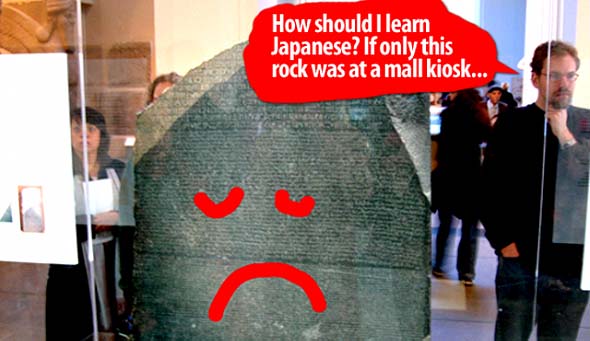
Alternatives to Rosetta Stone Japanese (i.e. Should I buy Rosetta Stone?)

One of the most common e-mail questions I get is “Should I buy Rosetta Stone Japanese?” It’s time to put an end to this e-mail silliness. From now on, I get to link to this post and video. Hopefully you, whoever “you” are (tell me in the comments), can get something out of this post as well.

P.S. Want even more Japanese language resources? Check out Tofugu’s Japanese Resources Page!

Here’s the itinerary:

  1. Should I buy Rosetta Stone Japanese?
  2. What makes Rosetta Stone “good”?
  3. Alternatives to Rosetta Stone Japanese
  4. Getting Your Opinion

Should I buy Rosetta Stone Japanese?

The nice and quick answer would be a nice and quick “no, probably not.” I’m not saying that Rosetta Stone is bad, necessarily. They put a ton of money into it, so of course they came up with something that’s decent. I’d give them a C+ or so – some parents wouldn’t accept a “C” grade, but on the other hand some parents would be super happy because they’re used to you getting F’s all the time (you know who you are). When it comes down to it though, if you’re going to buy Rosetta Stone, in terms of value versus what you can actually get out of it, you better be really damn rich. I imagine a Rosetta Stone customer looks something like this:

rosetta-stone-customer

or maybe this…

scrooge-mcduck

Rosetta Stone is fine, it probably works for some people, but it’s also a huge waste of money. Please, if you were planning on buying Rosetta Stone, stumbled upon this article, and changed your mind, send me the extra $1000 so I can buy a monocle, pocket watch, and top hat. I’ve always wanted to look like a rich Rosetta Stone Customer. Nya!

What Makes Rosetta Stone “Good”?

There’s a couple different versions of Rosetta Stone Japanese that you could buy. There’s the normal software package, which is around $500. Or, you can go with their TotalE program, which is all online and adds the benefit of having a live online Japanese teacher once a month, for a mere $1200 a year (they’ve lowered they’re prices, good for them – $20/month now) . The Rosetta Stone software is really spiffy, it’s pretty glitch-free, and if you go with TotalE the pictures are a lot less corny. All-in-all, it looks nice, which might be important to some of you when making a decision, but it still doesn’t change how expensive it is, and how you could be doing a lot better than Rosetta Stone.

Here are the things that they like about themselves, though.

Rosetta Stone Loves Their Marketing Budget

They spend a ridiculous amount of money on all that advertising / marketing / mall kiosk-ing stuff. The actual number eludes me at the moment, but I remember having myself a little heart attack when I heard it. But it makes sense – they are the big sleeping bear of language learning. Everyone knows who they are, and when you think “language learning” you probably think, at least for a couple of seconds, about Rosetta Stone as an option. This is great for them, of course, because it makes them look like they’re the best way to learn a new language. This is far from true, of course, but it’s all about how you present yourself, right? They do a great job of it. At the very least, even if you are hooked by their marketing department, try sleeping on the decision at least one night, or keep reading and try out the alternatives I’ve laid out below.

Rosetta Stone “Immerses” You Into the Language (Japanese)

baby

One thing Rosetta Stone likes about themselves is the idea that they teach you Japanese just like a baby in Japan would learn it. No grammar, no explanation, just practice and context. First of all, you’re not a baby in Japan (and if you are, you’re probably in good shape on the learning Japanese front), and secondly you aren’t spending 24 hours a day in front of Rosetta Stone (most likely) so it’s not anywhere near immersion (see immersion section down below for more info). At the most, you’re probably spending an hour or two doing the Rosetta Stone thing, which definitely isn’t enough if you want to take this approach. Either do it all the way, or don’t do it at all. Japanese babies don’t have 2 hours of Japanese “immersion” and then 22 hours of English. If they did, they’d all speak English, not Japanese, and that’s not the goal you’re trying to head towards here.

So is Rosetta Stone Japanese Good?

It’s okay, I’ll give them that, and probably not worth the money it costs (you’re paying a ton extra to fill their marketing budgets I imagine). Unfortunately for them, there are way better (and cheaper / free-er) alternatives out there that blow Rosetta’s socks off. The only problem is these alternatives don’t have marketing budgets like Rosetta, which means you’ve never heard of them before (that’s why I’m here!).

Alternatives to Rosetta Stone Japanese

So this is the part you might have been waiting for – here are the alternatives to Rosetta Stone Japanese. Sure, it is a big list of resources, but when used all together, you’ll find that your Japanese learning speed will go way up (compared to Rosetta Stone), you’ll spend a lot less money, and in the end probably have a lot more fun doing it. All these resources do a good job doing what they do, and Rosetta Stone just does a mediocre job doing all of these things. Much better to find a hip doctor that’s really good at hips, rather than one that’s mediocre at hips, hearts, elbows, golfing, and boob jobs. Am I right right, Dude, or am I right? (name that reference)

Immersion

We’ve already established that Rosetta Stone doesn’t cut it when it comes to immersion. AJATT kind of pioneers this method, and he’s a smart frood. Here are some great resources to help immerse yourself in Japanese for more than an hour or two a day, like Rosetta Stone.

itunesFavorite Choice: iTunes Japanese Podcasts
A lot of people have iPods, and even more people have computers, CD Players, and the like. It’s really easy to get Japanese podcasts for free and listen to them 24/7 (or whenever you have a chance, even at work I’m sure). All you have to do is change your location settings on iTunes to Japan, and suddenly you have access to every free Japanese podcast on there. You have to do a bit of a work-around to have access to things that cost money, but anything that’s free is good to go for you.

Choice 2: JapanesePod101 – JapanesePod101 is just what it sounds like: a website full of Japanese podcasts. In this case, their podcasts are designed to help people learn Japanese, and they do a pretty good job at it. There are paid programs, which get you things like PDFs and other study materials, but a lot is also available for free.

Choice 3: YouTube: YouTube has a ton of Japanese content you can sit and listen to, or put on in the background, and it can be a lot more interesting because you get the visuals with it. Just try and avoid subtitles, because that’s not doing you much good unless you really actively compare and contrast as you’re watching.

More Alternatives: Vimeo | NicoNicoVideo | CrunchyRoll (and of course, several “illegal” options as well, which I won’t be listing – sorry!)

Choice 4: Become a Japanese Hobo – They have pretty sweet hobo-houses. One-way tickets to Japan aren’t as much as round trip tickets? Perfect immersion strategy for the person who’s strapped for cash. Not sure how green cards work in this situation – I imagine you’d just become a fugitive?

TotalE Teacher Alternatives

One of the things you get with the TotalE program is a live online teacher. I called Rosetta Stone and got some details on this. You get one class a month (which you can repeat if you still don’t get things after taking it, but it’s the same lesson over and over), which changes every month as you progress. You go over the stuff you went over in the online app, which helps solidify things.

I think this is a bit of garbage – it’s a nice attempt at offering a good “teacher” solution to help guide you along, but you could still spend the $120 a month you’re spending somewhere else, and get a lot more out of it.

small-edufire-logo2Favorite Choice: eduFire for Live Online Classes
When it comes to finding an online Japanese teacher, eduFire is the way to go. There are alternatives to eduFire in the live online education space (which will be listed below), but they aren’t as good for Japanese just because their listings are a bit lacking (and the pricing can be pretty steep). eduFire has free online classes as well as a subscription program (a mere $29 a month for unlimited Japanese classes with live online teachers). Especially with the recent study that came out from the U.S. Dept. of Education which shows online learning as being more effective, I think it’s a no brainer (oh, and to be fair, I should probably mention I’m an employee here, but promise, not being bias. Research it for yourself if you want). Alternatives to eduFire: WizIQ | Myngle

Choice 2: CraigslistCraigslist is mostly in America, but I imagine there are “alternatives to Craigslist” in other countries as well. It’s a good way to find affordable local teachers, just be careful not to accidentally join a sex or drug ring.

Choice 3: TeachStreetTeachStreet is aiming to become the leader when it comes to teacher listings, online or local. Like Craigslist, they are only in certain locations, but if you’re in a fairly big city in the U.S. you might be in luck and be able to find some great Japanese classes as well.

Rosetta Stone Clones

cloned-sheep

There have even been some Rosetta Stone clones popping up. Complete alternatives to Rosetta Stone, and the cool thing is that they’re pretty much all free. There are some programs out there that don’t have Japanese (yet) as well, that I’m keeping my eye on, but here’s what’s available right now.

Favorite Choice – LiveMocha: Two things about LiveMocha. First of all, I’m not sure how they’re going to make money, because basically they’re offering what Rosetta Stone offers, except it’s free, and secondly, I’m not sure what Rosetta Stone is going to do once more people figure out about LiveMocha, because it’s basically Rosetta Stone (with a lot of its pitfalls as well, but hey, it’s free!).

Japanese Vocabulary Learning Alternatives:

At Rosetta Stone, because of the whole “baby immersion thing” you don’t really learn vocab in the traditional sense. Here are some great vocab resources for you to use instead:

Favorite Choice – Smart.fm: Smart.fm does an amazing job with flashcards. It’s like they can read your brain in a way that helps you learn more vocab and kanji at a nice and speedy rate. Just spend a little bit of time every day, and you’ll be a vocab expert in no time. Couple this with some of the other resources, and you have yourself a powerhouse. Alternative: Anki is a lot like Smart.fm, and has it’s own cult following. Maybe you’ll like it more than Smart.fm, but it’s not for me.

Second Choice – NihongoUp: NihongoUp is a little game you can play on your computer or iPod Touch / iPhone. Definitely takes some of the monotony out of vocab learning, and can help solidify a lot of things for you. You can trial run it for quite a while, and the paid version is too cheap to pass up (and the particle practice mode is gold).

Japanese Grammar Learning Alternatives:

grammar

Another thing that Rosetta Stone doesn’t really do is “Grammar.” I’m a big fan of grammar learning + actual usage + some of that immersion stuff to make it all meld together. Boo on you, Rosetta.

Favorite Choice – guidetojapanese.org: Tae Kim does a good job explaining grammar, and takes you all the way from basic to advanced. He does a good job simplifying things, and of course, everything over there is free, so indulge yourself!

Second Choice – Genki Textbooks: When it comes to textbooks, I think Genki is the best I’ve come across so far. Definitely not perfect by any means (and costs $30-$40, which really isn’t that bad for a textbook), but gets the job done. You can even use Smart.fm to practice the vocab from the textbook series.

Third Choice – Jgram.org: Jgram is a wiki of Japanese grammar. Sometimes their explanations are better than the top two, and sometimes they’re not. Either way, it’s a good resource to keep a hold of.

Japanese Language Exchange:

language-exchange

Language exchange is something that Rosetta Stone can’t really shake a stick at. Learning a language with a native speaker of that language is an awesome way to have fun, meet new people, and keep up with all the things the cool kids say.

Favorite Choice – Lang-8: Lang-8 is all about language exchange, which isn’t necessarily a new idea, but it’s an idea Lang-8 has taken and done good things with. At Lang-8, you write in the language you are learning (Japanese?), and then native speakers of that language (i.e. Japanese people) correct your entries in a way that makes it easy to see your mistakes so you don’t make them again. Everything’s free, though they have a premium plan that gets you more features and fewer ads.

Second Choice Skype Forums: I haven’t actually made my way to the Skype forums, so I can’t confirm this, but from what I hear you can find people to talk with that will help you learn Japanese (and then they’ll help you). Over at Lang-8, as well, you can see who has added a Skype account and talk to them that way too.

So What’s Your Opinion?

Oof, that’s a lot of writing, and my fingers hurt.

I bet some of you have used Rosetta Stone in the past (or are currently using Rosetta Stone… your rich bastard you). What do you think? What resources am I missing that you couldn’t live without (and totally beat down “The stone”?).

Anyways, so there you have it. That’s my opinion on Rosetta Stone. Decent / Okay / Mediocre, but not worth the money. It’s one of those situations where because they’ve made it so expensive, people automatically think it’s valuable, which isn’t always the case.

Either way, no matter what you decide to do, now is the best time to start learning Japanese. You don’t want to look back six months from now and wish you were six months into things. That always sucks big time. Go, figure out what your next actionable step is and start learning today. To find more cool Japanese resources, be sure to check out “Tofugu’s Top Ten Free Online Japanese Resources.”

Another Alternative

Update (2/01/10) – Since writing this article, I have started my own Online Japanese Textbook for Japanese learning called TextFugu. It’s designed specifically for those self-teaching themselves Japanese, which means it dives much deeper into self-teaching strategy and focuses on keeping you motivated to learn. Be sure to check it out and see if TextFugu is right for you and your learning style.

[yframe url='http://www.youtube.com/watch?v=2SO8yx2Y7yo']

This video includes an attempt at a British Accent. Ouch.

Video Transcript

Minutes 0:00-1:00

Minna-san konnnichi wa, koichi de gozaimasu. [meow sound]  When I’m checking my email inbox, I notice a couple of things.  First, I get a lot of emails.  Please don’t email me.  Second, a lot of them are about Rosetta Stone.  And, of course, the question is always the same.

Dear Koichi … that’s me.  What is your opinion of Rosetta Stone?  I would like to know your opinion before I spend $1,000 buying Rosetta Stone.  That guy’s a robot.

To all of you who have nice and short Youtube attention spans, the quick answer is, “No, you probably shouldn’t buy Rosetta Stone.”  It’s not because Rosetta Stone is bad, per se.  I’d give them a C+ or so.  You know, some parents wouldn’t be too happy.  Some would be happy because they’re used to you failing.

Now, let’s get that big white elephant gift out of the room.  Rosetta Stone is expensive.  It’s like $400 to $500 for the software pack.  And it’s like $1200 for their TotalE program.

If you’re going to buy Rosetta Stone, you probably have like a top hat, a monocle and a pocket watch, maybe a British accent as well…

Minutes 1:01-2:00

Oh, look at me [speaks in Japanese and words on screen say:  British accents sound intelligent to me.  Bad representative on my part.]  If you’re going to spend all that money on Rosetta Stone, don’t do it, stop, get off the ledge, go over to tofugu.com, check out all the resources that I’ve laid out for you that are great alternatives to Rosetta Stone and then send that extra money to me because I spend all my money on cat shirts or they have eye patches and I’m hungry, no food.  [meow sound]

Now, before I go on and list off a ton of resources that that make up that sinewy concert of alternatives to Rosetta Stone, let me tell you what Rosetta Stone has going for it or at least what they think they have going for them.  First of all, they spend a ridiculous amount on advertising and they have airport kiosks and mall kiosks.  Can’t beat the mall kiosks except for that hermit crab kiosk and the kiosk where you can get that cigarette that’s not actually a cigarette but it’s actually a gadget.  But, since they spend so much money on advertising …

Minutes 2:01-3:00

likely than not you’ve heard of them.  And, if you’re watching this video, then maybe you are actually considering buying from them.

They have a really good marketing strategy and a pool full of gold that they can swim through.

That, right there alone, is the key to success.

Now, most of the really cool resources that are available out there for free or very cheap.  They don’t have this kind of resource.

In fact, if you’re paying for Rosetta Stone, more likely than not, a lot of the money you’re putting in there is going straight towards the marketing budget.  That’s why everything costs so much.

So they have good marketing.  That’s reason number one why Rosetta Stone is pretty good.

Now, Rosetta Stone has another thing that they like about themselves.  They say that they can create this “immersive environment”.  They teach you Japanese in a way that’s just like a baby in Japan would learn the language.  Waaaah.

This, of course, is total B.S., because you’re not actually inside of an immersive environment.

More likely than not, you’re only gonna spend one to two hours at the very most, everyday, on Rosetta Stone. That leaves

Minutes 3:01-4:00

That leaves 22 other hours.  You don’t need to spend all that money to create an immersive environment for yourself.  You can do all sorts of other things like, for example, downloading Japanese podcasts and listening to them.  It’s really easy.  It’s free.  All you have to do is change your location setting in Itunes to Japan and you have access to thousands of Japanese podcasts.  On top of that, there’s a ton of Japanese programming available on the Internet through Youtube [sounds like vimeo], Crunchy Roll, all those kind of things.  If you want to immerse yourself in Japanese, you don’t need Rosetta Stone to do it for you.  In fact, if you are planning on spending $1,000 bucks on Rosetta Stone, use that $1,000 bucks to become a Japanese hobo.  Get that one way ticket over to Japan, become a hobo.  You’ll learn a lot faster and a lot better that way.  It’ll be fun.  Please note that I am not liable for any injury or death from anyone who becomes a hobo in Japan.  I said it.

That being said, that is just the tip of the iceberg in a world without global warming.  There are a lot other resources, a lot other alternatives …

Minutes 4:01-5:01

There are a lot of other resources, a lot of other alternatives to anything that Rosetta Stone throws at you and you’ll find them all over at tofugu.com, link on the right.

Basically, what I’m trying to say is you don’t have to spend a ton of money to learn Japanese.  The overall conclusion to the question, Should I learn Japanese using Rosetta Stone is ‘no.’”  If you want to know why and you want to see all of the cheaper or freer alternatives that absolutely destroy Rosetta Stone, check out the article that’s linked on the right.  And that is it for this video.

Thank you so much for watching and go learn some Japanese now.

Hey, coming up is a commercial, but after the commercial … it’s a good commercial by the way … after the commercial you get a little [sounds like magay], a little extra, right?

Alright.  So Christmas is coming up.  Oh, no.  How am I going to buy cool Christmas presents from Japan for people that like Japanese things?  I don’t know.  Maybe, you can check out flutterscape.  Flutter what?  Flutterscape.  Well, what’s that?   Oh, you don’t know flutterscape?  It’s really cool cause people in Japan

Minutes 5:01-End

People in Japan, they take picutres of neat things in stores.  And then you can say, hey, can you buy that for me and send it to me?  I’ll pay you a little extra and pay for shipping.

Oh that sounds cool.

Yeah it’s pretty neat.  People take lots of pictures of cool things and you just buy from them and it’s totally safe and stuff.

Oh, that’s nice.  So what kind of stuff do they have?

Oh, you know, cool Japanese things.  Anything?

But in all seriousness, Flutterscape, one of the coolest ideas I’ve ever seen.

It’s just like how I described it.  People take pictures of things.  You ask them, you say, hey can you buy that for me?  And they say, yeah.  And they go to the store. They buy it. They send it to a shipping center which makes sure they actually send it.  And they send it to you.  You sned them the money. Everything works out and you buy stuff.  Like, from stores from Japan.  It’s like you’re there except for it takes a little while longer.  Smart idea.

Meow.  Meow, meow.  Meow. Meow.  Meow. Meow, meow, meow. Meow, meow. Meow!

Oh, and you should follow me on Twitter.

  • mountaincritter

    Ah, sounds like what I heard was right. All “practice” without grammar dissection. To me, most the fun (and the meat) is in the grammar. It kind of seems like programs like Rosetta and Pimsleur just want you to learn that certain Japanese sounds “mean” certain things in English, without getting into the parts of speech or sentence structure. That'd drive me crazy.

    Anyway, first comment (woot!)

  • benstevenson

    I downloaded a copy of Rosetta Stone and even that wasn't worth the time/space. Like you said, there's not grammar, they just start teaching you phrases and vocab. I was interested in learning useless stuff like verb/adjective conjugation and particles, so it didn't really help. I would strongly suggest Human Japanese. The interface is much better than RS (aka not from the 90s) and they teach you everything you need to get started. As well as language there are also cultural and geographic tidbits which are quite interesting and supplement the lessons. There's even an iPod/iPhone version which is great for learning on the go.

  • wccrawford

    Edufire sounds great until you try to actually find classes to take. Almost every class is either when I'm working or sleeping. I seriously doubt I could manage to get $29 worth out of it in a month on classes like 'basic Japanese through music', which is one of the few classes at a time I could take it.

  • Helen

    Is Tae Kim's Guide a good resource to start learning Japanese from scratch?

  • http://www.tofugu.com koichi

    Good point – eduFire hasn't reached a point yet where all time zones are covered, but hoping that problem will solve itself over time

  • http://www.tofugu.com koichi

    Yep, it's not bad for complete beginners

  • wccrawford

    I found it to be quite helpful.

  • http://twitter.com/Livvyxo Livvy εïз

    You're alive!!
    This makes me joyously happy.

    If you'd like me to ever provide a voiceover for a british accent I'd be happy to do that. I'll make myself sound more stereotypical and manly for you to mime along accordingly. :)

    And I tried the preview of RS and was not impressed. Not at all.

    There are so many resources here I don't know where to start!

    I start a Japanese course at university next autumn; four years of solid japanese plus a year studying at a japanese university. Exciting… oh yes…
    daunting … incredibly…
    terrifying … completely.

    So before that I'd like to be able to know at least the basic kanji. What's your personal preference for total beginner Kanji learning?

  • TakuanDaikon

    Signed up for JapanesePod101 because of what I read on this article, and within the last five minutes I've gotten 13 emails from them, most of which are duplicates.

    Does not inspire confidence :(

  • http://www.tofugu.com koichi

    uh oh, really? They definitely send out a decent amount of e-mails, though I've never gotten any dupes. I'll let the big boss over there know about it. Thanks!

  • http://www.tofugu.com koichi

    Heisig's Remembering the Kanji is the most interesting in terms of memory and messing about with that. Personally I like smart.fm, along with just trying to do as much reading as possible to keep practicing, though I suppose that would be later down the line. Textbooks tend to do a good job introducing kanji in a decent way, too.

  • dragonfly

    I'd say with THE OLD smart.fm which we all loved and recommended… but the new monster? ouch! though i guess you can still study items- provided you have the right browser and fear no bugs; you just can't create them anymore ;_;

  • dragonfly

    you can really contact God, Koichi? :O

  • kevo

    I'll go for the hobo option! =D

  • Ally

    I've been steered away from Rosetta in the past after looking up reviews. I was recently told about Live Mocha and gave it a shot. Blah. It sucks. Just like Rosetta must suck. Most of your options I already know about (mostly from reading your blog) and they're great! Thanks! :)

  • Ally

    I loved using Human Japanese! I only wish they'd continue it with more lessons..

  • zonjineko

    Great read as always thx Koichi. I had never heard of LiveMocha – if I block out the Mocha brown, the data there is quite good (^_^)

    Do you consider KeyHoleTV an illegal option? Watching live Japan TV is great for listening comprehension.

  • http://gakuranman.com Gakuranman

    Nice article Koichi. Good to see you working those fingers a bit more (British accent needs work though ;) ). Have never tried Rosetta Stone, but was offered it once when walking through a shopping centre (that would be a 'mall' to all you peeps in Americaland). Poor lady was a bit ruffled when I mentioned about all the resources available online ^^;

    I just hope some of the big hawks at Rosetta Stone don't come down to try and silence you – or worse, recruit Tofugu for their evil cause! Would you trade your integrity for a monocle and a top hat? Hmm? Would you?

  • http://twitter.com/katiemuffett Katie Muffett

    This post and the comments will help me dodge a bullet. I do not have hundreds of dollars to give to something that isn't grammar intensive. And the bit about being a 'baby' was hilarious..and very true. Anyway, the bloke in the shopping mall lost interest in me when he saw I wouldn't be handing over cash. Good riddance!

    Immersion seems to be the only way to go, aside from the hobo idea. It really isn't easy when none of your family or friends is interested in Japan (beyond Akira Kurosawa and anime). And I can't say that I'd want to hook up with someone out of the blue just to be around a native speaker :/ Does that really work out productively for anyone? Maybe I'm just a crank. What if it was a really sexy Omori Nao look-alike? I would learn absolutely nothing.

    Japanesepod101 and Smart.fm compliment each other very well, imo – Smart has all the varied repetition and JPod gives excellent context. Though JPod tends to get missed out in my daily rota unfortunately. Tangorin is a handy dandy vocab finder tool as well.

  • myargonauts

    I thought joining the JET Programme was the best way to learn Japanese…??

    Nice Article – will retweet.

    -Jason

  • koiyuki

    So excellent Japanese instruction won't cost both arms and legs? Excellent. If you wanna be a rich punk, you need an albino cat, though. That is an absolute must have

  • Gary

    I recall that back in 1999 or 2000 my local computer store had an entire section for Rosetta Stone and other language software, and that the old blue-box Rosetta Stone offerings were $29.95 USD each, as compared to the spiffed-up $300 to $750 offerings of today. I actually still own a couple of the Rosetta Stone packages that I purchased back then for $25 to $35 retail price. Presumably they later hired some marketing wizards to completely overhaul the brand and the way they sold the software, now in the yellow box. Also, those earlier versions (circa year 2000) were clearly labeled as adapatations of U.S. State Dept. foreign language courses, which were and are in the public domain.

  • wccrawford

    I'd hang around someone I couldn't stand so long as they were a native Japanese speaker and would speak Japanese with me. ;)

    … Is what I'll say in a while when I'm ready for some verbal practice. I'm not quite there yet, but I can already tell that I'm going to be a bit desperate when it comes to that. Maybe I'll luck out and find some penpals online that want to go vocal.

  • aerliss

    I just don't understand why someone would bother paying out that much money without doing some research. One iddy biddy google search will give you plenty of free alternatives, and while some will not be great, what's the harm in trying them for a while if they're free?

    And then of course, we have lovely people who review all these free places to help us find the rights ones for us.

    Research, people, research! Saves you bundles of cash.

  • petedee

    Overall I've been pretty happy with Rosetta Stone. The price thing can be a hurdle but I got mine online through http://www.cbcwebcollege.com/shopcart and it's basically only $15 a month plus I get all languages and all levels. The virtual classroom provides me progress feedback through an individualized account, which the other programs don't. Plus I can log in anywhere (work or home, mostly) and it remembers where I left off.
    I agree it's not a panacea but I do think it's a great start. It's especially helpful to me because I had trouble sticking with a language and the Rosetta Stone style fixed that problem. The other methods provide a great supplement and like anything else you have to use it or lose it. I'm on level 3 of Spanish and going strong.

  • boston407

    I agree with your point on Rosetta Stone. There is a way to tweak its use, however, by writing out your answers on actual paper; tweak it further by not looking at the answers on the screen; and tweak it further still by using 漢字; and further still more by looking up ひらがな words on screen in 漢字. See what I mean? I call it squeezing blood out of “Stone”.

  • http://www.tofugu.com koichi

    Sure you can! I just showed someone how to do it – not as obvious as before, though. Poke around, you'll find it.

  • http://www.tofugu.com koichi

    Sure, but hard to know if he listens to his messages

  • Kimbi

    I have been looking at Rosetta Stone for a while. It is a big relief to know I don't have to ponder about it anymore. Most tools I have to pay money for I am very reluctant to purchase.

    I personally am constantly on the go, so I am restricted to mobile learning. I use my NDS mainly and often with Japanese learning homebrews and two Japanese children learning games: Anpanpan and Dora Gona. I'm not willing to move on until I can read the Hiragana and Katakana with confidence and know the stroke order by heart.

    I am also super excited to read my first story (kinda reliving the nostalgic child hood memory of reading my first English book all the way through.) I have my eye on Momotaro. If you could recommend and easier first Japanese story, that would be awesome.

  • skmt999

    I never bothered with Rosetta, I looked at it and could tell from the back of the box it wasn't going to work for me – but the Pimsleur Japanese worked pretty good at getting me to remember things that I just couldn't soak up from my textbooks. Mind you, Pimsleur only gets you to about JLPT4 level – assuming you're doing other studies at the same time. So it's useless after a certain point – and expensive if you aren't lucky or don't care about the law.

  • http://twitter.com/ImaginaryJapan Joe Munro

    I have to just add in here that I love Heisig's RTK. I use it along with anki to make sure I remember them all. He introduces the meaning and writing of 2000 characters, the pronunciation is done through immersion in other resources.

  • http://twitter.com/ImaginaryJapan Joe Munro

    Yeah, they drive me nuts! I never really found them that useful, and they spam like crazy! They are probably more useful than I think, I just can't get through the beginners podcasts (too much English!) to get to the more advanced ones (less English?).

  • http://twitter.com/ImaginaryJapan Joe Munro

    I would. Just saying. (Come on, a top hat? Those things are super cool!)

  • http://twitter.com/ImaginaryJapan Joe Munro

    If you're looking for some really easy Japanese stories I recommend buying “TheJapanShop.com's $5 Download Collection on CD Vol. 1: READERS & LESSONS” http://www.thejapanshop.com/product.php?product… . They include PDF's, audio readings of the stories, and definitions and explanations. It's definitely the way to go. If it's too much money ($24.95) you should at least consider one of the $5.00 downloads. Since you're restricted to mobile learning, you can put the MP3's on your mp3 player (if you have one) and print out the PDF's (or if you have a laptop and can bring that, that would work).

    I think it's kind of cool that you can remember the first book you read in English…I have no such memory :(.

  • ben shearon

    Hi Koichi

    Nice post, with lots of great stuff. Every time I read one of your lists though, I notice a bit gap -where is LingQ? Have you tried it? I think it's probably one of the best ways to learn through input. It took me about three years to start using it properly from when I signed up, but I am finding it very useful now.

    Really not sure about the 'British' accent, either ;)

    Toodle pip!

    sendaiben

  • http://twitter.com/ImaginaryJapan Joe Munro

    I have to admit I tried out Rosetta Stone and found it impossible to learn from. It just jumps into things without introducing the writing system. Hiragana, kanji, katakana? Who cares! but we're going to display it anyways even if you can't read it – maybe that style could work for Spanish or something but the Japanese writing system is far too in depth and complicated to learn it simply through immersion. Plus, the whole picture immersion thing just wasn't working for me.

    I do recommend anki over smart.fm though, it's far better for long-term memorization. You can even import the lists (now goals?) from smart.fm into anki with a plugin (at least, with the old smart.fm, I haven't tried this since they did the re-launch).

  • http://twitter.com/Livvyxo Livvy εïз

    Thanks! I'll check out smart.fm and those textbooks!
    I also found a pretty cool textbook, “A Guide to remembering japanese characters” by Kenneth G Henshall, it's basically like an index book with a little paragraph about each character.

    Also I love podcasts. I'm a podcast addict. but the last time I switched to the japanese itunes store it completely buggered my iphone. do you have any favourite Japanese related podcasts available from western stores?

    I'm aware I'm using you like Google here but I actually trust your recommendation and incredibly wise ways.
    (Shameless flattery will get me everywhere?)

  • darg

    At least in the US, another cheap option to RS is getting Pimsleur through your local library for free. Noted that a lot of people here are more interested in nerding out on the vocab/grammar (spent 5 years in school on Japanese myself and have worked through RTK1) so they probably won't like this option, but not going into excruciating detail on grammar and the like is seen as an advantage to such programs for people that just want to be able to speak the language in a hurry. You don't necessarily need to understand grammatical rules and kanji to be able to speak Japanese, so it all depends on your personal goals.

    Right now I'm working on Brazilian Portuguese with Pimsleur and am quite pleased thus far as my goal is to be able to be able to understand and have conversations with my Brazilian friends at capoeira and be able to get around taking an extended trip to Brazil. I loaded up the lessons onto the old ipod and listen on the train to class.

  • darg

    Here's the situation I believe programs like this are good for, although I'd take Pimsleur over RS: you're heading to Japan and want to be able to walk around and actually talk to people – writing/reading is most definitely secondary. This is especially true if you don't have much time to study, say maybe a month or two, tops. With no time, I'd rather know how to say a bunch of useful phrases than learn the Japanese writing system, which takes up quite a bit of time, and pick out the most important grammar intuitively as I learn the phrases.

    I'm visiting China next month, so something like this would be perfect for my trip for example.

    Something I'd like to know: for those who learn Japanese only through RTK/smart.fm/etc., how are your verbal communication skills? I've messed w/ RTK and smart.fm/anki myself and think they're great if used properly, but I could see how if this was your sole source of input that having something to help with speaking practice would be immensely beneficial as a supplement.

  • Kingandcountry18

    I tried Rosetta Stone back when I was a freshman in high school (now I'm a senior). I quickly switched to the old-fashioned method of studying by using the Genki series, then moving up to the text by the Japan Times called “An Integrated Approach to Intermediate Japanese,” and now I finally started the one by the same company called “Authentic Japanese: Progressing from Intermediate to Advanced.”

    The results of just putting in the time are phenomenal; I did a homestay this summer in Japan and rarely had to use English with my host (I'm not fluent of course lol).

    For all beginners: stay away from software! Use textbooks, practice speaking/writing, watch dramas (not anime!), and above all, put in the time (about an hour a day). I feel that the textbooks (along with any basic kanji texts) that I outlined above worked fine, and I am confident that they will work for other people as long as they put the time into it.

  • An

    Not from the 90s? Have you even tried V3 version of rosetta stone? That is fully flash based and looks pretty sweet. I have been using it for lvl1 and it's decent… But I wouldn't use it for anything other than a little vocab training. Before you put that monocle in my pocket let me say that I got a copy of it at the library.

  • Mitchell

    I have the same problem. I live in the European time zone. But I resolve this by changing my schedule to meet the schedule of most teachers like NaNa. Learning comes first, sleep later! Seriously that's how frikkin awesome Edufire is.

  • caughtredhanded

    Rosetta Stone is not worth the paper it is written on, period. In fact, it doesn't even come close. There are a million more beneficial alternatives out there that will get you to a much better level of understanding at half the cost, and most probably (though this part is my opinion and not based in fact) in half the time, and without all the annoying marketing tricks that they like to pull on you at any given venture.

    There is no alternative, as I know has been mentioned before, to good old fashioned text book learning. These things were designed to work, and have been proven to work for years and years, therefore there is nothing wrong with doing it this way. Okay, so you don't get the Wow! Pyrotechnics that you get from Rosetta Stone, but who cares, you're trying to learn Japanese, not how to make fireworks.

    My most important point however is, why not just get a tutor? Sure, all this home learning stuff is good, but you cannot, and will never be able to replace the knowledge and understanding that is garnered from sitting in front of a Japanese person and speaking Japanese with them, or have them take you through kanji formation, grammar etc.

    I'm taking JLPT2 this weekend, and I still have a one hour a week session with a Japanese teacher that I have been having since the beginning of time. It's less about new stuff these days, and more about just topping up on the old, keeping it fresh, and using the language. That said, the principle is still the same. If Rosetta Stone costs $1200 for the full course, then invest in a tutor. Mine costs me £15 per hour, per week, so £780, or $1248 per year. That may seem a lot, and it is indeed slightly more than Rosetta Stone, but at least you get somebody who is an expert in Japanese (whereas Rosetta Stone is a jack of all trades and a master of none) and you get to ask them questions, find more out about culture etc. and generally have a more fulfilling and rewarding experience.

    'Nuff said.

  • caughtredhanded

    I agree totally. Grammar is the building blocks of language, so without that, you're stuffed. None of these home study programmes give you the reasons why things work, they just pummel you with vocabulary and then expect you to put it all together yourself.

    Check out my alternative below /

  • http://www.nameoftherose.net Laura

    I actually replied to one of the e-mails complaining about the spammy nature of it all and someone replied to me and put me on special notices or something. I was surprised!

  • http://twitter.com/PickMyBran Brandon McL educator

    So I blanked out for a minute.

    Should I get Rosetta Stone? ;P

  • http://www.locanto.com/ Find tutors

    Nice read! I am all for the tutor too. Live learning is always more fun and definitely more effective. In my case anyway. Plus I have always wanted to learn Japanese anyway, so maybe I should start now? :)
    As far as the alternatives to Craigslist go: I prefer Locanto (http://www.locanto.com) because it is less spammy and they have a pretty good section to find tutors in your local area.

  • Nukemarine

    Rosetta Stone presents itself as a one-stop shop. Everything you need for fluency in any language.

    What it got right:

    1. Image/Audio – You have images to display the sentences, and “natives” reading the audio. This helps.
    2. Short term testing – If you get something wrong, you get it presented to you randomly till you get it right. At least for that section.

    However, these are being matched and bested by iKnow (smart.fm) and Anki.

    It just gets so many things wrong:

    1. Cookie cutter teaching. It uses the same format for English, Russian, Arabic, Japanese and any other language. To get the basics of a language across, you need to take a more guided path. Tae Kim/Genki helps here for grammar, while 2001.Kanji.Odyssey/smart.fm provides it for vocabulary.

    2. No long term retention. Once you passed a section, you never go back to that material in later sections unless it's used.

    3. SLOW. Everything on the first lesson seems cool cause you're learning new stuff. But soon, seeing minor variants of car colors and who's running after who gets tiresome. Then of course the interface itself is slow, and you cannot tailor how the information gets presented to you on tests. Again, the free or cheaper material trumps this soundly.

    4. Making it difficult or ambiguous. It seems minor, but it takes little to have implemented a “hint” which would display the sentence in your native language. Some of the pictures did not fully demonstrate what the sentence was saying, where using a native language would have removed doubt. Again, the cheaper material trumps this.

    Now, the above I can only say in relation to learning Japanese. In the last three years, the availability of Japanese material for self learning has exploded. However, if you're trying to learn Arabic or Russian, I could not tell you if Rosetta actually is the best choice at the moment. Then again, what we use for Japanese can easily be used for any language given a group effort to gather the material.

    I said it last year in relation to iKnow (prior to all their updates) that iKnow is a fine meal while Rosetta Stone is used bubblegum. While my opinion of iKnow (smart.fm) has lowered, it still trumps Rosetta Stone in most ways.

  • Kimbi

    It was Dr. Seuss “Green Eggs and Ham.” I lept up and told my teacher in excitement when I was done.

  • SarahXin

    Only good thing about Rosetta Stone: sharedtalk.com