
Japanese Language Cheatsheet for Travelers

japanese-language-cheatsheet

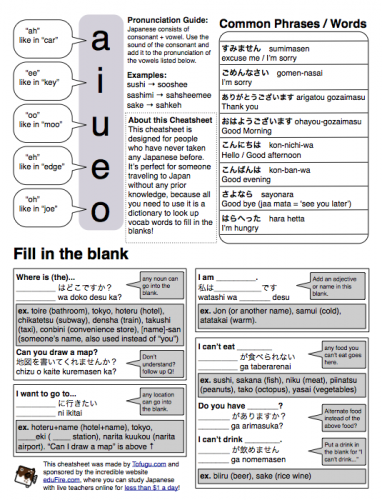
My boss is heading to Japan for a few days next week (lucky!), so I’m helping him with some really last minute language study before he heads out. The goal isn’t to teach him any grammar, vocabulary, or anything like that, the goal is to make sure he’s able to get by as simply as possible. That’s why I made him a one-page cheatsheet, and then sharing it with all of you.
japanese-language-cheatsheet

You can download it by clicking on the image of it up above, but let me offer some explanation on the pdf as well.

  • This document was created for people with little to no Japanese language ability or experience. So, if you know a lot of Japanese then you should probably take a look at some other cheat sheet. It’s good if you’re traveling to Japan, don’t know any Japanese, and want to have the bare minimum to get by.
  • I’ve included the “Japanese” version of most everything on there. This isn’t for the user of the sheet, it’s more for people who just can’t pronounce anything so that way they can just point to different things and native Japanese speakers will be able to read it.
  • The “fill in the blank” section will probably require a dictionary (I’d recommend getting one on your phone if you can). I’ve included possible vocab words that you can put in the blanks right on the cheat sheet, but that won’t cover every possible situation. With a dictionary you’ll have a lot more flexibility.
  • The Japanese language pronunciation guide might be a little confusing, but I couldn’t think of a better way to describe it. Most Japanese “letters” consist of both a consonant and a vowel (or just a vowel), and the sound of the vowel is pretty much always the same no matter what consonant is attached to it. Just do your best and point to things on the sheet all confused-kine if you have to. If you want to go more in depth on the pronunciation try learning some hiragana.
  • Of course, I’d recommend you actually go learn some Japanese rather than relying on this cheatsheet if you are planning on going to Japan. It’ll make your life a lot easier, and a one-pager won’t get you very far. It’s one page, and covers only the bare minimum!

Hope you enjoy it and find it useful. Feel free to share it around, give it to a friend, etc etc. Once again, here’s the download link!

Related posts:

  1. Japanese Particles [Cheatsheet]
  2. How to NOT find a Japanese language partner
  3. Hiragana Chart, Katakana Chart, Ready For Download

Twitter Digg Delicious Stumbleupon Technorati Facebook Email


  • wccrawford
    Nice sheet, but I cringe thinking about the poor souls that will be trying to understand what the sheet-user is saying. :D
  • The next line could be very handy too for travellers. ;)

    英語が話せますか?
  • True that - Will include in version 1.1 :)
  • I've always found the inclusion of phrases like that in guide books to be a bit silly, since you could ask it in English, anyway! Haha. Something like 「英語が話せる人(or 方)いますか」 might therefore be more useful. It's at least a better follow-up than awkwardly walking away when the answer is no.
  • It's more polite to ask something in the native language of the country where you are at the moment. ;)

    And your question is sort of the same (but on the other hand maybe more polite). You're asking if someone is a English speaking person? You'll probably get the same answer in the end... :)
  • I agree that it may be more polite, but I've never been offended when a tourist (I'm from Hawaii) came up to me speaking their native language...

    Also, most Japanese people know enough to say "No, sorry" in English. If they answered in Japanese (which is kind of what asking in Japanese invites) their answer would probably be more complicated and confusing!

    Anyway, I was trying to suggest something closer to "Is there anyone (here) who speaks English" in the simplest terms possible. That increases the chances of the person you're talking to helping you find someone who can speak English if they can't.
  • Or you can ask「結婚しませんか」to get someone's attention haha. :P

    What I experienced in the past is that if I asked someone if he or she could speak English I got simply a nod with no or 鳥渡. Gladly my Japanese has increased since the first time I went to Japan, so I can communicate with the Japanese now which helps a lot to get around. ;)

    But Japanese are really helpful even though the most can't speak English but they understand it if you explain it clearly and will try to help you with the question you have.
  • Cool -- will keep this around for future friends asking me for basic Japanese help :)
  • Name
    You might want to replace hara hetta with onaka ga suita if you want this to be used by both men and women...
  • bigw
    I find most phrases a waste of time - as a seasoned traveler
  • inuhime
    What's the difference between hara hetta and onaka ga suita/sukimashita?
  • Awesome idea!!
  • spencersetters
    Maybe try adding things like 。。。をください. Or even お願いします because that's a bit easier to use when you're asking for pretty much anything. ;)
  • Kris
    If it is for people who have never taken japanese and who know none, why bother with all the kanji? you could almost double the amount of phrases you could put on there just using romaji.
  • The kanji is for people who butcher the pronunciation so bad that nobody can understand them. That way they can just point.
  • Jakku
    Please correct me if I'm wrong, but don't most japanese read Romaji anyway? As they have to learn it to be able to type unless they have a hiragana keyboard and they also learn it at school O.o (I'm really not sure but I thought that was the case.)
  • yeah, but romaji sucks because there are literally 4 different romaji "schools-of-thought," which can also cause confusion. That's why there are multiple ways to type in different things (like shi and si, li vs ri, etc) So, (at least in my opinion), I just figured I go with something as simple as possible for the Japanese reader. I think someone would be more receptive to kanji/hiragana anyways, though once again that's just a hypothesis and obviously a big generalization on my part.
  • Jakku
    Fair enough :] Good job anyways, haha.
  • Very limited, but I think it is very realistic for someone who is just travelling. Most people seem to buy phrase books, but no one ever seems to use them because it's too difficult to find what you want to say.
  • Ken Takahashi
    wow thanks for the sheet, I think I know enough Japanese to do without the cheat sheet but it would be really helpful for other people I know to use. You worked hard to do all of these Japanese things. thanks
blog comments powered by Disqus