
Japanese Particles [Cheatsheet]

japanese-particles

[box type="info"]Newer version of the Japanese Particles Cheatsheet[/box]

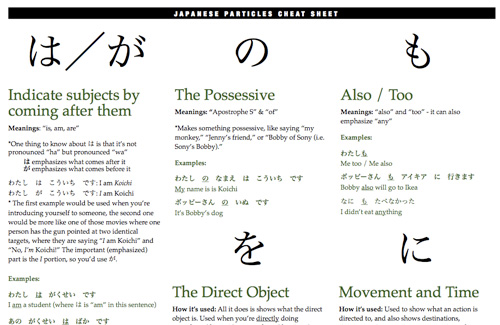
Japanese particles can be fun, if by fun you mean eye gouges and hair pulls. I haven’t come across too many people that enjoy Japanese particles. Tolerate? Sure, there are a few, but most people aren’t fans, and most teachers don’t make things too easy. Yesterday I taught a couple of courses on Japanese particles over at eduFire, and did everything I could to make particles easy and understandable. I figure if someone like me, who lacks a technical understanding of all grammar (in English, especially), can understand particles, then so should everyone else. I made things easy, cut out the fat, and simplified everything as much as possible, and I think for the most part it worked for people!In the process of doing that, I thought up the idea of making a Japanese Particles Cheatsheet. It’s a one page document that lays out all the main particles, explains their meaning, and shows some examples. It’s definitely not full of information, and I wouldn’t recommend using it to learn Japanese particles outright, but you can use it to help you tell one particle from another, especially if you’re just beginning Japanese (は and が particles can cause some problems, right!?), then that’s perfect.
japanese-particles-cheatsheet-img

So here it is, download this Japanese Particles Cheatsheet, use it in your class (teachers), share it with friends, Japanese learning colleagues, whatever. It’s all yours to enjoy. Definitely leave me some feedback though, if you have any, since I’ll probably be whipping together a 2.0 version at some point and I’m sure improvements can be made.

Download the [Japanese Particles Cheatsheet] Now!

  • Facebook User

    The は/が examples at the bottom of that section might benefit from the same italicization as the the examples in-line with the explanation.

  • http://www.tofugu.com koichi

    Heyo – thanks much! I'll take a look at it tonight!

  • taroroot

    Thanks koichi! This'll help when explaining particles to my cousin.

  • http://www.goddesscarlie.com GoddessCarlie

    Awesome resource, thanks Koichi :)

  • http://www.jamaipanese.com Jamaipanese

    instant save. You make it so simple, now I can finally tame the particle monster

  • Pingback: JapanSoc

  • http://www.thesoulofjapan.blogspot.com mcalpine

    I suck at paricles. Thanks for the download!

  • DarinM

    I've been study japanese for almost 2 years now and never got as good an explanation of は/が as that. Thanks! Really useful for people still just starting Japanese.

  • http://www.tofugu.com koichi

    punch it in the groin for me!

  • http://www.tofugu.com koichi

    Who doesn't? Best of luck with them!

  • http://www.tofugu.com koichi

    Really glad that it helps!

  • http://erikagrace303.deviantart.com erika303

    Nice cheat sheet! I'm sure it will come in handy after spring semester's ended, & I have to go back to independent studying :P Now I won't forget everything I've learned in class, over the summer!!! ..hopefully ^^;

  • Facebook User

    No problem. And since I'm offering constructive criticism I should also say thanks. Once I figure out how to wear out a PDF on my computer the way I would a piece of paper, I plan on doing so with this.

  • http://www.turning-iwatean.blogspot.com kanmuri

    Maybe I'm just crazy, but I feel that in most nominal sentences “ha” is used whereas in verbal sentence, “ga” is used. This is not a 100% all the time rule but it made a lot of things cleaer for me.

  • Pingback: Nihongo on The Net - March 26, 2009 - Nihongo Notes

  • http://youtube.com/profile?user=chokudori クリス

    *ゼック*です。

  • Nick_Ku

    Nice! Thanks Koichi!

  • http://digisumi.ca Sakomi

    Omg, thanks for sharing! 8D I always mess up this part on tests.

  • Stacey

    Thank you very much! ^^ I'll get to it straight away…

  • http://scalesoflibra.wordpress.com elisabel

    Hello Koichiさん,

    I've been reading Tofugu for a while now, first time commenting. Just wanted to say thanks for making this blog, it's so useful and fun!

    I'm one of those people that doesn't mind particles, but I was still a bit shaky on knowing when to use が versus は. My Japanese teacher said I have a strange tendency to use が too much but finally, here's a simple explanation! So, a heartfelt どうもありがとうございます!

  • Digger

    THANK YOU.

  • Samantha

    Thanks, Koichi! =D

    By the way, whoever made the banner for this entry deserves a hug. I think it's adorable – the little frowny face made my day.

  • http://expiring.blogspot.com selena

    Hiya,
    Been J-studying for far too long with far too little progress. This is really a nice cheat sheet. I once had to write a ten page paper on wa/ga (blast!) and I think one of the main things I came away with is that ga tends to be used more when introducing a new item into the conversation, and wa is used when the item is already familiar.

  • Jacob

    Thanks Koichi!
    Ummm, i was wandering, could you maybe do something with this sheet? like explain what they are and how to use them >> i have my GCSE (i'm English) in a couple months nad would really appreciate help understanding how to use some of the more complicated structures. Thanks!

    http://www.jpf.org.uk/language/download/Structu

  • レイカ♥

    you sir, are a hero.

  • http://www.yumeko.web.id agro

    Great material koichi-san! I'll certainly pass it around to my friends. (You counter cheatsheet was also really handy ^^)

    Explaining wa/ga is tricky. It's interesting that you chose to associate them with “is/are/am” (aka to be), since books/explanations that I've encountered correlates “to be” with da/desu in the example sentences you provided. (I'm on their camp btw :) )

    I myself would translate it as… Hmm perhaps just leave it at “it indicates the subject” and remarks that it normally doesn't translate to anything in normal English? And (dot-) underline the subject in the English translation to give indication that wa/ga marks that very thing.. Having it non-translatable wouldn't be too mind blowing for the student IMO, since particles like wo also don't translate to anything in English. Also, on sentences like “watashi wa xbox wo kaimasu”, we already can't assign “wa” to any English word there…

    Or I'll perhaps use “as for…” a la Tae Kim (but the English certainly won't sound natural)

    I'll be waiting for your next PDFs… :)

  • beka

    Hi koichi ^^
    dozo yoroshiku
    arigatou gozaimasu ^^
    thanx for explaining the particles..i had some problems with them hehehe…

    Thanx for sharing your knowledge ^^

    Mata ne

  • http://veronicahebs.blogspot.com Veronica

    Yay! Thanks for the great link :D

  • aliene

    this is good stuff…

    I have a whole particle dicitonary but I never really use it. Who has time to flip through a BOOK to find something when you're talking or in class? =_=”

  • Bobby

    Looks like a pretty good cheat sheet to cover the basics. One more distinction that people often mess up that you didn't cover is に/で. I know you can only fit so much on a cheat sheet, but I think the use of と as in 友達と話す is common enough to warrant mentioning, as well as using it to indication quotation.

    Why do people insist on it being a は/が distinction? Since は can be used in place of を as well, it's really a は vs が/を distinction. That said, the point about emphasis is a good one. Another common use of は probably worth mentioning is contrast: コーヒーは飲みますが、お茶はあまり飲みません。

  • spdrcd

    すごくありがと、コイチさんと塗布具の皆さん。

  • Pinkgloom

    Thanks for the upload, glad to see I'm not the only person who hates particles

  • Pingback: Links Around Town - 3 | Dumb Otaku

  • Chimiko

    Particles are really difficult.. >.> Sometimes, even when you know the difference, it's really hard to tell the meaning cause you've heard them use interchangeably all the time. It's really confusing.

    Thanks Koichi-sensei~!

  • Nya

    Thank you!
    Like everyone else the one particle that I always have trouble with is が, So thanks this will be very helpful!

  • http://tiny-writings.blogspot.com/ C.

    ありがとうございました! I studied Japanese for one year (2007) & am currently refreshing my memory of what i learned.

  • http://ellydishes.wordpress.com/ Elly

    Great chart! I like the simple, casual descriptions. I am probably the only person on the planet who is “hooked on particles” and I love me a good textbook description, but stuff should be made simple and quick for practical purposes, too.

    Also, nerd note, it's really nicely typeset…

  • Pingback: 100 Terrific Cheat Sheets for K-12 Teachers | Teaching Degree.org

  • http://www.facebook.com/profile.php?id=5724226 facebook-5724226

    LOL, My teacher passed this sheet out in class the other day!

  • http://www.tofugu.com koichi

    Good! I'm glad it's helping people!! :)

  • marinebarbie

    let me just say you are amazing! my husbands friend (aka my roommate) just moved his girlfriend here from japan shes learning English so its hard for me to understand her with never studying Japanese a day in my life ( also my attention span when i don't understand something is all over the place quicker then the conversation started lol) but im finding this sight full of some useful information i love how you break everything down and you make it so much fun. so really thank you for all the time and dedication you put into this page!

  • http://l2japanesefun.blogspot.com/ estrellita

    hello!! excelent sheet!! but can u plz reupload it to another page? cause it has already reached the download limit =(
    try plz saving the file to mediafire, savefile or smth like that plzzzz=))))

  • Dahlia

    Can not download :( It says Download Limit Exceeded *sobz*

  • rayk

    Can you reupload this to something like rapidshare or megaupload as that current download has been exceeded. Thanks!

  • rayk

    Actually found this through google and reuploaded to rapidshare, hope you don't mind!

    http://rapidshare.com/files/283236645/japanese-

  • estrellita

    ty very much!!!

  • http://twitter.com/amorspesfides FEY

    that's really helpful of you, thanks so much!

  • please

    awww, can someone re-upload this? onegaishimasu

  • please

    awww, can someone re-upload this? onegaishimasu

  • 灰色のカナダ人

    I think I've been blessed with the fact that I actually enjoy Japanese particles. I find them a very fun subject to learn about.
    Now if you could make a cheatsheet for verb conjugation, or rather, a whole article(maybe u already have?), expecially bases, I do not get them.
    good cheatsheet, great for when im having a 'brain fart' moment.