Japanese Online Translators: They Laugh at You

Ladies and gentlemen, step right up! Today I am going share with you the secret to producing perfect Japanese emails, comments, and even blog entries all without a drop of effort on your part! Sounds to good to be true, you say? Well of course, that’s because it is.

Hedgehog

Believe me when I say that I understand the inclination towards using online Japanese-English translators, but trust me, you’re much better off just doing your best on your own. Why? I’m glad you asked (if you didn’t, humor me, please). There are three main reasons:

They Don’t Work

Online translators are generally unable to translate anything properly and will likely make you sound like either a robot or a lunatic. Harsh, but true. I have a theory, actually, that the people who’ve created these programs have done this on purpose, just for kicks. After all, if you don’t know enough Japanese to translate your English text yourself, how will you check whether the translated version sounds correct or not? You can’t. It’s a brilliant and diabolical scheme, no?

To illustrate my point, here’s a snippet of the Japanese folktale, Momotarō (桃太郎):

成長した桃太郎は、鬼ヶ島の鬼が人々を苦しめていることを知り、鬼退治を決意する。両親から黍団子を餞別に貰い、道中にそれを分け与えてイヌ、サル、キジ を家来に従える。鬼ヶ島で鬼と戦い、見事に勝利を収め、鬼が方々から奪っていった財宝を持ち帰り、お爺さん・お婆さんの元に返り、幸せに暮らしたとさ。

Now, here’s the “translated” version from Babelfish and Google Translate, respectively:

Momotarou who grew the ogre knows that the ogre of the island has tormented the people, determines ogre suppression. From the parents you receive the millet dumpling in the parting gift, distribute that in the road and attend the dog, the monkey and the pheasant in the servant. That the ogre it fought with the ogre with the island, supplied victory beautifully, it carried back the treasure which the ogre keeps taking from the people, the grandfather returned to the origin of the grandmother, lived happily.

and

Momotaro growth by the demon Onigashima bedeviling people to know that the determination to rid demon.黍parting gift from the parents to貰いball, it distributed along the way that dogs and monkeys, pheasant subject to the rule. Onigashima battle with a demon and the impressive victory, the Demons will treasure these people to go away from the elderly man to return to his grandmother’s original, and lived happiness.

While you may be able to glean the meaning of the original paragraph out of this jumbled mess, it’s largely incoherent, and it doesn’t sound natural. Can you imagine the confusion that would result if the English versions were translated back into Japanese using the same programs? I shudder at the thought. So, my point here is, unless you want your translated Japanese to sound like that translated English, don’t use online translators. They just don’t work, and will leave your readers, pen pals, teachers, etc scratching their heads in bewilderment.

They’ll Make You Lazy. And Fat.

Well, maybe just lazy. Even if translators did work, you’d still be doing yourself a disservice by using them. Relying too much on those kinds of programs will only serve to set you back in your Japanese studies in the long run—actually learning the language, no matter how hard it is or how long it takes, is so much better than the instant gratification that you’d get by not doing any of the work yourself.

Also, dependence on online translators isn’t really practical in the real world (e.g. actually visiting Japan or answering questions in class). Except, maybe, if you have an iPhone. But still. Don’t do it.

It’s Dishonest

It’s just not nice to mislead the person you’re presenting your translated material to.

So Basically…

If you’re someone who already uses online translators, you’re probably more than a little peeved at me right now, which is understandable. But as much as you may think that my goal was to portray you as a jerk, it wasn’t. I just want to encourage you to stop and discourage others from starting. Sadly, I’ve used online translators a bit in the past (high school, haha), so I’m speaking from experience. For all the aforementioned reasons, it’s just not a good thing to start.

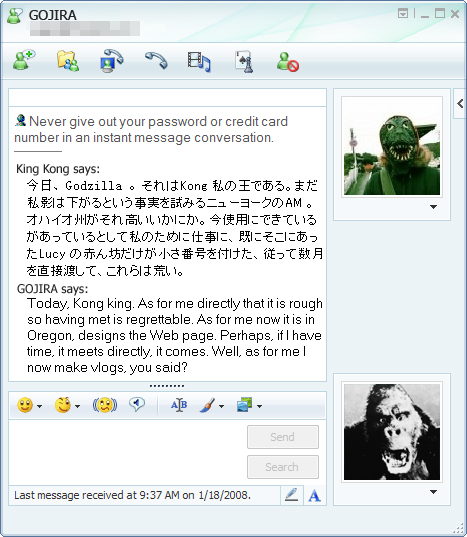
This is what happens when Gojira and King Kong use online translators to chat:

Monster Chat!

A Possible (If More Time Consuming) Alternative

If I’m going to tell you not to use translators, I should give you some other options for what to do if you need something written in Japanese but don’t know exactly how to do it, right?

First, give it your best try. Write out your sentence, paragraph, whatever, in the best Japanese you can. For now, you can put in English words/phrases where you don’t know the Japanese ones. Then, fill in the gaps—grammar, vocabulary, particles etc by using a dictionary, online Japanese lesson pages, or one of the many Japanese Learning/Translating Communities on LiveJournal (if you use these, you should still do most of the work yourself). Make sure you get rid of the English, too.

I’m going to backtrack a bit to note that I feel it’s best to stick to the grammar points and sentence structures you know already and try to only look up new vocabulary words. It’s really up to you, though. The thing you should definitely try to do, though, is learn (rather than just copy) the vocabulary/grammar that you look up, so that you don’t have to look it up again.

Next, depending on your situation, you could have someone check it. This can be your teacher, penpal, or even one of us (if it’s not more than three lines and doesn’t need to be done quickly) as a last resort. If you’re writing something that seems too trivial to be checked (e.g. a short comment on someone’s blog) or that doesn’t have time to be checked (e.g. an instant message), it’s probably best to post it as-is. A mistake or two is definitely not the end of the world.

This applies to a longer block of text, as well. If you’re self-conscious (try not to be!) about what you’ve written, you could always preface it with something like “Please excuse any mistakes”.

Good luck, you guys!

Thoughts From Koichi

Don’t expect to be able to write in Japanese right away. It’s something that comes with time and practice. Don’t get discouraged when you’re trying to write something in Japanese and it just doesn’t come out right away. That’s because you haven’t studied enough. I know we want everything right away, but it’s really best if you just keep studying. Things will fall into place, I promise! Eventually you’ll be able to write fairly well, just don’t expect it to happen when you first start you Japanese studies. That’s all I’ve got to add, I think.

Momotarō Text Source: Wikepedia JP

Picture Sources: Unknown

Edit: Let’s not link to too many translator sites in the comments, please.

  • http://www.koichiben.com koichi

    this article is full of spiff!

  • Tyler

    Erin wrote this, no?

  • http://www.tofugu.com Erin

    Tyler:

    Yes, I wrote this, haha. Why do you ask?

  • Ouroboros

    Everyone knows online translators don’t work.

    http://www.excite.co.jp/world/english/

    This is the most helpful though.

  • http://www.tofugu.com Erin

    Ouroboros:

    You might think so, but you’d be surprised at how many emails we get about using/not using online translators. Glad you’re in the know, though.

  • http://www.vietamins.com Viet

    Another great article Koichi!

    >.>

  • クリストフアー

    When I first started to learn Japanese, I tried to use online translators, but never got them to work as good as I wanted them to. I mainly used them to read the blogs from some of my favorite idols. Although I got the gist of what the blog was about, I was never satisfied with the translations. So I just gave up on them. Probably the only site I use often is this:

    http://www.romaji.org/ (日本 -> ロマジ)

    It really helps me read most of the kanji that I have yet to learn. I’ve even recognized a few from just using this site regularly (ex: 道、中、日、大、愛、山、田、子 etc.). I also use the occasional Japanese/English online dictionary, but yet to find one I like.

    PS: I didn’t notice until Tyler mentioned it, but as I was reading, I thought this was an article by Koichi. I guess I didn’t notice because you usually do “other” kinds of articles like the “Super Short Style” or the “Nissen Cup of Noodles” articles. By the way, thank you for those fashion sites.

    Well that’s my rant for today.
    スパムむすび FTW!

  • http://www.koichiben.com koichi

    this article is full of spiff!

  • kevinnwhat

    lol whole time i was reading this i pictured it was koichi writing it :P I think when i started to learn japanese i tried to use an online translator to translate japanese text into english, and realized it clearly doesnt work lol, thats when i stopped.

  • Tyler

    Erin wrote this, no?

  • Onimusha Nosferatu

    i think babelfish works most of the time for individual words (mostly nouns). when in doubt use katakana. that’s what i was taught. a good portion of young japanese ppl know english so if you saw it slow enough i think they’d understand.

  • http://www.tofugu.com Erin

    Tyler:

    Yes, I wrote this, haha. Why do you ask?

  • Ouroboros

    Everyone knows online translators don’t work.

    http://www.excite.co.jp/world/english/

    This is the most helpful though.

  • http://www.tofugu.com Erin

    Ouroboros:

    You might think so, but you’d be surprised at how many emails we get about using/not using online translators. Glad you’re in the know, though.

  • http://www.marcthayer.com Marc

    I mainly use online translators to look up a single word from time to time, if I don’t have a dictionary handy. If the English back to Japanese translation is the same, then I go with it and hope for the best. Most of the time, it’s fine.

  • http://www.vietamins.com Viet

    Another great article Koichi!

    >.>

  • Fredy

    ¡Reiría cuando la gente utilizaría los traductores en línea en clase española! ¡Nunca vendrían fuera de la derecha! Haha. This is from, “I would laugh when people would use online translators in Spanish class! They’d never come out right!” It took “on the line” instead of “online” and then it says “They would never come out of the right!” Yeah, it doesn’t work for Spanish and it definately doesn’t work for Japanese!

    Erin: ¡Me gusto tu articulo! ¡Lo hiciste muy bien! ¡Es posiblemente uno de tus mejores!
    Excuse my lack of accents casue I’m lazy and forget the key codes.

  • クリストフアー

    When I first started to learn Japanese, I tried to use online translators, but never got them to work as good as I wanted them to. I mainly used them to read the blogs from some of my favorite idols. Although I got the gist of what the blog was about, I was never satisfied with the translations. So I just gave up on them. Probably the only site I use often is this:

    http://www.romaji.org/ (日本 -> ロマジ)

    It really helps me read most of the kanji that I have yet to learn. I’ve even recognized a few from just using this site regularly (ex: 道、中、日、大、愛、山、田、子 etc.). I also use the occasional Japanese/English online dictionary, but yet to find one I like.

    PS: I didn’t notice until Tyler mentioned it, but as I was reading, I thought this was an article by Koichi. I guess I didn’t notice because you usually do “other” kinds of articles like the “Super Short Style” or the “Nissen Cup of Noodles” articles. By the way, thank you for those fashion sites.

    Well that’s my rant for today.
    スパムむすび FTW!

  • kevinnwhat

    lol whole time i was reading this i pictured it was koichi writing it :P I think when i started to learn japanese i tried to use an online translator to translate japanese text into english, and realized it clearly doesnt work lol, thats when i stopped.

  • クリストフアー

    @ kevinwhat

    Kevin just basically summarized my entire passage in about 2-3 sentences.

    舞鳥!

  • Onimusha Nosferatu

    i think babelfish works most of the time for individual words (mostly nouns). when in doubt use katakana. that’s what i was taught. a good portion of young japanese ppl know english so if you saw it slow enough i think they’d understand.

  • http://www.marcthayer.com Marc

    I mainly use online translators to look up a single word from time to time, if I don’t have a dictionary handy. If the English back to Japanese translation is the same, then I go with it and hope for the best. Most of the time, it’s fine.

  • Matthew

    Considering Spanish is much closer to English than Japanese is, you can only imagine how badly Japanese will come out if my Spanish sentences come out like so:

    “The rule of the sudoku: Each column, row, and 3×3 box must contain the numbers 1 to 9. Never have to guess a number. The solution provided can be reached only with the logic.”

    Yes, it came close, but it would look sloppy to a native speaker the other way around. Just imagine what it’ll do to Japanese.

  • Fredy

    ¡Reiría cuando la gente utilizaría los traductores en línea en clase española! ¡Nunca vendrían fuera de la derecha! Haha. This is from, “I would laugh when people would use online translators in Spanish class! They’d never come out right!” It took “on the line” instead of “online” and then it says “They would never come out of the right!” Yeah, it doesn’t work for Spanish and it definately doesn’t work for Japanese!

    Erin: ¡Me gusto tu articulo! ¡Lo hiciste muy bien! ¡Es posiblemente uno de tus mejores!
    Excuse my lack of accents casue I’m lazy and forget the key codes.

  • http://www.vietamins.com Viet

    Here is an awesome site to assist those that are actually doing some work by translating online content themselves.

    http://www.popjisyo.com/WebHint/Portal_e.aspx

    This is so much faster than opening up a dictionary or even using Jim Breen. I’ve used it a few times and I have no complaints.

  • eLsa

    ah~ online translators… fundamentally useless; but relatively good for laughs.

    i tried translating the lyrics of a Korean song from Korean to English once.
    Everytime the Korean word for ‘heart’ came up, it was translated into the word ‘breast’. So the translation ended up becoming something like:
    “Everytime I see you, my breast hurts”

    What a dirty song.

  • kevinnwhat

    @クリストフアー

    ^^ :D

    best site to translate something is jimbreens i think. Cept it doesnt actually translate it just give s you the meaning of the words. you can at least get what their talking about if you know what words there using :P

  • クリストフアー

    @ kevinwhat

    Kevin just basically summarized my entire passage in about 2-3 sentences.

    舞鳥!

  • Matthew

    Considering Spanish is much closer to English than Japanese is, you can only imagine how badly Japanese will come out if my Spanish sentences come out like so:

    “The rule of the sudoku: Each column, row, and 3×3 box must contain the numbers 1 to 9. Never have to guess a number. The solution provided can be reached only with the logic.”

    Yes, it came close, but it would look sloppy to a native speaker the other way around. Just imagine what it’ll do to Japanese.

  • http://www.vietamins.com Viet

    Here is an awesome site to assist those that are actually doing some work by translating online content themselves.

    http://www.popjisyo.com/WebHint/Portal_e.aspx

    This is so much faster than opening up a dictionary or even using Jim Breen. I’ve used it a few times and I have no complaints.

  • eLsa

    ah~ online translators… fundamentally useless; but relatively good for laughs.

    i tried translating the lyrics of a Korean song from Korean to English once.
    Everytime the Korean word for ‘heart’ came up, it was translated into the word ‘breast’. So the translation ended up becoming something like:
    “Everytime I see you, my breast hurts”

    What a dirty song.

  • mmnessa

    Am I the only one who reads the small letters under the titles of each post?? You can clearly see there who writes the article.
    And yeah, I agree with those who said that it doesn’t work with Spanish either. Online Translators Suck!. I get a lot of Spanish friends tell me that they can speak English when they are obviously using Babelfish (“It’s Dishonest…”, not to mention they sound like idiots).

  • kevinnwhat

    @クリストフアー

    ^^ :D

    best site to translate something is jimbreens i think. Cept it doesnt actually translate it just give s you the meaning of the words. you can at least get what their talking about if you know what words there using :P

  • クリストフアー

    ^^^^Viet

    Omg。。。 Thank you for listing that site. It makes things a lot easier and faster. Now I can enjoy reading my blogs without “alt-tabing” every couple lines. Very exciting! Haha yeah I know… I’m a nerd.

    o(^^o)(o^^)o わくわく

  • mmnessa

    Am I the only one who reads the small letters under the titles of each post?? You can clearly see there who writes the article.
    And yeah, I agree with those who said that it doesn’t work with Spanish either. Online Translators Suck!. I get a lot of Spanish friends tell me that they can speak English when they are obviously using Babelfish (“It’s Dishonest…”, not to mention they sound like idiots).

  • クリストフアー

    ^^^^Viet

    Omg。。。 Thank you for listing that site. It makes things a lot easier and faster. Now I can enjoy reading my blogs without “alt-tabing” every couple lines. Very exciting! Haha yeah I know… I’m a nerd.

    o(^^o)(o^^)o わくわく

  • Trogan Bird

    True – online translators for Asian Languages are not very good. I tried translating some things into Chinese (Cantonese) and it just doesn’t work. However, that said, there will come a time when they do – I remember a time when Spanish/German translators were rubbish, and now they get it right (mostly). There will come a time when you’ll be able to use a computer to translate darn near anything.

    Of course, nothing beats learning a language (you can’t carry a computer around you forever), and it’s not very personal to constantly use a translator. But the day is coming soon. Computers already have good facial recognition technology (people use to say computers would never be able to recognize faces), and soon, good language skills.

  • http://surrealu.blogspot.com claytonian

    I think Lang 8 is a great way to get help with one’s writing from the internet.

  • Trogan Bird

    True – online translators for Asian Languages are not very good. I tried translating some things into Chinese (Cantonese) and it just doesn’t work. However, that said, there will come a time when they do – I remember a time when Spanish/German translators were rubbish, and now they get it right (mostly). There will come a time when you’ll be able to use a computer to translate darn near anything.

    Of course, nothing beats learning a language (you can’t carry a computer around you forever), and it’s not very personal to constantly use a translator. But the day is coming soon. Computers already have good facial recognition technology (people use to say computers would never be able to recognize faces), and soon, good language skills.

  • http://surrealu.blogspot.com claytonian

    I think Lang 8 is a great way to get help with one’s writing from the internet.

  • Cherry

    It wasn’t until today that I could agree with you 100%.
    I recieved a message from a Japanese person in English. They clearly used a translator.
    I have no clue how to make left from right with their message. XD
    The first sentence was understandable. Everything else after that was tragic.
    I guess that’s how they think when I use a translator.

  • http://www.tofugu.com Erin

    Trogan Bird:

    Even if they do get that good (and I have no doubt they will), you said it yourself, “nothing beats learning a language (you can’t carry a computer around you forever), and it’s not very personal to constantly use a translator”.

  • Cherry

    It wasn’t until today that I could agree with you 100%.
    I recieved a message from a Japanese person in English. They clearly used a translator.
    I have no clue how to make left from right with their message. XD
    The first sentence was understandable. Everything else after that was tragic.
    I guess that’s how they think when I use a translator.

  • http://www.tofugu.com Erin

    Trogan Bird:

    Even if they do get that good (and I have no doubt they will), you said it yourself, “nothing beats learning a language (you can’t carry a computer around you forever), and it’s not very personal to constantly use a translator”.

  • Eevee

    My French teacher nearly quit last month because nearly half the class used a translator for their homework, and it was horrifyingly obvious… >.>
    Translator’s main problems are placing the meaning of a word into a sentence naturally… and figuring out what the word means based on the context. All languages have synonyms (fancy term for same word, different meaning), and that’s what they struggle with the most.

  • Eevee

    My French teacher nearly quit last month because nearly half the class used a translator for their homework, and it was horrifyingly obvious… >.>
    Translator’s main problems are placing the meaning of a word into a sentence naturally… and figuring out what the word means based on the context. All languages have synonyms (fancy term for same word, different meaning), and that’s what they struggle with the most.

  • chi

    thax for this topic and your advice!

    i have studied japanese about a year in university, i often use online traslators for words or noun pharse and some time sentences. I think maybe we want the fast result without thinking or we busy, dont have much time ….(many reasons)

    So, i also feel that i become lazy , and easy to forget any word that i ve studied, in my head now very difficult to call the those words that ve studied…( of course expect from greeting pharses : Ohaio / oyasumi…^_^)

    now im trying to change the ways of studying japanese of mine before and do my brain active…
    I think we not only memorise the new words but also know how to use them in sentences.,,,(if someone really like japanese and study seriously , by ur self is still good and main way.
     がんばってくださいね!
    チーより

  • chi

    thax for this topic and your advice!

    i have studied japanese about a year in university, i often use online traslators for words or noun pharse and some time sentences. I think maybe we want the fast result without thinking or we busy, dont have much time ….(many reasons)

    So, i also feel that i become lazy , and easy to forget any word that i ve studied, in my head now very difficult to call the those words that ve studied…( of course expect from greeting pharses : Ohaio / oyasumi…^_^)

    now im trying to change the ways of studying japanese of mine before and do my brain active…
    I think we not only memorise the new words but also know how to use them in sentences.,,,(if someone really like japanese and study seriously , by ur self is still good and main way.
     がんばってくださいね!
    チーより

  • クリストフアー

    @Chi

    This comment kind of sounds like it was put through an online translator.

    がんばります!アス~! (-_-)

  • クリストフアー

    @Chi

    This comment kind of sounds like it was put through an online translator.

    がんばります!アス~! (-_-)