Beginning Japanese III: Taking Steps

Learning Japanese

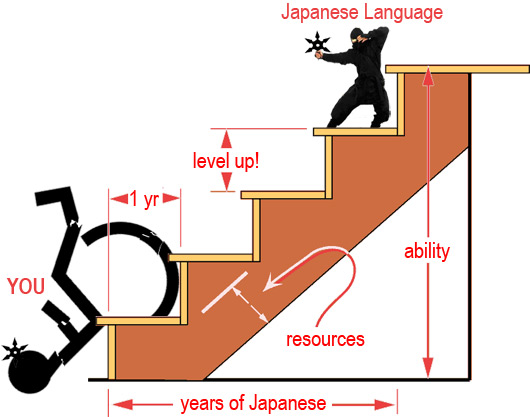
Surprisingly, learning Japanese really is like going up stairs in a wheelchair, possibly sans the ninja. I get so many emails of people asking me why their Japanese isn’t getting any better. Here’s how these emails usually go:

Hey Koichi, I’ve been studying Japanese for a few years now. I take classes, I talk with Japanese people, and I use flashcards for kanji…but I don’t feel like I’m getting any better. What am I doing wrong?

Response: You just have to keep on studying. Not “getting any better” is really normal. You’ll feel like this for a while, and then all of a sudden a bunch of things will fall right into place. You just need to keep on persevering, and then there will be a moment where everything suddenly gets better!

I don’t really delve into the details of this phenomenon via email, so I’d like to take this opportunity to tell you everything I know (which might not be that much, so all of you studying out there can help me).

Here’s my story. I started studying Japanese in high school, and spent two years stumbling through the language. After going to Japan for a year, I learned that there were, in fact, distinct steps in the Japanese learning process.

Although it is different for each person and each situation, most people feel like they are climbing stairs when learning Japanese. Here’s what might happen:

  1. You will study-study-study, and you’ll feel like you are getting nowhere. It’s okay! Keep studying and you will be fine.
  2. After a while you will feel upset at yourself for not getting any better (optional)
  3. All of a sudden, everything will fall right into place. It really will feel like you’ve “leveled-up;” like you’ve picked up a Mario Mushroom. You won’t suddenly become fluent, but there are distinct levels and feelings to each level, and each one feels like a fairly large jump.

So there you have it! When I was in Japan it felt like every two months I would suddenly make the move upwards. While studying not in Japan, those level-ups take a lot longer. Wherever you are, though, expect sudden advancement when you least expect it. You just have to persevere through the hard times and you’ll be rewarded for sure.

People who have been studying Japanese for a while: Please share your stories! Please let us know if this is true or if I’m making it all up. It definitely is true for myself and for others I know, but I’m excited to see what others have to say.

  • Kirby

    I found it a lot harder to get mushrooms while not being in the kingdom. Never tried Japanese though. Lol.

  • http://www.tofugu.com Erin

    I’M SO UPSET AT MYSELF!!!

    Oh, hang on. Everything just fell into place. Never mind D:

    P.S. Nice illustration. Very scientific.

  • Kevin

    koichi did you start studying japanese by yourself? or did they offer it at your school? ive recently started to self-teach myself, everything was fun and great when i was learning hiragna and katakana, and yes sushi was my first word :P. Then i start grammar and was like :O. I just keep going cause im starting to pick up on some videos i watch in japanese, which is rewarding enough for me to continue on. Even if its only one word :P

  • http://www.koichiben.com koichi

    I started through a high school programme

  • Kirby

    I found it a lot harder to get mushrooms while not being in the kingdom. Never tried Japanese though. Lol.

  • http://www.tofugu.com Erin

    I’M SO UPSET AT MYSELF!!!

    Oh, hang on. Everything just fell into place. Never mind D:

    P.S. Nice illustration. Very scientific.

  • http://www.vietamins.com Viet

    Apparently alcohol is my booster >.>

  • Kevin

    koichi did you start studying japanese by yourself? or did they offer it at your school? ive recently started to self-teach myself, everything was fun and great when i was learning hiragna and katakana, and yes sushi was my first word :P. Then i start grammar and was like :O. I just keep going cause im starting to pick up on some videos i watch in japanese, which is rewarding enough for me to continue on. Even if its only one word :P

  • http://www.koichiben.com koichi

    I started through a high school programme

  • http://www.punkednoodle.com/champloo khursten

    This is totally true. I’ve been studying Japanese since 2001 there abouts and it was… SELF STUDY. I studied because I wanted to read the mangas I got. And for a good two years or so, I was at least surviving on hiragana and some katakana and understanding some basic phrases like “Urusai!” or “yamete”. In essence, I was slowly building my vocab that way. Since I didn’t have to use it in a classroom, I was not obligated to remember them. I was dictionary dependent. (and not even a electronic jiten at that. ;A;)

    In college, I took formal Japanese to some extent. I got the fundamentals of the grammar and eventually figured out the right books for studying Japanese, like Minna no Nihongo etc. It was when I took these formal lessons that I finally got a better hand at things. It took me four years since then to get my sankyuu, but it was a long, worth it trip.

    Up to now, I don’t think my Japanese is at par yet. I’m trying to talk in Japanese bit by bit everyday through mixi and through Japanese friends. Like your advice, the best I can say is just try to keep using it everyday. Read Japanese websites, play japanese games, watch animes raw, read manga, expose yourself to Japanese as though you’re living in Japan. You’re bound to level up in a year or so. ^^v and you’ll be proud of yourself. The key to your success in reading Japanese is exposure. So yeah.

  • http://myspace.com/fredydb327 fredy

    Haha. Well, I studied Japanese durign the summer, learning hiragana and some kanji and a bit of katakana. I also learned some phrases and structure of the sentences and things like that. Basic things. I kind of thought I was going to be screwed and really behind in Japanese 2, since that’s what I had signed up for, hoping I’d learned enough. So I did feel like I wasn’t getting anywhere for a bit when school came. Today I get to Japanese 2 and was amazed I actually understood the teacher and the students. I acutally knew some things some of the students didn’t know. Then again, some of those kids in my Japanese class seem really bad and they don’t care. It’s likely they were placed in Japanese since they ran out of room in the other classes like Spanish. My teacher said there’s going to be basic review the first two weeks and thinks I’ll be fine. So I suppose this is a good level up. Still, I can’t stop laughing at how the class is. One half is full of the kids that love anime, I saw about three reading manga, and they care about learning. The other half is full of some kids who were making fun of the language and said they didn’t care. I was in the middle. Haha. I’m off to do the Japanese homework.

    PS: I like the graphic, but it’s kind of said that the “me” character is dead with a broken neck, arm, and legs.

  • http://www.vietamins.com Viet

    Apparently alcohol is my booster >.>

  • mohakun

    I’ve been studying Japanese for a little over a year, and so far so good. I feel like I’ve learned alot for a beginner, the keyword is beginner hehe. I remember my very first day in japanese class, all I knew was konnichiwa and arigatou. Now i can ask for things, express myself to some extent, learned ~190 kanji in 8 months, mastered hiragana and katakana. I still have alot to learn though. My reading and writing are alot stronger than my oral and listening…I still feel as though jpn ppl talk too fast. My oral could have been better, but i dont know, it’s just sometimes i dont feel confident talking in japanese, i guess i’m too shy at times, but I better man up this year, cause we’re learning alot more, and apparently our sensei loves giving oral exams :/. I just hope i can be fluent in Japanese in writing,speaking and reading!….that’ll be my 4th and last language to learn!

  • Dan

    I feel the exact same way about this. I’ve been studying for about 2.5 years now and I def. feel like I’ve hit a plateau with my conversation. However, I’ve found a few tools recently that have really helped. One is Sharedtalk.com; a great resource for language exchange. After you sign up (it’s free!) you can go in large community chatrooms or privately message people and talk to them that way. I’ve met a bunch of people through the service and now we talk on Skype occasionally. Check it out!

  • http://www.punkednoodle.com/champloo khursten

    This is totally true. I’ve been studying Japanese since 2001 there abouts and it was… SELF STUDY. I studied because I wanted to read the mangas I got. And for a good two years or so, I was at least surviving on hiragana and some katakana and understanding some basic phrases like “Urusai!” or “yamete”. In essence, I was slowly building my vocab that way. Since I didn’t have to use it in a classroom, I was not obligated to remember them. I was dictionary dependent. (and not even a electronic jiten at that. ;A;)

    In college, I took formal Japanese to some extent. I got the fundamentals of the grammar and eventually figured out the right books for studying Japanese, like Minna no Nihongo etc. It was when I took these formal lessons that I finally got a better hand at things. It took me four years since then to get my sankyuu, but it was a long, worth it trip.

    Up to now, I don’t think my Japanese is at par yet. I’m trying to talk in Japanese bit by bit everyday through mixi and through Japanese friends. Like your advice, the best I can say is just try to keep using it everyday. Read Japanese websites, play japanese games, watch animes raw, read manga, expose yourself to Japanese as though you’re living in Japan. You’re bound to level up in a year or so. ^^v and you’ll be proud of yourself. The key to your success in reading Japanese is exposure. So yeah.

  • http://alecinjapan.com Alec

    That’s exactly how it’s been in my experience; you feel crap and then you have a damn-I’m-good day and everything feels better! And then some stuff comes along which you don’t really understand and you feel crap again, hehe.

    If you’re studying, you can only be getting better!

  • http://myspace.com/fredydb327 fredy

    Haha. Well, I studied Japanese durign the summer, learning hiragana and some kanji and a bit of katakana. I also learned some phrases and structure of the sentences and things like that. Basic things. I kind of thought I was going to be screwed and really behind in Japanese 2, since that’s what I had signed up for, hoping I’d learned enough. So I did feel like I wasn’t getting anywhere for a bit when school came. Today I get to Japanese 2 and was amazed I actually understood the teacher and the students. I acutally knew some things some of the students didn’t know. Then again, some of those kids in my Japanese class seem really bad and they don’t care. It’s likely they were placed in Japanese since they ran out of room in the other classes like Spanish. My teacher said there’s going to be basic review the first two weeks and thinks I’ll be fine. So I suppose this is a good level up. Still, I can’t stop laughing at how the class is. One half is full of the kids that love anime, I saw about three reading manga, and they care about learning. The other half is full of some kids who were making fun of the language and said they didn’t care. I was in the middle. Haha. I’m off to do the Japanese homework.

    PS: I like the graphic, but it’s kind of said that the “me” character is dead with a broken neck, arm, and legs.

  • mohakun

    I’ve been studying Japanese for a little over a year, and so far so good. I feel like I’ve learned alot for a beginner, the keyword is beginner hehe. I remember my very first day in japanese class, all I knew was konnichiwa and arigatou. Now i can ask for things, express myself to some extent, learned ~190 kanji in 8 months, mastered hiragana and katakana. I still have alot to learn though. My reading and writing are alot stronger than my oral and listening…I still feel as though jpn ppl talk too fast. My oral could have been better, but i dont know, it’s just sometimes i dont feel confident talking in japanese, i guess i’m too shy at times, but I better man up this year, cause we’re learning alot more, and apparently our sensei loves giving oral exams :/. I just hope i can be fluent in Japanese in writing,speaking and reading!….that’ll be my 4th and last language to learn!

  • kdipko

    Wow..thanks everyone. All of your stories make me feel much better about starting Japanese this fall!!!

  • Dan

    I feel the exact same way about this. I’ve been studying for about 2.5 years now and I def. feel like I’ve hit a plateau with my conversation. However, I’ve found a few tools recently that have really helped. One is Sharedtalk.com; a great resource for language exchange. After you sign up (it’s free!) you can go in large community chatrooms or privately message people and talk to them that way. I’ve met a bunch of people through the service and now we talk on Skype occasionally. Check it out!

  • http://alecinjapan.com Alec

    That’s exactly how it’s been in my experience; you feel crap and then you have a damn-I’m-good day and everything feels better! And then some stuff comes along which you don’t really understand and you feel crap again, hehe.

    If you’re studying, you can only be getting better!

  • http://www.tendy.org Tendrax

    I noticed this the other day myself, I’ve been studying on my own for a few months now, and I haven’t made to much progress, then the other day I was attempting to read soemthing in hirigana, with my usual method of trying to read, then double checking myself with my dictionary, and it was just like, BAM, I read it and understood it without trying, it was really awesome and felt great. Like you said, feels like a level up.

  • kdipko

    Wow..thanks everyone. All of your stories make me feel much better about starting Japanese this fall!!!

  • Mathias

    The illustration is awesome!

  • Mathias

    The illustration is awesome!

    As I’m on one of the very lower steps of the Japanese stairway i can’t say too much i guess.
    But to me learning hiragana, katakana and the grammar (so far) of Japanese was the easy part.

    What really troubles me are all the homophones and homonymes of Japanese, and of course all those Kanji.

    Regarding the homophony problem take a look at the following quote from http://www.kanji.org/cjk/reference/japhom.htm:

    [----------- QUOTE -------------------------------------------------------------------------------]

    Here is an example of how complex the problem is. Let us say take the phrase Hi no sasanai yashiki (A Mansion with no Sunshine), which could be the name of a novel or a film. Here are twelve legitimate ways (some more likely than others) of how to write this.

    1. 日の差さない屋敷
    2. 日の射さない屋敷
    3. 日のささない屋敷
    4. 日の射さない邸
    5. 日の差さない邸
    6. 日のささない邸
    7. 陽の射さない屋敷
    8. 陽の差さない屋敷
    9. 陽のささない屋敷
    10. 陽の射さない邸
    11. 陽の差さない邸
    12. 陽のささない邸

    We did a survey on six native Japanese speakers, some of whom are professional translators and writers, asking them how they would write the above phrase. Surprisingly, we received six different answers, none of which matched the “standard” form found in dictionaries (#1 above). Clearly, even native speakers of Japanese cannot possibly be expected to know which specific variant is used in the official title.

    [----------- END OF QUOTE ------------------------------------------------------------------------]

  • http://www.tendy.org Tendrax

    I noticed this the other day myself, I’ve been studying on my own for a few months now, and I haven’t made to much progress, then the other day I was attempting to read soemthing in hirigana, with my usual method of trying to read, then double checking myself with my dictionary, and it was just like, BAM, I read it and understood it without trying, it was really awesome and felt great. Like you said, feels like a level up.

  • Mathias

    The illustration is awesome!

  • Mathias

    The illustration is awesome!

    As I’m on one of the very lower steps of the Japanese stairway i can’t say too much i guess.
    But to me learning hiragana, katakana and the grammar (so far) of Japanese was the easy part.

    What really troubles me are all the homophones and homonymes of Japanese, and of course all those Kanji.

    Regarding the homophony problem take a look at the following quote from http://www.kanji.org/cjk/reference/japhom.htm:

    [----------- QUOTE -------------------------------------------------------------------------------]

    Here is an example of how complex the problem is. Let us say take the phrase Hi no sasanai yashiki (A Mansion with no Sunshine), which could be the name of a novel or a film. Here are twelve legitimate ways (some more likely than others) of how to write this.

    1. 日の差さない屋敷
    2. 日の射さない屋敷
    3. 日のささない屋敷
    4. 日の射さない邸
    5. 日の差さない邸
    6. 日のささない邸
    7. 陽の射さない屋敷
    8. 陽の差さない屋敷
    9. 陽のささない屋敷
    10. 陽の射さない邸
    11. 陽の差さない邸
    12. 陽のささない邸

    We did a survey on six native Japanese speakers, some of whom are professional translators and writers, asking them how they would write the above phrase. Surprisingly, we received six different answers, none of which matched the “standard” form found in dictionaries (#1 above). Clearly, even native speakers of Japanese cannot possibly be expected to know which specific variant is used in the official title.

    [----------- END OF QUOTE ------------------------------------------------------------------------]

  • Gaijin

    The level up thing really makes sense, learning Japanese is practically like playing Super Mario – when you find the little green mushroom (whatever now that could be IRL) you get leveled up.
    Leveling up gives you just the right amount of power for you to continue studying without shouting 「死ね〜」 all over the place.

    I’ve only studied for about a year and a half, but it’s been going damn well this far.

  • Gaijin

    The level up thing really makes sense, learning Japanese is practically like playing Super Mario – when you find the little green mushroom (whatever now that could be IRL) you get leveled up.
    Leveling up gives you just the right amount of power for you to continue studying without shouting 「死ね〜」 all over the place.

    I’ve only studied for about a year and a half, but it’s been going damn well this far.

  • Onimusha Nosferatu

    i’ve been studying for about a year and am practically conversant. my biggest limitation is lack of vocabulary. japanglish doesn’t work all the time. haha. speaking, writing, and talking outside of class helped a lot even though it pissed my friends off. a tip i think would help ppl studying would be to talk to a japanese person. most japanese ppl i meet are more than happy to help. in general being exposed to the language almost 24/7 greatly improves comprehension. i think it’s pointless to only use japanese while in a class like a lot of ppl in my class. the class can only teach you so much before you have to put in real effort. motivation is key to becoming fluent. seriously think why you are learning japanese. ( i will forever think learning japanese to pick up japanese girls is the dumbest reason ever.) i think plateau-ing will happen, but like koichi said don’t give up and keep studying and you will level up.

  • Daniel

    I’ve only studied for about two months. I don’t really have much time for learning the language, I’m busy with school and my family.

    Maybe on the weekends I’ll start learning again.

  • Onimusha Nosferatu

    i’ve been studying for about a year and am practically conversant. my biggest limitation is lack of vocabulary. japanglish doesn’t work all the time. haha. speaking, writing, and talking outside of class helped a lot even though it pissed my friends off. a tip i think would help ppl studying would be to talk to a japanese person. most japanese ppl i meet are more than happy to help. in general being exposed to the language almost 24/7 greatly improves comprehension. i think it’s pointless to only use japanese while in a class like a lot of ppl in my class. the class can only teach you so much before you have to put in real effort. motivation is key to becoming fluent. seriously think why you are learning japanese. ( i will forever think learning japanese to pick up japanese girls is the dumbest reason ever.) i think plateau-ing will happen, but like koichi said don’t give up and keep studying and you will level up.

  • Daniel

    I’ve only studied for about two months. I don’t really have much time for learning the language, I’m busy with school and my family.

    Maybe on the weekends I’ll start learning again.

  • http://sspeckcomcast.net Stephen Speck

    I find the biggest hurdle is getting over one’s fear of making a mistake and embarrassing themselves in another language. I feel I’ve overcome that hurdle, and my Japanese is better for it.

  • JohtoKen

    My strategy of implying Japanese after a few years.

    1) Go to places with Japanese speakers and talk to them. I will sometimes avoid those who wish for only fluents to speak to them.

    And the crap part.

    2) Order a copy of Sgt. Frog when it comes out in America. Play it in Japanese. TURN OFF SUBTITLES. See if I can understand what the crap they’re saying. If I give up, I can always watch the episodes in English.

  • aliene

    Nope, you’re not making this up (though the illustration was a touch of genius).

    I’ve been studying in classes on and off, and kinda studying it on my own for TEN YEARS now.

    And, I’m currently officially qualified only at JLPT3.

    What does that say? The learning curve is very different when you’re in a proper class or not, when your self-studying, when you’re living in a Japanese environment or not. But wait. I digressed. I felt that long void of not having improved for the longest time (probably because I stopped classes) but after going back to classes for 1 year now, I can really feel the “level-uppedness”. Serious.

  • http://sspeckcomcast.net Stephen Speck

    I find the biggest hurdle is getting over one’s fear of making a mistake and embarrassing themselves in another language. I feel I’ve overcome that hurdle, and my Japanese is better for it.

  • JohtoKen

    My strategy of implying Japanese after a few years.

    1) Go to places with Japanese speakers and talk to them. I will sometimes avoid those who wish for only fluents to speak to them.

    And the crap part.

    2) Order a copy of Sgt. Frog when it comes out in America. Play it in Japanese. TURN OFF SUBTITLES. See if I can understand what the crap they’re saying. If I give up, I can always watch the episodes in English.

  • aliene

    Nope, you’re not making this up (though the illustration was a touch of genius).

    I’ve been studying in classes on and off, and kinda studying it on my own for TEN YEARS now.

    And, I’m currently officially qualified only at JLPT3.

    What does that say? The learning curve is very different when you’re in a proper class or not, when your self-studying, when you’re living in a Japanese environment or not. But wait. I digressed. I felt that long void of not having improved for the longest time (probably because I stopped classes) but after going back to classes for 1 year now, I can really feel the “level-uppedness”. Serious.

  • Immelmann

    I’m sorry, but.. I’m gonna have to disagree, and I’m saying this as someone who has some amount of experience with languages. I hope that I don’t come off as arrogant in this message; I just want to help other people avoid the mistakes I made (especially when studying French in high school).

    There’s several ways to learn a language. The languages we usually learn first are the one(s) spoken to us in our home, and the one we’re taught in at school. In my case, these are Russian and English (I don’t actually speak this formally; I just want to make my posts as easy as possible to digest), and, as far as I’m concerned, were acquired effortlessly, through immersion combined with study. Another language I picked up as a child (through immersion) is Hebrew, which I can only understand and speak (but not read or write); however, as you begin thinking in the languages you’re most fluent in, it becomes harder to learn new ones through immersion alone, because your thinking will interfere with the learning process.<!–more–>

    By the age this happens, chances are a second language will have been introduced to you at school. (I don’t think this applies to Americans as much as it does to Europeans; if I’m not mistaken, most American schools only teach 2 years of German or French in school) This is where things start going sour! Most school programmes rely heavily on drills remeniscent of those you might see in the military, hardcore memorisation, and other methods that leave many absolutely sure that they simply have no talent for learning languages by the time they enter College/University. I learned French this way, largely due to my efforts outside of class, and while I could read French literature by the end of school, it took me a whole 6 years to get that far, and my oral skills were (and still are) lagging.

    Now, you might be wondering to yourself: I’ve mentioned some of what I don’t like about School Language Programmes, but I haven’t really presented any sort of alternative! Well, have no fear. The first mistake made by most people is that they don’t attempt to get “a feel” for their target language. Think about yourself: you could probably write with few mistakes in your first language, even without knowing or thinking about sentence structures, grammatical rules, etc. To improve this subconscious knowledge of your target language, try to integrate it into your life whenever you can. Watch TV, read news, keep a diary, and, best of all, try to think in your target language whenever possible. *Of course, to get to the point where you can do this, you’ll need to know some vocabulary, sentence structures, grammar, etc!

    *There’s an audio-only programme out there, called Pimsleur’s Japanese if I’m not mistaken. It’s a collection of 90 lessons, sold in boxes of 30, with each box being priced at about 200$. I found these lessons to be priceless when I just started learning, and re-sold them after ripping all the lessons to MP3 format, but I recognise that this may be out of bounds for some of us.

    So, now we finally get to what in my opinion is the most important section of what’s turned into a long-winded essay! How do you memorise those frickin kanji and Japanese words? Of course, most of us believe that we need to use repition – writing and rewriting, flash cards, etc etc etc.. Well, I for one, hate studying like that! What I’m about to say will sound like one of those “Penis Enlargement” scams you’ll find in your junk mail, but I really did chance upon a programme which completely revolutionised my approach to studying Kanji, in Japanese as well as Mandarin. It’s hard to explain how it works, so I’ll start with an example: when I first saw the word 買います, here’s how I memorised the kanji: “I saw a shellfish, which I then proceeded to buy.” The radicals used in the kanji for “Buy” are “eye” and “shellfish,” top to bottom in that order, so now I have no problems remembering the kanji and it’s meaning! It sounds kinda silly, but it works.. oh, it works! And that is how Heisig’s method deals with every kanji.

    The best thing is, after you figure out how he does it in his book, you can do it yourself! Why is this so fantastic? Because, under this paragraph is a link to a free sample of Heisig’s “Remembering the Kanji:” while I would encourage everyone to buy the book, I once again recognise that not everyone can/wants to/will do so, so I would at least urge you to check out his sample so you can start memorising your Kanji this way. I don’t know if it will work for everyone, but after starting with Heisig’s method, I memorise about 25 kanji every day. To keep things simple, Remembering the Kanji only gives you the english word for the every kanji. I never realised this might’ve been part of the problem, but only having to memorise a kanji and the word for it in English – as opposed to Kanji, on/kun readings, as well as English meaning – has made me a lot less confused. As I know a lot of the words already (just without the Kanji), I can often start integrating what I learned into my Japanese exercises. Anyway, enough about Heisig’s method: now go and check it out. It’s free:

    http://www.nanzan-u.ac.jp/SHUBUNKEN/publication

    There’s also a bunch of sites which will help you revisit kanji in a way that is consistent with this method.

    And, for my final paragraph, I’ll talk about memorising words! When I was learning French, I just learned new words by using them over, and over, and over, and over again (painful memories). Now, however, I’m more grown up, smarter, and just don’t have the time anymore, so, I use associative memorisation, as well as various hooks to help me remember. For instance, when I was memorising the word for “boring” – tsumaranai – I pictured me sitting at a table with a bunch of people I thought were real boring, and the word “tsumaranai” being repeated in the background. For the verb “to smoke,” or suwanai, (I memorise verbs in their “nai” form so I can tell whether they’re type 1 or type 2 and then conjugate them to whichever form I need), I imagined a smoking person inhaling the smoke with a hissing “ssuuu”, and then releasing it with a puffy “wa.” I can memorise about 20-30 words this way, with about 80-90% retention when I test myself the next day, and near complete retention if I revisit the words I learned for 5 minutes every day. All in all, I spend about an hour between kanji and new vocabulary each day, and 10-15 minutes on repeating what I learned before. Like I already explained, I learn about 25 kanji and 25 new words every day. However, sentence structures, grammar, and “getting a feel” for the target language – Japanese, in my case – is even more important than these things, so memorisation is my second priority, and trying to bring Japanese into my daily life whenever possible is priority number one for me. All in all, I really wish I knew all of this when I was studying French, because I could’ve gone twice as far in the time I had!<!–more–>

  • angela

    i started studying japanese in year 8 and im in year 12 now.
    yeah well for the first 3.5 years i felt like i was wasting my time. you know – just learning random words and not really making sense of it all.
    but in year 11, 12, it ‘fell into place’. i started tutoring, learning all those structures, phrases etc and once i reached that ‘level’, i felt really encouraged to keep on learning.
    whether it be watching japanese vlogs, or watching drama.. making japanese friends
    and then practising japanese dialogue– i really felt i was grasping the language after
    overcoming that first ‘step’ and so i agree with koichi

  • Immelmann

    I’m sorry, but.. I’m gonna have to disagree, and I’m saying this as someone who has some amount of experience with languages. I hope that I don’t come off as arrogant in this message; I just want to help other people avoid the mistakes I made (especially when studying French in high school).

    There’s several ways to learn a language. The languages we usually learn first are the one(s) spoken to us in our home, and the one we’re taught in at school. In my case, these are Russian and English (I don’t actually speak this formally; I just want to make my posts as easy as possible to digest), and, as far as I’m concerned, were acquired effortlessly, through immersion combined with study. Another language I picked up as a child (through immersion) is Hebrew, which I can only understand and speak (but not read or write); however, as you begin thinking in the languages you’re most fluent in, it becomes harder to learn new ones through immersion alone, because your thinking will interfere with the learning process.

    By the age this happens, chances are a second language will have been introduced to you at school. (I don’t think this applies to Americans as much as it does to Europeans; if I’m not mistaken, most American schools only teach 2 years of German or French in school) This is where things start going sour! Most school programmes rely heavily on drills remeniscent of those you might see in the military, hardcore memorisation, and other methods that leave many absolutely sure that they simply have no talent for learning languages by the time they enter College/University. I learned French this way, largely due to my efforts outside of class, and while I could read French literature by the end of school, it took me a whole 6 years to get that far, and my oral skills were (and still are) lagging.

    Now, you might be wondering to yourself: I’ve mentioned some of what I don’t like about School Language Programmes, but I haven’t really presented any sort of alternative! Well, have no fear. The first mistake made by most people is that they don’t attempt to get “a feel” for their target language. Think about yourself: you could probably write with few mistakes in your first language, even without knowing or thinking about sentence structures, grammatical rules, etc. To improve this subconscious knowledge of your target language, try to integrate it into your life whenever you can. Watch TV, read news, keep a diary, and, best of all, try to think in your target language whenever possible. *Of course, to get to the point where you can do this, you’ll need to know some vocabulary, sentence structures, grammar, etc!

    *There’s an audio-only programme out there, called Pimsleur’s Japanese if I’m not mistaken. It’s a collection of 90 lessons, sold in boxes of 30, with each box being priced at about 200$. I found these lessons to be priceless when I just started learning, and re-sold them after ripping all the lessons to MP3 format, but I recognise that this may be out of bounds for some of us.

    So, now we finally get to what in my opinion is the most important section of what’s turned into a long-winded essay! How do you memorise those frickin kanji and Japanese words? Of course, most of us believe that we need to use repition – writing and rewriting, flash cards, etc etc etc.. Well, I for one, hate studying like that! What I’m about to say will sound like one of those “Penis Enlargement” scams you’ll find in your junk mail, but I really did chance upon a programme which completely revolutionised my approach to studying Kanji, in Japanese as well as Mandarin. It’s hard to explain how it works, so I’ll start with an example: when I first saw the word 買います, here’s how I memorised the kanji: “I saw a shellfish, which I then proceeded to buy.” The radicals used in the kanji for “Buy” are “eye” and “shellfish,” top to bottom in that order, so now I have no problems remembering the kanji and it’s meaning! It sounds kinda silly, but it works.. oh, it works! And that is how Heisig’s method deals with every kanji.

    The best thing is, after you figure out how he does it in his book, you can do it yourself! Why is this so fantastic? Because, under this paragraph is a link to a free sample of Heisig’s “Remembering the Kanji:” while I would encourage everyone to buy the book, I once again recognise that not everyone can/wants to/will do so, so I would at least urge you to check out his sample so you can start memorising your Kanji this way. I don’t know if it will work for everyone, but after starting with Heisig’s method, I memorise about 25 kanji every day. To keep things simple, Remembering the Kanji only gives you the english word for the every kanji. I never realised this might’ve been part of the problem, but only having to memorise a kanji and the word for it in English – as opposed to Kanji, on/kun readings, as well as English meaning – has made me a lot less confused. As I know a lot of the words already (just without the Kanji), I can often start integrating what I learned into my Japanese exercises. Anyway, enough about Heisig’s method: now go and check it out. It’s free:

    http://www.nanzan-u.ac.jp/SHUBUNKEN/publications/miscPublications/pdf/RK4/RK%201_sample.pdf

    There’s also a bunch of sites which will help you revisit kanji in a way that is consistent with this method.

    And, for my final paragraph, I’ll talk about memorising words! When I was learning French, I just learned new words by using them over, and over, and over, and over again (painful memories). Now, however, I’m more grown up, smarter, and just don’t have the time anymore, so, I use associative memorisation, as well as various hooks to help me remember. For instance, when I was memorising the word for “boring” – tsumaranai – I pictured me sitting at a table with a bunch of people I thought were real boring, and the word “tsumaranai” being repeated in the background. For the verb “to smoke,” or suwanai, (I memorise verbs in their “nai” form so I can tell whether they’re type 1 or type 2 and then conjugate them to whichever form I need), I imagined a smoking person inhaling the smoke with a hissing “ssuuu”, and then releasing it with a puffy “wa.” I can memorise about 20-30 words this way, with about 80-90% retention when I test myself the next day, and near complete retention if I revisit the words I learned for 5 minutes every day. All in all, I spend about an hour between kanji and new vocabulary each day, and 10-15 minutes on repeating what I learned before. Like I already explained, I learn about 25 kanji and 25 new words every day. However, sentence structures, grammar, and “getting a feel” for the target language – Japanese, in my case – is even more important than these things, so memorisation is my second priority, and trying to bring Japanese into my daily life whenever possible is priority number one for me. All in all, I really wish I knew all of this when I was studying French, because I could’ve gone twice as far in the time I had!

  • Jonathan

    I’m a pianist, and “falling right into place” happens (to those doubting your Japanese).
    What I mean by that is, when I start a new piece, and practice it for a while, it feels like I’ll never progress in that piano piece. But then all of a sudden, I’ll start playing it and I have no trouble doing it.
    Let’s just hope its the same for me when I start to learn Japanese lol.

  • angela

    i started studying japanese in year 8 and im in year 12 now.
    yeah well for the first 3.5 years i felt like i was wasting my time. you know – just learning random words and not really making sense of it all.
    but in year 11, 12, it ‘fell into place’. i started tutoring, learning all those structures, phrases etc and once i reached that ‘level’, i felt really encouraged to keep on learning.
    whether it be watching japanese vlogs, or watching drama.. making japanese friends
    and then practising japanese dialogue– i really felt i was grasping the language after
    overcoming that first ‘step’ and so i agree with koichi

  • Jonathan

    I’m a pianist, and “falling right into place” happens (to those doubting your Japanese).
    What I mean by that is, when I start a new piece, and practice it for a while, it feels like I’ll never progress in that piano piece. But then all of a sudden, I’ll start playing it and I have no trouble doing it.
    Let’s just hope its the same for me when I start to learn Japanese lol.

  • Mathias

    Wow, Immelmann, pretty long comment. :)

    Your approach to learning new words / kanji is very interesting.
    In fact I just started using a Kanji trainer program that
    uses a similar approach.

    You start with a grid of 16 kanjis on your screen. On the bottom
    there is a phrase, an association like “A man who hoicks his arms because he burns.” Based on that association you look for a Kanji that fits and select it (in this case that would be 火), if you clicked the right one, it is locked in. After that you have to pick the translation from a set of 16 possible words / phrases on the right, in that case “fire”.

    Through the association both meaning and kanji are linked together.
    So it’s only the usual approach of X means Y, but there is a logical link.
    That way I learned these 16 kanji effortlessly in one day.

    So remembering words with help of mental images, methaphors, pictures or just any kind of association vastly accelerates the learning process.

  • Mathias

    Wow, Immelmann, pretty long comment. :)

    Your approach to learning new words / kanji is very interesting.
    In fact I just started using a Kanji trainer program that
    uses a similar approach.

    You start with a grid of 16 kanjis on your screen. On the bottom
    there is a phrase, an association like “A man who hoicks his arms because he burns.” Based on that association you look for a Kanji that fits and select it (in this case that would be 火), if you clicked the right one, it is locked in. After that you have to pick the translation from a set of 16 possible words / phrases on the right, in that case “fire”.

    Through the association both meaning and kanji are linked together.
    So it’s only the usual approach of X means Y, but there is a logical link.
    That way I learned these 16 kanji effortlessly in one day.

    So remembering words with help of mental images, methaphors, pictures or just any kind of association vastly accelerates the learning process.

  • Immelmann

    Thanks, Mathias.. I hadn’t meant to write this much, but I figure that if at least one person benefits from my post, my time will have been worth it.

    The method you mentioned sounds pretty similar to Heisig’s! Unfortunately, I use Mac OS most of the time, and even though I have Windows I hate rebooting to use it, so I don’t use software like that too often. The program does sound very good, though! And congrats on learning that many kanji in one sitting. At this rate, you can learn the Joyo kanji in one year! Even if you take it easy and only learn 10 kanji a day, you’ll still be done with the bare minimum in 200 days, which will leave you another 165 days to link the kanji to their various readings. Good luck to both of us :)

  • Immelmann

    Thanks, Mathias.. I hadn’t meant to write this much, but I figure that if at least one person benefits from my post, my time will have been worth it.

    The method you mentioned sounds pretty similar to Heisig’s! Unfortunately, I use Mac OS most of the time, and even though I have Windows I hate rebooting to use it, so I don’t use software like that too often. The program does sound very good, though! And congrats on learning that many kanji in one sitting. At this rate, you can learn the Joyo kanji in one year! Even if you take it easy and only learn 10 kanji a day, you’ll still be done with the bare minimum in 200 days, which will leave you another 165 days to link the kanji to their various readings. Good luck to both of us :)