Beginning Japanese III: Taking Steps

Learning Japanese

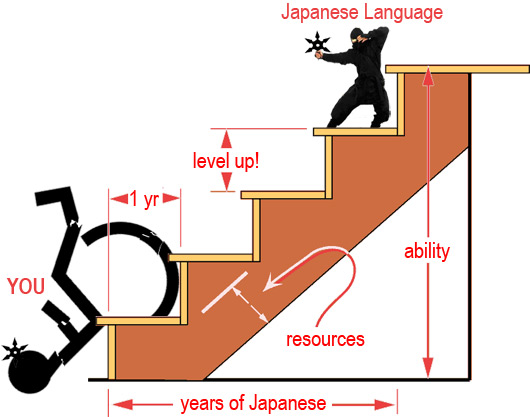
Surprisingly, learning Japanese really is like going up stairs in a wheelchair, possibly sans the ninja. I get so many emails of people asking me why their Japanese isn’t getting any better. Here’s how these emails usually go:

Hey Koichi, I’ve been studying Japanese for a few years now. I take classes, I talk with Japanese people, and I use flashcards for kanji…but I don’t feel like I’m getting any better. What am I doing wrong?

Response: You just have to keep on studying. Not “getting any better” is really normal. You’ll feel like this for a while, and then all of a sudden a bunch of things will fall right into place. You just need to keep on persevering, and then there will be a moment where everything suddenly gets better!

I don’t really delve into the details of this phenomenon via email, so I’d like to take this opportunity to tell you everything I know (which might not be that much, so all of you studying out there can help me).

Here’s my story. I started studying Japanese in high school, and spent two years stumbling through the language. After going to Japan for a year, I learned that there were, in fact, distinct steps in the Japanese learning process.

Although it is different for each person and each situation, most people feel like they are climbing stairs when learning Japanese. Here’s what might happen:

  1. You will study-study-study, and you’ll feel like you are getting nowhere. It’s okay! Keep studying and you will be fine.
  2. After a while you will feel upset at yourself for not getting any better (optional)
  3. All of a sudden, everything will fall right into place. It really will feel like you’ve “leveled-up;” like you’ve picked up a Mario Mushroom. You won’t suddenly become fluent, but there are distinct levels and feelings to each level, and each one feels like a fairly large jump.

So there you have it! When I was in Japan it felt like every two months I would suddenly make the move upwards. While studying not in Japan, those level-ups take a lot longer. Wherever you are, though, expect sudden advancement when you least expect it. You just have to persevere through the hard times and you’ll be rewarded for sure.

People who have been studying Japanese for a while: Please share your stories! Please let us know if this is true or if I’m making it all up. It definitely is true for myself and for others I know, but I’m excited to see what others have to say.

  • http://100tipstrickstomasterjapanese.wordpress.com/ Nigel

    Just wanted to leave my two bits — as a lot of people have said, the pattern of improvement-frustration-improvement is definitely the case for language learning. I’ve often wondered why. I find that often when I’m studying Japanese the hardest my ability actually seems to go *down* a bit. I think that our minds need some time to integrate new knowledge and that, in fact, that integration takes energy too. Perhaps that’s why there’s that time-lag between the work and the improvement; there’s an invisible stage we all go through where it all sinks in. If that’s the case then that feeling of “magical” improvement is just the slightly delayed result of hard work.

  • http://100tipstrickstomasterjapanese.wordpress.com/ Nigel

    Just wanted to leave my two bits — as a lot of people have said, the pattern of improvement-frustration-improvement is definitely the case for language learning. I’ve often wondered why. I find that often when I’m studying Japanese the hardest my ability actually seems to go *down* a bit. I think that our minds need some time to integrate new knowledge and that, in fact, that integration takes energy too. Perhaps that’s why there’s that time-lag between the work and the improvement; there’s an invisible stage we all go through where it all sinks in. If that’s the case then that feeling of “magical” improvement is just the slightly delayed result of hard work.

  • Ryan

    hey mathias can you link the program by any chance?

  • Ryan

    hey mathias can you link the program by any chance?

  • http://www.kimpix.net Kim Ruben

    Seems the most of you have an upper advantage though; Japanese Classes/Courses.

    Unfortunately in this northern abandoned part of Norway there’s no such thing.
    Another problem is I don’t have any education so most of those programs, if there were any available, I would not be eligible for them. The last 6 months I’ve been contacting different schools in both Norway and Japan, as well as the friggin’ Embassy of Japan over here :) Trying to figure out what my chances are to actually move to Japan to learn the language and then see where that might take me. However the information received has been sparse and I feel kinda lost in the dark not knowing who to talk to/contact now… I would think though if I manage to find some “cheap” international Japanese Language School in Japan the State Educational Loan Fund might chip in and thar be hope!

    Anyways… Self-studdy isn’t impossible I guess but I imagine it takes way longer than actually being around Japanese/Japanese speaking people like you say and especially taking a class where you have a plan to follow. Figuring out what books to get for self-study is pretty hard (and expensive) since each one has their own learning style and recommendations rarerly help then unfortunately.

    Blargh, enough self-pity… Loving the site and your vids, Koichi, keep on keepin’ on!

  • http://www.kimpix.net Kim Ruben

    Seems the most of you have an upper advantage though; Japanese Classes/Courses.

    Unfortunately in this northern abandoned part of Norway there’s no such thing.
    Another problem is I don’t have any education so most of those programs, if there were any available, I would not be eligible for them. The last 6 months I’ve been contacting different schools in both Norway and Japan, as well as the friggin’ Embassy of Japan over here :) Trying to figure out what my chances are to actually move to Japan to learn the language and then see where that might take me. However the information received has been sparse and I feel kinda lost in the dark not knowing who to talk to/contact now… I would think though if I manage to find some “cheap” international Japanese Language School in Japan the State Educational Loan Fund might chip in and thar be hope!

    Anyways… Self-studdy isn’t impossible I guess but I imagine it takes way longer than actually being around Japanese/Japanese speaking people like you say and especially taking a class where you have a plan to follow. Figuring out what books to get for self-study is pretty hard (and expensive) since each one has their own learning style and recommendations rarerly help then unfortunately.

    Blargh, enough self-pity… Loving the site and your vids, Koichi, keep on keepin’ on!

  • ~Crow

    @ Kim Ruben: [In Norwegian]
    UiO har et språkkurs for japansk, om du er interessert. Selvsagt, om du bor i fuckings Finnmark eller på Svalbard skjønner jeg at du er frustrert. Google “talk now japanese” for språkkurs til PC/Mac. De finnes i mange forskjellige nivåer, så det går an å komme ganske langt på bare det. Om du i tillegg laster ned Skype, og henger på steder som dette (samtidig som du får adressene til folk) kan du komme enda lenger, nesten gratis..

    [In English]
    University of Oslo has a Japanese course, if youre interested. Of course, if you live in fucking Finnmark (way way north) or on Svalbard (…Its an island… In the ocean…), I understand your frustration. Google “talk now Japanese” for language trainers for PC/Mac. They’re available in many different levels, so you can get pretty far on them alone. If you also download Skype, and hang around places like this (while getting the adresses of people) you can go even further, almost for free..

    I only know a few scattered words in Japanese, as I’ve only picked up a few things via anime and hentai, surprisingly. BUT! I intend on going there for education later on, be it on my own, or with some course, i dont know.

    Step thingie sounds plausible, and i adore the illustration with the ninja illustrating japanese, killing the student with a grammar shuriken of 運命.

  • ~Crow

    @ Kim Ruben: [In Norwegian]
    UiO har et språkkurs for japansk, om du er interessert. Selvsagt, om du bor i fuckings Finnmark eller på Svalbard skjønner jeg at du er frustrert. Google “talk now japanese” for språkkurs til PC/Mac. De finnes i mange forskjellige nivåer, så det går an å komme ganske langt på bare det. Om du i tillegg laster ned Skype, og henger på steder som dette (samtidig som du får adressene til folk) kan du komme enda lenger, nesten gratis..

    [In English]
    University of Oslo has a Japanese course, if youre interested. Of course, if you live in fucking Finnmark (way way north) or on Svalbard (…Its an island… In the ocean…), I understand your frustration. Google “talk now Japanese” for language trainers for PC/Mac. They’re available in many different levels, so you can get pretty far on them alone. If you also download Skype, and hang around places like this (while getting the adresses of people) you can go even further, almost for free..

    I only know a few scattered words in Japanese, as I’ve only picked up a few things via anime and hentai, surprisingly. BUT! I intend on going there for education later on, be it on my own, or with some course, i dont know.

    Step thingie sounds plausible, and i adore the illustration with the ninja illustrating japanese, killing the student with a grammar shuriken of 運命.

  • http://www.kimpix.net Kim Ruben

    Åh, bare språkkurs alene? Høres jo greit ut, men så er jeg litt skeptisk til sånt (her i Norge) siden man ikke får brukt det så mye ellers, om man ikke såklart, som du nevner, ordner seg en god del japansktalende kontakter via Skype eller noe lignende. Skal sjekke ut det programmet selv om jeg har hatt litt dårlig erfaring med slikt tidligere. Takker for tipsene. Thanks. ありがとうございます

  • http://www.kimpix.net Kim Ruben

    Åh, bare språkkurs alene? Høres jo greit ut, men så er jeg litt skeptisk til sånt (her i Norge) siden man ikke får brukt det så mye ellers, om man ikke såklart, som du nevner, ordner seg en god del japansktalende kontakter via Skype eller noe lignende. Skal sjekke ut det programmet selv om jeg har hatt litt dårlig erfaring med slikt tidligere. Takker for tipsene. Thanks. ありがとうございます

  • http://www.youtube.com/profile?user=intense7 Aaron

    I’m going to go against the grain here and disagree with you. For me, there was no point in time where I noticed a substantial increase in ability. It’s been much more consistent and gradual. The way I learn Japanese doesn’t even make sense to myself. I don’t really have a particular method or style of remembering things. No association, not huge repetition saga’s, no massive study sessions. I used to try these things but they are really inefficient time wise. Now I’ve just given up and decided to just learn things on instinct. Which I believe is the best way to learn any language because think of the way you use your first language.
    Do you first construct the sentence in your head? Do you look for associated items to help you remember words? No, you just say it because it’s instinct and you know what to do from habit. You’re so familiar with things you don’t even need to think in order to construct sentences.
    I once asked an international student from Laos how he learned the English language and whether he thought about what he was going to say in his first language first then translate it or just say it right out in English. He said originally he’d translate it, but after a while he went straight to English.
    I don’t know if any of this will make sense to you but immersion is the best way to learn a language. If you don’t have an environment to throw yourself into, just use the language at every opportunity you get. Stop thinking in English and start to think in Japanese, it helps you turn things that you used to have to track down from your memory into readily available words and phrases that can be used on instinct.

  • http://www.youtube.com/profile?user=intense7 Aaron

    I’m going to go against the grain here and disagree with you. For me, there was no point in time where I noticed a substantial increase in ability. It’s been much more consistent and gradual. The way I learn Japanese doesn’t even make sense to myself. I don’t really have a particular method or style of remembering things. No association, not huge repetition saga’s, no massive study sessions. I used to try these things but they are really inefficient time wise. Now I’ve just given up and decided to just learn things on instinct. Which I believe is the best way to learn any language because think of the way you use your first language.
    Do you first construct the sentence in your head? Do you look for associated items to help you remember words? No, you just say it because it’s instinct and you know what to do from habit. You’re so familiar with things you don’t even need to think in order to construct sentences.
    I once asked an international student from Laos how he learned the English language and whether he thought about what he was going to say in his first language first then translate it or just say it right out in English. He said originally he’d translate it, but after a while he went straight to English.
    I don’t know if any of this will make sense to you but immersion is the best way to learn a language. If you don’t have an environment to throw yourself into, just use the language at every opportunity you get. Stop thinking in English and start to think in Japanese, it helps you turn things that you used to have to track down from your memory into readily available words and phrases that can be used on instinct.

  • http://www.freewebs.com/wowphoenixextreme Tim

    omg some off you guyx are really lucky that you learn jap at school i need to learn it with own strength, btw anybody has a good succetion how and where i must learn jap on the web offcourse well that would be a great help, btw i want to learn jap because i’m going to study there in 2012-13 hehe so it’ll be handy if i could learn much in these years ^^ all help is welcome!:D

  • http://www.tofugu.com Erin

    Tim:

    I’m glad you’re going to go study Japanese in a few years! It’ll be a great experience, A little word of advice, though: the term “jap” is pretty politically incorrect, and I would strongly advise you not to use it.

  • http://www.freewebs.com/wowphoenixextreme Tim

    omg some off you guyx are really lucky that you learn jap at school i need to learn it with own strength, btw anybody has a good succetion how and where i must learn jap on the web offcourse well that would be a great help, btw i want to learn jap because i’m going to study there in 2012-13 hehe so it’ll be handy if i could learn much in these years ^^ all help is welcome!:D

  • http://www.tofugu.com Erin

    Tim:

    I’m glad you’re going to go study Japanese in a few years! It’ll be a great experience, A little word of advice, though: the term “jap” is pretty politically incorrect, and I would strongly advise you not to use it.

  • Kelly

    I’ve only just begun learning Japanese. Unfortunately, I can’t take Japanese lessons, because they’re too expensive. The ‘only’ languages we can (and have to) learn at school are English, French, German, Dutch (I live in the Netherlands), and if you’re on a really high level when it comes to school, Latin and Greek.
    I’m trying to learn Japanese from a CD, but it’s not really working. And I can’t find a (free) way to learn the Japanese ‘alfabets’.
    I agree about your theory.
    It was the same for me learning English.
    Not getting anywhere, and then, all of a sudden, another leap forward.

  • Kelly

    I’ve only just begun learning Japanese. Unfortunately, I can’t take Japanese lessons, because they’re too expensive. The ‘only’ languages we can (and have to) learn at school are English, French, German, Dutch (I live in the Netherlands), and if you’re on a really high level when it comes to school, Latin and Greek.
    I’m trying to learn Japanese from a CD, but it’s not really working. And I can’t find a (free) way to learn the Japanese ‘alfabets’.
    I agree about your theory.
    It was the same for me learning English.
    Not getting anywhere, and then, all of a sudden, another leap forward.

  • Ben

    Kelly,

    Japanese alphabet would first be Hiragana, then Katakana, then if you’re brave, dive into Kanji. There are plenty of places to learn these for free. Just memorize the characters and what sound is attached to them. The kanji learning may not be easy to find for free, but you may find something. For audio learning, try Japanesepod101.com’s podcast which I believe is free, and you can download their lessons (over 500) and listen any time. Good luck with your study.

  • Ben

    Kelly,

    Japanese alphabet would first be Hiragana, then Katakana, then if you’re brave, dive into Kanji. There are plenty of places to learn these for free. Just memorize the characters and what sound is attached to them. The kanji learning may not be easy to find for free, but you may find something. For audio learning, try Japanesepod101.com’s podcast which I believe is free, and you can download their lessons (over 500) and listen any time. Good luck with your study.

  • Kelly

    Thanks a lot.
    I’ll check right a way.

  • Kelly

    Thanks a lot.
    I’ll check right a way.

  • Julia

    Ah! I completely understand where your going with this. It’s funny too because this happened to me today. (not on a large scale mind you but it was still an accomplishment in my book)

    This semester I began to take Japanese in college and I’m about a good 3 months ish into it…and because my teacher is evil >:D *but in a good way* We’ve memorized all of the Hiragana and Katakana now we’re focusing mostly on kanji, vocab and sentence structure….Well after all this studying I felt as if I wasn’t getting better at all infact I felt all the japanese that I could muster was the sentence that my teacher required me to translate during class when he would call on me…or so I thought >.>

    So today I was hanging up my clothes after school and was going over Japanese in my mind and then I started rattling off long sentences about my day, what I did yesterday what I want to do today, eat, what I saw etc etc etc. But it was strange, as if I just climbed up one of those miniscule steps.

    Thats just a bit of my experience…now I have to go study some more so I can climb that next step :P

    Happy Learning!

  • Julia

    Ah! I completely understand where your going with this. It’s funny too because this happened to me today. (not on a large scale mind you but it was still an accomplishment in my book)

    This semester I began to take Japanese in college and I’m about a good 3 months ish into it…and because my teacher is evil >:D *but in a good way* We’ve memorized all of the Hiragana and Katakana now we’re focusing mostly on kanji, vocab and sentence structure….Well after all this studying I felt as if I wasn’t getting better at all infact I felt all the japanese that I could muster was the sentence that my teacher required me to translate during class when he would call on me…or so I thought >.>

    So today I was hanging up my clothes after school and was going over Japanese in my mind and then I started rattling off long sentences about my day, what I did yesterday what I want to do today, eat, what I saw etc etc etc. But it was strange, as if I just climbed up one of those miniscule steps.

    Thats just a bit of my experience…now I have to go study some more so I can climb that next step :P

    Happy Learning!

  • lonna

    Wow you are so right about that! It’s the same with drawing. There are these long periods where nothing seems to come out right, then just one day my drawing ability comes back and always better! It’s a really weird phenomenon but it defiantly happens in languages too! The main thing is, is just sticking it out!

  • lonna

    Wow you are so right about that! It’s the same with drawing. There are these long periods where nothing seems to come out right, then just one day my drawing ability comes back and always better! It’s a really weird phenomenon but it defiantly happens in languages too! The main thing is, is just sticking it out!

  • Mateo

    Hey, Koichi, I love the blog and youtube channel!

    I don’t study Japanese yet, but I plan to in the future. This “level-up” phenomenon is quite true, I’ve noticed, with most languages. It’s been happnening to me with Spanish. I study nearly every day, but it is only every other week or so that I notice even the slightest improvements. Friends of mine have talked about the same thing with French and Chinese.

    Keep up the good work!

  • Mateo

    Hey, Koichi, I love the blog and youtube channel!

    I don’t study Japanese yet, but I plan to in the future. This “level-up” phenomenon is quite true, I’ve noticed, with most languages. It’s been happnening to me with Spanish. I study nearly every day, but it is only every other week or so that I notice even the slightest improvements. Friends of mine have talked about the same thing with French and Chinese.

    Keep up the good work!

  • lily

    Hey,
    I’m having trouble with kanjii and sentence structure.Along time ago I found this really cool site that helped me understand kanjii and how it makes meanings.Now I forget what the site is and of what I learned.

  • lily

    Hey,
    I’m having trouble with kanjii and sentence structure.Along time ago I found this really cool site that helped me understand kanjii and how it makes meanings.Now I forget what the site is and of what I learned.

  • Mike

    Immelmann, thanks a ton for the post. That’s some legit advice from an experienced learner. Although this taking steps post is inspiring and all, it really hasn’t directly helped me figure out how to learn Japanese more easily. Your post, however, has some really great tips. This Koichi guy did have one piece of advice though, and you agreed with him on it: study. That’s definitely something I’ve got to work on.

    I’m actually 1 month into Japan right now. I studied at college for about 8 months before I came over. My number 1 difficulty the whole time I’ve been here is vocab. I feel like when it comes to speaking I’ve got the grammar down decently well but vocab just completely limits me from understanding anything. When I’m talking with co-workers we are constantly bringing out our phones to translate words. I love this word association idea, and I’m going to give it a shot. I think if I just get some kind of practice going every day though I’ll be in much better shape.

  • Mike

    Immelmann, thanks a ton for the post. That’s some legit advice from an experienced learner. Although this taking steps post is inspiring and all, it really hasn’t directly helped me figure out how to learn Japanese more easily. Your post, however, has some really great tips. This Koichi guy did have one piece of advice though, and you agreed with him on it: study. That’s definitely something I’ve got to work on.

    I’m actually 1 month into Japan right now. I studied at college for about 8 months before I came over. My number 1 difficulty the whole time I’ve been here is vocab. I feel like when it comes to speaking I’ve got the grammar down decently well but vocab just completely limits me from understanding anything. When I’m talking with co-workers we are constantly bringing out our phones to translate words. I love this word association idea, and I’m going to give it a shot. I think if I just get some kind of practice going every day though I’ll be in much better shape.

  • SarahXin

    I love this site, it's so helpful. =] And wow, Immelmann, thanks for your post. I'm a self-taught high schooler (nobody offers Japanese in New Hampshire!! T_T) so it can get really discouraging.

  • Shinki

    Erm what program is dat?

  • NintendoExpedition

    Funny stuff. I never really thought of it as a staircase with a ninja on top (although a few of my friends have).

  • eDRoaCH

    I read a great book called Mastery by George Leonard that talks about this phenomena. It basically applies to all learning in life, and it is like steps. It's short, I highly recommend it.

    Oh and alcohol IS a great tool for most people. We all know it drops some of the barriers between the brain and the mouth, and loosening up is an important factor. Though while you think you are way better, at least some of it has to do with the fact that the native speakers have more of an ability to figure out what you are saying than you give credit for normally.

    Now dont think I'm telling everyone to go out and drink!

  • MK

    We'll call this falling down the stairs to realize what you know –
    I had 4 semesters of Japanese in college, which is just enough time to squeeze in the two Genki books. However, my Japanese has fallen out of use, and I find myself restudying things to get back into the swing of it. What's frustrating about this is that there are little things that I forgot without practice amidst a wealth of what I already know, which means 70% of what I reviews is stuff I remember. The encouraging thing is realizing how much I know, however, and I can verify the steps thing in this regard because I recognize things from when I took my first steps towards learning the language. I remember grammar points and tests largely. Things I struggled with ages ago when I learned it is easy to recover now in review. So even as someone who has fallen down some stairs lately, I can guarantee there is a magnificent thing that happens every so often — my personal favorite being conjugating short forms without having to think about it, very satisfying.

  • bestpenisenlargement

    I am Very thank full the owner of this blog. Because of this blog is very imformative for me, – Best Penis Enlargement – We list and review the Top Penis Enlargement in market

  • bestpenisenlargement

    I am Very thank full the owner of this blog. Because of this blog is very imformative for me, – Best Penis Enlargement – We list and review the Top Penis Enlargement in market

  • http://www.cornerstonesworld.com/articles Cornerstonesworld.com

    Brilliantly put, Koichi-san!
    The business of language study, I feel should go together with tourism and travel – things are very hard for a student of Japanese who's never been to the Old Country.
    I studied Japanese for over 4 years with 3 private tutors (same one for the first 3 years and 2 others for about a year and a half). In 2007 I completed みんなの日本語 II and mastered the skill set required to pass JLPT 3-kyu. At times progress felt slow, but I worked hard and progress happened. After this point though, I reached a dead end: for the next 2 years I continued to work with my teacher once per week, my daily kanji practice, learning vocabulary, etc. However, even though I understand the theory about how けいご sentences are formed and know a fair amount of upper-intermediary grammar, I still struggle to hold a daily conversation with a good friend about basic things. It's weird – put an exercise in front of me and I can do it, but it takes me 8-12 hours or more to write a one-page letter to my friend about my day (a conflict of too much grammar and theory in my head). Over the past 8 months I've slacked on my study because work intensified significantly with the crisis, but I plan to take it up again. However, I believe now from experience that the only way to push past this step is to actually GO to live in Japan for a few months and/or work for a Japanese company. I know many people flirt with the language for a year or two and think that they can keep it as a hobby, however, anyone over 25 with no Japanese roots and who has not yet made enough money to retire or just coasts through life as a trust fund baby will find this task impossible. If your reason for learning is to be able to watch Totoro with no subtitles, then perhaps…. maaaybe you can attain that goal, but high-level language like mastered by Koichi-san (reading articles without ふりがな on asahi.com) or writing articles or doing translations will continue to elude you until you can transfer it from an 1/2hour-per-day hobby/chore status to a life-vital4-5 hours-per-day, i.e. if you can combine it with your daily life or paying work. I have seen the same phenomenon with foreigners who come to my country to learn Russian – their base knowledge gleaned from books becomes useless after a point and the only way to continue to improve is: daily INTERACTION with native speakers! (^^)

    Nothing worth having is ever easy! OSU!! – Oleg from Riga

  • Anon

    Very good article; this is exatly how learning Japanese works. In fact, this is how learning any skill works.

    There's a book I read a long time ago called Mastery: The Keys to Success and Long-Term Fullfillment by George Leonard that outlines exactly what you said. Namely, that your ability in a given skill will rise quickly at first, then you plateau for a long time before it happens again. The best thing to do about this is to simply know that it's coming and accept it as part of the process. “The Master's learning curve rises quickly, plateaus for a while, and with consistent practice, rises again with some regression and plateaus again for a while and so on. The Master knows that Mastery is a lifetime path. The Master enjoys living on the plateau. The Master knows that while he is on the plateau, learning is happening and practice will inevitably raise him to a higher level.”

    So enjoy pushing through the tough times! Once you push through your couple of plateaus, you're probably doing better than 95% of the people who have tried to learn that skill (in my experience). Feels good man.

  • Anon

    Very good article; this is exatly how learning Japanese works. In fact, this is how learning any skill works.

    There's a book I read a long time ago called Mastery: The Keys to Success and Long-Term Fullfillment by George Leonard that outlines exactly what you said. Namely, that your ability in a given skill will rise quickly at first, then you plateau for a long time before it happens again. The best thing to do about this is to simply know that it's coming and accept it as part of the process. “The Master's learning curve rises quickly, plateaus for a while, and with consistent practice, rises again with some regression and plateaus again for a while and so on. The Master knows that Mastery is a lifetime path. The Master enjoys living on the plateau. The Master knows that while he is on the plateau, learning is happening and practice will inevitably raise him to a higher level.”

    So enjoy pushing through the tough times! Once you push through your couple of plateaus, you're probably doing better than 95% of the people who have tried to learn that skill (in my experience). Feels good man.

  • Akiko

    I just stumbled across your blog, this post is so old… 4 years. >.> Oops… I’ve been studying Japanese for almost 3 years on my own. This is totally how it is, at least for me. I started with the basics, ひらがな、and カタカナ。After learning those, I bought a ton of books that had quite a bit of variety for teaching, and had different learning tools. I picked it all up faster than I expected really… I did take 4 years of Mandarin in high school so that helped a little bit with knowing the meaning of some of the kanji. At least the more basic ones. Then I hit a plateau… I felt like it was a dead end, like I won’t ever get any better. I tried to do everything I could in Japanese, I even wrote my shopping lists in Japanese. I went to Japan and was able to say some things, but I was too shy to use anything I had learned, and was scared to DEATH of offending someone by saying the wrong thing, not being humble enough, or something like that. 

    Fast Forward two years. I picked up studying again (with getting married, having surgery, and then getting pregnant it was a long couple of years and Japanese just fell by the wayside…) and re-introduced myself to everything I had already learned, just so I didn’t forget it all. This time around, I found some new resources which I will give my honest opinion about. I’ll go ahead and give my opinion about my older resource(s) too since no one will likely read this anyway, since the post is 4 years old. 

    Japanese: Demystified  - Book : 
    I found this at Barnes and Nobles (US bookstore). I LOVE this book. The way it explains things, and starts throwing kanji right at you from the very beginning so I didn’t get dependent on reading hiragana alone. Now when I read Japanese, if it’s all in hiragana, I’m kind of screwed. Hahaha… I would rather have the kanji in there than not. It has quizzes, written practices, exams, oral practices, and examples. All of which I believe are excellent learning tools. I love this book, and would recommend it to anyone seriously interested in learning Japanese. 

    Japanese-English/English-Japanese Dictionary:This is good to have, but to be perfectly honest, I barely EVER use it. Would still recommend having one, just to have it for reference. I would NOT however recommend using it as a crutch of any kind. If you tried to learn english by relying on a dictionary I think you would be discouraged pretty quickly. Hesig’s Method:I do not approve. I tried this for a month. At first I thought it was fantastic, because it helped me remember kanji. But then I ran across a comment in a forum about some of his “definitions” aren’t at all accurate. So I contacted two of my native Japanese friends who do indeed live IN Japan, and I wrote out the Kanji, and the meaning he gave, and asked it was accurate. One was completely appalled at this method of learning, and insisted that repetition is best. (That didn’t shock me in the least). But even with that said, she said after doing a bit of research on it herself, she found there were too many mistakes to really trust it. So I abandoned it. Pimsleur’s Approach: I love this man. I have every single lesson in my phone and in other devices and listen to them whenever I get a free moment. One lesson a day, and then the next day I review the old lesson, and then start the newer one. Never more than two in a day though. But that’s just what I found works best for me. It definitely helps with pronunciation. But not so much for picking apart sentences and learning grammar. If you can’t get a native Japanese to talk to, this is a good practice tool too. Although it’s just repetition, and not creating your own sentences. Rosetta Stone PC Program:I. Hate. Rosetta. Stone. Some people swear by it, and that’s fine. But I find it almost insulting to the Japanese language. The first time I opened it, I found it incredibly overwhelming, and scary. The first part isn’t so bad, just repeating simple words like “ball”, “car”, “cat”, “man”, “woman”, “girl”, “boy”, etc. etc. But then the next segment started getting really complicated, and if you aren’t knowledgeable in Japanese at ALL, 「男の子と男の人」sounds like a tongue twister. It’s good for learning to say things, and sentences, but I don’t think you can “learn a language” solely using this program. It doesn’t break things apart at all, or dive into particle usage, or particle meaning, or proper verb conjugations and how to do them. My friend went to Japan using only the knowledge from this and she had a very hard time. (this same friend claimed to be fluent in Japanese and at the time only knew how to say “you are a witch” and “cute”…>.<)  Sure she could ask 「トイレはどこですか。」but if someone started giving her directions how to get there, she was royally screwed. Once I learned the words, could read them, and understand the grammar, this tool was easier to use, and made more sense. Again though, that is just my opinion. As far as your little illustration goes (genius, by the way) that is totally how it is. After my hiatus, I got back into it and felt like "OH now I get it… how could I have been so confused…" I'm starting to get to that point with simple verb conjugation but that's a WHOLE section of study unto it self. :) 

  • AStupidSwede

    I just have this really sad and lazy story of how I actually decided to learn Japanese as a 13 years old, but the only place I could look for lessons was my first snail-mail Japanese pen friend. Granted, she did give me a katakana and hiragana syllables chart and introduced me to the first basic phrases (my name is, I live in and I’m this old) and after that it was a real long and slow uphill not finding any studying material. I am and was a poor teen in Sweden with no internet connection at home. Years went by before a local library had an old “Teach Yourself Business Japanese” in English (my English was pretty much as good back then as it is now so that was no problem) which I have borrowed so much the library just sent me a bill and let me buy it off of them. Now, you’d think I’m a super sugoi nihongo ninja 11 years later, but I’m still only at the stage where I can understand kinda much when I hear it, but speaking and building sentences with more than one word? Bu bu! Dame desu! And my spelling is awful.

    I have bravely tried to keep my knowledge in shape by at least writing my diary with the japanese weekdays, but with noone to talk to, it’s really really hard. I say “tada ima” and “okaeri nasai” to myself when I come home. I call my parents okasan and otousan (mostly because this grabs their attention more than my native options) and a lot of loner boner stuff like that. I used to talk some to people in Japanese even if they didn’t understand me, just to at least try to practice. This, of course, does not correct me if I’m wrong and I keep forgetting things or mistake them for something else. I tried to speak Japanese with other gaijins, but their Japanese was usually worse than mine, so I gave it up. I am still trying to get Japanese friends, but the only ones who want to talk to me on the language-exchange sites are Maroccans and Turkish people, even at strictly Japanese-English exchange and (it does exist but isn’t used) Swedish-Japanese. Flash-cards never work for me; I just write the kana alphabets down over and over and over and over to memorize them. Kanji on the other hand is much harder, since they tend to all look the same to me @_@

    The reason I’m here? Because I’m at another phase of really trying to pick up the pace and learn more than just enough to be bothered by the badly translated fansubs. And if you wonder, I prefer manga to anime, but that doesn’t help me since I can’t buy any manga with furigana in sweden and scanlations are already translated to English… I’m gonna try to study sentence structure more with all the particles like は を え の and so on so forth. I still do believe my vocabulary is in dire need of expansion, so I’m gonna study some more verbs and keep on trying to sort out the business stuff from the normal stuff and perhaps find out if Hotta-kun ever gets together with maeda-san.