
Transitive and intransitive verbs can seem like one of the most difficult parts of learning Japanese. Just below kanji and keigo, these verb types lurk in a murky confusing place, but are found in the very earliest of Japanese lessons. Even as a super beginner, if you've learned your first verb, you've already been exposed to them. But the truth is, transitive and intransitive verbs are pretty simple to understand. You just need to have the right foundation first.
Prerequisites: This article contains basic Japanese vocabulary and grammar as well as hiragana, katakana, and some kanji with furigana. All English grammar will be explained.
- Transitive vs Intransitive in Japanese
- Examples of Transitive / Intransitive Verbs in Action
- Transitivity Pairs
- Transitive and Intransitive Verb Misconceptions
- How to Learn Transitive and Intransitive Verbs
To start, let's break down what these words mean in English:
| Transitive Verb | A verb that takes a direct object |
| Intransitive Verb | A verb that does not take a direct object |
Based on this information, the first step to learning transitive and intransitive verbs is understanding direct objects. A direct object is whatever the verb of the sentence is acting upon. It can be anything from a noun to an entire phrase, as long as it's what the verb is acting upon.
Let's look at some basic examples:
Sam kicked the ball.
Noun verb direct object.
We can find the direct object by asking a "what" question.
Sam kicked what? The ball.
What did Sam kick? The ball.
Sam is doing the verb kicked to the ball. That means the ball is the direct object of the sentence.
Let's look at another example:
My dad read the newspaper.
Pronoun noun verb direct object.
My dad read what? The newspaper.
What did my dad read? The newspaper.
A direct object is whatever the verb of the sentence is acting upon.
My dad is doing the verb read to the newspaper. The newspaper is the direct object.
Earlier, I said that transitive verbs have a "direct object," whereas intransitive verbs do not. Because of that, you know the above verbs were transitive verbs. They were doing something to something else. Sam kicked the ball and my dad read the newspaper.
So what does it look like when a verb does not take a direct object? When the verb is not acting upon something, or directly doing something to something else?
Sam slept.
Noun verb.
You can't ask the questions "Sam slept what?" or "What did Sam sleep?" because you can't "sleep" something, like you could kick or read something.
How about this one:
My dad worked.
Pronoun noun verb.
Again, the questions "My dad worked what?" or "What did my dad work?" don't make sense here. They sound like strange questions because worked isn't a verb that can do itself to something else.
In both of these cases, slept and worked function without direct objects. This makes them intransitive verbs.
Transitive vs Intransitive in Japanese

Usually, in English, we can tell which type of verb is which through the context of the sentence and asking "what" questions, like I did above. But most verbs in English aren't solely one type or the other. For example, the verb open is a common one that can be both transitive and intransitive in English.
I opened the door.
Pronoun verb direct object.
The door opened.
Noun phrase verb.
The verb "open," by itself, is not inherently more transitive than it is intransitive or vice versa. It can be used in both situations:
- A door being opened by someone or something
- A door opening by itself (like an automatic door)
Most English verbs are flexible like this, with a single word that goes both ways. In the Japanese language, however, there is a unique verb for each type of usage. It's like you have to learn two separate verbs: one transitive and one intransitive. Luckily, they are similar to each other, so it might be better to say you have to learn two different versions of the same verb, but my point is, unlike English, transitive and intransitive verbs are different from each other.
Let's look at the same "open" example above, but in Japanese this time.
私はドアを開けました。
Pronoun は direct object を verb.
ドアが開きました。
Noun が verb.
The Japanese sentences give us a little more information than their English counterparts thanks to the particles. Yes, Japanese particles are finally here to help you!
私はドアを開けました。
- 私はドアを開けました。
- I opened the door.
In the first sentence, we know from the particle を that there is a direct object. So when we ask the question, "What is being opened?" The answer is ドア (the door). From your studies of the particle を, you probably already know this particle always comes after a direct object. It's telling us what we are doing the verb to. Hopefully this sounds familiar, because this is exactly how we defined transitive verbs!
Put two and two together and you'll realize that if you see を, the verb following it is going to be a transitive verb! It's acting upon the direct object: ドアを開けました。
開ける is a transitive verb.
The other particle in the sentence (私はドアを開けました) is は, the topic marker. I (私) am the topic of the sentence and I opened the door. "I" am what we're talking about, here. However, it's important to remember that Japanese sentences omit the topic of the sentence, unless it's absolutely necessary. So it is more common to see ドアを開けました, even though we actually mean 私はドアを開けました. The は, or the topic, is not required for you to know whether a verb is transitive or intransitive.
ドアが開きました。
- ドアが開きました。
- The door opened.
In this second sentence, the only particle is が, which marks the subject as new or important information. This makes ドア the subject. The subject does the verb 開きました. The door opened. The door is doing the verb, but the verb is not acting upon anything.
開く is an intransitive verb.
Looking at these two verbs side-by-side, they may even seem like the same word, except for the okurigana 送り仮名, or the kana characters that stick outside of the kanji.
- 開ける
- 開く
They share the same kanji and kanji reading (あ), but they don't actually have the same meaning. (While rare, not all of these pairs share the same kanji reading though, so keep that in mind.)
開ける is inherently a transitive verb. Something is doing something to something else. Without context or particles this word still means "to open something." It's almost like the word is を開ける with the particle attached and the idea that it is always acting upon a direct object is forever sticking out of the front.
開く is inherently an intransitive verb. It never does something to something else (i.e. it doesn't take a direct object). And could be thought of as meaning は/が開く or "something opens" because it's always the subject (and very rarely, the topic) that's opening.
There is one, final clue as to which verb is which in Japanese and it's in the terms for the verbs themselves.
Transitive Verb: tadōshi 他動詞
他 (other) + 動詞 (verb)
A verb done to other things.
Intransitive Verb: jidōshi 自動詞
自 (oneself) + 動詞 (verb)
A verb done by itself.
If you know the Japanese words for transitive and intransitive verbs, it's a lot easier to remember which is which. Those of you who are at Level 21 on WaniKani know what I'm talking about. If you're not there yet, here's a mnemonic to help you to remember which is which based off the English versions of the words:
A transitive verb transfers its action to something else. An intransitive verb does not.
Easy-peasy!
Examples of Transitive / Intransitive Verbs in Action
Let's look at some basic Japanese verbs that are easy to see as transitive or intransitive, thanks to their usage and English translations. Then we'll get into some of the more complicated examples after.
Transitive Verbs:

Remember: a transitive verb transfers its action to a direct object. It is doing something to something else.
飲む To Drink
- コーヒーを飲みます。
- I drink coffee.
First, ask the what question. What do you drink?
Since you are doing the action of drinking to coffee (the direct object), you know this is a transitive verb. You have to drink something: the coffee.
読む To Read
- 本を読みました。
- I read the book.
Let's ask that question again. What do you read? The book!
You're doing the action of reading to the book (the direct object). You can't read nothing, so you know this is a transitive verb.
Now that you have some practice, I want you to try to do the process we did for the above two examples on your own. After all, you need to be able to do this out in the wild. I'll hold your hand a little bit, but get ready to spread your wings when I let go, little birdie. It's a long ways down and I built our nest in a broken glass factory.
食べる To Eat
- パンを食べませんでした。
- I didn't eat the bread.
What did you (not) eat?
What does the answer tell you about the verb?
買う To Buy
- デパートで新しいセーターを買いました。
- I bought a new sweater at the department store.
Ask your "what question."
Now, what kind of verb is it?
作る To Make
- 日本料理を作りたいです。
- I want to make Japanese food.
I think at this point you know the drill.
These were all quite easy, because the answer was always the same: these are transitive verbs, because they are transferring their action onto something. They all have a direct object, that thing that they are doing the verb to.
Intransitive Verbs:

Ask yourself the "what question." What are you going? Oops, that doesn't make sense.
Now that you've read all this, and you've gone through the transitive verb examples, can you define for me what an intransitive verb is? Or at the very least, can you tell me what it isn't? You'll need to be able to pull this from your brain if you want to use this knowledge in the wild, so I want you to try.
Did you do it?
Good.
Hopefully you said something along the lines of: an intransitive verb does not take a direct object. Or, an intransitive verb isn't doing something to something else.
行く To Go
- 学校に行きます。
- I'm going to school.
Ask yourself the "what question." What are you going? Oops, that doesn't make sense. You could try to ask "where are you going" and that would make sense, but that's not a what question, meaning there's no direct object. You're not doing something to something else. 行っています is an intransitive verb.
働く To Work
- 東京で働くつもりです。
- I plan to work in Tokyo.
Do you know what the "what question" is? The answer is:
"What are you work?"
Now ask, did that make any sense? The answer is of course "no," so you know there is no direct object. This means you know that 働く is an intransitive verb.
I'm going to let go of your hand again so you can practice doing this on your own. See if you can ask the "what question" for the rest of the examples. Ask yourself if it makes sense and see if you can find a direct object. Go through the process of identifying why these are intransitive verbs.
生きる To Live
- 今、彼が生きているのかすら分かりません。
- I don't even know if he's alive now.
泣く To Cry
- 泣かないでください!
- Please don't cry!
泳ぐ To Swim
- ここで泳いではいけません。
- Do not swim here.
None of these sentences have direct objects and I hope you were able to figure out why.
- What do you live?
- What do you cry?
- What do you swim?
If you try to ask any of these "what" questions it won't make much sense. Give it a try and feel how unnatural the question sounds with these verbs. Just make sure you don't change the "what" to a different type of question. Sure, you will be able to ask questions that make sense, but this won't help you to identify if there's a direct object or not.
Transitivity Pairs
Now you know how transitive and intransitive verbs work, so let's go back to the verb "open." In English, we use open when there is a direct object and when there is not:
I opened the door.
The door opened.
But in Japanese we use two verbs that look and sound similar:
私はドアを開けました。
ドアが開きました。
Each verb has its own inherent transitivity, so 開ける can only be used as a transitive verb, with a direct object, and 開く can only be used as an intransitive verb without a direct object. They both share the same concept of "open" but express slightly different meanings of "open something" and "something opens."
To break this down, let's look at some pairs that happen to have unique words in the English language too!

| 落とす / To Drop | 落ちる / To Fall Down |
|---|---|
| グラスを落としてしまった。 | 彼は椅子から落ちた。 |
| I dropped a glass. | He fell off the chair. |
The first sentence is pretty simple—you dropped a glass. But let's ask a "what" question anyway.
What did you drop? A glass.
In the second sentence a boy fell off of his chair. This is the same concept as the "drop" in the first sentence, in that something is falling through the air and hitting the floor. But in English we don't use "dropped" here, we use "fell."
Let's ask a "what" question for the second sentence.
What did he fall?
Hmm, that doesn't make sense. And it shouldn't, because this is an intransitive verb.

| Transitive | Intransitive |
|---|---|
| 入れる / To Put In | 入る / To Go In |
| 次に、水を入れます。 | お風呂に入りたい。 |
| Next, put the water in. | I want to take a bath. |
The first sentence is one you'd see in a recipe book, telling you that the next step is to put water into a pot or a kettle. Let's ask our "what" questions again.
What do you put in next? The water.
The second sentence is something you'd say if you haven't bathed in a while. Let's ask a "what" question for this sentence.
What do you want to take? A bath.
That worked. Uh oh, I said it's an intransitive verb.
But wait, this isn't what it's saying in Japanese. The particle に does not mark the direct object, instead it's expressing movement. In this case, it's your body wanting to go into a bathtub. You're entering the bath. Imagine "bath" as more of a place than an object and think back to this sentence:
- 学校に行っています。
- I'm going to school.
It doesn't make sense to ask "What are you going?" remember?
So let's simplify this bath sentence and ask the same question.
- お風呂に入りたい。
- I want to enter a bath.
What do you want to enter?
That sentence may sound right but it should be "where" if the bath is the place you're going with に. You're entering that bath. Just like you'd go to school.
This one is a little tricky, but it's important to know that there are exceptions like this. Just remember that without を, there is no direct object, even if the English sentence makes it seem like there is. What we care about is the Japanese sentence.
Let's look at a few more examples, but this time I want you to try to make the connections yourself. See if you can identify which verb is transitive, which is intransitive, and why.

| 出す / To Take Out | 出る / To Come Out |
|---|---|
| 夜にゴミを出さないでください。 | 臭い水が出ました。 |
| Please don't take out the trash at night. | Stinky water came out. |

| 育てる / To Raise | 育つ / To Grow Up |
|---|---|
| 子供を育てるのは大変だ。 | 子供がのびのび育つべきです。 |
| Raising children is very difficult. | Kids should grow up carefree. |

| 消す / To Erase | 消える / To Go Out |
|---|---|
| コンピューターを消しなさい。 | 懐中電灯が消えました。 |
| Please turn off the computer. | The flashlight went out. |
These pairs are a little easier to figure out, because in English the words actually change (sort of like in Japanese!). But there are many English words that can be both. That makes things a little more difficult. But now that you've seen the above examples, I don't think it's too big a leap for you to understand there can be different verbs for the transitive and intransitive versions of one English verb in Japanese.
Let's look at some examples of this.

| Transitive | Intransitive |
|---|---|
| 変える / To Change | 変わる / To Change |
| 人生を変えたい。 | 目の色が変わります。 |
| I want to change my life. | My eye color changes. |
Let's ask "what" for the first sentence.
What do I want to change? My Life.
Change is being done upon my life (and I want it). My life is the direct object and this is a transitive verb.
For the second sentence it's just something my eyes do. I'm not changing my eye color, they change on their own. Let's ask our question anyway.
What does my eye color change?
I mean, you could say "itself" but isn't that just a meta way of saying it isn't acting upon something else? This is an intransitive verb.

| 建てる / To Build | 建つ / To Build |
|---|---|
| 自分の家を建てました。 | 近所に新しいアパートが建っています。 |
| I built my own house. | A new apartment is being built in my neighborhood. |
Instead of relying on "what" questions, let's think about these situations.
In the first sentence, you built your own house, presumably, with your own two hands. Congratulations! You have a house now and you are the one who made it happen.
In the second sentence a new apartment is being built in your neighborhood, but you're not doing it. You might not even know who's doing it. It could be aliens for all you know. And what you do know is this: being built does not have a direct object after it. It's an intransitive verb.
I'm going to let you try to figure out the rest yourself. Look at the Japanese sentence, look at the particles, and pay close attention to what's actually happening in the scenarios these sentences are explaining. Try not to rely on the "what" question anymore, because… surprise! It's a crutch.

| 閉める / To Close | 閉まる / To Close |
|---|---|
| 彼女はドアを閉めました。 | ゆっくりとドアが閉まっています。 |
| She closed the door. | The door is closing slowly. |

| 点ける / To Turn On | 点く / To Turn On |
|---|---|
| 電気を点けてください。 | 電気はもう点いていますよ。 |
| Turn on the light please. | The light is already on. |

| 止める / To Stop | 止まる / To Stop |
|---|---|
| 音楽を止めてください。 | 赤信号で、車は止まりました。 |
| Stop the music please. | The car stopped at the red light. |
So there you have it. To wrap all this information up in a nice bow, the differences between transitive and intransitive verbs are:
Transitive Verbs:
- take a direct object
- the direct object is marked with the particle を
- you can make an easy "what" question to find the direct object
Intransitive Verbs:
- do not take a direct object
- almost always follow the particle が
- usually don't make sense with a "what" question
BUT:
- there are always exceptions, especially with particles
- に and で do not mark direct objects
- English makes it harder than it needs to be so look at the Japanese sentence, not the translation
Transitive and Intransitive Verb Misconceptions
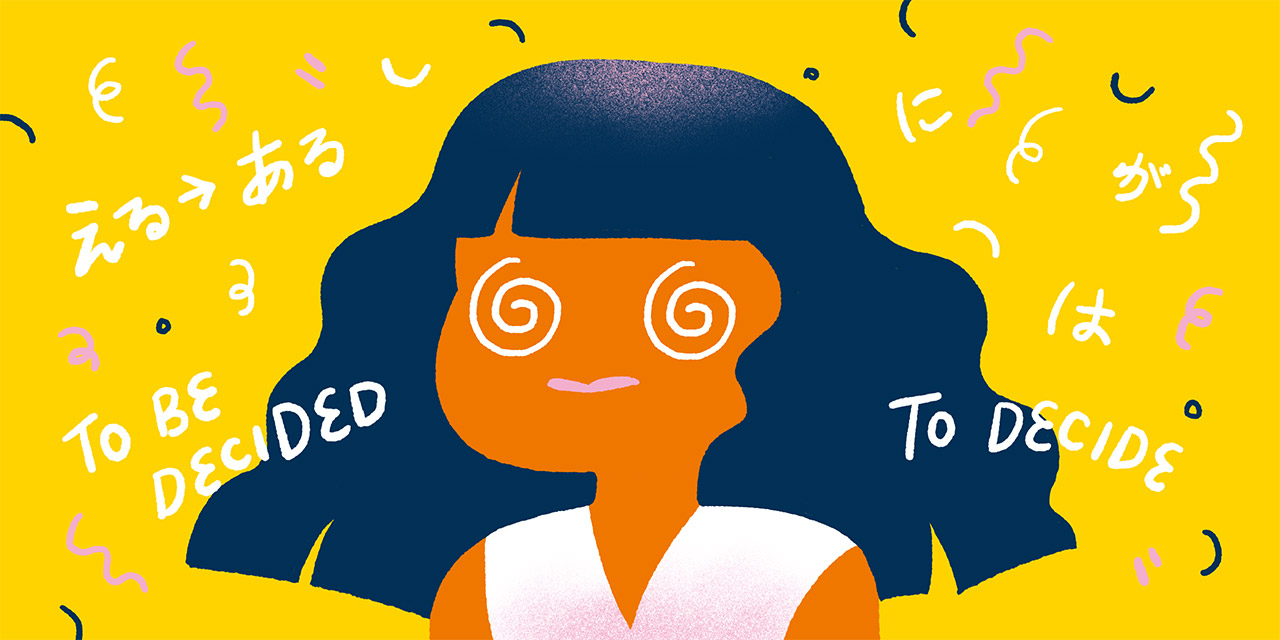
It's time to set the record straight.
I hate to even bring these up, but over my decade+ of learning and teaching Japanese I've run into the same misconceptions about transitive and intransitive verbs for what feels like hundreds of times. It's time to set the record straight.
Is Transitive and Intransitive the Same as Active and Passive Voice?
No. Let's go over this again (or just like, scroll up a little):
| Transitive Verb | A verb that takes a direct object |
| Intransitive Verb | A verb that does not take a direct object |
Here's the definition of active voice and passive voice:
| Active Voice | The subject does the action of the verb |
| Passive Voice | The subject is acted upon by the verb |
They're completely different concepts, but there can be some overlap, which seems to cause confusion. Let's look at each type of sentence to clear everything up once and for all!
- コウイチさんはドアを開けました。
- Koichi opened the door.
The verb is transitive because it's doing its action to the direct object. This sentence is also in the active voice because the subject (Koichi) is doing the action of the verb (opened).
- ドアが開きました。
- The door opened.
The verb is intransitive because it's not affecting a direct object and this sentence is in the active voice because the subject (the door) is doing the action of the verb (opened).
コウイチさんは and ドアが are both the topic and subject of these sentences. They're both performing their verbs. They are both in the active voice.
- ドアは、コウイチさんに開けられました。
- The door was opened by Koichi.
The verb is transitive because it's doing its action to the direct object. But the sentence is in the passive voice because of the special verb ender られました. In English and in Japanese, we can see the direct object's placement has now been switched with the subject. It is now the subject (the door) that is being acted upon (開けられました).
So where did this misunderstanding come from?
You can thank English dictionaries for this one. If you've tried to do other reading on this subject before, or simply looked up some English translations in your Japanese dictionary, you've probably seen definitions like this from Jisho.org:

If you don't look at the example sentences (or have any idea what transitivity is) you may see "to be decided" as the only counterpoint to its partner 決める:

To decide and to be decided look like the active and passive voice versions of the verb:
Active: I need to decide on the menu.
Passive: The menu was to be decided by me.
However, both of these sentences have a direct object. They are both transitive verbs.
The real meaning of these Japanese verbs are:
決める: To decide something.
決まる: Something is decided.
That's it!
If you wanted to write the two active and passive sentences above in Japanese you would use 決める for both, because in both you are deciding something (the menu).
But you can't have a nice "to verb" for both of them, which is the preferred way to present information in English dictionaries. This need to fit the format, if you will, creates weird passive voice entries for Japanese words that can cause some major confusion.
As I said earlier, the passive voice is expressed by a completely different grammatical pattern in Japanese (開ける→開けられる), one that most people don't learn until the intermediate level of their studies. We aren't going to worry about it for now, but just keep in mind that transitive and intransitive verbs are not the same as active and passive voice.
Does が Always Means the Verb Is Intransitive?
No. While it's not always the case, remember the Japanese language loves to omit information. This includes implied direct objects. Sometimes you will see transitive verbs used in a sentence with the particle が but without the particle を.
- 私が高校生のころに読みました。
- When I was in high school, I read [it].
This is a perfectly grammatical Japanese sentence. It just happens to mark the subject with が and excludes the direct object [it]. However, we know 読む can only be transitive in Japanese. It needs a direct object, so even though we can't see it, the direct object is implied. Something was read in high school.
This sentence could also look like this:
- 私が高校生のころにその本を読みました。
- When I was in high school, I read the book.
Here it's easier to see the verb 読む is transitive thanks to the particles pointing out その本 as the direct object. But because of the common habit of omitting information in Japanese it's important that we don't rely solely on them. All verbs have inherent transitivity, so we don't need the direct object to tell us, because as Japanese speakers, we already know 読む is transitive.
But you're even more likely to see this:
- 高校生のころに読みました。
- [When I was] in high school, I read [it].
Now 私が and その本 are gone. But a Japanese person can still tell everything that's going on in this sentence.
Another thing to watch out for is intransitive verbs that don't take が. One example of this, that you may have noticed earlier, is this sentence:
- お風呂に入りたい。
- I want to take a bath.
The verb 入る is an intransitive verb, but it isn't using が here. In fact, 入る uses the particle に far more than the particle が and we talked more about it earlier. But we know 入る is intransitive and it isn't taking a direct object, even though the particle が is not in this sentence.
Aren't There Simple Patterns to Memorize Pairs?
No. I can't tell you how many websites and resources try to make perfect lists showing patterns so you can memorize which verb is transitive and which is intransitive based on its okurigana.
The truth is, they're are all wrong.
They'll usually try to say things like, "If a verb ends in す it's always transitive!" Or "ある verbs are intransitive most of the time! And they change to える" and blah blah blah. But this is completely unreliable. Let's just look at the most common pattern people recommend you study:
Transitive える → Intransitive ある
This states that if you see a verb that ends in える it's transitive and if it ends in ある it's intransitive. This works with verb pairs like:
| Transitive Verb える | English | Intransitive verb ある | English |
|---|---|---|---|
| 上げる | To Raise Something | 上がる | To Rise |
| 決める | To Decide Something | 決まる | To Be Decided |
| 閉める | To Close Something | 閉まる | To Be Closed |
But guessing like this will only work… 20% of the time. Which means 80% of the time you're getting it wrong.
Other patterns say, okay, well then if that first pattern didn't work, then use this:
| Transitive Verb える | English | Intransitive verb う | English |
|---|---|---|---|
| 開ける | To Open Something | 開く | To Be Open |
| 立てる | To Stand Something Up | 立つ | To Stand |
| 入れる | To Insert Something | 入る | To Enter |
Oh oops, did we tell you える endings were transitive? They're actually intransitive sometimes too. Too bad it can also be:
| Transitive Verb す | English | Intransitive verb える | English |
|---|---|---|---|
| 返す | To Return Something | 返る | To Be Returned |
| 倒す | To Knock Over | 倒れる | To Get Knocked Over |
| 直す | To Fix Something | 直る | To Be Fixed |
And don't forget:
| Transitive Verb あす | English | Intransitive verb える | English |
|---|---|---|---|
| 出す | To Remove Something | 出る | To Exit |
| 逃がす | To Let Go | 逃げる | To Escape |
| 負かす | To Defeat Someone | 負ける | To Lose |
This is a mess.
Even making these lists was a pain in the butt and I already know these words!
Why would you torture yourself like this, trying to study weird, useless lists when you can just learn them in context? If you learn in context, you get all those wonderful markers in the original Japanese!
So please don't go looking for a list or fall for one of those "easy guess" pattern guides.
How to Learn Transitive and Intransitive Verbs

So now that you know all about transitive and intransitive verbs in Japanese, how do you go about learning them? There are a few different methods that we like. Some of them may work for you, some of them may not. Just make sure you figure out what works best for you and don't worry about the rest!
1. Learning in Pairs
One of the simplest ways to learn the differences between these verb pairs is learning them together. Now, not all verbs have a transitive/intransitive counterpart, but there are at least 300 or so unique pairs that are commonly used in Japanese.
When you're adding them to your normal study routine, keep these points in mind:
- Make sure their meanings are accurate and different from each other
- Find collocations and study them in context (with particles!)
- Use pictures to visualize the actions taking place
2. Learn as You Go
If you aren't the type of person who can sit down with a list and memorize, then the next best thing is to have some simple awareness. When you're learning a new verb, look it up in the dictionary. I'd recommend looking it up in a dictionary that offers example sentences instead of simply relying on a marker for transitive or intransitive.
Then check to see if it is a part of a pair by looking up other words that use the same kanji. You don't have to learn both of them, but make sure you're using the word you are trying to learn the correct way. And as always, try to focus on native material so you can become familiar with set phrases that are used with that specific verb.
3. Don't Worry About It!
Over time you'll develop a framework around these words. As you add more information, this web of information will grow larger and connections will be made.
If you're already putting in the time and effort to study Japanese, you're going to make mistakes. Mixing up which verb is which isn't that big of a deal, in the long run. But as long as you fix those mistakes, pay attention to real world examples, use the language as much as you can, and you'll probably start automatically using the right verbs in the right places.
Over time you'll develop a framework around these words. As you add more information, it becomes an interconnected web, and this web will grow larger and more connections will be created and strung together. Like many things in Japanese (kanji, to name one) the more you know the easier it gets, thanks to the fact that your brain is excellent at identifying patterns after you input enough data. But inputting that initial data is really difficult and you just have to slog through it, little by little. Transitive and intransitive verbs fall into this category. The first handful you learn will be extra difficult, but those words will provide a foundation that will make learning future words much easier.
This is especially true if you study using sentences, collocations, and focus on native material as much as possible. The more content you're exposed to, the more things will start feeling right and wrong to you. Just like how you can tell by asking "I slept what?" that the verb "slept" isn't transitive.
No matter what method you choose, hopefully you never have trouble knowing whether a verb is transitive (direct object!) or intransitive (no direct object!) again. ❤