
For some reason I’ve been getting a lot of emails regarding this subject lately. There are a lot of people out there learning Japanese on their own who don’t know what to do first. Of course, there isn’t a set way to start learning Japanese. Everyone will have their own opinions and their own ideas on how it should be done. I think mine are pretty standard, and nothing revolutionary, but hopefully it will be a good jumping off point for some beginners out there who don’t know what to do next.
Part 1: Where Do Self-Teachers Start
-
Start with hiragana. Most class settings start you off by learning some basic words, and that’s graavvy, but when learning on your own, I think you need to take a slightly different approach. Since you are learning alone, you won’t get help with your pronunciation from your teacher. You need to start with hiragana in order to learn the basics of how Japanese sounds, and how the structure of the letters works. By learning hiragana first, you will understand how words are put together, and how they are said. If you don’t have a teacher to correct you, learning hiragana will give you the best base that you can get for starting Japanese.
-
Make sure you check your pronunciation: There are sites out there that will help you pronounce all those crazy Japanese syllables. Practice your hiragana by saying it with the computer. Once you can say all the letters perfectly, you are well on your way to having good pronunciation.
-
Start putting together words: Now you know hiragana, so start using it! If you’ve managed to get this far, you probably know a few words. Start spelling them out and say them out loud. I remember the first day I could spell sushi. That’ll be one of your first words, like a little baby.
-
Right about here is where you pick up a beginning Japanese textbook like Genki or Yokoso and do what it tells you. Those aren’t necessarily the best Japanese text books, but they’ll do the job. Remember, learn hiragana first, and then break your text book open. I guarantee you will have stronger basics and it will speed up your learning in the long run. Everyone faito!
That about does it. If you have any more questions, or anything to add, please do! There are so many things that us “classroom Japanese learners” take for granted that can’t be compared to the self-learner. I think there are a lot of people out there trying to learn on their own, so let’s support each other with ideas, mistakes, and success stories…just don’t tell me about how your love for Naruto inspired your Japanese language abilities, or you’ll get some Pepsi-man shafting.
Part 2: Pronunciation is King

If you can speak English (fluently), then you have no excuse. You should be able to pronounce everything in Japanese, and pronounce it nearly correctly (with the exception of the ‘R’ sound, but even that isn’t too bad). If you are having trouble with Japanese pronunciation it is either because of poor basics or you are being lazy. If you really work hard, think, and try, you will be able to pronounce Japanese well…maybe not perfect, but you will get darn close. This, however, is all dependent on you. If you don’t concentrate on pronunciation when you’re first learning, there’s a good chance that you’ll never have another chance to re-learn it. The longer you spend not practicing it, the harder it will be to fix it. As words and sentences get more and more complicated, your pronunciation will get more and more gai-jin. Don’t let this happen!
As a beginning student, here’s what you need to do:
-
The best place to start is when you’re learning hiragana. A lot of students try to rush through this section so they can start writing things. They basically know what sound they are writing when they write/read it, but not many people go through and practice pronouncing each letter one by one. This, I think, is very important, and creates the base for literally everything else you end up doing. From hiragana you learn how words are put together, the early basics of writing, the beginnings of reading, and finally, pronunciation. Almost every aspect of Japanese learning is somehow tied to hiragana, so use that to your advantage. While you read and write each letter, make sure you can pronounce them as well. In the long run, this will help you so much.
-
Repetition is key. Nothing comes easy, especially when it comes to Japanese things, so you have to sit and repeat repeat repeat repeat repeat (get it?). Think of it like the 100,000 sword swings of Musashi (or something like that). You have to go through the basic motions thousands of times in order to come out with something efficient and beautiful. If you have someone or something good that you can emulate, sit there and rewind to the same spot, copying what they say. Even if you don’t know what you are saying, you are practicing you pronunciation. Saying new things is just like learning how to throw a curveball. At first it feels awkward, but as you throw more and more you get more comfortable. Your mouth has to get used to the Japanese language. It’s not just the sounds, but it’s where you put the stresses and how you transition between words as well. All of these things take repetition, and the more you do this as a beginner, the faster you will advance in the long run.
-
Be able to recognize small differences in similar sounding words.
-
Keep things slow. Don’t try to blaze through sentences right away. That’s how you’ll make mistakes. This may seem obvious, but there really are a lot of people who do this and develop bad habits. Sometimes it’s harder to go through a sentence slowly because you lose some of that rhythm, but in the long run you’re teaching yourself to look out for certain things within a sentence. By doing this you’ll be helping yourself out.
All in all, I would say there are three main parts to Japanese pronunciation: Vowels and consonants, rhythm, and accent. Vowels are a huge part of the Japanese language (pretty much every other letter by English romaji standards). Try to get used to this quickly. Rhythm also is very important. Japanese and English rhythm is a bit different, so of course it’s something you should probably think about learning. Go ahead and try putting all the stresses in the wrong places when speaking English – it sounds kind of silly, right? That’s why it’s important to concentrate on rhythm as much as you can now, while nothing is habit yet. Lastly, check your accent. Sometimes it is hard for people to know what they sound like. Maybe try recording yourself and listening to it (cringe).
Learning pronunciation is a bit of a painful and grueling process for some people, but it will be well worth it in the end. Not enough people/teachers make pronunciation equally as important as everything else, and I think that’s a big mistake. Stressing pronunciation from the very beginning is just as important as learning hiragana or basic vocabularies, possibly more important. There aren’t any really weird sounds in the Japanese language, so everyone should be able to do it with a little practice. Just make sure you start learning (and concentrating on it) earlier rather than later.
Part 3: Taking Steps
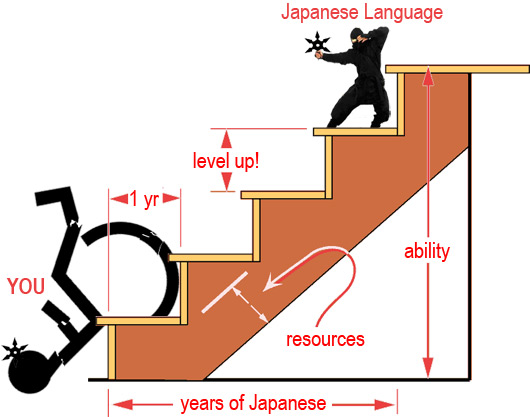
Surprisingly, learning Japanese really is like going up stairs in a wheelchair, possibly sans the ninja. I get so many emails of people asking me why their Japanese isn’t getting any better. Here’s how these emails usually go:
Hey Koichi, I’ve been studying Japanese for a few years now. I take classes, I talk with Japanese people, and I use flashcards for kanji…but I don’t feel like I’m getting any better. What am I doing wrong?
Response: You just have to keep on studying. Not “getting any better” is really normal. You’ll feel like this for a while, and then all of a sudden a bunch of things will fall right into place. You just need to keep on persevering, and then there will be a moment where everything suddenly gets better!
I don’t really delve into the details of this phenomenon via email, so I’d like to take this opportunity to tell you everything I know (which might not be that much, so all of you studying out there can help me).
Here’s my story. I started studying Japanese in high school, and spent two years stumbling through the language. After going to Japan for a year, I learned that there were, in fact, distinct steps in the Japanese learning process.
Although it is different for each person and each situation, most people feel like they are climbing stairs when learning Japanese. Here’s what might happen:
-
You will study-study-study, and you’ll feel like you are getting nowhere. It’s okay! Keep studying and you will be fine.
-
After a while you will feel upset at yourself for not getting any better (optional)
-
All of a sudden, everything will fall right into place. It really will feel like you’ve “leveled-up;” like you’ve picked up a Mario Mushroom. You won’t suddenly become fluent, but there are distinct levels and feelings to each level, and each one feels like a fairly large jump.
So there you have it! When I was in Japan it felt like every two months I would suddenly make the move upwards. While studying not in Japan, those level-ups take a lot longer. Wherever you are, though, expect sudden advancement when you least expect it. You just have to persevere through the hard times and you’ll be rewarded for sure.
People who have been studying Japanese for a while: Please share your stories! Please let us know if this is true or if I’m making it all up. It definitely is true for myself and for others I know, but I’m excited to see what others have to say.